
Your Rankings Held. Your Clicks Vanished: What Is GEO?
An explainer on GEO (Generative Engine Optimization): why rankings can hold while clicks fall as AI answers replace search visits, how AI engines pick which sources to cite, and six practical steps to make content more citable across Google, Bing Copilot, ChatGPT, and Perplexity.
A few days ago, a friend of mine who runs a B2B software company invited me to dinner. The dishes had barely hit the table when he slid his phone across and showed me the traffic curve in his analytics dashboard.
"Look at this," he said. "Our rankings haven't moved. Three core keywords, all still sitting in the top three of page one. But our traffic? Cut in half."
I stared at it for a long while. He was right. The rankings hadn't budged an inch — the traffic looked like it had been stolen from under them.
You've probably already guessed who the thief was. AI.
By 2025, more than half of Google's search results pages carried AI Overviews at the top — the answer was fully delivered before the user clicked a single link. The click-through numbers sting even more: the top organic result's click-through rate fell from 28% to 19%. Practically overnight. Brutal.
Users get their answer, close the page, and leave. Whether your article ranks first or tenth barely matters — nobody clicks either way.
That all sounds pretty hopeless. But despair only lasts so long — then you get back to work. And the work has a name: GEO.
What Is GEO?
GEO stands for Generative Engine Optimization.
Simply put: stop obsessing over getting your page to rank first, and start figuring out how to get your content cited by AI — pulled into the answers it gives.
Think of it this way. SEO used to be a fight for shelf space in a supermarket. You wanted the best spot, the most visible display, so shoppers walking past would grab your box on impulse. Now shoppers no longer browse the shelves. They walk up to the clerk and say, "Get me something that fits." And the clerk answers instantly with a recommendation — adding, by the way, whose product it is.
GEO is a fight for that one sentence out of the clerk's mouth.
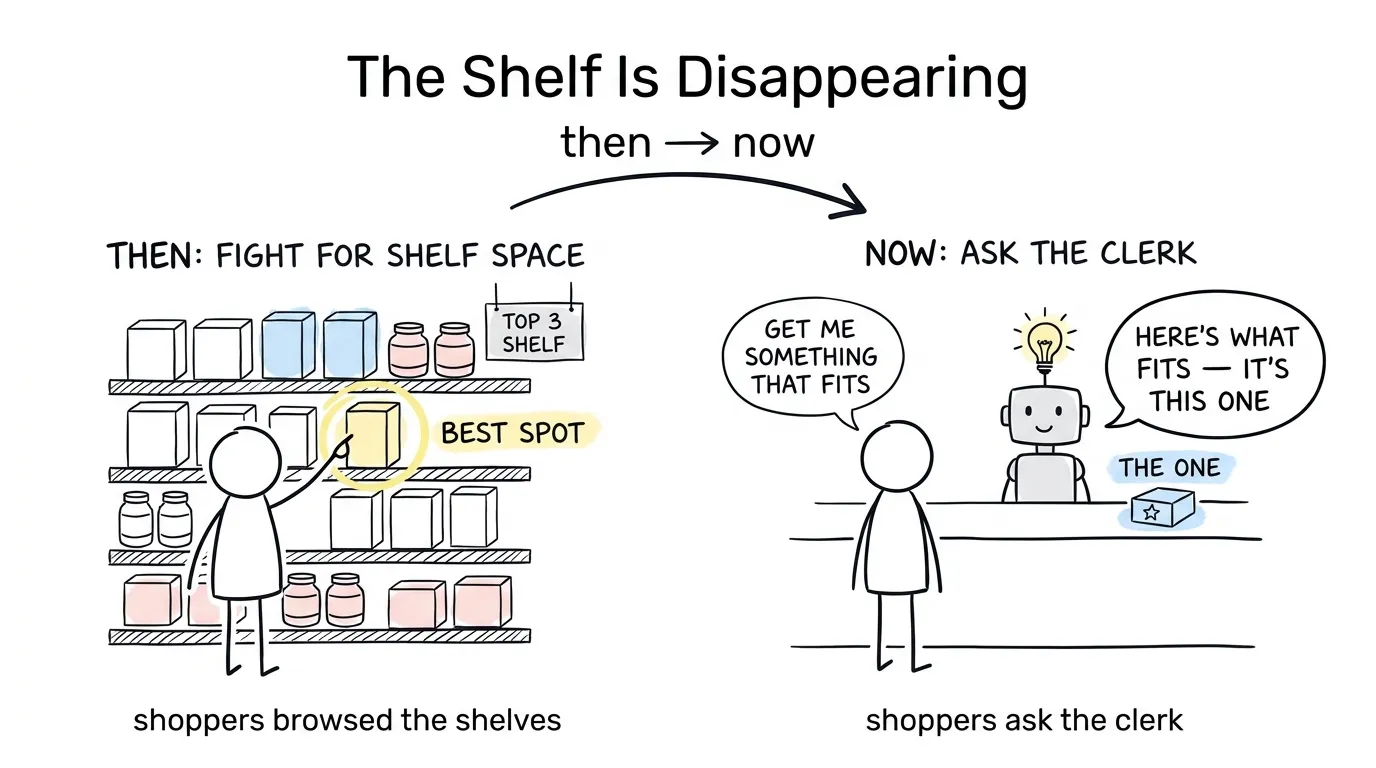
Some will ask: hasn't AEO (Answer Engine Optimization) been doing this all along? Not quite. AEO competes for the featured snippet at the very top of the results page — users still click through to your page for the answer. GEO moves you directly into the AI's response itself; the user may never click through at all. From competing for a position to living inside the answer — that's a generational leap.
Even Wix has shipped a dedicated "AI visibility" dashboard that tracks where you show up inside AI answers. When the tooling has grown itself, tell me: is this an elective, or a requirement?
Will GEO Replace SEO?
Many people's first reaction to GEO: so was all that SEO work for nothing?
No. GEO doesn't tear SEO down and start over — it builds an extra floor on top. The foundation stays the foundation: content quality, authority, trust.
Here's an example. Search for CRM and HubSpot has sat on Google's front page for years. Ask ChatGPT to "recommend a CRM," and it will most likely name HubSpot too. Why? Because "this brand is trustworthy" has been confirmed over and over, in every corner of the web. Traditional search trusts it, and so does AI. The trust carries over.
But three things have genuinely changed.
First, the questions got longer. People used to search "best CRM" — two words. Now they ask AI: "What are some CRMs that suit a small team and connect with the tools we already use?" Queries have gone from keywords to plain speech. Your keyword strategy needs to upgrade into a question strategy.
Second, what you compete on has changed. It used to be keyword density and backlink counts. Now it's structure. A team called Go Fish Digital ran real-world tests and found that when AI picks material to cite, it clearly favors structured content: clean H2 and H3 subheadings, bulleted takeaways, crisp little summaries.
Third, identity now beats keywords. A domain that at a glance was registered to chase a keyword can still scrape by in traditional search. AI isn't buying it. It only mentions the brands it knows — ones that have been referenced across multiple credible settings: HubSpot, Salesforce, Monday.com. A domain it has never heard of? It won't dare put that in an answer.
Why not? Because when AI gets something wrong, it's its own reputation on the line.
AI won't cite what it can't understand — and it certainly won't cite what it can't vouch for.
How Does AI Actually Decide Whom to Cite?
Break a single AI search apart and you'll find four steps.
Step one, rewriting. The conversational question you asked gets cleaned up first, reshaped into a form that's easier to search against.
Step two, retrieval. Using the rewritten question, candidate documents are pulled in from sources like web pages and research papers.
Step three, summarization. Everything retrieved gets distilled into key points.
Step four, generation. The key points get assembled into a paragraph and delivered to you.
Across those four steps, GEO's life-or-death battleground is step three.
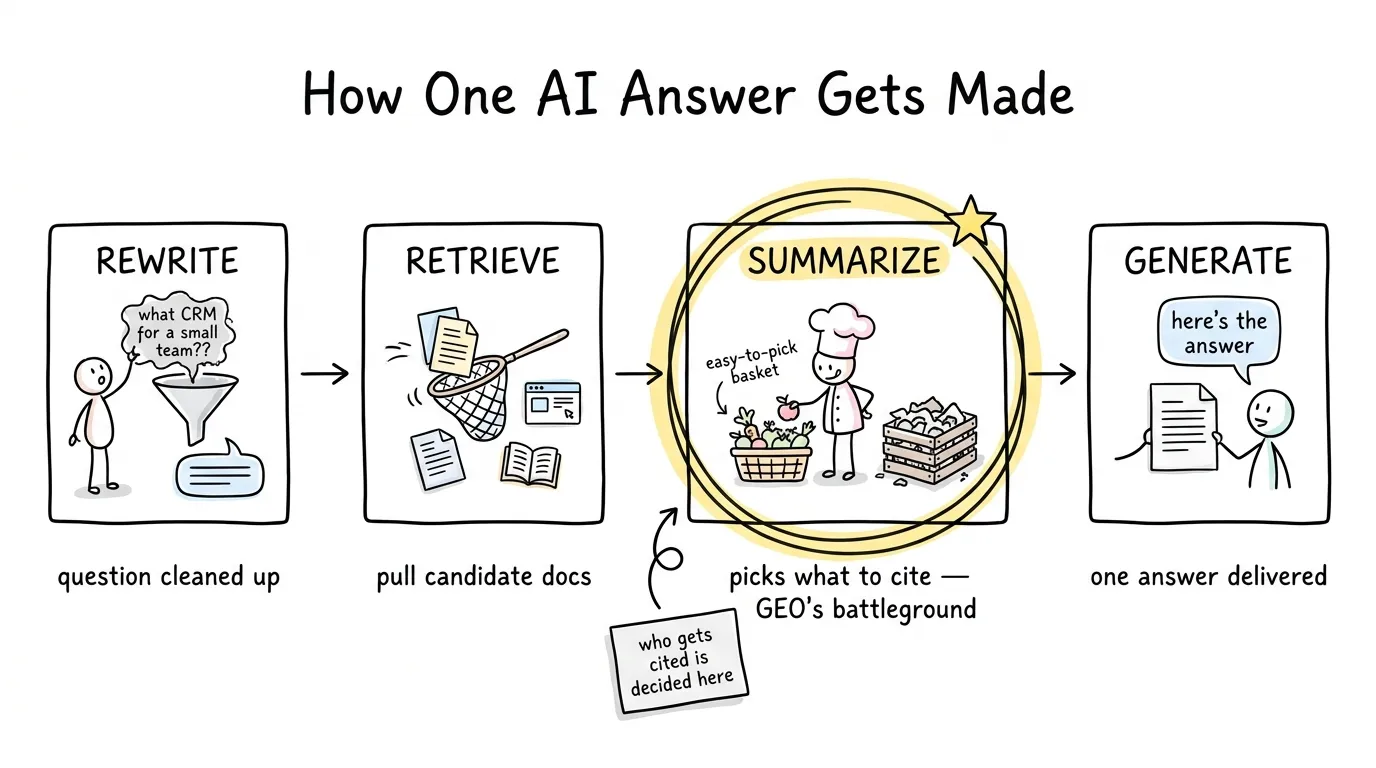
A summarization model picks its material the way a chef picks produce at the market. What's neatly arranged, freshly washed, and obviously ready for the pan gets chosen first. Content with clear structure, precise facts, and short paragraphs is exactly that easy-to-pick basket.
As for your sprawling article in three giant, unbroken blocks — however brilliant the prose, the chef can barely lift it. Why should you be the pick?
What Do You Actually Do? Six Moves
Move one: keep doing SEO — it's the starting point. When AI generates answers, it frequently draws on content that already ranks well in traditional search. If you can't even crack Google's first page, expecting AI to mention you out of thin air isn't realistic.
Move two: write your content as "answer blocks." Use the user's actual question as your subheading. Under it, nail the answer in the first sentence or two — no throat-clearing. Prefer a list over a wall of paragraphs. And above all remember: fewer adjectives, more numbers. "92% of our enterprise users say our platform is easy to deploy" — AI can lift that at a glance. "Customers are generally quite satisfied with the onboarding experience" — there's nothing there for AI to quote.
Move three: clear the technical bar. Add schema markup to pages like FAQ, HowTo, and Product; drop an llms.txt file into your site's root directory listing the pages you most want AI to read; and clean up the HTML on your key pages — pile up less JavaScript. Why? AI crawlers can't read content buried inside scripts. If it doesn't render, it can't be read. If it can't be read, it can't be cited. That's exactly where the chain breaks.
Move four: show up where your users talk. Reddit, Quora, Stack Overflow, plus review sites like G2 and Capterra — all of it feeds the large models. Wherever your users ask questions or vent frustrations, that's where you should appear. Meanwhile, keep an eye on the list articles already ranking on page one — the "Top 10 AI Tools" kind — and find a way in. AI loves citing authoritative lists.
Move five: one story across the whole web. Your website, GitHub, LinkedIn, press releases — keep the brand description consistent. Say one thing here and another there, and users get confused; AI gets more confused. And a confused AI won't dare cite you.
Move six: change your dashboard. Traditional KPIs track rankings and clicks; now you need three new gauges on top:
AI citation share. Of the questions you're tracking, what fraction of AI answers cite you.
Traffic from AI. Don't dismiss this channel. From what I've observed myself, visitors arriving via chatbots are often already midway through their decision — and convert better.
Answer-block coverage. Of your target questions, how many have a piece of your content inside the answer. For the ones that don't, note who holds the slot — then take them one by one.
On the tooling side, something like Semrush's AI Toolkit is already running questions in bulk, recording, mention by mention, how often each brand gets named by AI. It can even pull a report on whether your share of voice is higher in ChatGPT or in Gemini.
Oh, and one more thing that's remarkably easy to overlook: keep your content fresh. A large model's knowledge base only updates every so often. The article you publish today may not get "eaten" until months from now. So go back regularly and refresh old pieces — swap in current numbers and cases — mark the last-updated date honestly in your sitemap, then resubmit through the search console. Let AI know this page of yours is fresh.
One Question, Four Engines, Four Temperaments
Ask the same question — "what's the best project management software for a small team" — to four different engines, and you'll get four completely different answers.
Google AI Overviews largely mirrors its own organic first page: Asana, Trello, ClickUp, Monday.com, Wrike. Strong in traditional rankings, strong here.
Bing Copilot puts Monday.com first and even praises it as "very flexible." It pulls live search results while favoring sites with clear markup and clean pages. Not ranked in the top three? If your page reads well, it will still see you.
ChatGPT's answer reads more like a classic reading list. Large models remember through their training snapshots — whoever appears in those long-circulating list articles is who it names. However gorgeous your brand-new blog post, if it never made those old lists, ChatGPT never sees it.
Perplexity is the most interesting. It pulls in newer faces like Plaky and Smartsheet, because it scans freshly published blogs, community discussions, even pricing PDFs. Whoever is active in the community gets the edge.
One trusts rankings, one trusts structure, one trusts historical share of voice, one trusts freshness.
So don't bet it all on one engine. Do the homework on all four fronts.
Finally, Back to My Friend
As dinner wound down, I told him: stop staring at that traffic curve and beating yourself up. The curve fell, and it truly isn't because you did a bad job. The shelf itself is disappearing.
From here on, more and more questions will be answered outright by AI. Whether anyone clicks a link matters less and less. What you're fighting for is no longer the front row of the shelf — it's the sentence the clerk says without thinking.
Write your content clearly. Build your identity. Spread trust across the entire web. Then wait for AI to speak.
Shoppers don't browse the shelves anymore. Your job is to be the one the clerk says without thinking.
Here's to becoming that name soon.
Continue reading
Related articles

It's 2026: Stop "Buying" AI Tools for Your Marketing Team — Start "Hiring" AI Agents
This learn article explains how AI agents differ from standalone AI tools in marketing, outlines three agent categories — build-your-own platforms, CRM-native agents, and vertical tools — and covers use cases across SEO, social media, advertising, and reporting, plus criteria for choosing one.

What Is GEO? How Your Brand Gets "Mentioned" in the Age of AI Search
An explainer on GEO (Generative Engine Optimization) for e-commerce and DTC brands: how it differs from SEO and AEO, why AI answers shape brand visibility, and eight practices covering question-focused content, consistent brand messaging, structured pages, external evidence, comparisons, and AI mention tracking.

AI Is Already Making Decisions for Your Customers. Are You on the List?
A learn article explains GEO (Generative Engine Optimization): why AI-generated answers now shape which brands customers see, and how SEO fundamentals, entity clarity, citable evidence, and monthly measurement affect visibility in AI answers.