
The People Who Built Marketo Are Back to Take Marketo's Business
The article looks at AI-native marketing automation startups challenging Marketo, including Phave from Marketo co-founder Jon Miller. It contrasts rules-based automation with AI reasoning and weighs Marketo's integrations and loyal user base against switching pressure.
Lately I've been looking at a few newly launched marketing automation products, and I've noticed their slogans are strikingly alike.
One company, called Inflection.io, says: "Replace Marketo, finally." Which translates to: at long last, you can swap out Marketo.
Another, Conversion.ai, has aimed its guns in the same direction. And a company called Paminga has gone ahead and built a "Marketo translator," dedicated to helping customers move everything out of Marketo wholesale.
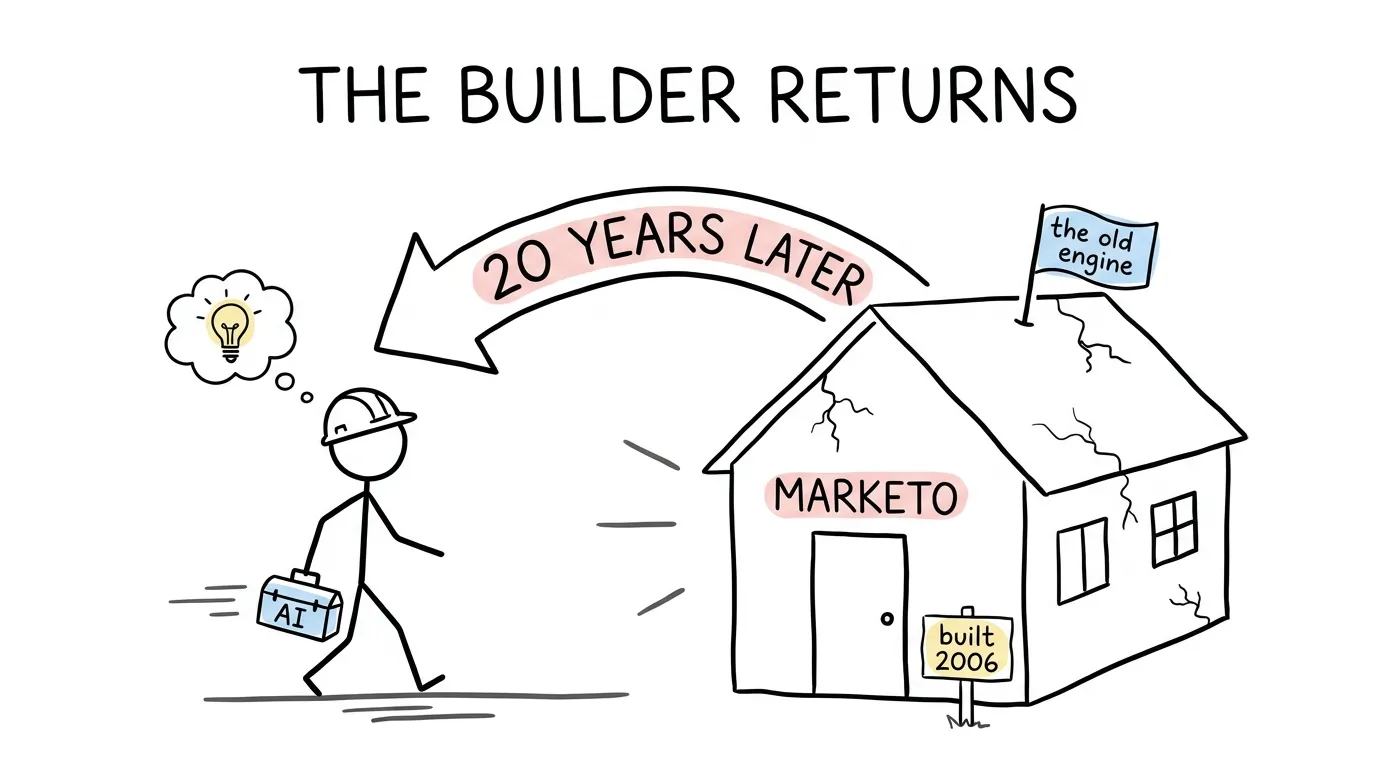
The most ruthless one is a company called Phave. Its founder is the very person who built Marketo with his own hands back in the day.
Picture the scene: the man who built the house returns twenty years later and starts tearing down the house he built.
What signal is this? So today, let's talk about what's going on here.
How Marketo Rose
What is a marketing automation platform? Simply put, it's software that helps B2B companies "nurture customers" automatically. Who visited the website, who downloaded the whitepaper, who should be followed up by sales — it queues them, scores them, and sends the emails, all on its own.
Why did it take off in the early 2000s?
Because back then, B2B marketing teams were under real pressure. Sales had adopted CRM, and every step of the funnel was laid out in plain sight. Marketing? The money was spent, the events were held, but nobody could say how much revenue marketing had actually contributed. When the boss asked, "What exactly is marketing good for?" there was no answer.
In 2006, the research firm SiriusDecisions introduced the famous "demand waterfall," slicing a prospect's path from first inquiry to sales-ready lead into standardized stages. The marketing automation platform was the machine that made this process run automatically: thousands upon thousands of leads, followed up automatically, scored automatically, reported automatically.
But notice: the foundation of this machine was the era's understanding of "how customers buy things." A person shows interest, marketing nurtures them, and once they're ripe, hands them over to sales.
Real B2B purchasing today looks nothing like that. On a deal worth hundreds of thousands, more than one person calls the shots: the users, the budget holders, the risk bearers — each with their own concerns. Yet traditional marketing automation, at its core, is still running on a script written more than twenty years ago.
The foundation is old. That is where every story in this piece begins.
AI Has Replaced the Engine
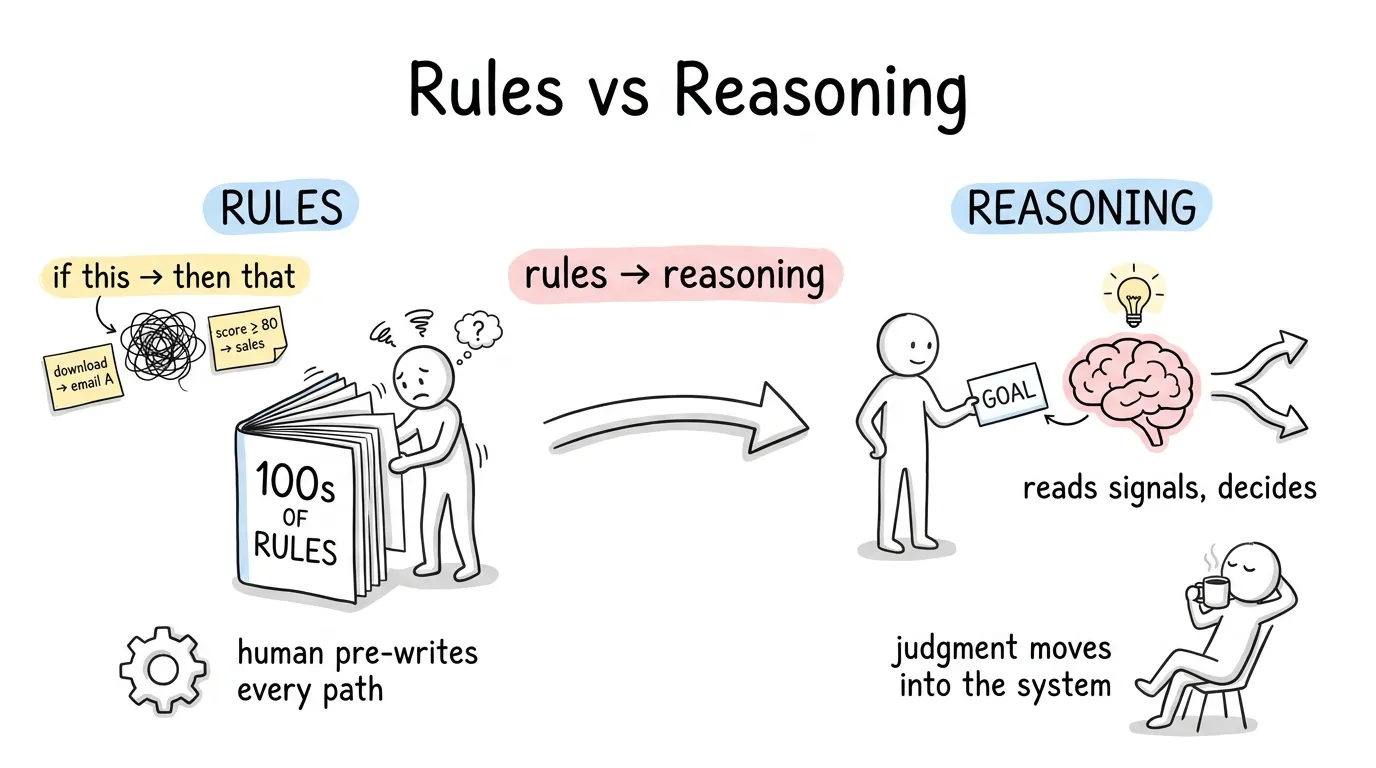
The core of traditional marketing automation is "rules."
What does that mean? Everything has to be thought through by a human in advance. Customer downloads the whitepaper, send email A three days later; opened it but didn't click, send email B five days later; clicked the link, add ten points; score crosses 80, notify sales to follow up.
These rules are configured one by one by marketing operations people. The more complex the customer journey, the more rules, exceptions, and dependencies pile up, until the whole thing becomes a tangled ball of yarn nobody dares touch.
The arrival of AI offered another path.
Jon Miller, co-founder of Marketo and now CEO of Phave, summed up the shift in one phrase: from rules to reasoning. From "rules" to "reasoning."
Before, you had to anticipate every possibility for your customers and write the responses into rules. Now, the new platforms want the system itself to read the context, read the signals, and make judgment calls based on the goal.
Rules won't disappear, of course. Wherever compliance, permissions, and legal red lines are involved, deterministic rules are still needed. But a great deal of "human judgment" is moving out of marketers' heads and into the system.
That is exactly where the new players are aiming. What they're challenging is a more fundamental question: how many people does it actually take to run marketing automation?
Marketo's Math Is Getting Harder to Justify
Is Marketo easy to use? I have a friend who spent a decade and more in its trenches. His exact words: to use Marketo, you first have to learn to "think the way Marketo thinks."
He once told me about a small incident.
Early on, he changed a process, extending the time customers spent waiting at a certain step from 3 days to 5 days. Any normal person would assume: people already standing at that step would simply wait two extra days.
Wrong. Marketo's logic: everyone already inside keeps walking the old 3-day path; only people entering after the change get the 5-day path.
It's the kind of counterintuitive detail you only learn by stepping on the landmine once. And landmines like it are everywhere in Marketo.
But flip it around, and the people who have stepped on every landmine become valuable. So companies have to keep people who understand Marketo on the payroll: building flows, maintaining integrations, troubleshooting. Even the simplest marketing action can't do without these specialists.
Specialists aren't cheap. The platform isn't cheap either. Adobe has never published Marketo's standard pricing; every contract is negotiated one deal at a time. By my friend's observation, plenty of companies spend $50,000, $60,000, $70,000 a year. And what that money buys is mainly this: sending emails, scoring leads, running nurture programs, tracking the website, and syncing with Salesforce.
Converted into RMB, that comes to 300,000–500,000 yuan a year. And that's only the platform — the cost of the people isn't counted yet.
If you use every feature to the fullest, maybe it's worth it. What if you're using barely half? That's a bill that's getting harder and harder to explain to the boss.
The interface is an even older sore point. Before Adobe's acquisition in 2018, Marketo had launched a new interface called Sky, hoping to modernize. But users couldn't leave the old interface, so the new and the old coexisted and everyone was miserable. In 2022, Sky was retired. In 2026, Adobe gave Marketo another round of interface changes. What changed was icons and layout. The foundation is still that same foundation.
And the new players? They were designed from day one around today's usage habits, today's data standards, today's AI capabilities.
It's like a hotel that has been renovated three times but still runs on pipes laid thirty years ago. The new hotel next door was built to the latest standards from the day its foundation was dug.
Why Marketo, of All Targets
If you're out to disrupt marketing automation, why does everyone name Marketo? Eloqua has its own kind of complexity, Pardot was born in the same era, and HubSpot keeps evolving. But no matter where the conversation wanders, it circles back to Marketo.
Because it's the fattest and the most famous prey.
First, the market segment it occupies has the richest customers. Companies using Marketo tend to have mature marketing operations teams, enormous databases, piles of complex integrations, and budgets that are real money. These are exactly the people hurting the most — and the ones who can afford to pay to switch platforms.
Second, Marketo's reputation is the new players' best advertising. For twenty years, "powerful but complex" has practically been its label. A new player only needs to say one line: "We know all about your pain." Marketo spent twenty years educating the market to be ready for that line.
Third, and most dramatic of all: the rebels are the very people who built it. Phave was founded by Jon Miller together with Nick Bonfiglio, a former Marketo product executive. Inflection's two co-founders, Aaron Bird and Dave Rigotti, both worked at Marketo too.
They know better than anyone why customers can't walk away from it — and better than anyone where it can't carry tomorrow.
The people who built the palace have come back to pry up its floor tiles. Is there a louder starting gun than that?
But It Won't Be Easy
Don't rush to write Marketo's eulogy. Its moat is deeper than you think.
Its integration with Salesforce is so mature the two seem grown together. Behind it stands Adobe's enterprise ecosystem. Those complex flows that have been running for a decade or more — whether the new platforms can actually take them over has yet to be proven.
And what's even deadlier is "people."
Marketo users can complain about it from morning to night. But propose replacing it? Whoa, whoa — no way.
Why? Because a lot of people spent ten, fifteen years turning themselves into Marketo experts, and their professional worth is tied to it. This community has a strong culture of its own, with a saying: "Bleed Purple" — your blood runs purple, and purple is Marketo's brand color. This loyalty is Marketo's softest, and yet hardest, line of defense.
But think about Kodak. The owners of the film shops were all master craftsmen in their day, too.
Loyalty and switching costs only work while there is "no better option." Once people see that the same job can be done in a completely different way, the defenses will loosen faster than anyone predicts.
Adobe hasn't been sitting still, either. It's adding AI capabilities into Marketo, launched Marketo AI skills, and built an MCP server (an open standard that lets AI assistants connect to external systems), hoping people can drive marketing campaigns in plain language.
The real question is: can Adobe swap out Marketo's "operating system" without tearing down the infrastructure its existing customers depend on to survive?
On one side, an installed base deeply dependent on the old model; on the other, a future that has to move to reasoning. This ship has to swap its engine while sailing — with a boatload of passengers aboard.
A Word at the End
The essence of this battle can be said in one sentence:
Traditional marketing automation sells "we've thought the process through for you; you do the configuring." The new platforms sell "you tell us the goal; we'll do the reasoning."
These are two worldviews. The old one fed Marketo for twenty years. The new one is already lining up outside the door.
Marketo has every right to say: I've seen plenty of so-called disruptors — the grass on their graves is two meters tall.
Fair enough. But this time is different. Because among the people standing outside the gate are a few who, back then, built this wall together with you.
Every moat fears two things: time, and the wall-builders turning their guns around.
Continue reading
Related articles
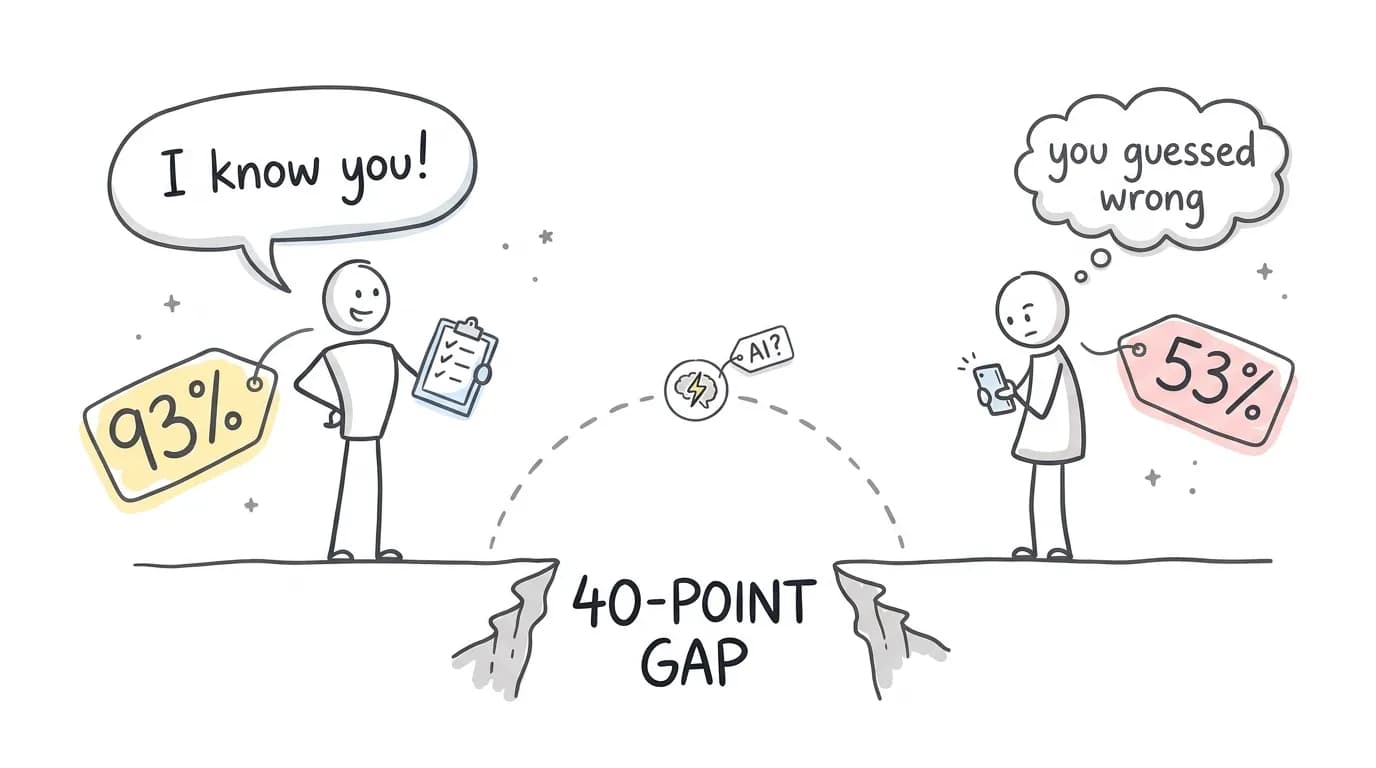
What Is AI Marketing Automation? It Starts With a 40-Point Gap
A learn article explaining what AI marketing automation is: how learning-based systems differ from rule-based automation, how AI decisioning optimizes message, channel, and timing choices, what data it depends on, and where it applies across the customer lifecycle.

Marketing Automation Is Shifting from "You Do It" to "You Say It"
This article explains how marketing automation is shifting from rule-based platforms that merely execute toward AI agents that plan, create, publish, and review campaigns, covering delegable tasks, underlying technologies, tool categories, adoption steps, and risks such as privacy and automating without strategy.
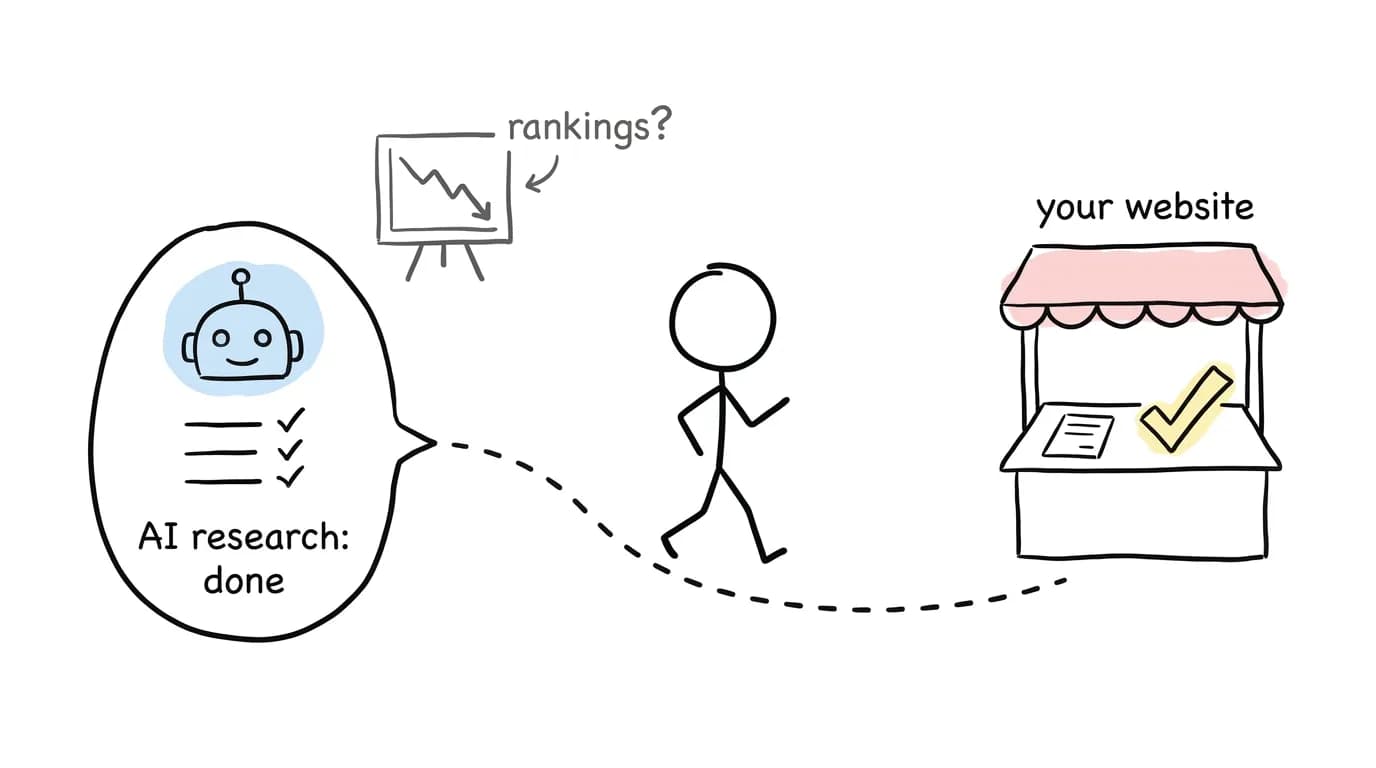
Rankings Are Taking a Dive, Customers Are Sprinting Ahead: This November, I Re-Ran the Numbers on AI Search
A learn article on how AI search reshapes marketing measurement, covering reported mismatches between rank-tracking tools and live Google results, ChatGPT's business profile test, single-page visitors as high-intent leads, and CRO plus GA4 tracking verification practices.