
AI Can Lead Buyers to Your Door — Then What?
Argues that AI search visibility and GEO can bring buyers to a B2B website, but keeping them depends on the site's cognitive load after they land. Covers how buyers self-serve research, why vague copy costs trust and confuses AI readers, and a four-part test: understandable, findable, trustworthy, actionable pages.
A couple of days ago, a friend of mine who runs an enterprise software company invited me out for tea. He looked worried.
He told me their visibility in AI search was already strong. When customers asked ChatGPT or Perplexity, "who are the credible vendors in this space?", his company often came up by name. The exposure metrics looked great.
But inbound inquiries just weren't growing. Customers clicked through from the AI to the company website, took a look around, and left.
I asked him: once a customer lands on your site, can they tell what your company actually does?
He froze.
That one frozen pause is what produced this article.
What Is Cognitive Load?
Many companies assume that once AI mentions you and search results surface you, the business is in the bag.
It doesn't work that way.
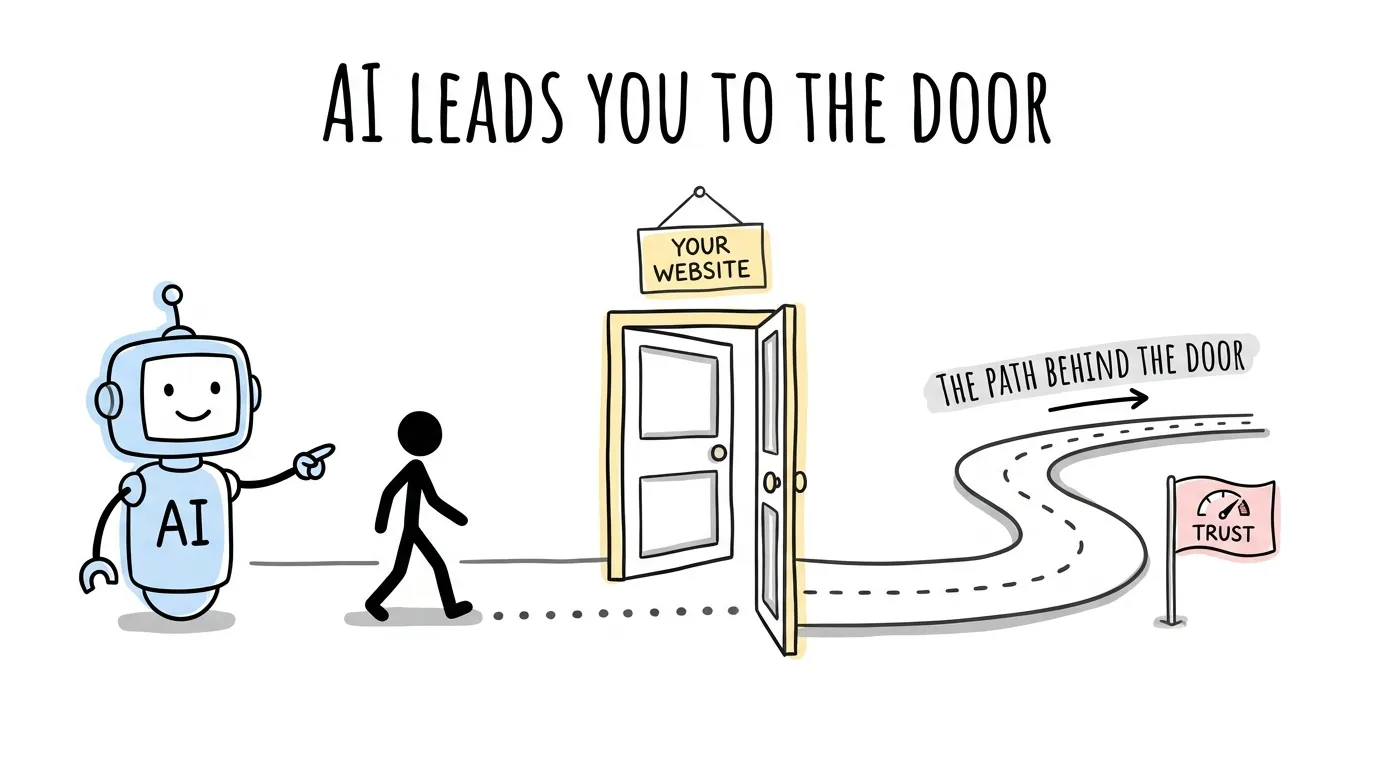
Winning exposure in Google, ChatGPT, or Perplexity only walks customers to your front door. The path once they step inside is yours to lead.
How smoothly they walk it comes down to one thing: cognitive load (the amount of mental effort a person must spend to process information and make a decision).
What is cognitive load, concretely? It's how hard a customer's brain has to work to understand you, trust you, and finally buy.
And remember: behind it sits a business ledger, measured in real money.
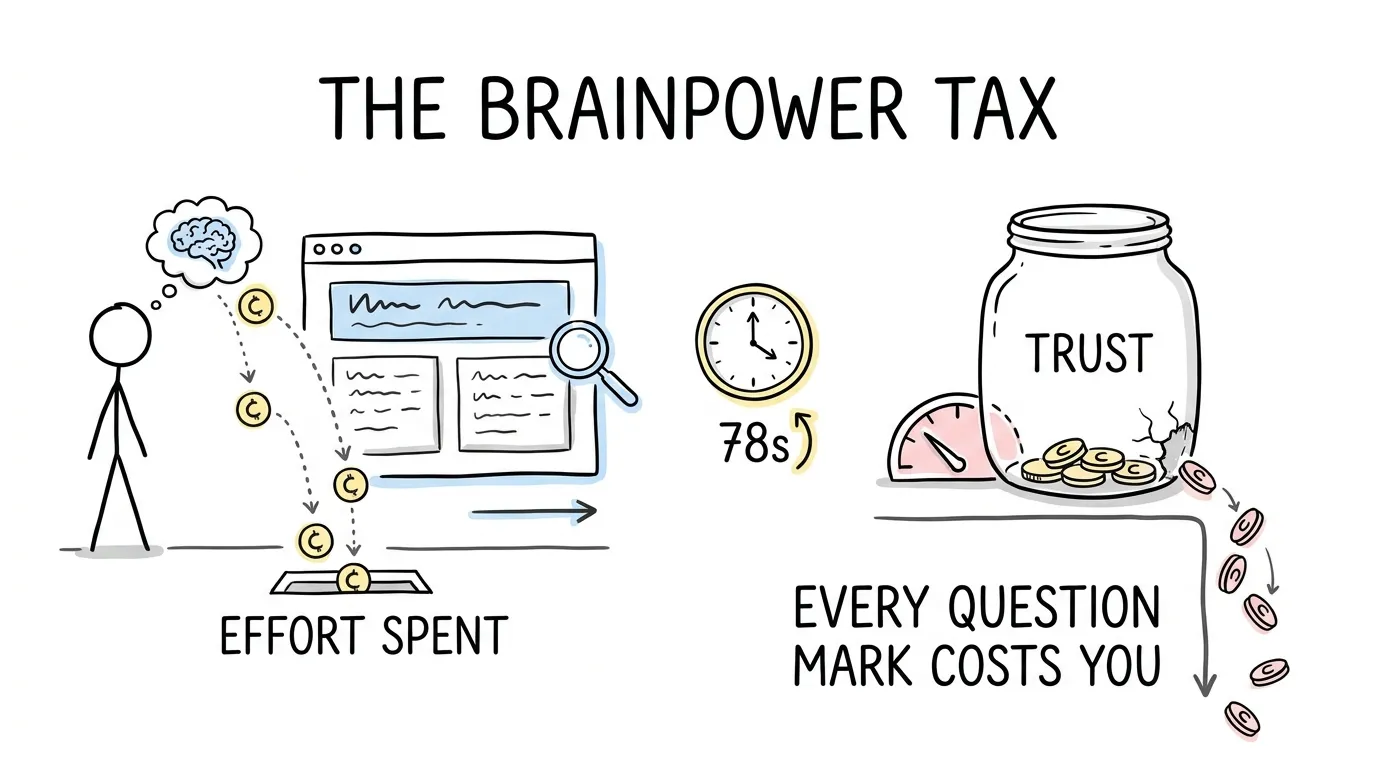
Every extra ounce of brainpower a customer spends on your website is deducted from their trust.
Your Website Carries More Weight Than You Think
Start with some numbers.
6sense ran a study of B2B buyers: by the time buyers meet a salesperson, they are nearly 70% through the buying process. By their first conversation with sales, 81% already have a preferred vendor in mind.
What does that mean? It means the website stopped being a "company introduction" a long time ago. It is where customers run their own due diligence. Before they ever meet you, they have already vetted you on your site.
What stings even more is time.
Databox measured it: the median session duration on B2B company websites is just 78 seconds. Contentsquare's report says the average is still falling — down another 7% year over year.
Seventy-eight seconds — what does that mean in practice? You pour the customer a cup of tea; before the tea has even cooled, they have just about finished their first-pass judgment of you.
On one side, decisions are happening earlier and increasingly completed by buyers on their own. On the other, the time left for your website keeps shrinking. When these two collide, cognitive load stops being a user-experience problem and becomes a deal-closing problem.
Your Visitors Arrive With Completely Different Jobs
Let me run a quick scenario so you can feel it.
Say you're a procurement lead who has done all the homework. You've read the analyst reports, gone through customer reviews, looked at the AI-generated product comparisons. You open this company's website not to "learn about" them.
You're here to verify.
You want concrete product details, methodology, security certifications, implementation requirements, quantifiable results. And what's on the page? "Industry-leading." "Disruptive innovation." "AI-powered."
And what does that language earn? Nothing. Every line you read leaves you with one more question mark, not one fewer.
Now say you've just been pulled onto the buying committee at the last minute. You weren't part of the past few months of research, and the decision meeting is next week. You rush onto the website in a panic, click around furiously, download the materials. In the analytics, visitors like you show up as sudden bursts of traffic: several pages in a row, grabbing a pile of content.
At a moment like this, a badly structured website forces you to reassemble the company's story yourself, from a heap of scattered fragments.
A clean website gives you a path instead: from the business problem, to the solution, to the evidence, to how it gets implemented, to what to do next.
Same company, two kinds of visitors, completely different jobs. Yet the website usually serves them the same set of polished clichés.
AI Gets "Confused" Too
Here's the interesting part: reducing cognitive load isn't just for humans. AI reads your website too.
AI certainly doesn't get "tired" the way people do. But it does run into something: ambiguity.
The same product from the same company goes by three different names on three different pages; key information is scattered in unrelated corners; the whole site runs on ad-copy platitudes. Reading it, AI has to guess: which sentence is authoritative? How do these concepts relate to each other?
Guess wrong, and the summary it hands your customer is a plausible-sounding but off-target introduction.
So you'll notice that what saves human brains effort and what saves machines effort is the same playbook:
- Headlines answer customers' questions directly;
- Product and capability names are consistent across the whole site;
- Coined terms come with a plain-language explanation;
- Evidence sits right next to every claim;
- Key content is crawlable text, not locked inside images;
- Pages are linked together into a logic, with dates, sources, and methods spelled out.
This creates a shared clarity dividend: people find things faster, machines read them more accurately.
Generative Engine Optimization (GEO) is about making content findable by AI; a cognitively clean website is about making content comprehensible to AI and humans alike. One owns the entrance, the other owns comprehension. Lose either one and the whole thing falls apart.
A Quick Test: Where Does Your Customer's Brainpower Go?
So how do you know whether your own website burns brainpower?
There is a purpose-built cognitive load test. It measures how much mental cost a target customer has to spend on your website to get through three steps: understand, trust, act.
The test looks at four things.
- Understandable. Can a customer quickly grasp what you do, who it's for, and why it matters?
- Findable. Does the information hierarchy guide the customer, or does the navigation offer a pile of entry points with no clue where to start?
- Trustworthy. Does every claim have evidence behind it? Can the customer trace that number all the way back to a specific customer, a time frame, a method, and a source?
- Actionable. Do customers at different levels of readiness each get a next step of their own? Or do all roads end at "contact sales"?
Why do these four matter? Because one survey found that only 35.7% of B2B buyers rate their experience on vendor websites positively.
In other words, more than half of all websites are making customers spend brainpower for nothing.
The Goal Isn't Simplicity — It's Conviction
There's a common misunderstanding here.
The moment "reduce cognitive load" comes up, someone assumes it means dumbing the product down and cutting the details.
Wrong. Your customers are buyers of complex offerings — they don't merely tolerate the details, they use them to assess risk. Your job is to organize the details the way customers assess risk.
What does a website that does this well look like? The core promise is spelled out up front, the product architecture is laid out in plain view, evidence sits beside every claim, and customers are left with several paths to verify things for themselves.
One claim, one number, one source, one method. Chain that evidence together, and customers will dare to trust you.
GEO and Answer Engine Optimization (AEO) can get you onto a customer's shortlist. Whether you stay on it depends on the few dozen seconds after they land.
Back to That Cup of Tea
Later I told my friend: what you're missing isn't exposure — it's a website that can speak for you.
It's AI's job to walk customers to your doorstep. Whether the path behind the door is easy to walk is your job.
Buying decisions today are increasingly completed by customers themselves, with AI as the intermediary. On a journey like that, clarity is part of closing.
Here's wishing you a website that's a door your customers can push open — and walk right through.
Continue reading
Related articles

It's 2026: Stop "Buying" AI Tools for Your Marketing Team — Start "Hiring" AI Agents
This learn article explains how AI agents differ from standalone AI tools in marketing, outlines three agent categories — build-your-own platforms, CRM-native agents, and vertical tools — and covers use cases across SEO, social media, advertising, and reporting, plus criteria for choosing one.

What Is GEO? How Your Brand Gets "Mentioned" in the Age of AI Search
An explainer on GEO (Generative Engine Optimization) for e-commerce and DTC brands: how it differs from SEO and AEO, why AI answers shape brand visibility, and eight practices covering question-focused content, consistent brand messaging, structured pages, external evidence, comparisons, and AI mention tracking.

AI Is Already Making Decisions for Your Customers. Are You on the List?
A learn article explains GEO (Generative Engine Optimization): why AI-generated answers now shape which brands customers see, and how SEO fundamentals, entity clarity, citable evidence, and monthly measurement affect visibility in AI answers.