
94% of Marketers Are Already Using AI. So Why Are the Results So Wildly Different?
This learn piece argues that differences in AI marketing results come from data foundations rather than the tools themselves. It walks through measurable use cases, reporting automation, attribution, lead scoring, content workflows, social listening, email personalization, and choosing tools based on available data.
A while back, an old friend of mine who works in marketing invited me to dinner. Over the meal, he sighed: his company had carved out a dedicated slice of this year's budget for AI. They'd bought a pile of tools, and everyone on the team was using them. But at the quarterly review, his boss asked one question: how much extra money has AI actually made us?
The room went silent.
He said, I honestly had no idea how to answer.
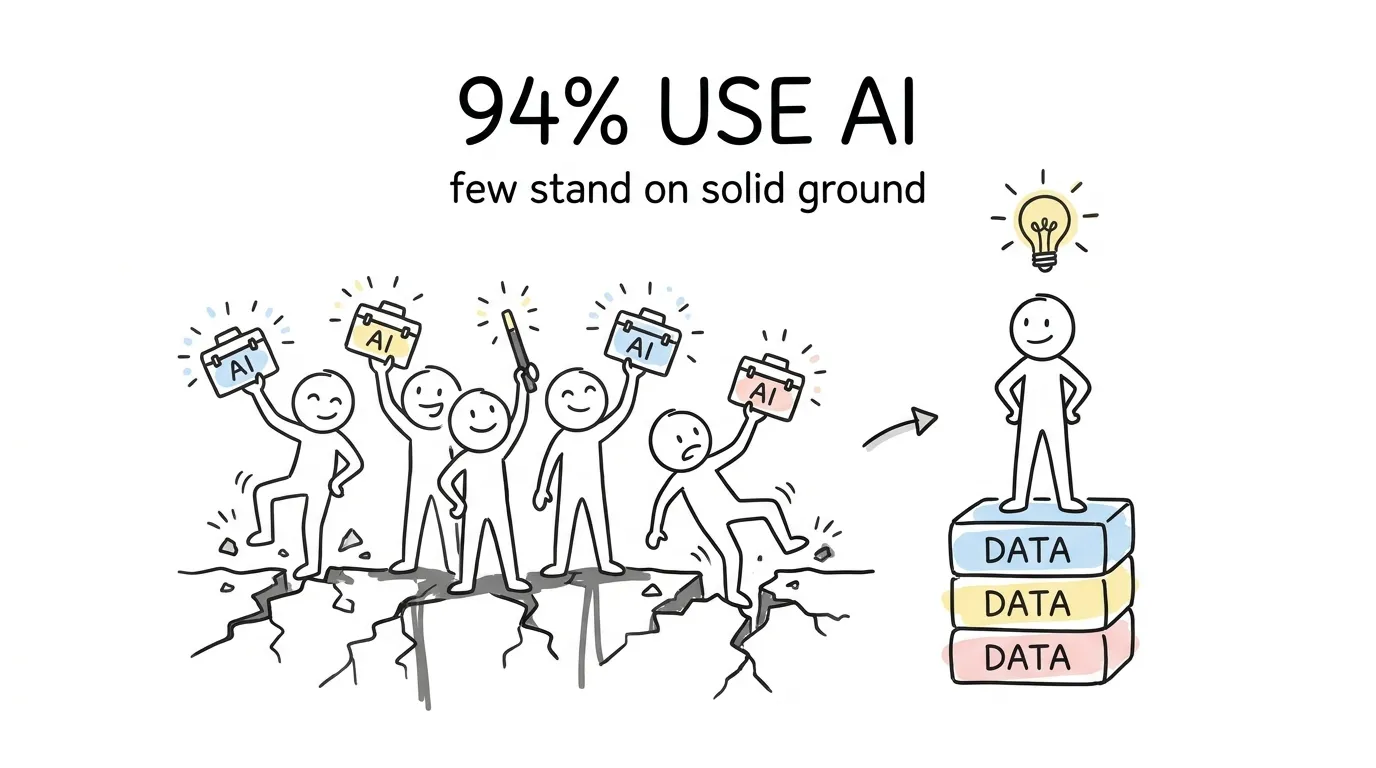
I wasn't surprised at all. There's a survey number that keeps making the rounds in our industry: 94% of marketers have already worked AI into their daily workflow. Ninety-four percent. Practically everyone has one. But the ones actually getting results? Few and far between.
So where does the problem lie?
Most people's first reaction: the tools aren't good enough — swap in something more advanced. That's what I thought at first, too. Then I worked something out: the problem was never with the AI. It's with the ground the AI is standing on.
That ground is data.
What Exactly Is a "Use Case"?
Let me start with a painful truth. When most teams say "we're going to use AI for marketing," what they actually have in mind is a feature checklist: this one writes copy, that one makes images, another sends emails automatically. They turn on all of them, dabble in all of them, and three months later the whole lot is gathering dust.
Why? Because that's not a use case.
So what is a use case? A use case is a clearly bounded, specific task whose return you can actually calculate.
"Use AI to improve our marketing" — that's not a use case. That's a wish.
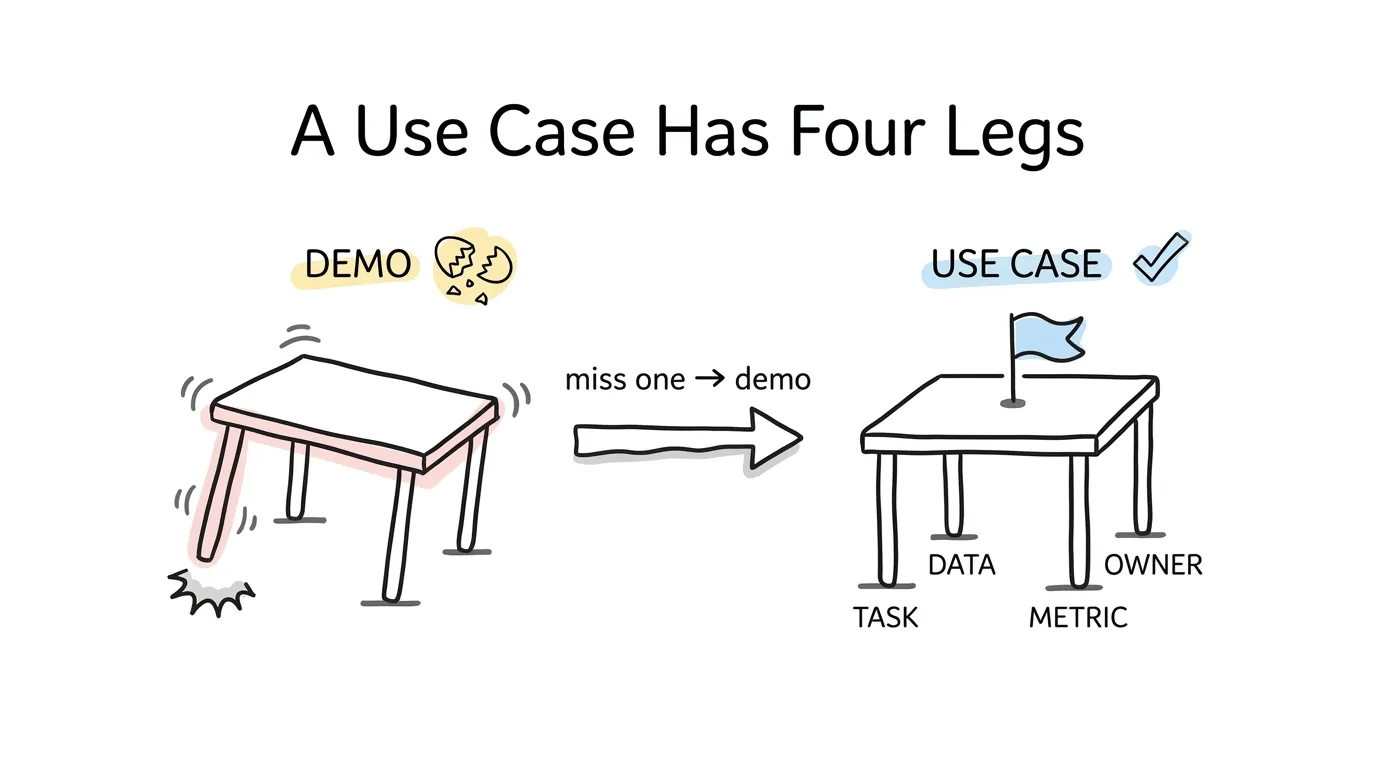
"Use a predictive scoring model to push customers showing purchase signals within 60 days to the top of the outbound call list, and measure it by the sales-accepted lead rate" — now that's a use case. A clearly defined problem, clearly defined data, a clearly defined metric, and a clearly defined owner.
Miss any one of the four, and all you have is a demo.
I've watched too many teams run an A/B test, find that AI-written email subject lines lifted open rates by a few points, and declare victory — then hold a meeting to celebrate. And then? Nothing. That improvement was never baked into a process, so next quarter everything resets to zero.
Experiments prove it works. Use cases make it pay. The gap between the two is exactly where most teams stall.
By the way, how do you pick from the use cases on your shortlist? Measure them against two rulers: first, how much impact this could have on the business; second, whether you can actually pull it off with the data and team you have today. High on both — do it first. High impact but not feasible — put it on the roadmap, because it tells you exactly what infrastructure to build next.
Start With the Fastest Win: Reporting
If you can only pick one thing to do first, start with reporting.
Why? Do the math and you'll see.
A marketing analyst spends 20% to 40% of the workweek just logging into platforms, exporting spreadsheets, cleaning data, and stitching reports together. Twenty to forty percent! None of that work produces a single insight. It's pure manual labor.
And this is exactly what AI is best at: clear rules, high repetition, large volume. Automatically pull the data from every ad platform, unify it into one consistent standard, calculate the customer acquisition cost (CAC) for each channel, and push it to a dashboard that refreshes daily — or even hourly.
As a bonus, this cures an old headache: three people pull data from the same platform and get three different answers. Why? The platform updated its numbers at noon; you pulled in the morning, your colleague in the afternoon. An automated pipeline pulls once per cycle, and everyone sees the same thing.
Once the data flows, you can layer something on top: have AI write you a plain-English summary. No more staring at a wall of numbers — it just tells you: this channel's CAC jumped 18% because the cost per click on some campaign went up; that channel's click-through rate improved 12%, bringing in 40 new leads.
The dashboard stops being a display case for numbers and becomes a decision assistant.
Now the Most Valuable One: Attribution
First, a question: why did your customer buy?
You might say: because they saw our ads.
Then let me push: which time? Maybe they scrolled past one of your videos three months ago, clicked a search ad last week, got an email yesterday, and filled out a form today. So whose credit is it?
The traditional approach is to split it by gut feel: 40% to the first touch, 40% to the last, the middle divided evenly. Awkward the moment you say it out loud — because different touchpoints play fundamentally different roles for different people at different stages.
What AI does is lay out thousands upon thousands of real purchase paths and look: which combinations of touchpoints keep showing up right before a deal closes? Which channels amplify each other? Which touches were just passers-by with no effect at all?
You might discover: attending a webinar has almost no predictive power for closing enterprise customers, but works remarkably well for mid-market ones. Or: when a search ad appears after a customer has already read your content, deals close noticeably faster; used as a cold-start first touch, it has no such effect.
Insights like these — rule-based models will never give them to you.
But there's a precondition, and it's the thing I most want to say today: an attribution model is only usable if you can tie one person's behavior across every channel into a single record.
Your ad data lives in system A, your social data in system B, your sales records in system C. If the three sides don't reconcile, the model is blind. And you need enough samples — a few hundred to a thousand closed deals as your floor. A model trained on too few examples will simply mistake noise for a pattern.
Lead Scoring: From Gut Feel to Real Probabilities
How is lead scoring traditionally done? Rules dreamed up on the spot: the "Director" title earns 10 points, downloading a whitepaper earns 5, booking a demo earns 15.
Behind every one of those rules is a marketer's intuition. And intuition is no match for data.
What a predictive model does is dig up every lead that ever entered your funnel, see who actually closed, and work backwards: which features genuinely predicted a deal?
The answers are often counterintuitive. You might find that job titles barely matter, while "how quickly someone shows interest after first contact" is the strong signal. Or that leads from one industry close at three times the rate of others, even though company size looks identical.
Of course, the model isn't a one-and-done deal. Markets shift, products change, your target customers evolve too. A model trained last year may misfire this year. So retrain it regularly — and feed back the reasons sales gives when they reject a lead, so the model keeps learning and keeps getting sharper.
Content: Don't Publish Whatever AI Spits Out
On content, I want to offer a particular word of caution.
Lots of people now have AI write the piece and hit publish the moment it's done. I'd urge you to think twice. An unpolished AI first draft is shallow on facts, generic in tone, and cookie-cutter in structure — readers spot it at a glance.
AI's real value in content lives in two places.
The first is up front: research and topic selection. Picking topics used to run on intuition plus keyword search volume. Now there are tools — Clearscope, Surfer, that class of products — that can break down the top-ranking content and tell you what readers actually want to ask on this subject, and what the search engine is actually rewarding. And if your CRM holds your sales records, feed the questions customers genuinely asked on calls to AI for clustering: there's your content calendar, every topic aimed at a real need.
The second is turning one piece of content into ten. A full transcript of a livestream can become a WeChat article, a short-video script, a set of visual cards. Nobody had the manpower to do this before; now AI produces a first version in minutes. Which pieces are worth splitting? Look at the data — which piece actually brought in customers, not just traffic.
As for the writing itself, my advice comes down to one line: AI drafts. Humans decide.
Social and Email: Hear the Wind Early, Keep Pace With Every Person
Two more things that tend to be underestimated.
On social, the biggest value isn't scheduled posting — it's listening. The daily chatter about your brand across the internet is far beyond what humans can keep up with. AI can sort mountains of mentions by sentiment, topic, and urgency, and the most valuable ability is catching the wind before it turns: complaints about a certain feature are climbing; a competitor's narrative is starting to brew. Spot it three days early, and you have time to prepare a measured response instead of being woken at midnight by a PR fire.
On email, many people think personalization means putting a name in the greeting. Far too shallow. True personalization is structural: someone who opens every email but never buys, and someone who clicks links but never reads, should be on completely different follow-up rhythms. Tools like Klaviyo can already automatically adjust what to send and when to send it based on each person's behavior. Even the hour of sending varies person to person: some check email in the morning, others only at lunch. A good system staggers the same email to each person based on their historical open habits.
Someone ran a controlled test on this: the same list, half receiving behavior-tailored versions, half receiving the batch-and-blast version. Open rates rose 10% to 30%; click rates rose 15% to 40%. This isn't mysticism. It's arithmetic.
A Few More, Covered Quickly — Just as Valuable
For the sake of space, a few rapid-fire items.
Ad creative: give AI a product description and an audience definition, get 50 draft headlines in 30 seconds, then have people pick, refine, and test. Sheer volume beats any human brainstorm — but the judgment stays human.
Segmentation and churn alerts: AI can find clusters in behavioral data that no human eye would ever spot — say, the group that studies the pricing page daily but never books a demo. What matters even more is the churn warning: logins dropping sharply, support tickets piling up, a key feature going untouched. These signals often surface months before the customer ever says they're cancelling. Reach out with a targeted gesture at the right moment, and the account is saved.
Competitor monitoring: a rival repositions, tries a new channel, ships a new feature — AI keeps watch for you. One caution, though: these tools give estimates derived from public data. Fine for reading trends; treat them as precise numbers and you'll be fooled.
Choosing Tools? Don't Start With Features
Last thing: picking tools. The market has more AI marketing tools than anyone can survey, and most teams choose whichever demo dazzles them most.
A demo is meticulously polished to impress you — not to fit you. My advice is to flip the order: don't start by asking what this tool can do. Start by asking what data it needs — and whether we have it.
Every predictive model needs clean, unified, up-to-date data. Fail that, and even the best tool just spins its wheels. Garbage in, garbage out. That's not a joke — it's the number one reason AI marketing projects fail.
Once you've picked, don't roll it out company-wide right away. Run a pilot first: 60 to 90 days, real data, real scenarios. And set the success criteria before you start: how much of a lift in lead quality counts as passing, how much reporting time saved counts as on target. Setting the bar after the fact is just grading your own homework.
One more rule: for every recommendation a model gives, you should be able to ask "why." A black box that hands out scores with no reasons is one no team will dare act on. People don't hand decision-making power to something they can't understand.
One Last Story
Back to my friend from the beginning.
After that dinner, he did one thing: he bought no new tools at all. Instead, he spent a month connecting the data scattered everywhere and cleaning it up. Three months later he messaged me: same AI tools, completely different results.
With marketing AI, when everything else is played out, what's left to compete on is the foundation. The 94% are already on the road. From here on, the contest is who has solid ground under their feet.
Here's wishing you the same: lay the foundation first. Then talk about taking off.
Continue reading
Related articles

It's 2026: Stop "Buying" AI Tools for Your Marketing Team — Start "Hiring" AI Agents
This learn article explains how AI agents differ from standalone AI tools in marketing, outlines three agent categories — build-your-own platforms, CRM-native agents, and vertical tools — and covers use cases across SEO, social media, advertising, and reporting, plus criteria for choosing one.

Did the Money You Spent on AI Marketing Ever Come Back?
A guide to measuring AI marketing ROI across three layers: ad reports, sales pipeline, and the financial ledger. Covers metrics such as ROAS and CPA, eight dashboard metrics, industry benchmarks, and common measurement mistakes.

How to Pick a Creative Automation Platform: First, Figure Out What These Eleven Actually Do
A learn article sorts eleven creative automation platforms — including Bannerflow, Celtra, Smartly.io, and Storyteq — into four functional groups and proposes five evaluation questions covering publishing reach, automation depth, ease of adoption, team fit, and verifiable evidence.