
AI Marketing Daily · 2026-10-10
Nine stories today, one clear throughline: AI is already on the budget sheet, while most teams still can't produce the evidence.
Nine stories today, one clear throughline: AI is already on the budget sheet, while most teams still can't produce the evidence. An enterprise survey puts the productivity gap and the ROI shortfall squarely on the table; three GEO pieces map out how the traffic entry points are switching tracks; two e-commerce lists push tool pricing down to a few dozen dollars a month; and the two organization-and-governance pieces are about keeping what's already running from falling over. Best read over breakfast, circling the one item you can act on this week.
🎯 Today's Headline
AI budgets are growing faster than proof of ROI: spending outpaces proof
What happened
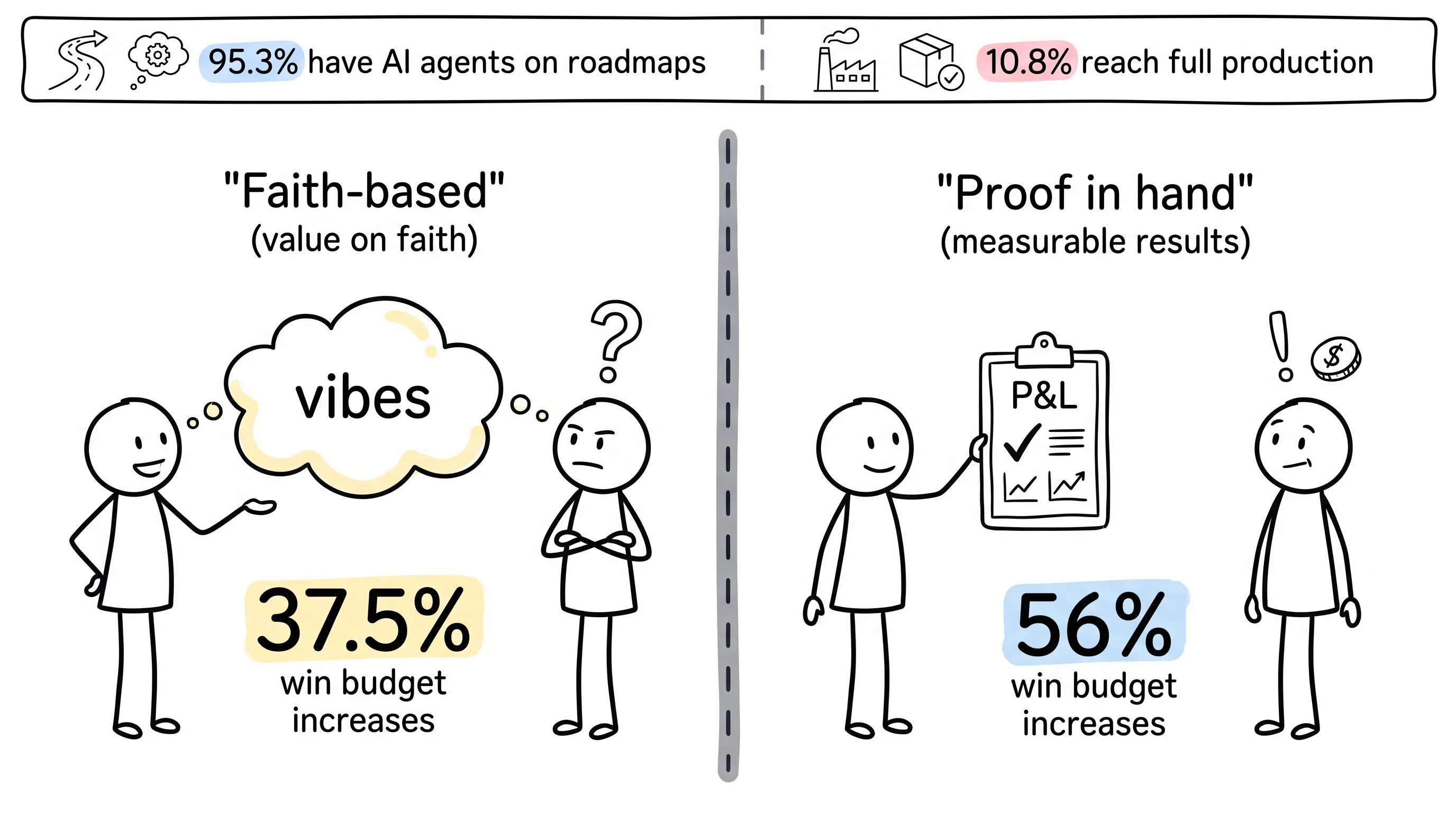
On October 9, MarTech covered The Martech Weekly's Enterprise Martech Outlook 2026 survey. Two-thirds of enterprises have already set up dedicated AI budgets, and 95.3% have written AI agents into their roadmaps. Sounds sizzling — until you look one layer down and it's gone half cold: only 10.8% of agent programs have reached full production scale, while nearly nine in ten remain stuck in planning, proof-of-concept, or limited production. Another figure stings just as much: 40.2% of MarTech leaders can't say how much financial return their technology investment actually delivered.
AI is having a bigger impact on marketing operations (69.3%) than on customer experience (59.9%). Internal use cases like writing, editing, and data analysis are visibly ahead in maturity, while agent scenarios like journey optimization, attribution, and audience selection are still climbing the slope. Governance is cautious too: only 1.6% allow fully auto-generated content to go straight to customers, 43.3% require review before anything goes external, and 24.4% simply restrict AI to internal use.
The maturity gap between the two ends of the agent spectrum deserves a closer look. Scenarios like co-pilot, copywriting and editing, data management, data analysis, and video generation are already in production, with returns you can point to; journey optimization, decision engines, audience selection, campaign creation, attribution, loyalty optimization, and offer agents are still catching up. The reason isn't hard to grasp: the first group produces output you can see and touch, while the second inherits attribution and data flows that were already complicated. The report says it plainly: getting an agent to give you an answer is easy — confirming the answer is real is the hard part. If the workflow itself is shaky, the agent just makes it shaky faster.
Why it matters
This data punctures the industry's self-congratulatory narrative. The story of the past year was that agents were about to take over marketing; the survey shows real-world progress running far behind the launch-event script. The comparison worth copying into your notebook: among teams that can prove their value, 56% won budget increases; among those reporting value on faith, only 37.5%. AI enjoys special treatment during the investment phase, but eventually everything comes back to the same budget table. One line from the report deserves memorizing: if the production time you saved is entirely eaten up by validating the output, the efficiency premium goes to zero — that's the interrogation coming at your next budget meeting.
What it means for marketers
For marketing leaders, this report is ready-made budget-defense material. When reporting AI investment, don't just talk output volume — make clear whether the hours saved are being offset by validation work. For teams running agent programs, the report supplies a sequencing rule: ship the mature scenarios first — co-pilot, copy editing, data management; approach scenarios that inherited dirty data pipelines, like journey optimization and attribution, with caution. For front-line marketers, a 43.3% review rate means the human review step isn't disappearing anytime soon — turning yourself into the most efficient reviewer in the loop is the safest positioning right now.
There's also a role-level view. The report's division of labor hints clearly: AI benefits operations roles first (69.3%), with customer-experience roles next (59.9%). If your KPI sits on the customer-experience side, don't rush to stuff agents into the journey — get the internal production chain running smoothly first, and trade the time you save for bandwidth to redesign the experience. The investment phase tolerates experiments, but every one of them needs a paper trail.
How to use it
Three steps. First, this week inventory your AI programs and split them into two columns — visible results versus just-looking-good-in-the-report — then cut anything in the second column that hasn't reached production. Second, give every agent still running a numeric value yardstick, such as cost saved per hour or first-pass review approval rate per thousand content pieces; don't fob anyone off with a vague "efficiency gains." Third, self-audit against the survey's governance red lines: which lane does customer-facing content actually travel today — the 1.6% lane or the 43.3% one? If you can't even produce review records, fix governance before you talk expansion.
There's also a ready-made path for framing the report. It splits teams into two kinds: those who speak with visible results, and those whose value demos it calls "faith-based." Before next quarter's budget request, file every AI program under one of those two labels — anything still in the faith-based bucket either gets measurement or gets voluntarily downgraded. Volunteering weakness beats having your budget cut for you; that line is for the CMO. The report is downloadable from The Martech Weekly's website — registration required.
My take
The number I value most isn't 10.8% — it's the 56% versus 37.5% pair. It says budget authority has moved back into the hands of people who can do the math. The agent story will keep being told, but over the coming year, the programs that survive will be the ones that can hand over a clean P&L. Building proof like a product capability is worth more than three more agents.
🔗 Further reading: Read the full article
🏷 Industry Data
Ten named cases: what AI marketing's ledger numbers look like
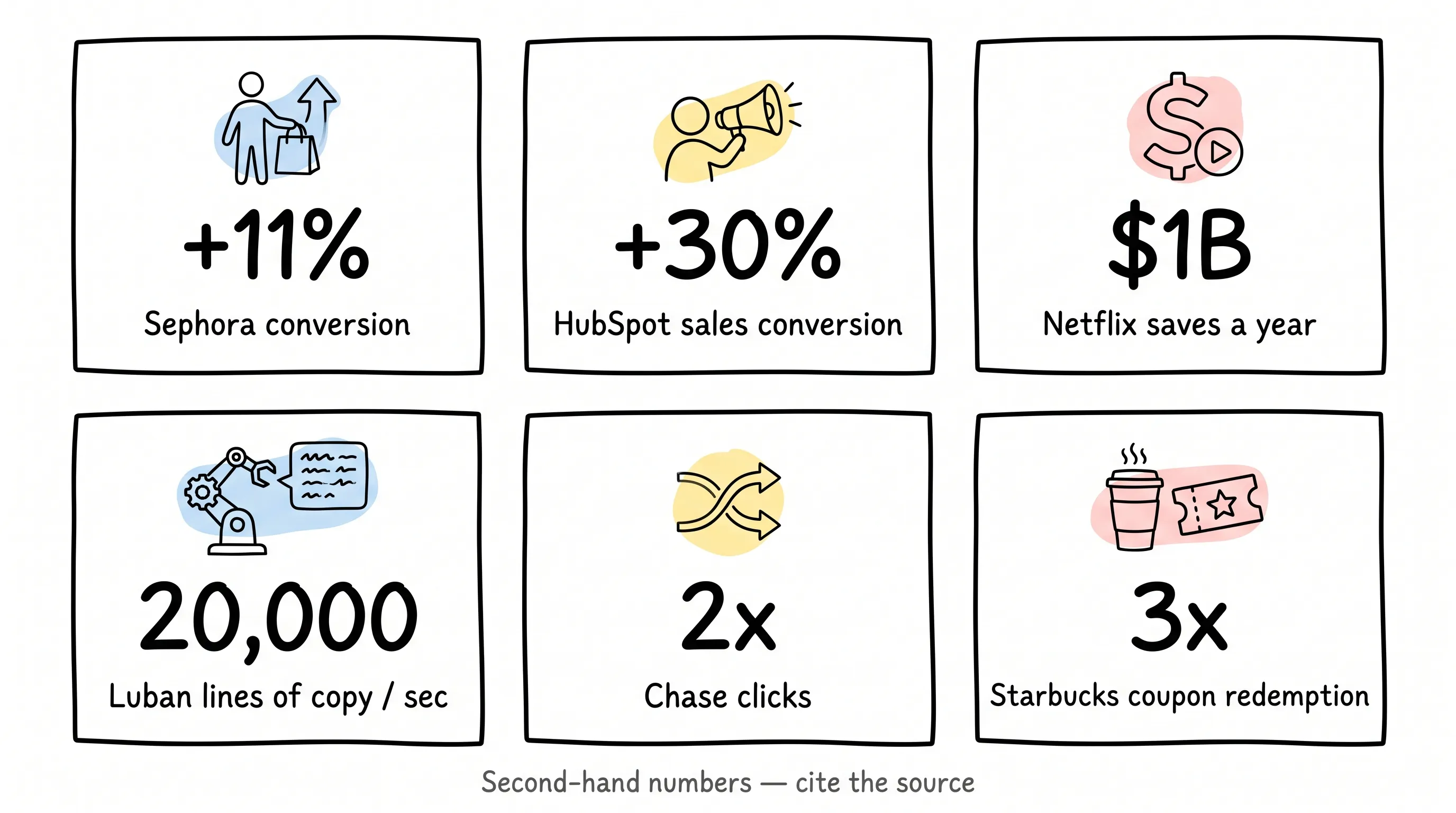
Hashmeta has compiled ten brand-level case studies whose numbers you can lift straight into your deck. Sephora's AI personalization engine delivered an 11% conversion lift and roughly $100M in incremental revenue; Coca-Cola used GPT-4 plus DALL-E to cut global content production time in half; HubSpot's AI lead scoring raised sales conversion rates by 30%; Alibaba's Luban generates 20,000 lines of copy per second, with A/B-tested click rates 8% above human copy; Unilever used AI for programmatic buying and cut CPA by 25%; Spotify's hyper-personalized emails get opened 2 to 3 times more than broadcast sends; Chase used Persado's AI copy to double click rates at the top end, then signed a five-year enterprise agreement; Starbucks' Deep Brew tripled coupon redemption; Netflix's recommendation engine saves about $1B a year in retained value, with thumbnail selection alone lifting click rates 20% to 30%; and a Singapore SME used AI SEO to grow organic traffic 340% in six months — paired with lead response inside 90 seconds, it lifted qualified conversions 58%.
Look closer and three shared patterns emerge. At the execution layer, AI removed the human speed bottleneck — 20,000 lines of copy per second and a 90-second response time are just the two extreme samples. At the personalization layer, the conversion and retention gains from individual-level recommendations arrive as step changes; targeting with audience segments no longer cuts it. On the time dimension, returns compound: models get more accurate with every interaction, content libraries grow with every publish, and late entrants pay multiples to catch up. One layer is easy to miss: not a single one deployed AI in isolation. Sephora has beauty advisors training the recommendation logic, Chase has senior copywriters evaluating AI output, Starbucks feeds Deep Brew with first-party data from 30 million active members. AI amplifies human expertise — it doesn't replace it.
McKinsey's benchmark data sits in the same range: companies with AI fully embedded in marketing functions see revenue gains of 3% to 15% and sales ROI gains of 10% to 20%. One more data point is especially valuable if you run a lead-driven business: a lead followed up within 5 minutes is 9 times more likely to convert than one followed up after an hour.
One caveat: these figures are second-hand compilations. Neither Sephora's $100M nor Netflix's $1B can be verified line-by-line in the companies' own financial reports — cite them with attribution and don't pass them off as your own research findings.
💬 Practitioner's take: what this list saves is the time you'd spend arguing your budget case — copy two or three numbers from your industry onto the slide and you're ready to use it. The Alibaba and Chase entries fit copywriting and media-buying teams closest; use them as your benchmark baseline before setting your own targets.
🔗 Further reading: Read the full article
The e-commerce AI landscape: 89% of retailers are already using it
Commerce Pundit's e-commerce AI guide offers a set of scale numbers: the AI e-commerce market, $7.25B in 2024, is projected to grow past $64B by 2034 at a compound annual growth rate above 24%; 89% of retailers are already using or piloting AI; and AI-influenced US holiday-season sales will exceed $62B in 2026. Consumer expectations have shifted too: 72% of shoppers want an AI shopping assistant, and among the under-45 crowd it's above 80%.
The ROI ranking of use cases is equally clear. Personalized recommendations still lead: roughly 35% of Amazon's revenue comes from its recommendation engine, and smart applications can lift conversion rates by as much as 23%, spanning product pages, homepages, search results, and checkout upsells. In dynamic pricing, McKinsey measured AI price optimization adding 2 to 5 percentage points to EBITDA; leading retailers already reprice every 10 minutes — raising prices when demand runs hot and discounting when inventory piles up are the same system. Demand-forecast error can drop 20% to 50%, logistics costs fall 15% on average, and capital tied up in inventory shrinks 35% on average. Fraud detection sweeps thousands of signals in milliseconds, and false-decline rates fall with it. AI support conversations convert at 12.3% — 4 times the rate of unassisted browsing; since about 70% of carts get abandoned, spotting high-intent exit behavior and intervening in real time is worth real money. From January to July 2025, AI-driven revenue per visitor rose 84%. And the structural gap between adopters keeps widening: over a three-year horizon, AI leaders grow revenue 1.5 times faster than non-adopters, with shareholder returns at 1.6x.
The brand cases make it tangible. Walmart uses AI to shift stock at store-level granularity, planning inventory around weather and local events; H&M uses purchasing and social-media signals to stock different assortments for different regions, cutting both returns and stockouts; ASOS combines visual search with size recommendations to push return rates down — the biggest gross-margin killer in fashion e-commerce.
The entry bar has dropped all the way: solutions that once demanded seven-figure budgets now start at $50 a month for small businesses. The real threshold is no longer budget — it's where to start.
💬 Practitioner's take: don't let the panorama intimidate you — pick one entry point by pain point. If support eats the most hours, start with a chatbot; if inventory keeps breaking, start with forecasting. Measure results after 30 to 60 days, then add the next one. Stack five tools at once and you'll end up with five that don't run.
🔗 Further reading: Read the full article
🏷 Marketing Tools
Eight e-commerce AI tools, with price tags from support to attribution
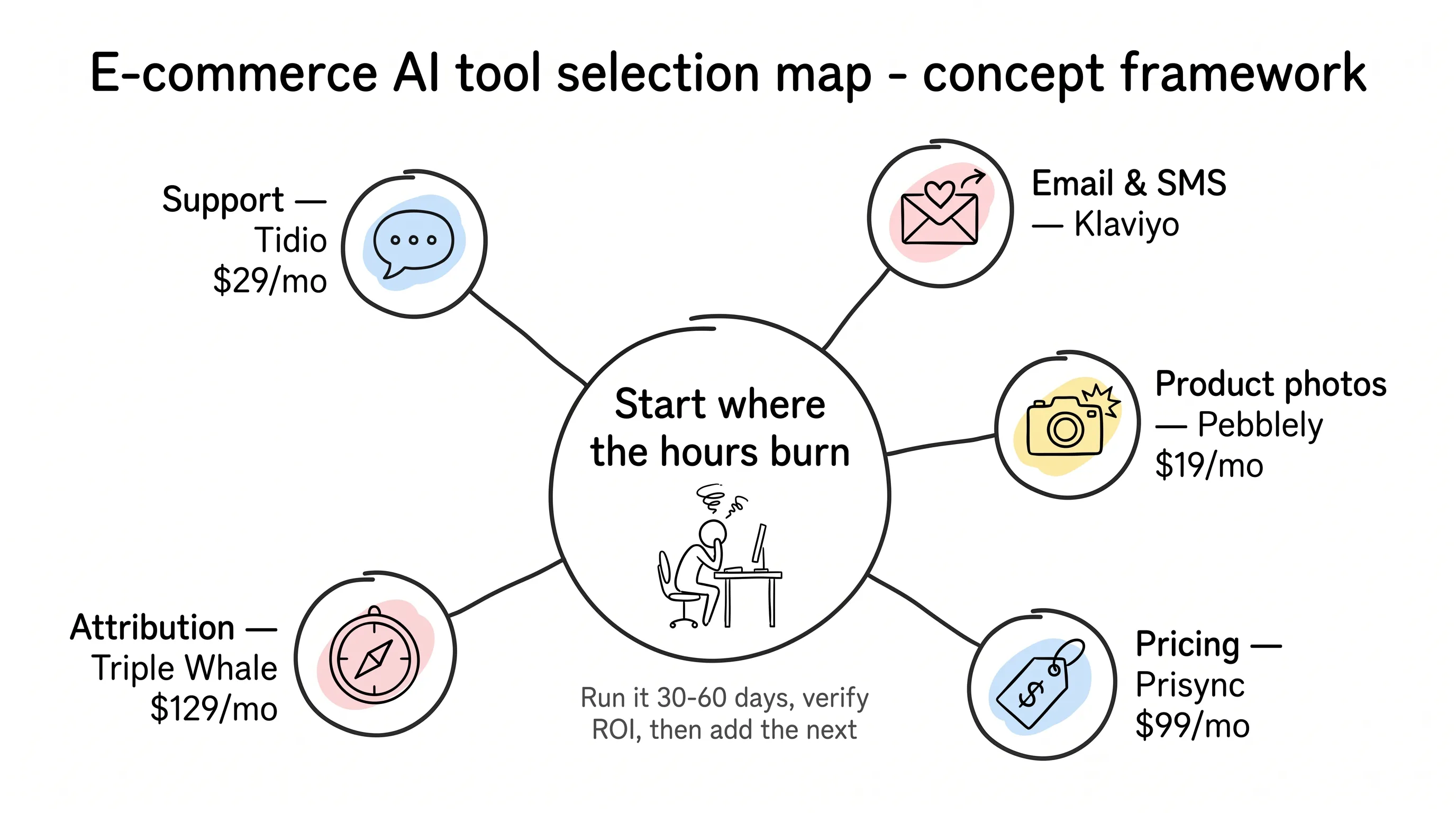
DSCP's buyer's guide filters out eight tools in active production, with prices and use cases spelled out. Support is the highest-ROI AI application in e-commerce right now: 96% of conversational AI deployments are for support, and 75% of consumers are happy to go to a chatbot for simple questions like order status and returns. Tidio's Lyro, powered by Claude, checks order status, recommends products based on conversation context, and runs after-sales automations like shipping reminders. The free tier covers 50 conversations a month, paid plans start at $29, and the Lyro add-on is $39 — sellers burning 10 to 15 hours a week answering repetitive questions get that time straight back.
Email and SMS go to Klaviyo. It sends welcome sequences by traffic source, triggers repurchase messages based on what customers bought, flags at-risk customers early, and hands subject-line testing and send timing to the model as well. Nucleus Research measured 5.4x ROI for marketing automation platforms — for brands that haven't automated their workflows yet, this may be the largest untapped revenue opportunity sitting untouched on the table. Shopify Magic is built in and free, drafting product descriptions, collection pages, and email subject lines to save 60% to 70% of the time — though finished copy still needs a human pass for brand voice and detail. Sellers outside that ecosystem can look at Jasper and Copy.ai. Pebblely crushes product-photo costs from $50–200 per image to under $1: one upload produces contextual backgrounds and platform-specific sizes, and a store with 200 SKUs across multiple colorways gets thousands of images in a few hours. The free tier is 40 images; paid starts at $19 a month.
Further down the list: Prediko for SKU-level demand forecasting (blending inventory, supplier lead times, and promo calendars into purchase recommendations), Prisync for dynamic pricing (watching competitors from $99 a month, protecting your Buy Box and margins), Searchspring for on-site search (tolerates misspellings; shoppers who use site search convert 2 to 3 times higher), and Triple Whale for unified attribution (from $129 a month, identifying which channel is really driving revenue).
The macro judgments cited in the guide: Gartner expects 75% of e-commerce companies to be using AI automation in at least one function by the end of 2026; IDC expects global AI spending to top $301B this year; and 53% of retailers already use AI for forecasting, personalization, or inventory optimization. The author also draws a boundary: physical fulfillment — picking, packing, shipping — still needs human oversight. AI brings the customers in; fulfillment keeps them.
💬 Practitioner's take: the right way to shop this list is to cut in at the most labor-hungry step, which for most sellers is support or email. Adopt one, run it 30 to 60 days, verify the ROI, then add the next. Tidio's free tier is testable this week — first-hand experience at zero cost.
🔗 Further reading: Read the full article
🏷 AI Search & GEO
GEO's three pillars: getting models to retell your brand story
EM Marketing has laid out the GEO playbook Thomas Smith shared on a podcast. First, keep three terms straight: GEO (Generative Engine Optimization) means being cited and recommended by generative engines like ChatGPT; AEO (Answer Engine Optimization) is broader — getting direct answers on any surface, featured snippets included; AIO (AI Overviews optimization) specifically means getting into Google AI Overviews. The behavioral data is already in: referral traffic from chatbots rose 357% in a year, and with it came the AI dark funnel — brands can no longer see what users asked during the early research stage.
The three pillars unfold in turn. Technical clarity: don't wall off AI crawlers with robots.txt — brands that blocked scrapers early for fear of being copied are now blocking the very systems that speak on their behalf; schema has gone from nice-to-have to must-have. Consistent narrative content: an LLM is a pattern recognizer that feeds on stories — the brand story you tell is the story it retells to users, so keep the naming of your brand, products, and key people consistent across every owned platform, and answer the long tail exhaustively in your FAQ. Brand authority: build reputation through proper PR, industry directories, and high-authority platforms — models believe what they read.
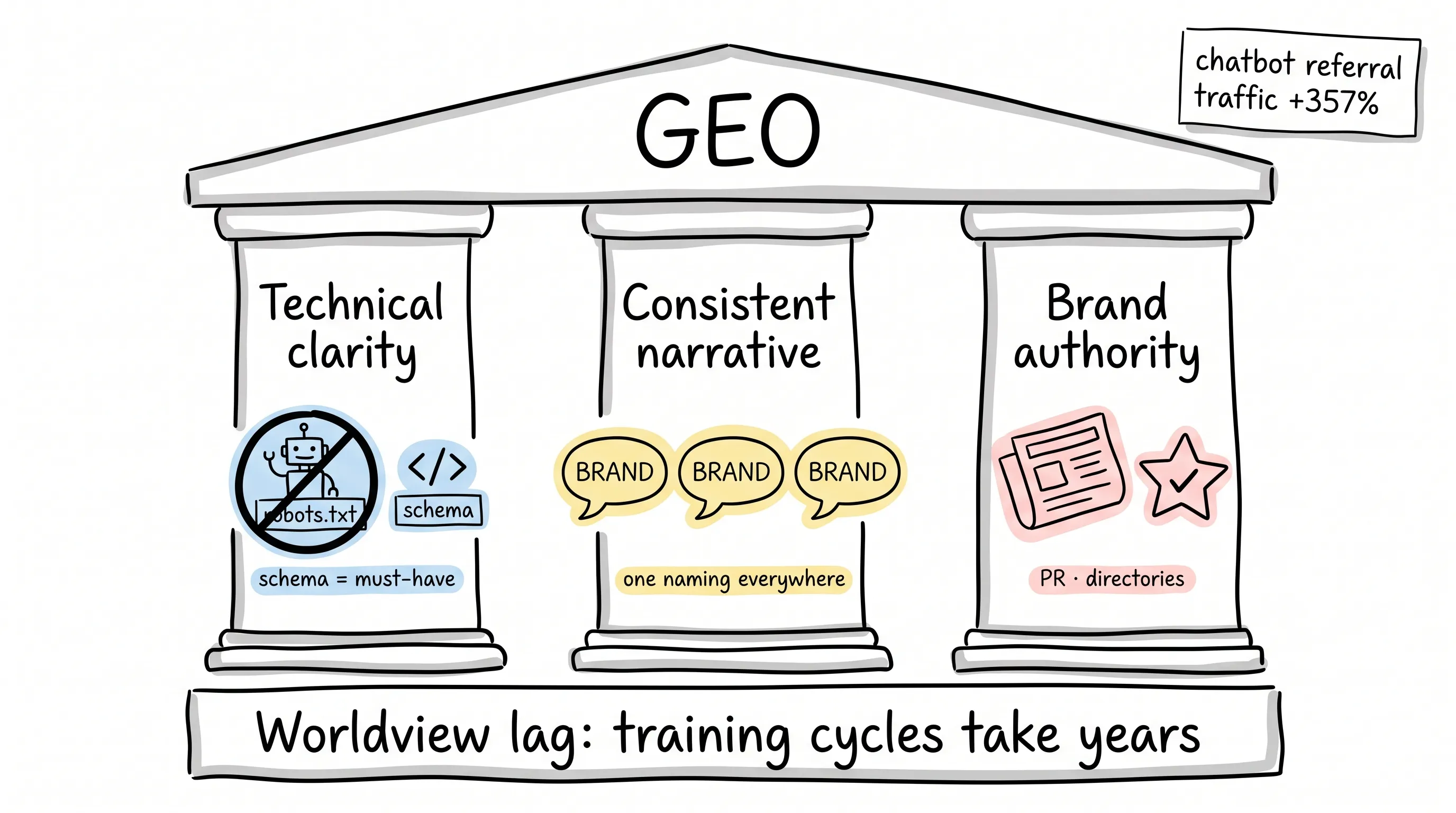
The truly painful one is called worldview lag. A model training cycle takes years, so negative brand impressions formed early may take years to correct — and that's the argument for investing in GEO now. Two forward-looking calls: paid GEO is coming — ads in Google AI Overviews match against the informational content of product pages, so someone searching how to pan-sear a steak will see the cast-iron brand that wrote the steak guide; and in agentic AI scenarios, the one placing the order may be the AI itself.
💬 Practitioner's take: two of the three pillars are actionable this week — check whether robots.txt is accidentally blocking AI crawlers, and fill in Organization and FAQ schema across your site. Unifying brand naming is a small chore many teams have put off for a year; put it on today's agenda.
🔗 Further reading: Read the full article
The Great Decoupling: impressions up, clicks down, conversions rising anyway
Demand Local frames AI search's impact as a Great Decoupling. About 60% of Google searches now end without a click; ChatGPT has 400 million weekly users handling roughly 37.5 million search-type questions a day. Impressions are up, clicks are down, yet conversions earned through AI citations are rising. NerdWallet is the specimen: in 2024, traditional website traffic fell 20% while revenue rose 35% — on the strength of AI search optimization.
The divergence in platform source preferences deserves copying into your notes. ChatGPT favors Wikipedia and reference sources; about 40% of Perplexity's citations come from Reddit; Copilot leans toward business publications like Forbes. Feed the same content to all three platforms and you get entirely different results — the brand's homework has become cultivating mentions on authoritative third-party sources. arXiv's GEO research measured visibility gains of up to 40% in generative answers with the right tactics.
Local search is the unexpected survivor. 76% of people who search locally visit a store within 24 hours, local search accounts for about a quarter of website traffic, and 28% of local searches lead directly to a purchase. AI platforms lack location awareness and can't perform real-world actions like visiting a store or booking — and Google rarely inserts AI Overviews into local results. For multi-location brands, four assets are the hard currency of local GEO: NAP (name, address, phone) consistency, LocalBusiness schema, review response speed, and real-time inventory feeds. eMarketer's data points to a time window: 47% of brands still have no deliberate GEO strategy — the first-mover dividend is still on the table. Gartner's forecast is worth quoting too: 79% of consumers will be using AI-powered search within a year, and 70% already trust generative search results.
The hands-on checklist, five pieces: write content in Q&A format, add FAQ and LocalBusiness schema, organize your site into topic clusters, cultivate third-party mentions, and monitor brand citations across each AI platform.
💬 Practitioner's take: spend half a day on a baseline test first — throw your industry's high-frequency questions at ChatGPT, Perplexity, and Gemini, and see whether your brand comes up, and alongside whom. Once you know where the citation gaps are, you'll know whether to shore up Reddit, Wikipedia, or your own schema first.
🔗 Further reading: Read the full article
GEO runs on a new measurement system: three platform types, three playbooks
An SMA Marketing instructional video sorts AI platforms into three types. Training-data-only platforms like Claude and Llama update on training cycles — slow to show results, so brands need to position early and wait for the next round of training. Real-time search platforms like Perplexity and SearchGPT plug straight into search indexes, so some SEO fundamentals transfer over. Hybrid platforms like ChatGPT and Gemini draw on training data and can also reach the Google index or Bing data — both levers need pulling. The video also maps out the per-platform playbooks: Google AI Overviews is the most influenced by traditional SEO, ChatGPT weighs contextual relevance more, and Perplexity favors in-depth niche content.
The most valuable part of the video is the measurement track switch. SEO watches rankings and click-through rates; GEO's goal is getting the brand into AI answers, so the metrics to watch are cross-platform brand mention rate, opportunity size (which models your audience actually uses), and movement in branded-search volume. A user may finish their research inside an AI chat, then turn around and search your brand name directly — keep an eye on the correlation between branded search volume and AI mentions. The fundamentals still work: structured data is easier for LLMs to parse, don't block crawlers, site authority still counts, and user engagement feeds back into the loop. Google has updated its own best practices, explicitly noting that if you want your content in AI Overviews, don't block these crawlers. One calendar reality-check: training-data models refresh only once every few batches — there's no squeezing in on short notice, so plan on a long horizon.
💬 Practitioner's take: turn GEO from a vibes project into a measurable one — start a three-column sheet: mention rate per AI platform, opportunity size, and branded-search volume, updated weekly. Allocate resources by the three platform types; one plan for all platforms won't carry all three.
🔗 Further reading: Read the full article
🏷 Organization & Governance
Don't force everyone into an AI builder
MarTech columnist Melissa Reeve pushes back against metrics-driven mass building. The current state: Shopify requires employees to use AI reflexively and folds it into performance reviews; Accenture ties AI usage to promotion eligibility; the evaluation metric has already upgraded from using AI to building with AI. Dataiku surveyed 685 CIOs in July: 84% admit employees are shipping AI applications faster than IT can govern them, and 72% can't verify whether those agents actually achieve their design goals. This is Goodhart's Law in the wild — the moment a metric becomes the target, people start gaming the metric.
The consequence is a builder monoculture. One passage from the article is hard to forget: an agency partner cleared out everyone in a four-person studio who hadn't embraced AI, then counted himself lucky the team's slowest-to-adopt designer was still there — because the bit of human touch clients wanted lived in her. An architecture-governance lead at a financial services firm calls this architectural fit: building is the easy part. Builders assume someone comes after them to take over, but the person taking over often doesn't exist. A consultant in the energy industry described the accountability moment: when something breaks at the system's edge, the fix lives in the heads of three or four people.
The author proposes a four-role ecosystem: the Builder starts things, the Maintainer keeps systems running, the Monitor watches for drift, and the User — the largest group — does their job by making good use of what others built. Marketing automation's day two is predictable: the promo ends but nobody switched the agent off, a model update shifts the brand voice off-key, someone renames a CRM field and lead routing breaks — and the builder has already moved to another team. An SRE lead at an online grocer ran 11 dojo training sessions over six weeks, produced 17 applications, and then discovered abundance without triage — more apps than anyone could sort through. Governance showed up uninvited.
The fixes are almost suspiciously cheap. A four-question checklist: Does performance evaluation reward keeping one thing healthy for six months? If not, what you're paying for is a pile of prototypes. Who do you call when something breaks? Every team has that default go-to person — do they and their boss know that's their role? Who's responsible for spotting drift? The person who flags copy going off-tone and asks where the list came from is your Monitor. Does every application launch with a named maintainer attached? Pairing one at launch costs almost nothing; retroactively assigning ownership costs far more. A word for the Users, too: making good use of what others built is doing your job — the review form should say so. The article closes by borrowing DevOps history: platform teams and blameless postmortems gave maintainers a formal role, and marketing AI is standing at exactly that same moment.
💬 Practitioner's take: one thing you can do this week — go through your team's review forms and write sustained healthy operation into the incentives, weighted the same as new builds. Pair every agent that ships with a named maintainer; the cost is roughly zero, and what you save is the firefight six months out.
🔗 Further reading: Read the full article
AI content governance, nine pieces: speed arrived, control didn't
Kagen's piece points out that AI has already solved the content-speed problem — and exposed the governance gap. 88% of organizations use AI in at least one function (McKinsey), and 64% of content marketers use it regularly, but only 25% of executives believe their organization is prepared for generative AI governance and risk (Deloitte). When speed outruns the approval process, brand consistency, product claims, image rights, and regional compliance all slip out of control — and when multiple teams each run their own tools, the exposure stacks up.
Nine controls, arranged along the workflow: prompt pre-checks that catch prohibited claims, unlicensed celebrity likenesses, competitor references, and regionally sensitive wording before generation; brand-compliance rules embedded into the creation flow — logo, colors, typography, photography style, and tone all written as machine-checkable rules rather than manually compared against a brand-book PDF; role-based permissions so who generates, who reviews, who publishes, and who sees the audit logs each have their seat; structured approval workflows where low-risk social variants take the automated fast lane and paid placements for financial products go through brand plus legal plus regional compliance; mandatory human review for high-risk content (product claims, health and financial language, executive-facing statements); version tracking that preserves the full chain from prompt, model version, and editing instructions to approver; plus reusable asset management, regional compliance, and a final accountability mechanism.
All of it boils down to one question: when legal or the boss asks who approved this piece, the system must produce the complete record within minutes. If it can't, governance isn't built yet.
💬 Practitioner's take: you don't need all nine built at once — start with two: prompt pre-checks and approval workflows; those two block the most incidents. Write the criteria for what counts as high-risk content into a one-pager and send it to everyone; it's far cheaper than deleting posts after the fact.
🔗 Further reading: Read the full article
💡 Today's Big Picture
Put today's nine stories side by side and one clean fault line appears: AI's supply side is in surplus everywhere, while the evidence side is in deep shortage. The headline survey says 95.3% are planning and 10.8% are in production; the governance report says 88% are using it and 25% believe they have it under control; the organization piece says 84% of CIOs admit governance can't keep up with the pace of building. Three different sources point at the same gap: the money has been spent, but the control and the proof haven't caught up. The gap is itself an opportunity — whoever builds the proof system first is the one whose budget keeps growing like that 56%.
On the other side of the fault line, the three GEO pieces mark out a time window. Search entry points are switching from link lists to AI answers: 60% of Google searches end in zero clicks, 47% of brands have no GEO strategy yet, and model worldviews harden on an annual cycle. Those who invest now get the first-mover position — by the time everyone moves, the payback cycle will be measured in years. The GEO and e-commerce AI lists also serve one reminder: the tool-side threshold has fallen to tens of dollars a month, and the competitive dividing line has shifted from whether you can afford it to whether someone owns making it run smoothly.
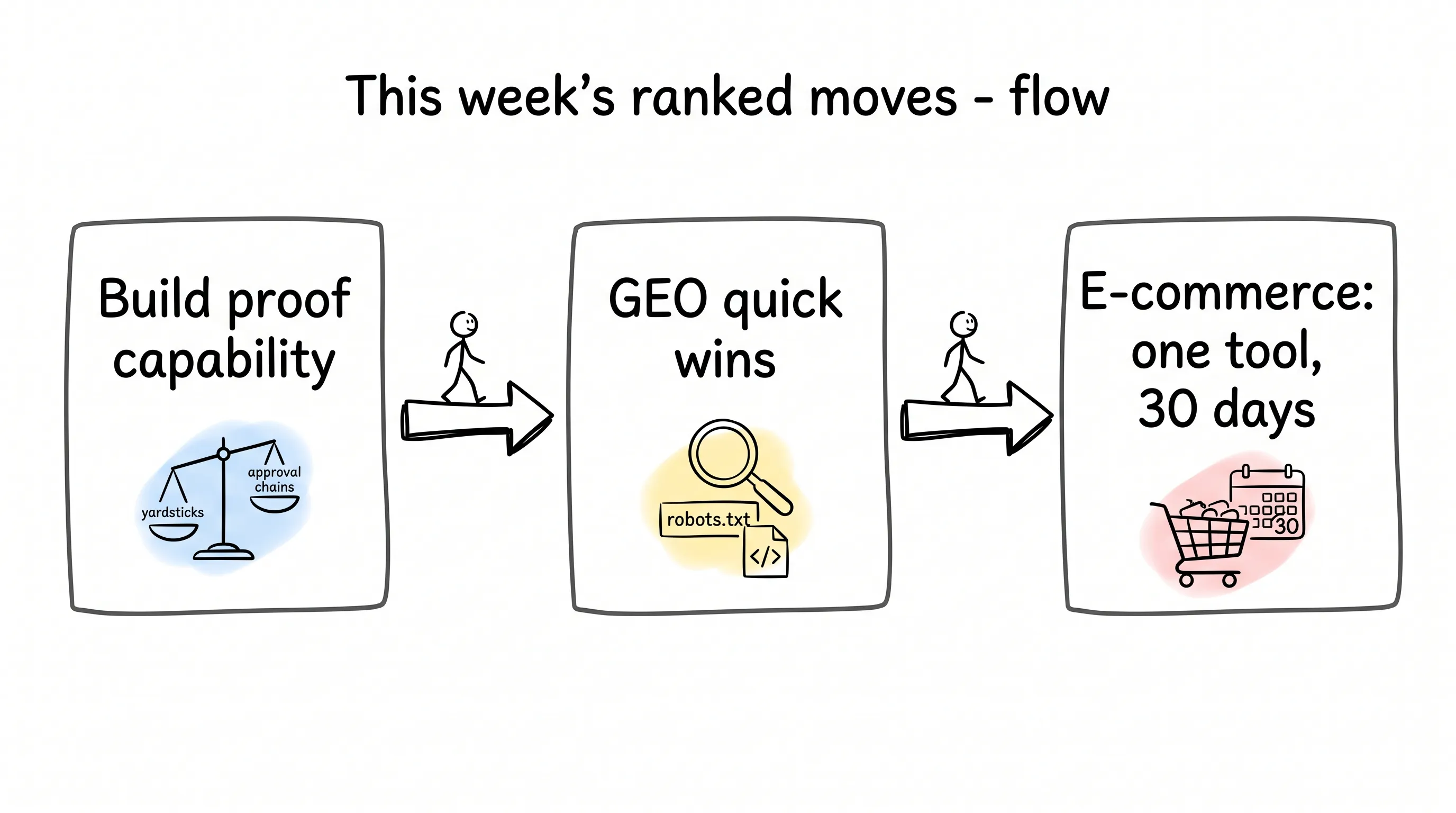
Rank this week's moves. First build proof capability — add value yardsticks and approval chains to every AI program in flight; that's the precondition for the budget surviving. Then circle GEO's two quick actions: check robots.txt, add schema. E-commerce teams pick one tool for the most labor-hungry step and trial it for 30 days. Direction isn't short of information anymore — what's short is finishing one of these.
Continue reading
Related articles

AI Marketing Daily · 2026-08-22
No explosive new tool was released today; the headline is a claim that keeps getting proven: buy all the tools and your delivery speed still doesn't change — the bottleneck is...

AI Marketing Daily · 2026-08-21
Everything that happened in AI marketing over the last 24 hours, and which item deserves your action today — this one read covers it.

AI Marketing Daily · 2026-08-19
Over the past 24 hours, two themes have dominated the AI marketing world: regulatory shoes dropping one after another (the IAB released its AI Disclosure Framework V2 yesterday,...