
Marketing Teams Are Rushing to Build AI Tools — So Who's Keeping Them Alive?
An opinion piece on AI adoption in marketing teams argues that rewarding only builders creates a monoculture, citing a Dataiku CIO survey on governance gaps. It describes four roles — builders, maintainers, monitors, users — and four questions to check what performance reviews actually reward.
A few days ago, I sat in on an industry roundtable with exactly one topic on the agenda: in the age of AI, does everyone have to be a builder?
Halfway through, one guy shared his own story, and it stuck with me.
Back in the dot-com days, he said, his boss patted him on the shoulder: Kid, go learn HTML. One day, everyone will be writing web pages.
Thirty years later, he has written about three lines of HTML in total.
He never built technology — he has always used what other people built. A while back, his fridge broke, and he asked AI what kind of new one to buy. Instead of recommending a new model, the AI walked him through inspecting the fridge first, then tossed him a repair video. The fridge got fixed.
His own summary: "I haven't built a single thing. I'm just a user. And my guess is, there are going to be a whole lot of people like me."
What a spot-on observation.
The Prevailing Wind: If You Don't Build, You're Not Trying
Start with the prevailing wind.
In April 2025, Shopify's CEO Tobi Lütke set a rule for all staff: reflexively using AI is now the baseline expectation, and it will be factored into performance reviews. A wave of companies followed suit. Accenture went further, tying AI usage directly to promotion eligibility.
The marketing organizations I talk with most often have raised the bar another level: from "using AI" to "building things with AI." Custom GPTs, agents, automation workflows stitching the CRM to the email platform. When review season arrives, anyone empty-handed visibly loses their nerve.
And the result? People actually started building.
In July of this year, Dataiku surveyed 685 CIOs and got two numbers:
84% admitted that employees are building agents and apps faster than IT governance can keep up.
72% said they cannot reliably verify whether these agents actually do what they were designed to do.
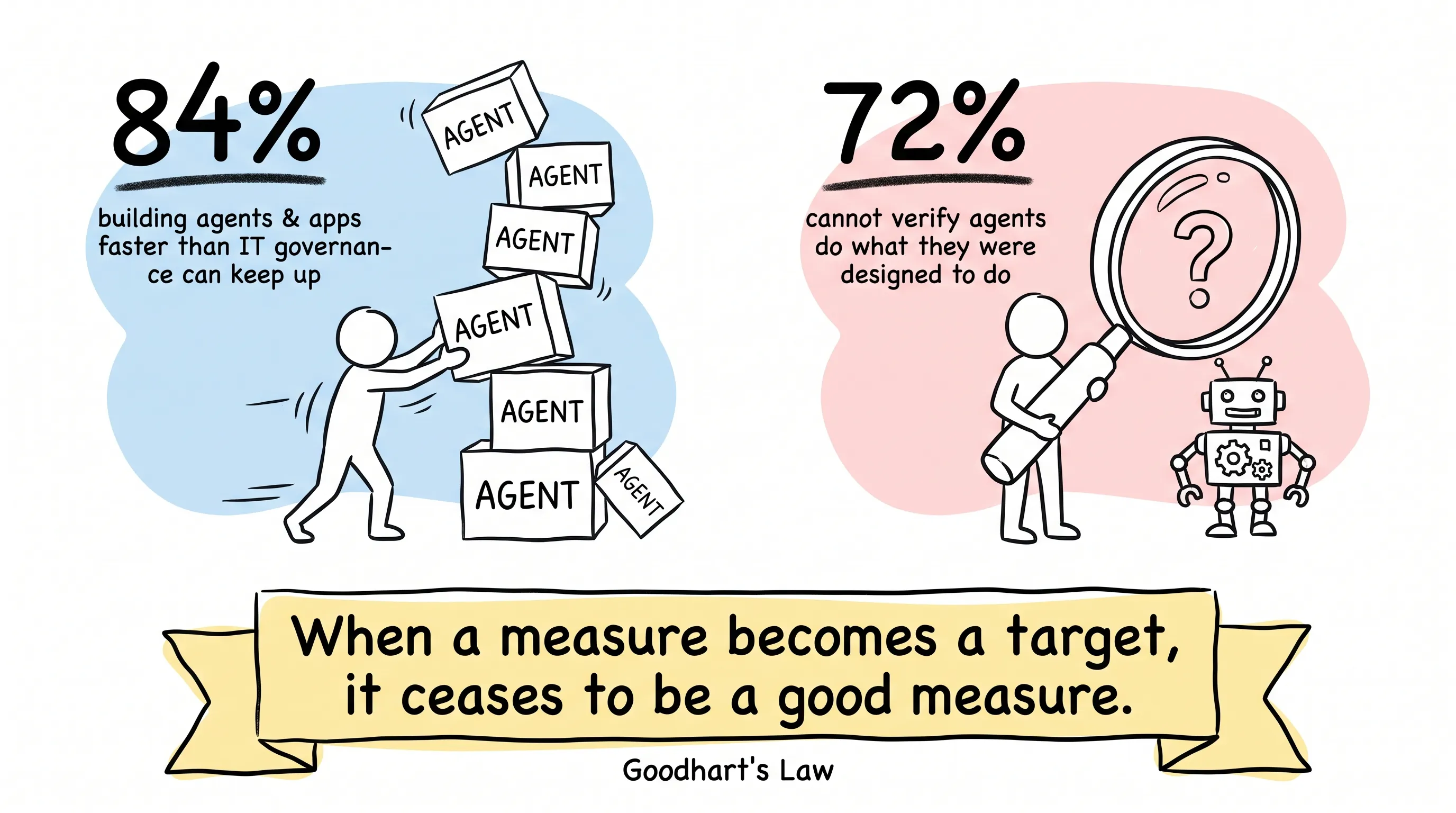
Why do the numbers look so bad? Goodhart's Law said it long ago: when a measure becomes a target, it ceases to be a good measure.
Reviews only reward building, so everyone builds like crazy to prove it.
Reward Only One Kind of Person, and You Get a "Monoculture"
What is a builder monoculture?
It's when an entire team's hiring, training, and promotion all revolve around one personality type.
People who love building tend to look alike: they love to innovate, love risk, light up at a blank canvas. These are fine traits, of course. But if those are the only ones you reward, what about everyone else?
At the roundtable there was a small industrial-goods marketing agency, four people, everyone all-in on AI. Someone asked how they pulled it off. The owner put it bluntly: "The ones who couldn't use it aren't in my agency anymore."
Brutal.
Later he talked about his designer, the slowest adopter on the team. At first he was so anxious he could hardly stand it, itching to see her push the tools to their limits. Then it clicked, and he was relieved she was still there: "I still want the human touch."
I'll co-sign that. I count as a builder myself, and I know the species all too well: fast runners, but the moment something works, their eyes are already on the next idea, leaving a trail of prototypes behind that nobody picks up.
Building fast is not the same as building finished.
A Healthy AI Team Has Four Kinds of People
So what does an organization that truly uses AI need?
Four kinds.
Builders, the starters. They see repetitive work and can't resist automating it.
Maintainers, the lifelines. Troubleshooting, isolating, fixing — this is what energizes them most. A blank canvas? Not their thing.
Monitors, the lookouts. They keep the system from crossing the line, and wherever drift starts, they're always the first to smell it.
Users, the ones getting the work done. They use tools other people built, and use them to do their own jobs beautifully. This is by far the largest group. They're exactly who the guy at the opening was prophesying.
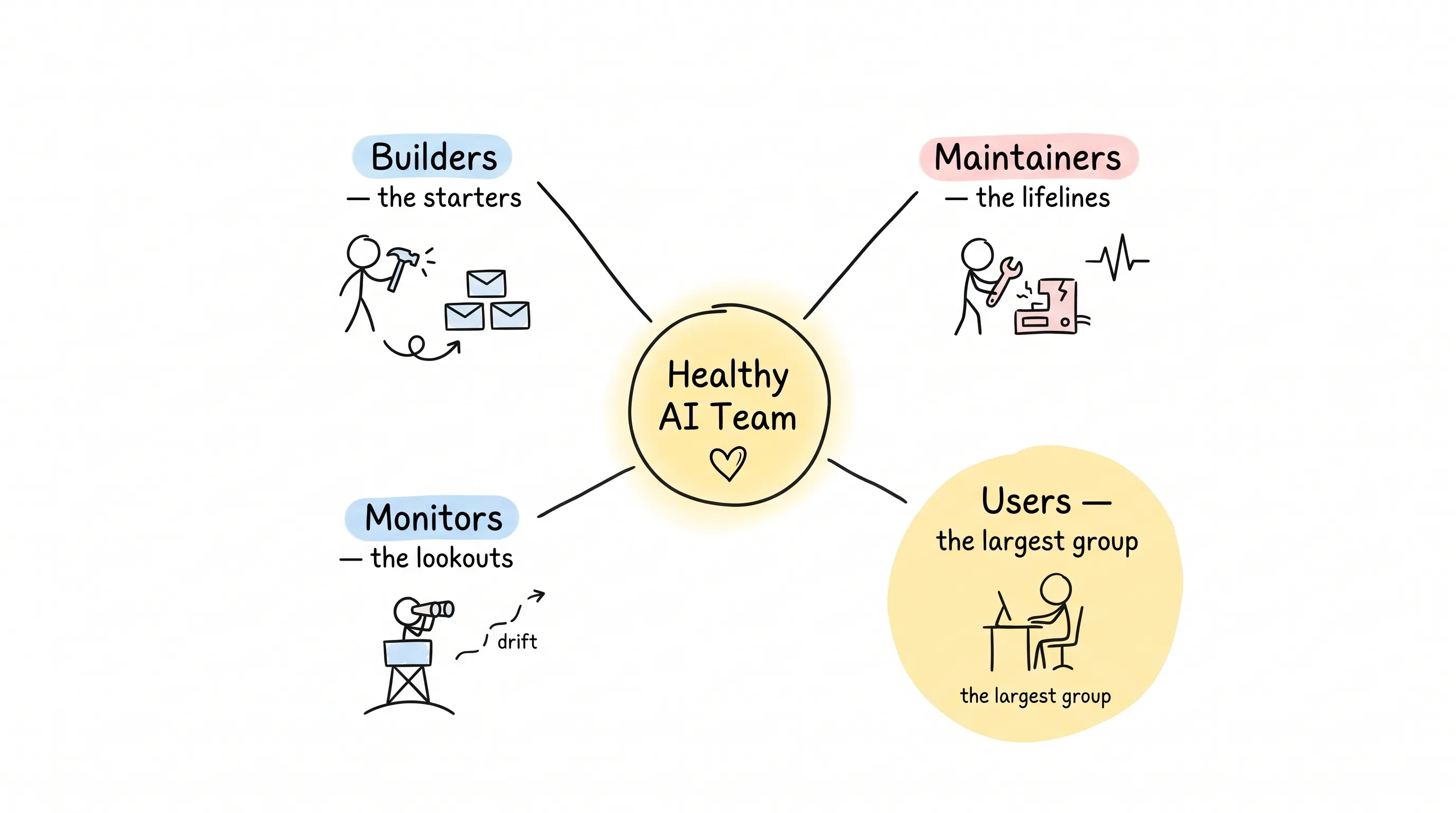
These four types are four temperaments. If reviews reward building only, the natural maintainers on your team will spend all their energy pretending to be builders — while the work they're actually great at goes undone.
Building Is the Easy Part
At the roundtable, an architecture governance lead at a financial services firm put a name on it: architecture fitness. His exact words: "Building is the easy part." The builders assume someone downstream will naturally take over. "But that's not a good idea."
Another consultant, just wrapping up a project in the energy sector, described the moment it blew up: someone built a cool tool and wanted to deploy it under the system's existing rules. Everyone froze: wait a minute — those rules? We never sat down and defined them. When things later broke at the edges of the system, all the knowledge to fix them lived in three or four heads.
Here's an even more spectacular one. A platform lead at a membership-based fresh-grocery e-commerce company ran 11 two-day AI dojos in about six weeks, teaching the entire company to build, then held an all-hands where 300 people watched their colleagues' creations. It worked brilliantly: 17 apps lined up to emerge. And then? His exact words: "Harvest, but no triage." And after that, "governance showed up uninvited."
Marketing teams run this script every day.
The promotion ends, and the agent doesn't turn itself off. The model gets upgraded, and the brand voice suddenly sounds off. Someone renames a CRM field, and the lead-routing automation quietly breaks — nobody notices. The person who built the whole setup has moved to another department.
Every one of these needs a maintainer or a monitor. But in most organizations, that role doesn't even have a name.
Four Questions to Ask Yourself
What's the right ratio? It depends on team size and the stock of what's already built — there's no formula. Don't rush to restructure; first ask yourself four questions.
One, what do the reviews actually reward? If shipping a new automation scores higher than keeping an old automation healthy for six months, then what you're buying with all that money is a pile of prototypes. Does "keeping it alive" count as the same credit as "building it"?
Two, when something breaks, whose phone rings? Every marketing team has that one person. He is your maintainer. Does he know it? Does his manager?
Three, who is watching for drift? Think of the person who keeps saying "this copy has crossed the line," "where did this list come from." That's your monitor.
Four, does anything ever launch without a second name attached? Giving a builder a named maintainer at launch costs almost nothing. Reassigning ownership after the incident costs far more.
By the way, there's also the biggest group of all: users. Let them be users in peace. A marketer who uses a well-built tool well is doing their job. On the review form, that's exactly how it should read.
DevOps Walked This Road Fifteen Years Ago
Fifteen years ago, the DevOps world looked like this too: a small handful of teams doing continuous delivery, everyone else watching from the sidelines. Then came platform teams, communities of practice, blameless postmortems — giving "the people who keep systems alive" a formal seat, and the gap finally closed.
Marketing now stands at the same crossroads. The builders have done their part, and I'm sincerely grateful to them. The next step is to give maintainers and monitors a name, and the credit.
Look back at your team this week: who is the builder? Who are the maintainers and monitors? And which type does your performance review actually reward?
Those who build the tools deserve applause. Those who keep the tools alive deserve a name.
By the way, may your fridge never need fixing. If it really breaks, don't rush to buy a new one — ask AI first. It will most likely help you fix the old one.
Continue reading
Related articles
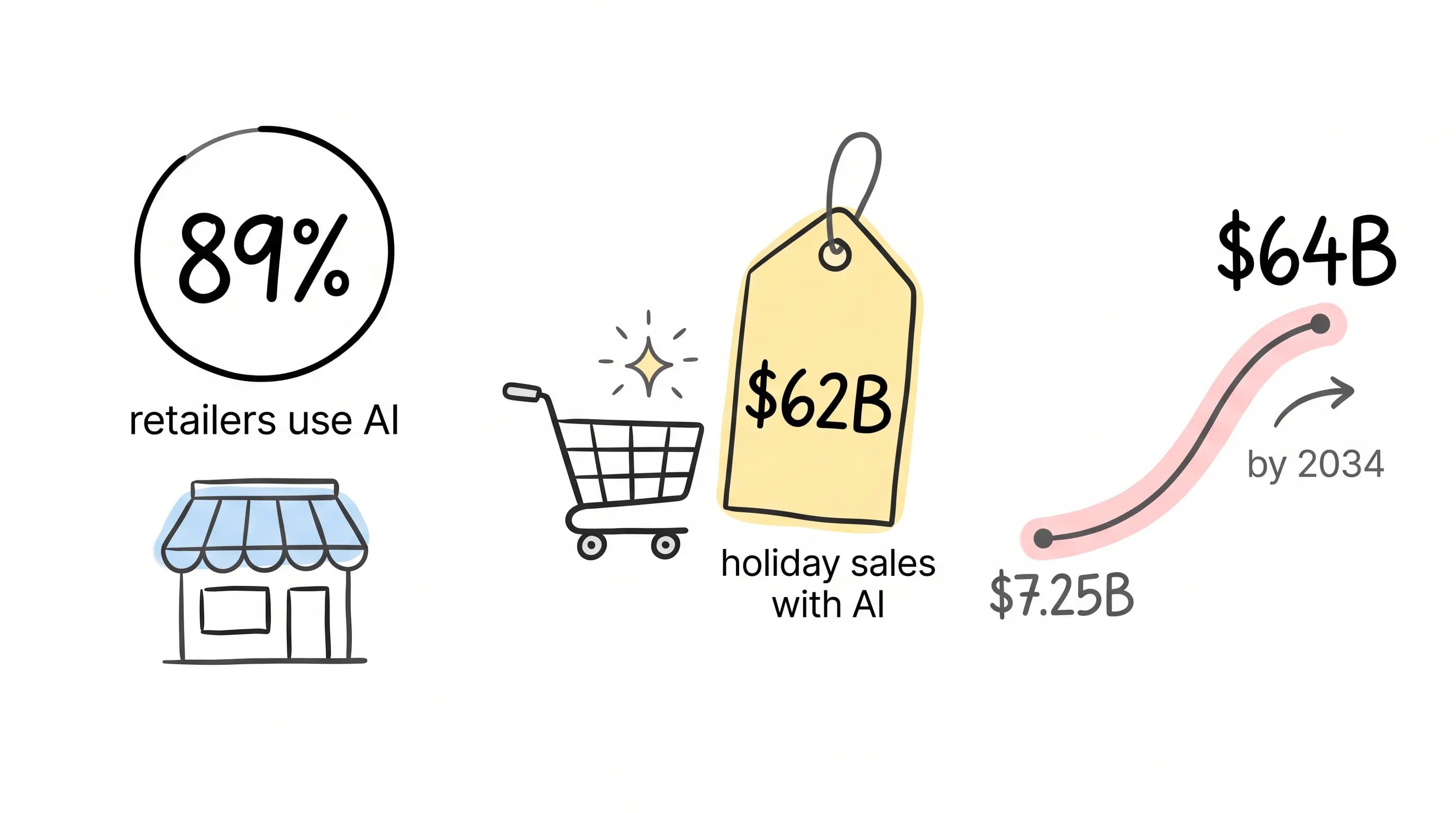
89% of Retailers Are Already Using AI. The Playbook for E-Commerce Has Changed
A learn article on AI in e-commerce: adoption context, use cases from recommendations, search, dynamic pricing, customer service, inventory, and fraud control, plus B2B applications, generative AI content, tool examples, pitfalls, and a six-step adoption path.
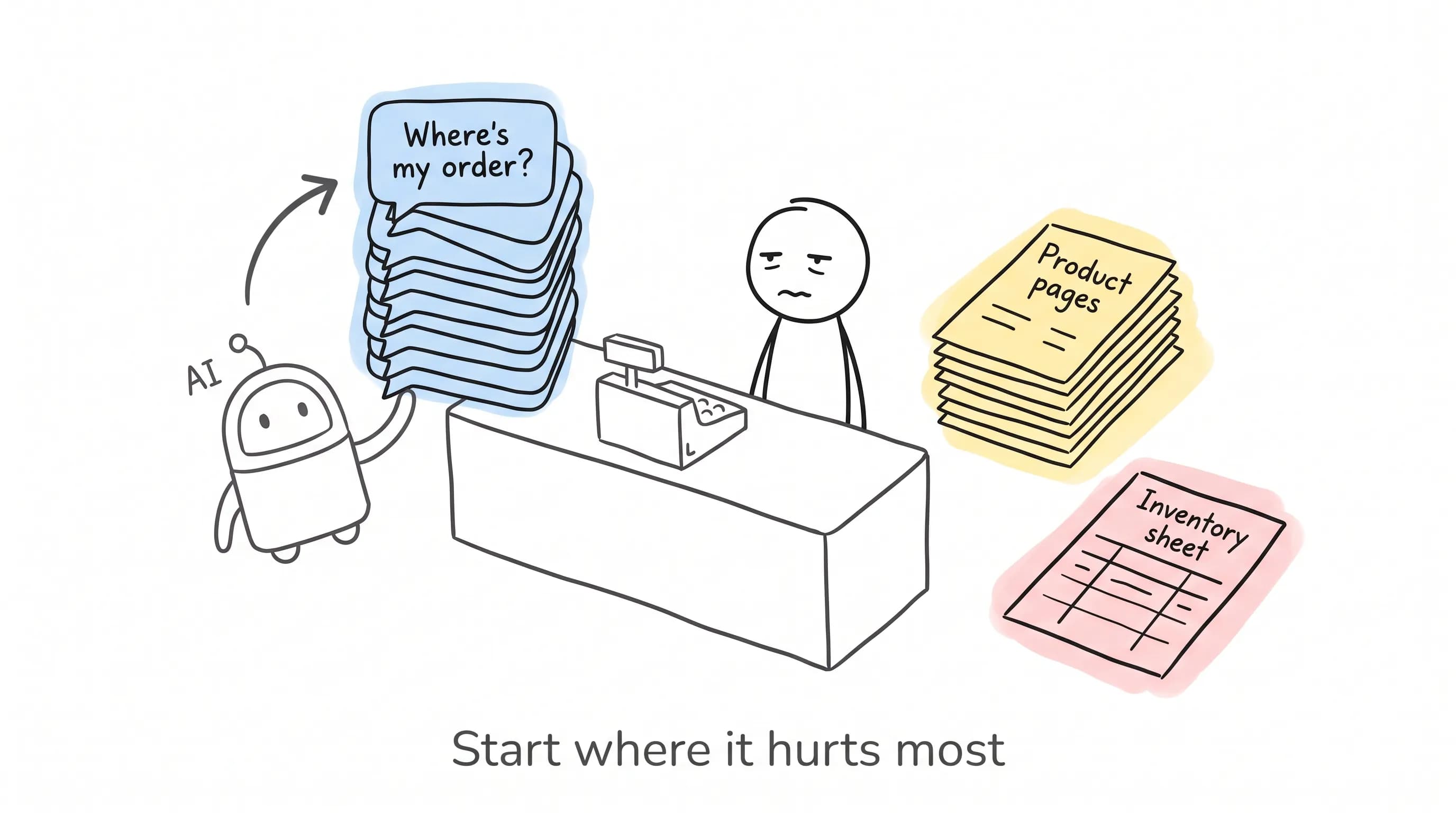
It's 2026 — Which AI Tools Should You Actually Adopt as an E-commerce Seller?
A learn article walking e-commerce sellers through eight AI tool areas — customer service, email and SMS, copy, product images, inventory, pricing, on-site search, and analytics — and advising adoption one or two areas at a time, starting where the most time is lost.

Marketers at a Fork in the Road: Generative AI Stands Behind All the Disruption
A learn article explaining what generative AI is and how it helps marketers with content output, personalization, imagery, chatbots, A/B testing, and translation. It also covers risks like brand voice, copyright, and bias, cites brand case studies, and outlines four future directions.