
Does AI Know Your Brand? A Look at GEO, the New Craft
An explainer on GEO (Generative Engine Optimization): how AI engines like ChatGPT, Perplexity, and Gemini differ, how GEO goals and metrics diverge from SEO, and which SEO skills still carry over.
A few days ago, an old friend who has spent more than a decade in foreign trade invited me to dinner. Halfway through the meal, he pulled out his phone and showed me: "Look, our official website ranks number one on Google. But when I asked ChatGPT 'which companies are best at this kind of product,' the answer went on for five whole paragraphs, and not a single one mentioned us."
He asked me: is this some kind of black magic?
I said no. This is a new craft, called GEO.
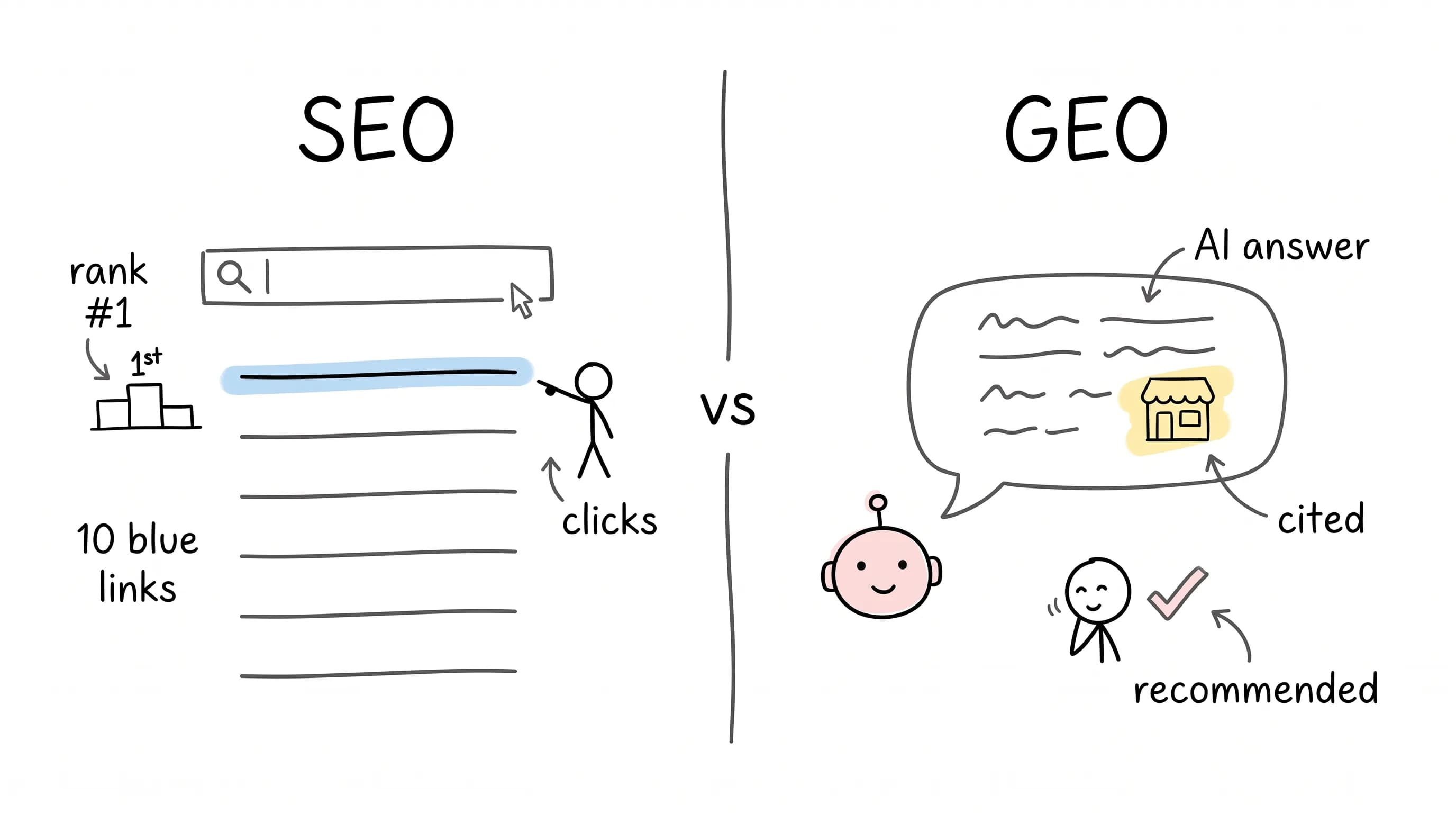
What is GEO? Generative Engine Optimization. Put simply: in the past, you found ways to get Google to rank you at the top; now, you have to find ways to get AI like ChatGPT and Perplexity to mention you—on their own—in their answers.
These are two different things. Genuinely, completely different things.
First, Straighten Out the Timeline
To understand this new craft, you first need to see how it grew, step by step.
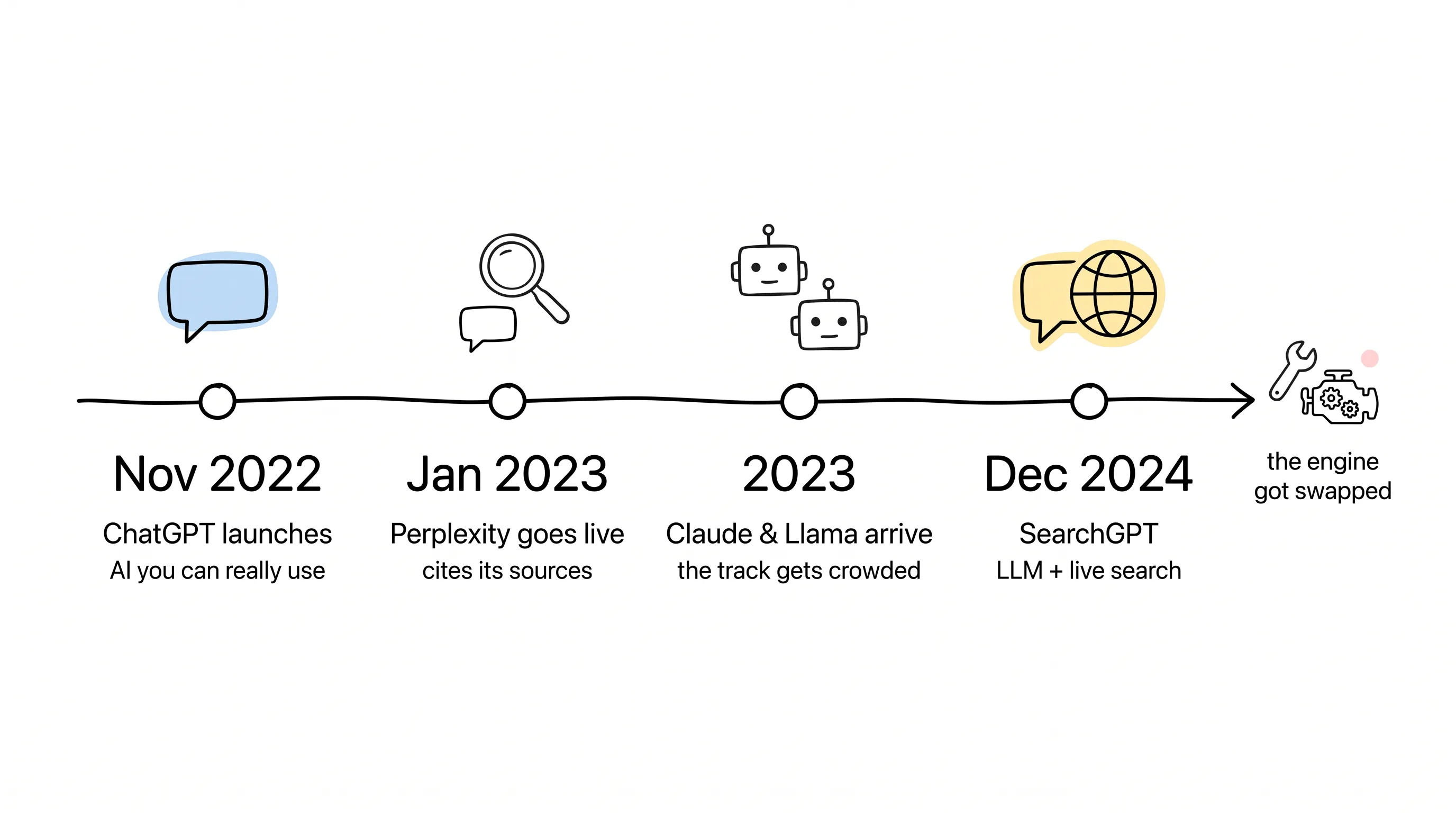
In November 2022, ChatGPT launched. From that day on, conversational AI became something you could genuinely use.
Two months later, Perplexity went live. It zeroed in on ChatGPT's biggest early pain point: giving you no sources. The AI could sound perfectly convincing—but where exactly did that come from? Nobody knew. Perplexity was built to attack exactly that: "citing its sources."
In 2023, Claude and Llama arrived one after another, and the track got crowded overnight.
In December 2024, SearchGPT came out, welding large language models and web search together. AI no longer relied on memory alone—it would go search live, on the spot.
You see: in just over two years, the engine underneath search has been swapped out entirely.
The user hasn't changed—still that same person looking for answers. What changed is the machine that answers the questions.
Three Types of Engines, Three Playbooks
So how do these AI systems actually work on the inside?
Let me sort them for you. The market looks dazzling, but there are really only three types.
Type one runs purely on training data. Claude, Llama, and the like carry "batch memory" poured in all at once—no internet, no real-time refresh. Trying to influence one is like trying to get a student who has only memorized the old textbook to write your name on the exam: you have to wait until he gets the new textbook. Slow.
Type two connects directly to search. Perplexity and ChatGPT's search mode go dig through the web on the spot when answering. This resembles traditional SEO, but not entirely—because there is still a layer of model and training data sitting on top.
Type three has a foot in both camps. ChatGPT and Gemini shuttle between the two. Gemini stands directly behind Google's web index, with an asset base so deep it's intimidating. ChatGPT, meanwhile, leans on Bing, plus a partnership with Apple, and has picked up a good chunk of real-time data.
So don't expect one playbook to work across every platform. Some levers run on SEO; some levers run on "teaching" the model. You have to keep separate accounts.
The Goal Has Changed: From Pulling People In to Being Mentioned
So what exactly separates SEO and GEO? The goal.
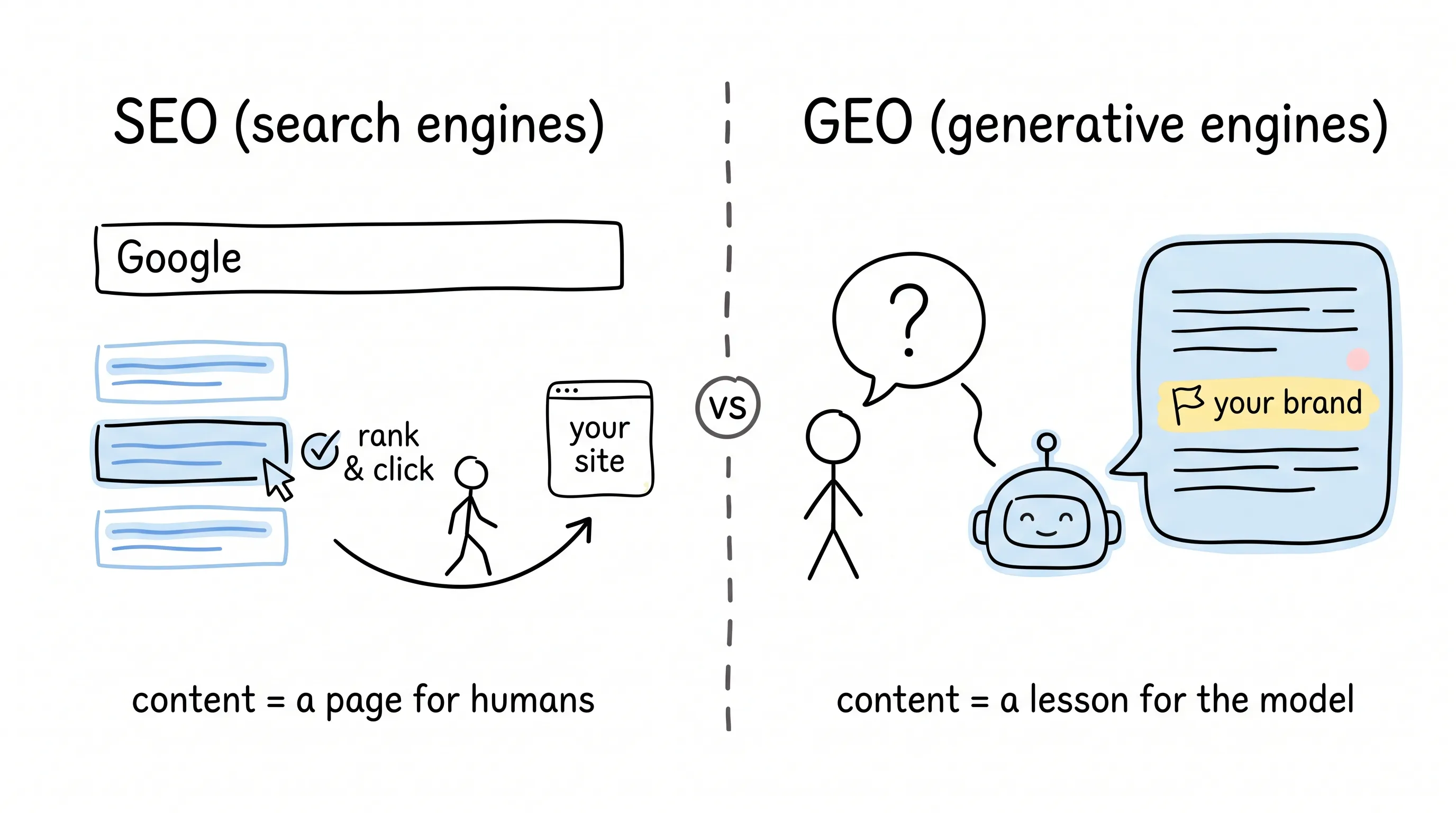
SEO's goal is to pull people from search engines onto your website. The core moves are ranking and clicking.
GEO's goal? Getting your brand to appear in AI's answers.
Picture the difference between these two scenes. A user searches on Google, sees a row of blue links, clicks into your website. A user asks ChatGPT, the AI talks for five paragraphs, and your name shows up in the third.
In the former, content is a page for humans to look at. In the latter, content is a lesson for the model. You are teaching it: this question and this entity of mine are bound together. You want it to think of you first the next time this kind of question comes up.
The content is still the content. But the reader has changed—from humans to machine plus human.
Old Rulers Can't Measure the New Market
The goal changed, so the measuring stick has to change with it.
What did we look at before? Organic traffic, keyword rankings, click-through rates. That set of rulers basically fails in GEO.
What do we look at now?
Look at brand visibility. Stop staring only at Google's top ten—go count: ask the same question in Gemini, how many times are you mentioned? In ChatGPT? In Perplexity? In AI Overviews? Count across every platform, and only then will you know whether you actually have a presence in the AI world.
Look at the size of the opportunity. Which model are your customers actually using to ask questions? How big is that pool? That decides where your effort goes.
Look at branded search. Many people ask in AI, then turn around and search your brand name directly on Google. Google is slowly becoming a "navigation tool," while the complex questions have all moved over to the AI side. An unusual movement in branded search volume may be the echo of that one mention in an AI answer.
One more thing: we are still in the early-adopter stage of the technology adoption lifecycle. The pool isn't big, but it's rising fast. Getting in now is the cheapest it will ever be.
Which Old Skills Still Work?
The good news is that most of SEO's inheritance can still be passed down.
Content, as before, is the lifeblood. Besides being a place for humans to browse, your website is also participating in training large language models. So don't just write product specs—write how you solved those complex problems. What the model learns is "who knows their stuff."
Technical SEO still works. Structured data (Structured Data: code that explicitly tells machines what your page means) is far easier for machines to read than ordinary pages. By the way, Google has already updated its official guidance: if you want your content in AI Overviews, don't block AI crawlers at the door.
Authority still matters, but the algorithm has changed. Lots of backlinks and mentions genuinely work in some markets, and are less effective in others. Each model calculates "authority" differently—don't measure everything with one ruler. Good keyword rankings don't mean AI will mention you either. There's correlation, but not one-to-one correspondence.
User experience is the fuzziest part, but it matters more and more. After users get their answer in AI—did they click through, and was the problem solved once they did?—all of that feedback feeds back in. With free tools like ChatGPT and Perplexity, every single use of yours helps them learn more precisely what "a good experience" means. Don't forget: behind the machine, there are still humans.
One Platform, One Playbook
So should you optimize separately for each model?
Yes.
Here's what I got when I tested a few industries myself: Google AI Overviews rankings are the most influenced by traditional SEO, but they don't only look at traditional SEO—you also have to learn to answer questions well in a conversational way.
ChatGPT leans more on contextual relevance, deeply stamped by training data. To get it to mention you, you have to write content with depth, explain your expertise thoroughly, and then wait. Some model versions have live search attached, which makes it faster.
Perplexity sits between the two—one side has live search, the other weighs contextual relevance. It also has an interesting preference: it favors niche content over broad, all-in-one content. Answering one narrow question to the skies works better than laying down a pile of generic pages.
And one more detail: each model updates on a different rhythm. Some update every few days, some refresh daily via live search, some move only once in many months. How "fresh" your content is—and how much that's worth—depends on which engine you're dealing with.
Back to That Dinner
When we settled the bill that day, I told my old friend: all that SEO skill of yours wasn't wasted—it's the foundation. It's just that a new building is about to go up on top of it.
User habits have already taken the first step. They've started asking AI directly, instead of searching web pages.
You can say it's still early. It is early. But back in November 2022, ChatGPT was just "a little thing that could chat."
A few years—that's all it takes.
May your brand be remembered by AI, a little sooner.
Continue reading
Related articles
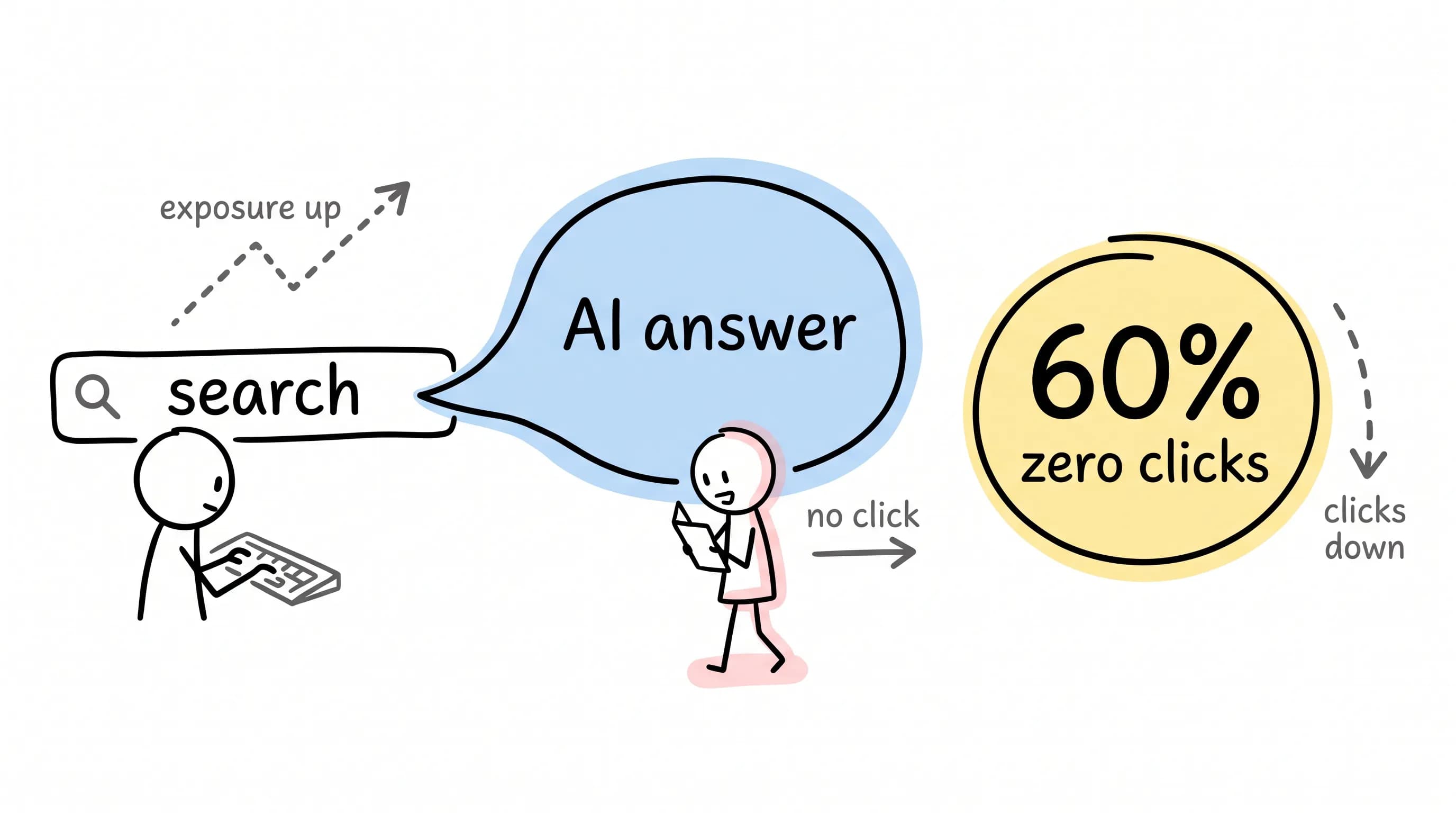
60% of Searches No Longer End in a Click: What Is GEO, and Why Whoever Figures It Out First Wins
An explainer on GEO (Generative Engine Optimization): why many searches now end without a click, how AI decides which brands to cite, and why local businesses and first-party data matter. Covers E-E-A-T, entity clarity, third-party mentions, and attribution challenges as clicks decline.
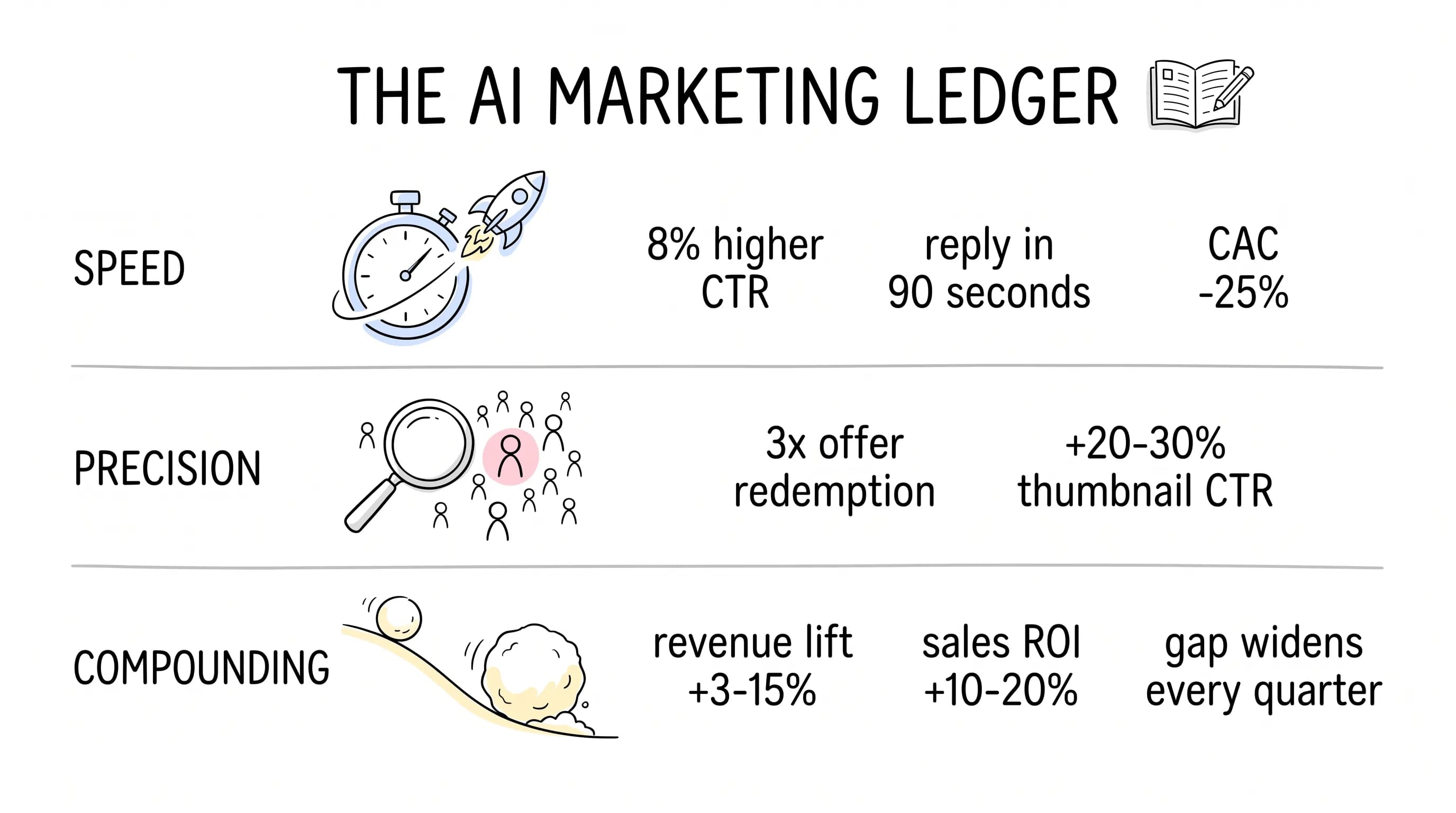
Does AI Marketing Actually Pay Off? Let Me Tell You 10 Stories — Each One Comes with a Ledger
A learn article retells ten AI marketing case studies—from Alibaba's Luban copy tool to JPMorgan Chase's Persado ad-copy tests—each paired with reported metrics, and closes with entry advice on SEO, GEO/AEO, faster lead response, and AI customer service.
Your Next Customer Might Not Be Human
This learn article explains GEO (Generative Engine Optimization): how brands get cited and recommended in AI answers instead of competing for search rankings, covering technical access, Schema, content consistency, and long-lasting model impressions.