
Your Next Customer Might Not Be Human
This learn article explains GEO (Generative Engine Optimization): how brands get cited and recommended in AI answers instead of competing for search rankings, covering technical access, Schema, content consistency, and long-lasting model impressions.
A few days ago, I watched a scene play out right in front of me.
A friend wanted to buy a coffee maker. He didn't open a shopping site, and he didn't search Google. He opened ChatGPT and asked one question: which one is good for a beginner?
The AI gave him a paragraph, recommended two machines, and explained exactly why.
He nodded, and placed the order.
Not a single webpage was opened in the entire process. Not one blue link. No comparison shopping.
Staring at that answer, I suddenly realized something: getting your brand written into that answer has become a business of its own.
This business has a name: GEO, Generative Engine Optimization.
What is GEO?
In the past, doing SEO meant fighting for rankings. A user searched, a row of links appeared on the screen, and if you ranked first, you captured the most clicks.
And now? Users go ask ChatGPT, Claude, or Gemini. What the AI gives back is one synthesized answer. No list, only narrative.
Your brand either gets written into that narrative, or it simply doesn't exist.
SEO fights for ranking. GEO fights to be cited, to be recommended. One letter apart, two completely different playbooks.
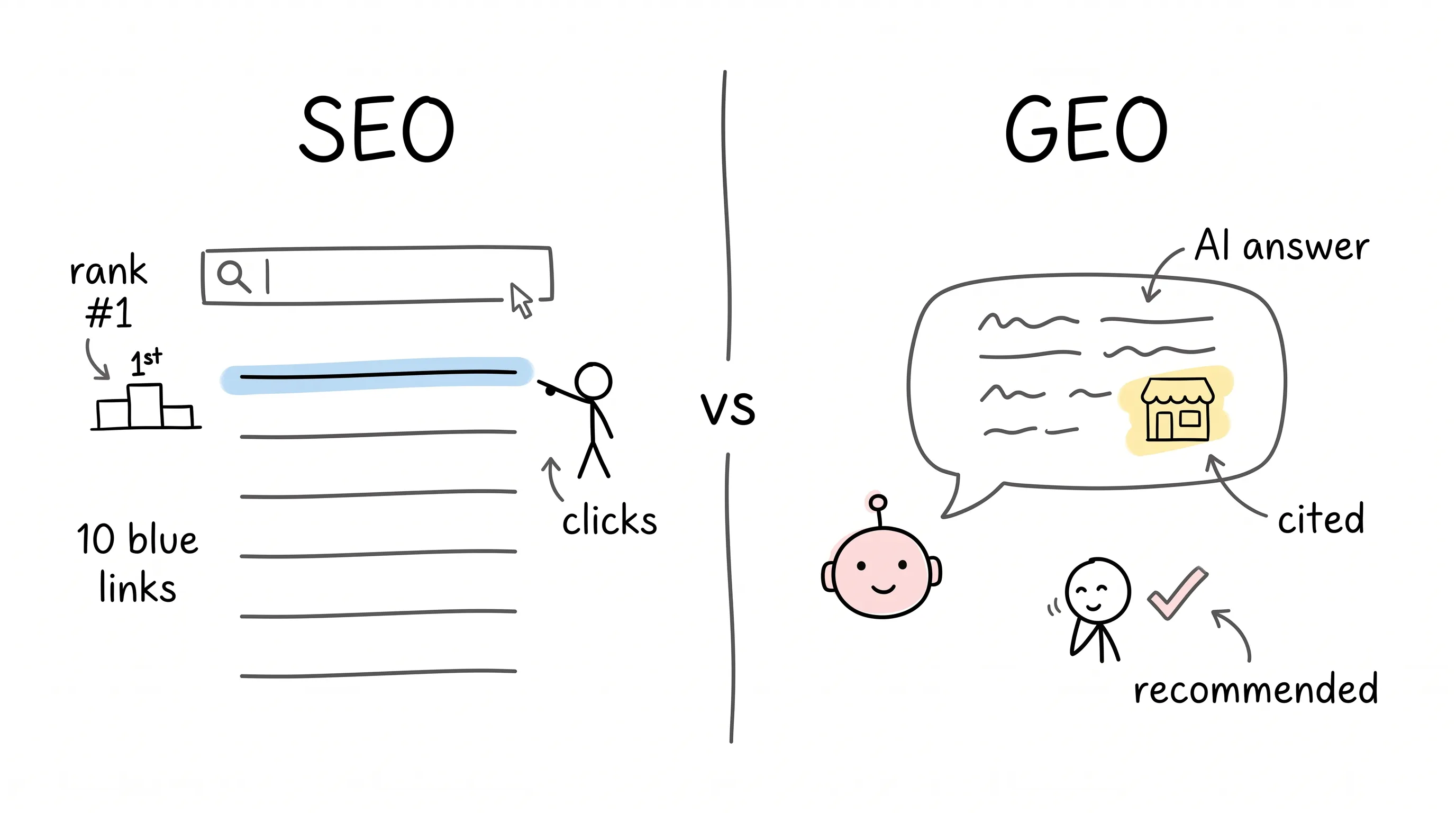
Someone will ask: aren't there also AEO and AIO? Isn't that confusing? In plain language: GEO means getting AI to mention you and recommend you in its answers. AEO is broader — winning the direct answer in any question-and-answer setting, Google's featured snippets included. AIO means getting your content picked up and assembled into Google's AI Overviews, that pinned summary at the top of the page. The names come in every flavor, but the direction is the same: make the machine willing to speak for you.
This isn't armchair theory. In 2025, one set of figures showed that referral traffic from chatbots to brand websites grew 357% year over year.
357%. What does that mean in practice? Consumers are already using AI to do their pre-purchase homework. They ask which model suits them, and who else it stacks up against. And all of this happens somewhere your dashboards can't see.
Some people call it the "AI dark funnel." Dark, because the brand cannot see it.
How do you break through? Three gates.
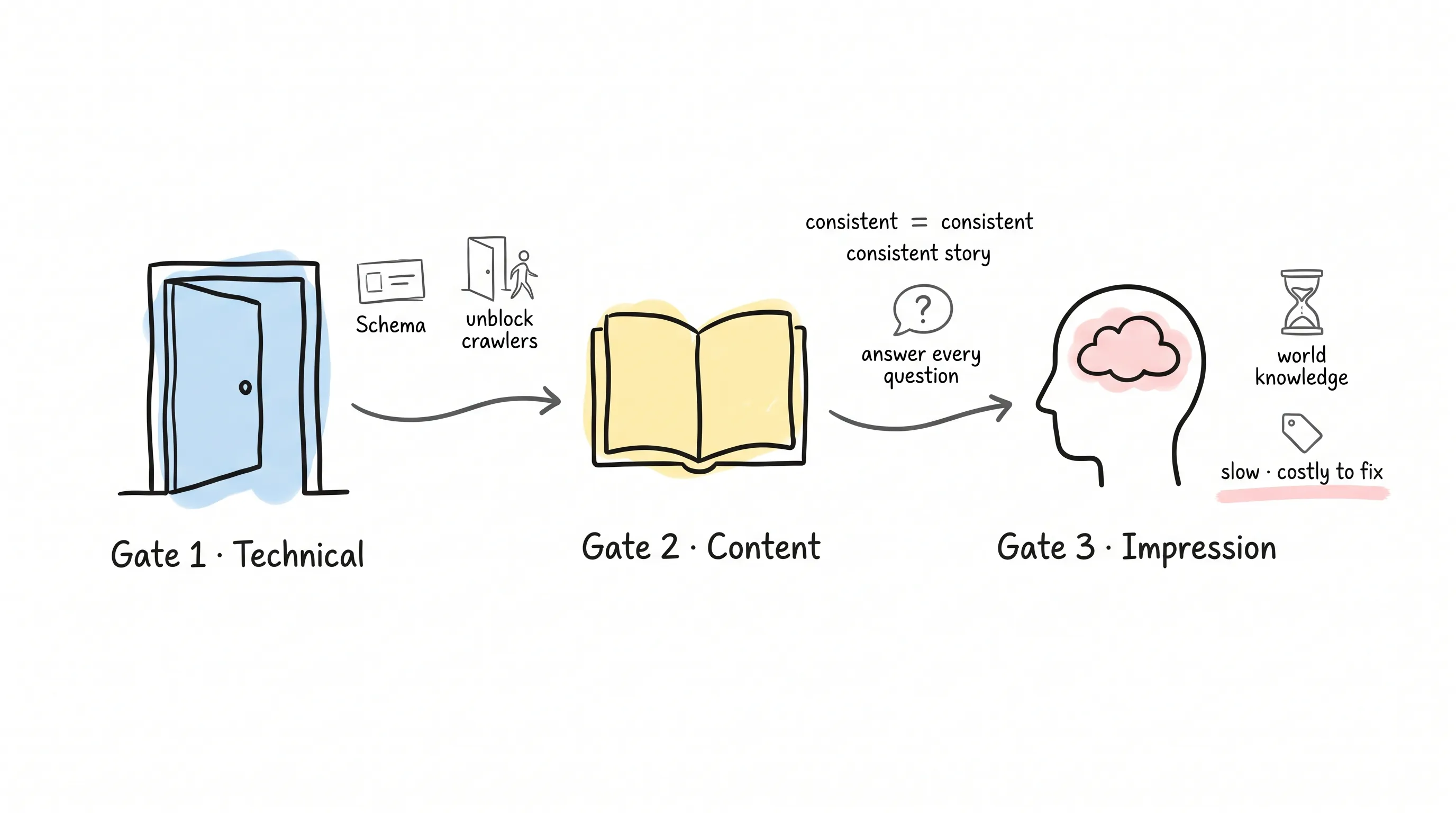
Gate One: The Technical Gate. Make Yourself Visible to the Machine
Generative engines crawl web pages too. If your technical foundation has problems, they may simply route around you. Worse still: they can't route around you — and they get your brand wrong.
Plenty of companies' first instinct was, ironically, self-sabotage. A couple of years ago, quite a few of them, afraid of having their content "stolen" by AI, blocked all AI crawlers in their robots.txt.
That's like moving your storefront from Main Street into a back alley, then wondering why nobody shows up.
If you want AI to cite you, the first thing to do is open the door.
The second thing is Schema. What is Schema? It's a "business card" written for machines — using a format machines can read, it spells out clearly who you are, what you sell, your company history, and where your social accounts live.
In the SEO era, Schema helped, but it wasn't essential. Now it's different. AI needs unambiguous context to recognize you, and Schema is exactly that — a self-introduction with no emotion in it, and no room for error.
Gate Two: The Content Gate. The Machine Is a Very Demanding Reader
What is a large language model, at its core? A "pattern recognizer trained on human language."
It takes stories at face value, and it's astonishingly easy to fool. Whatever story you tell it, it turns around and tells that story to the user.
So content in the GEO era can no longer be keyword stuffing "written for the algorithm." It has to be a story genuinely well told.
Think about it: AI reads the entire web. If your official site, your product pages, and your social accounts all use the same story and the same brand name, it will remember you. If the name changes from one day to the next, it can't connect the dots.
To put it bluntly: machines can't remember things that are vague. Consistency is your identity card in the AI world.
There's also an unglamorous tactic: answer every question your users might possibly ask, before they ask it. Write the product pages in detail, write the FAQ in full. AI likes to fish answers out of concrete content — the more specific you write, the more accurately it repeats you.
Gate Three: The Impression Gate. The Slowest, and the Most Expensive
AI takes everything it reads across the web, forms a judgment about your brand, and stores that judgment in its world knowledge.
Where's the trouble?
Technical problems are fast to fix. Get the crawlers unblocked, fill in the Schema, and within days you can be re-read. World knowledge is a different animal — it comes from training. Training a large model is expensive and slow, and it happens only once every few years.
Which means: if a model forms a negative — or simply irrelevant — impression of you early on, that impression may follow it around for years.
Once a model's world knowledge is set, the bill for fixing it gets measured in years.
This is also why you can't wait. While most brands haven't yet solidified inside the AI's worldview, get your story told clearly and told consistently. Windows of opportunity never announce themselves in advance.
One Step Further Out
Two things are happening.
First, paid GEO. Google is already experimenting with paid recommendations inside AI Overviews. Say someone searches "how to pan-sear a steak" — the answer might come with an ad for a cast-iron skillet.
The interesting part: which ad the AI picks is decided by the informational content on the product page. The brand behind that skillet happened to have published a "how to sear a steak" piece.
Sit with that for a second. Ad placements are no longer decided by bidding alone — first they check whether you've told the story. So every product page needs a story, not just specs.
Second, agentic AI — AI agents. Soon AI won't just answer questions; it will run errands for you: booking flights, placing orders, making payments.
By the time that day comes, the purchase decision will no longer be made by a person sitting in front of a screen.
AI is no longer the assistant. AI is the buyer.
Back to my friend with the coffee maker.
He did a "search," but not a single link was clicked. Moments like this will only multiply from here, until they become the default move.
Will your brand appear in that default move?
While the machine is still learning to understand the world, tell it your story — word by word, line by line.
May your brand be the one the machine recommends — and means it.
Continue reading
Related articles
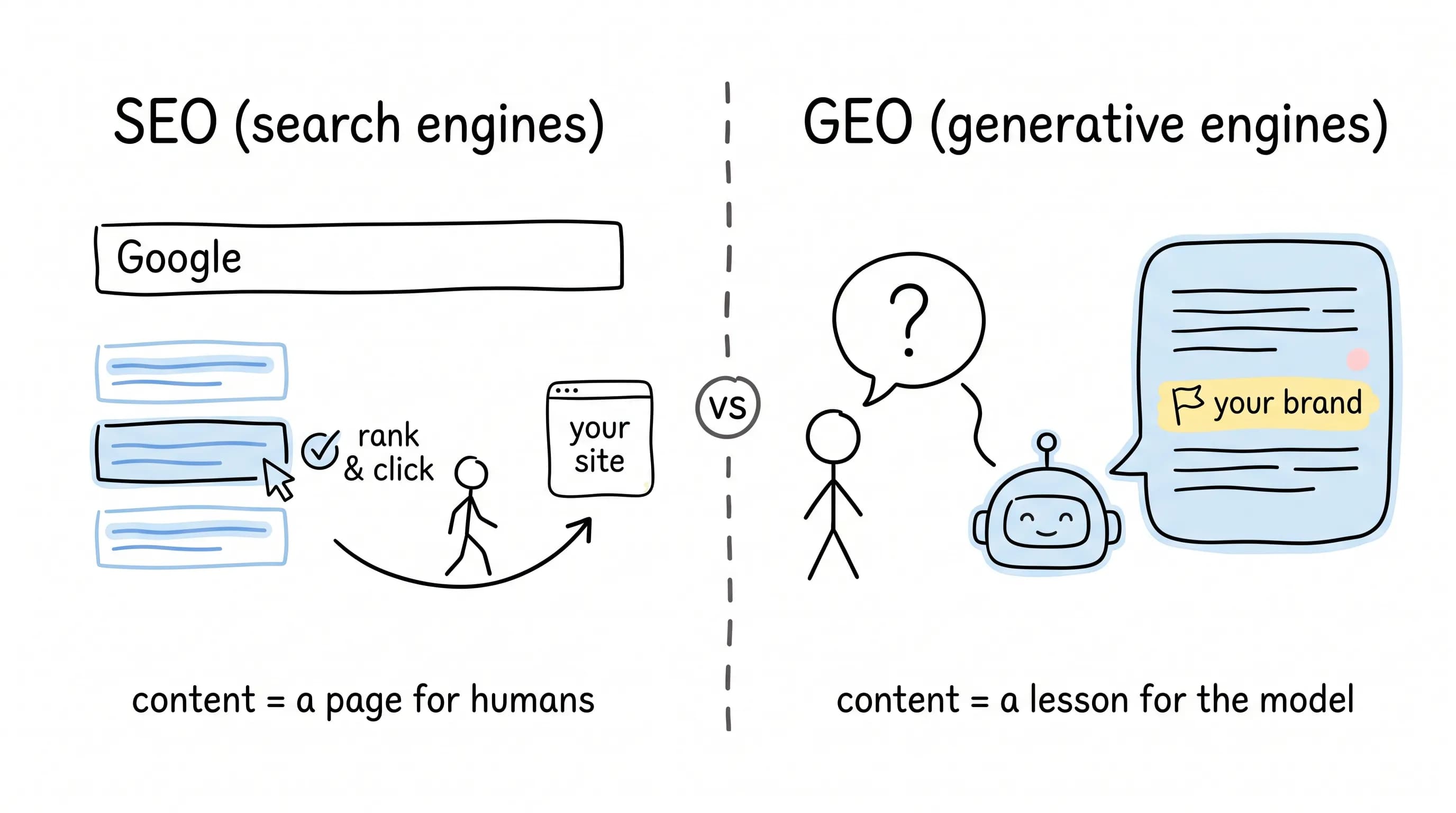
Does AI Know Your Brand? A Look at GEO, the New Craft
An explainer on GEO (Generative Engine Optimization): how AI engines like ChatGPT, Perplexity, and Gemini differ, how GEO goals and metrics diverge from SEO, and which SEO skills still carry over.
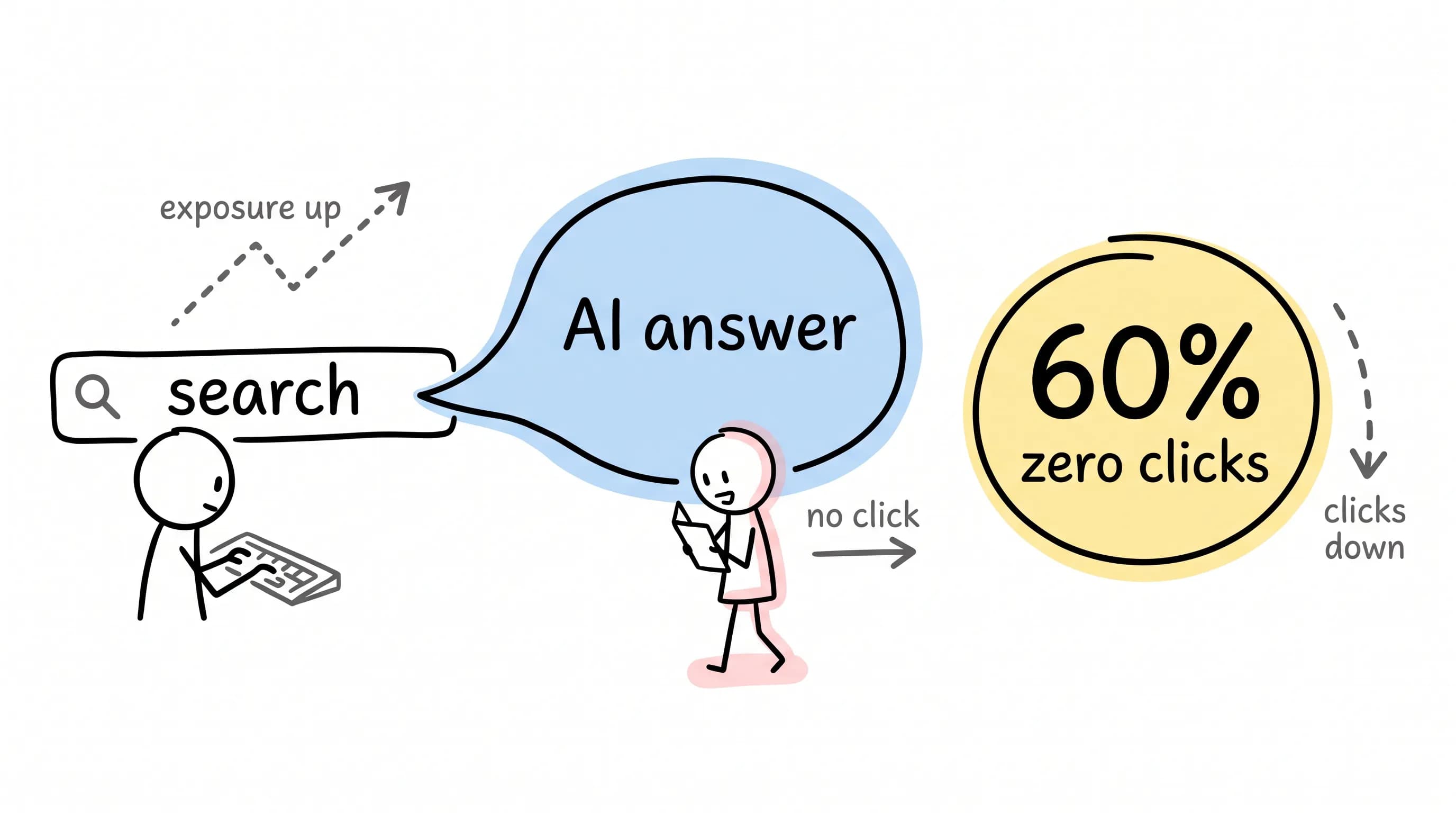
60% of Searches No Longer End in a Click: What Is GEO, and Why Whoever Figures It Out First Wins
An explainer on GEO (Generative Engine Optimization): why many searches now end without a click, how AI decides which brands to cite, and why local businesses and first-party data matter. Covers E-E-A-T, entity clarity, third-party mentions, and attribution challenges as clicks decline.
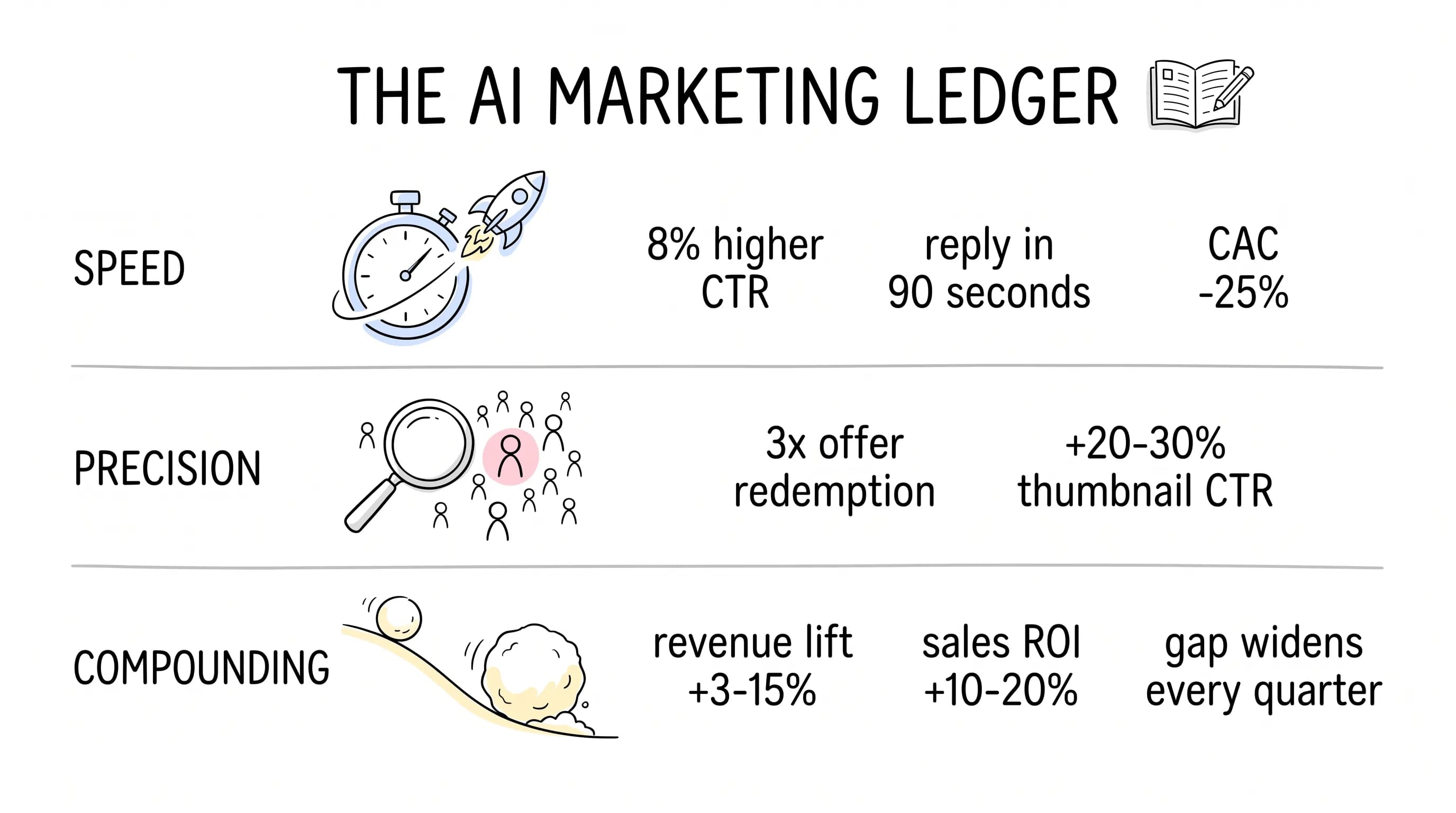
Does AI Marketing Actually Pay Off? Let Me Tell You 10 Stories — Each One Comes with a Ledger
A learn article retells ten AI marketing case studies—from Alibaba's Luban copy tool to JPMorgan Chase's Persado ad-copy tests—each paired with reported metrics, and closes with entry advice on SEO, GEO/AEO, faster lead response, and AI customer service.