
Does AI Marketing Actually Pay Off? Let Me Tell You 10 Stories — Each One Comes with a Ledger
A learn article retells ten AI marketing case studies—from Alibaba's Luban copy tool to JPMorgan Chase's Persado ad-copy tests—each paired with reported metrics, and closes with entry advice on SEO, GEO/AEO, faster lead response, and AI customer service.
A few days ago, a friend of mine who runs a cross-border e-commerce business took me out to dinner and asked me a question: "This AI marketing thing — is it actually useful, or just another round of hype? Don't talk to me about trends. Show me the numbers."
I said, fine — I've got numbers to spare. That night I went back through the case studies on file and picked out ten — some from giants, some from small companies. Every one of them comes with a ledger solid enough to drop on a boardroom table.
Today, I'm walking you through that ledger.
What Counts as a "Real Return"?
Not the "empowerment" you hear at product launches, but the incremental growth that shows up in financial reports.
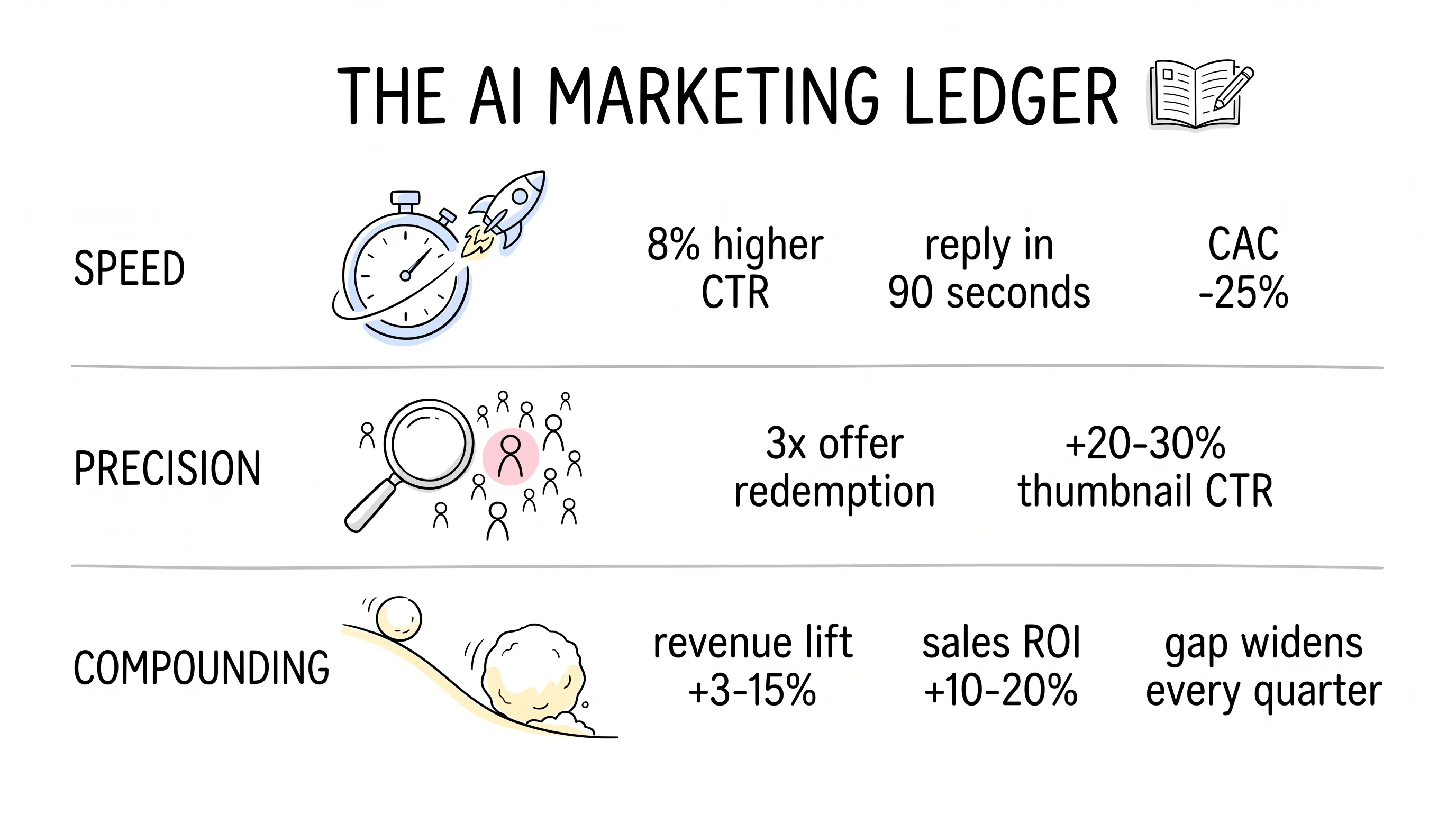
In 2023, McKinsey published a State of AI report with a number in it: companies that truly integrate AI into their marketing function see revenue lift by 3% to 15% on average, and sales ROI improve by 10% to 20%.
These are not small numbers. That's a gap that widens every quarter.
So where do those numbers come from? Averages alone tell you nothing — you have to see what specific people actually did. Let me tell you a few stories.
Ledger One: Speed — How Much Is It Worth Exactly?
Let me start with one that genuinely surprised me.
Alibaba has an AI copywriting tool called Luban. It writes product descriptions for merchants on the platform — 20,000 lines a second. Volume no human team could ever produce, done in the blink of an eye.
Impressive!
But you'd say: writing a lot doesn't mean writing well, right?
Someone actually ran the comparison. In A/B tests, product descriptions written by AI averaged an 8% higher click-through rate than human-written ones. Yes — the AI you assumed "could never sound human" came out ahead on average.
Coca-Cola got into the game even earlier. In 2023, it pulled in OpenAI and Bain to run a campaign called "Create Real Magic," using GPT-4 and DALL-E to let consumers generate brand creative themselves. The public-facing campaign was one layer; the more substantial story was underneath: AI compressed its content production cycle by up to half. For a company running thousands of localized campaigns at the same time, what is half that time worth?
Unilever, meanwhile, pointed AI at programmatic ad bidding. The market changes by the minute: a competitor cuts prices, a news story drags sentiment off course, a platform updates its rules. Humans can't react in time; AI can adjust in real time. The result: customer acquisition cost in key markets dropped 25%. Measured against the scale of its ad spend, that's hundreds of millions of dollars saved a year.
HubSpot's play was at another link in the chain. It built AI lead scoring into its own CRM and first ran it through internal sales: teams that scored leads with AI converted 30% better than teams doing it manually. The logic is plain — reps stop wasting time on contacts who were never going to buy.
At this point you might say: those are all giants. Small companies don't have that volume — is AI still useful for them?
Useful — and small companies actually see results faster. A small B2B services company in Singapore partnered with a platform that provides AI marketing services: AI assisted with writing content while humans kept editorial control. In six months, organic search traffic rose 340%. Even more striking was the response speed. Following up on leads manually used to be slow; once AI took over — WhatsApp, email — every message got a reply within 90 seconds. Conversion of qualified leads rose 58%.
Ninety seconds. Think about how many forms you've filled out yourself, and how long you waited with no one answering.
Ledger Two: Stop Treating "a Crowd" as "One Person"
Behind Sephora's app and website runs a personalization engine, reading your purchase history, skin-tone data, and browsing behavior. Users who tried its AI virtual try-on tool (Virtual Artist) converted at an 11% higher rate than those who hadn't. Within one fiscal year, personalization brought in more than $100 million in incremental revenue.
$100 million, earned by "understanding you just a little better."
Starbucks went even further. It has an internal AI platform called Deep Brew that pushes offers to 30 million active members. What does it look at? Purchase history, location, time of day — even the weather that day. What gets pushed on a rainy day and what gets pushed at eight in the morning are two different things. After launch, offer redemption rates hit 3 times what the old rule-based segmentation achieved.
Three times. It turns out members were never unwilling to engage — you were just pushing the wrong things.
Spotify's Wrapped, which floods everyone's feed every year, is only the tip of the iceberg above water. Below the waterline, it writes separate emails and sends separate notifications to every single user. AI-generated personalized emails get open rates 2 to 3 times those of mass sends.
And then there's Netflix. The company itself has disclosed a number: its recommendation system as a whole preserves about $1 billion a year in retention value. Without it, churn would be markedly higher, and Netflix would have to spend far more buying content to make up for it.
The easiest thing to overlook is that a big chunk of Netflix's AI isn't in the product at all — it's in marketing. Take thumbnails. Different people see different covers for the same show, and the one picked by computer vision can click through 20% to 30% better.
Same show. Change one image. 20% to 30%.
Treating ten thousand people as one type of person loses to treating each person as an individual. Every case that did personalization well delivered step-change jumps — not gains squeezed out inch by inch.
Ledger Three: Even a Bank Was Convinced
There's one story I find interesting every time I tell it.
JPMorgan Chase ran a remarkably rigorous experiment: it had AI — powered by Persado's natural-language engine — write ad copy head-to-head against its own senior copywriters, in controlled tests.
The result: some of the AI versions more than doubled the click-through rate of the human versions.
Stunning. This is a bank we're talking about. You know how strict compliance is in finance — writing copy there is dancing in chains. Even with the chains on, it won — and Chase went ahead and signed a five-year enterprise agreement with Persado.
Even the most conservative industry has already validated it. What is every other industry still hesitating about?
Three Ledgers In — What's the Common Thread?
Look back at the stories I've told you, and three things stand out.
First, speed. 20,000 lines of copy a second, leads answered in 90 seconds, bids adjusted in real time. What AI eliminates is the bottleneck at the execution layer; judgment at the strategy layer still belongs to humans.
Second, precision. Treat each person as an individual, and conversion and retention deliver jumps, not slow climbs.
Third — and this is what I most want to say: compounding. The more the models are used, the more accurate they get; the content library snowballs; the response systems get sharper. Companies that start today widen the gap with latecomers every quarter. Once that gap has opened, chasing it is hard.
That said, don't rush to go all in. Not one of these companies tossed AI at the problem and coasted to a win. Behind Sephora are sales associates who trained the recommendation logic; behind Chase, senior marketers who evaluate what the AI produces; behind Starbucks, strategy teams who designed the loyalty mechanics.
Put simply: AI amplifies human expertise — it doesn't replace it.
The biggest budgets won't necessarily win. The ones who moved first already have.
Want In? Where Do You Plant Your Feet First?
If you share the question my friend had at the start, my advice is: don't get greedy. Plant your feet in three places — each one compounds.
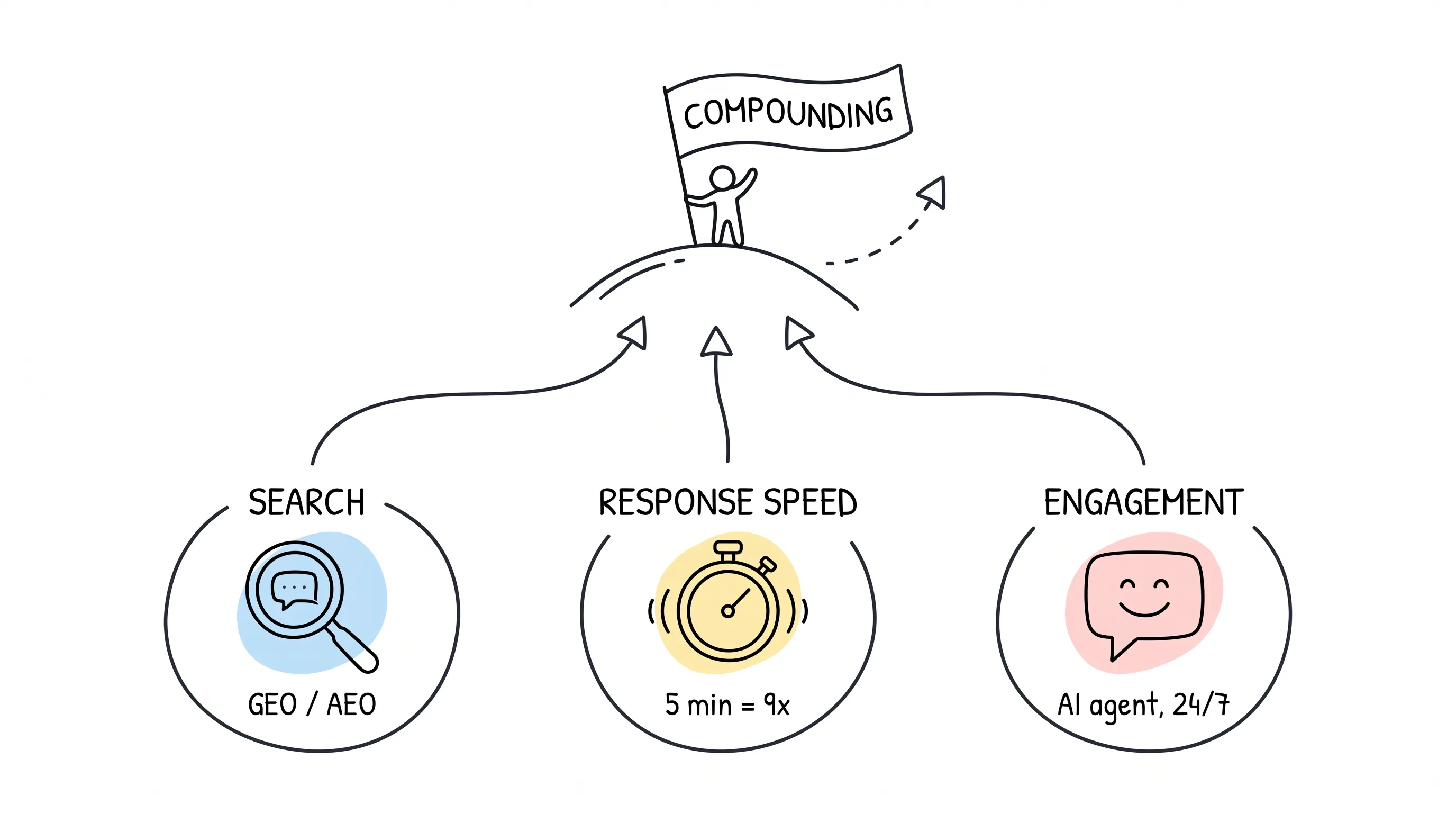
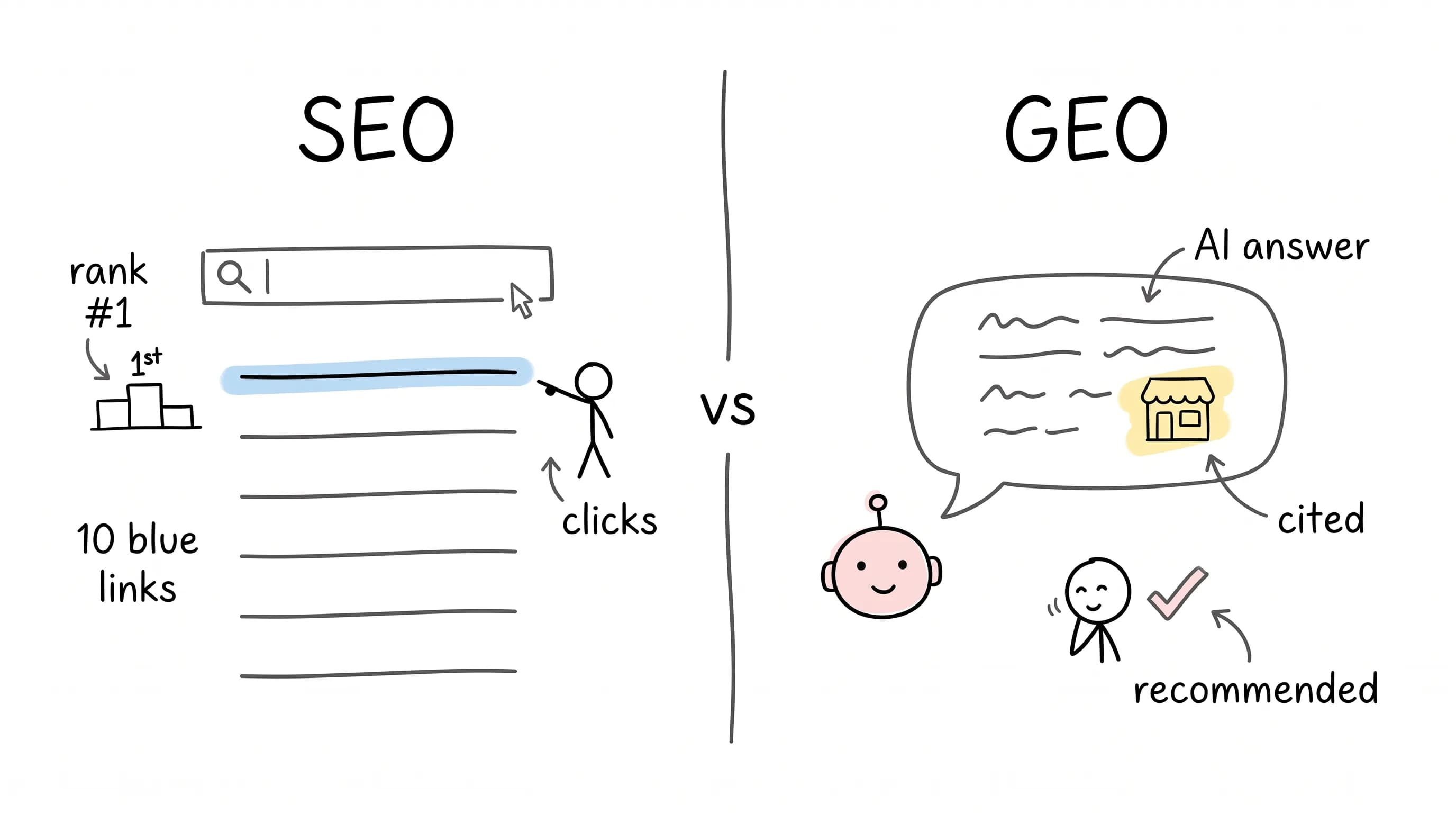
First, search. Use AI to steadily produce content that can rank — don't bet on one wave of viral hits carrying you forever. And people no longer only search on Google; they ask ChatGPT and Perplexity too. Getting these AI engines to answer accurately and cite you — insiders call this GEO and AEO (Generative Engine Optimization / Answer Engine Optimization). In plain words: claim a spot inside AI's answers. That spot is only going to get more valuable.
Next, response speed. That McKinsey report has another number: a lead followed up within 5 minutes is 9 times more likely to convert than one followed up after an hour. Nine times. Meanwhile, at most companies, leads sit in the inbox overnight. Put AI on round-the-clock watch across WhatsApp, email, and website chat, and that gap is plugged.
Last, engagement. FAQ-style bots can retire. An AI customer-service agent that remembers conversations, makes recommendations, and knows when to hand off to a human replicates the retention effects Starbucks and Spotify built — at a small company's cost.
Back to That Dinner
Halfway through the meal, that friend asked me: "So if I start now, am I still in time?"
I said: the ledgers are all up there. In these ten stories, not one company waited until it could see clearly before moving.
Here's hoping you're the next one to slam a ledger down on the table.
Continue reading
Related articles
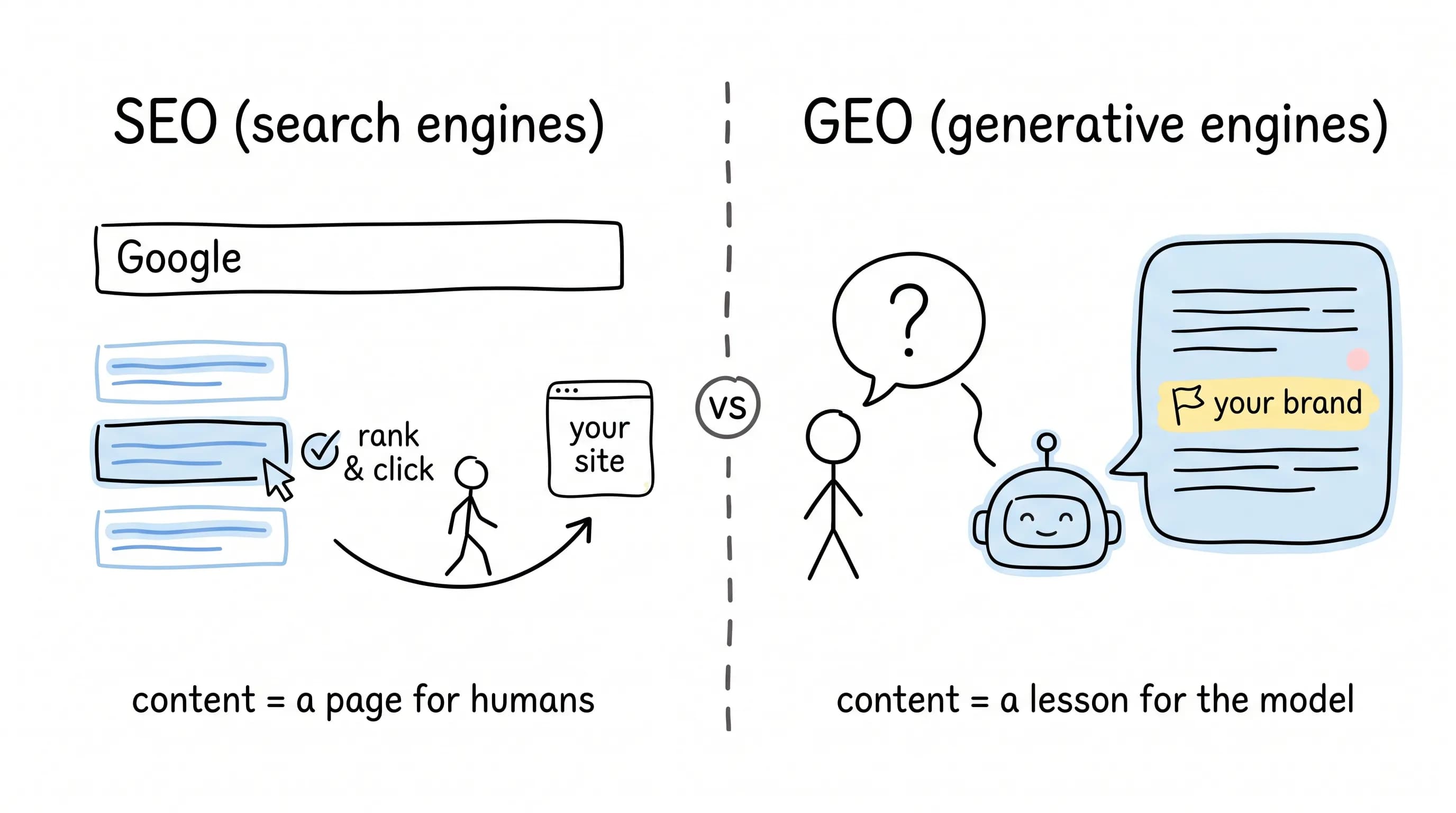
Does AI Know Your Brand? A Look at GEO, the New Craft
An explainer on GEO (Generative Engine Optimization): how AI engines like ChatGPT, Perplexity, and Gemini differ, how GEO goals and metrics diverge from SEO, and which SEO skills still carry over.
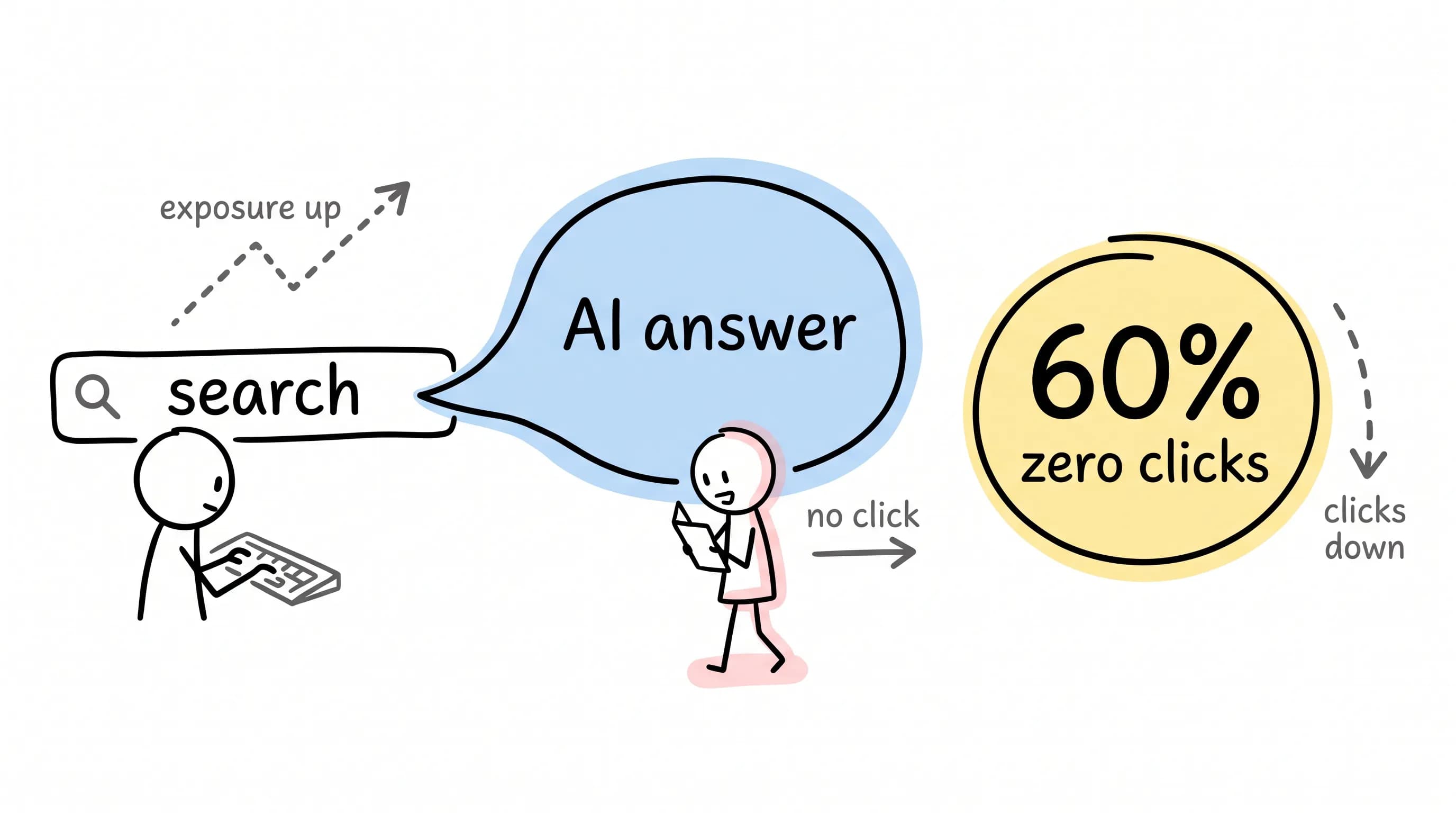
60% of Searches No Longer End in a Click: What Is GEO, and Why Whoever Figures It Out First Wins
An explainer on GEO (Generative Engine Optimization): why many searches now end without a click, how AI decides which brands to cite, and why local businesses and first-party data matter. Covers E-E-A-T, entity clarity, third-party mentions, and attribution challenges as clicks decline.
Your Next Customer Might Not Be Human
This learn article explains GEO (Generative Engine Optimization): how brands get cited and recommended in AI answers instead of competing for search rankings, covering technical access, Schema, content consistency, and long-lasting model impressions.