
60% of Searches No Longer End in a Click: What Is GEO, and Why Whoever Figures It Out First Wins
An explainer on GEO (Generative Engine Optimization): why many searches now end without a click, how AI decides which brands to cite, and why local businesses and first-party data matter. Covers E-E-A-T, entity clarity, third-party mentions, and attribution challenges as clicks decline.
A few days ago, I had dinner with an old friend who runs a car dealership.
Halfway through the meal, he started sighing. He said: "It's strange. We never cut the website budget, we keep publishing content, our rankings haven't dropped — but traffic keeps getting thinner every year. And here's the weirdest part: business is fine. Walk-ins, calls asking for quotes — not one fewer."
I heard him out, then asked him one question in return: "Have you ever counted how many people search for something these days and never click a single link?"
He froze.
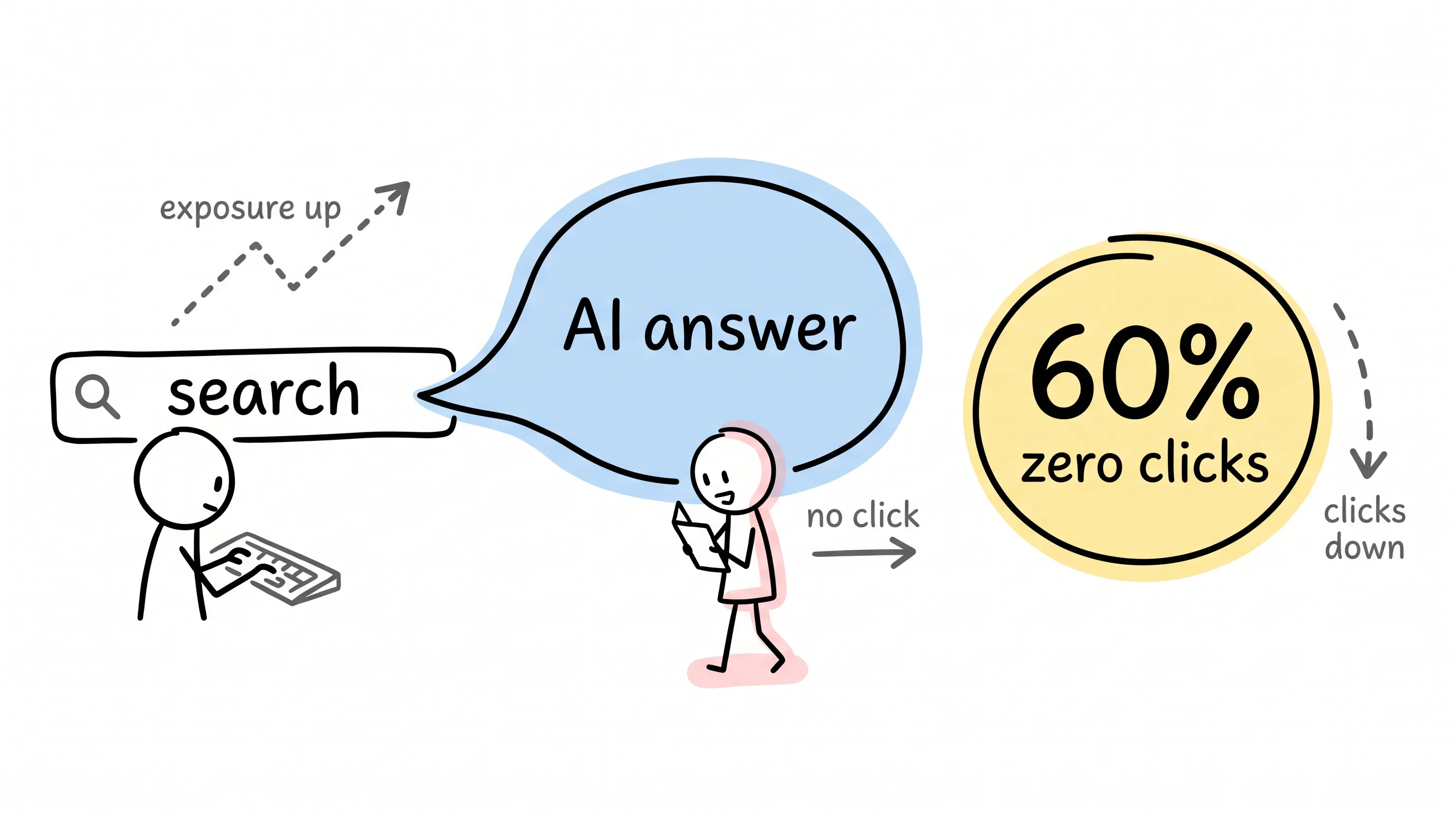
Multiple studies point to the same fact: today, nearly 60% of Google searches end in "zero clicks." What does that mean? Users searched, looked, and left. The answer appears right on the search page — and more and more often, that answer is written by AI, not supplied by any website.
Dig one level deeper: ChatGPT serves some 400 million users every week and handles an estimated 37.5 million search-like queries per day. In 2025, Gartner predicted that 79% of consumers would be using AI-enhanced search within a year — and at the time, 70% already said they trusted results generated by AI.
What my friend ran into was not a problem unique to his store.
When AI starts making decisions on users' behalf, a brand's survival shifts from "being found" to "being cited."
What Is the "Great Decoupling"?
Let's start with a counterintuitive phenomenon.
The industry calls it the "Great Decoupling": a website's exposure in search results keeps rising, while its clicks keep falling. Quite a few studies have documented that search results with AI summaries show a clear drop in organic click-through rates.
Think about it — doesn't it look like a shopping mall? The foot-traffic counter shows more and more people passing by, yet fewer and fewer push the door and walk in. By the old logic, this mall is finished.
But here's the interesting part: sales haven't dropped, and some brands have even grown.
Take NerdWallet, an American personal-finance platform. In 2024, its traditional website traffic fell 20%, yet revenue rose 35%. Traffic down, revenue up — unthinkable in the past.
Why? Because users had already finished their homework with AI. The AI read dozens of websites, synthesized one answer, and happened to mention in passing, "NerdWallet's take is..." The user came straight to it, trust in hand.
Clicks are turning into a lagging metric; whether AI mentions you is the new shelf.
So What Does AI Actually Value?
What is GEO? Generative Engine Optimization.
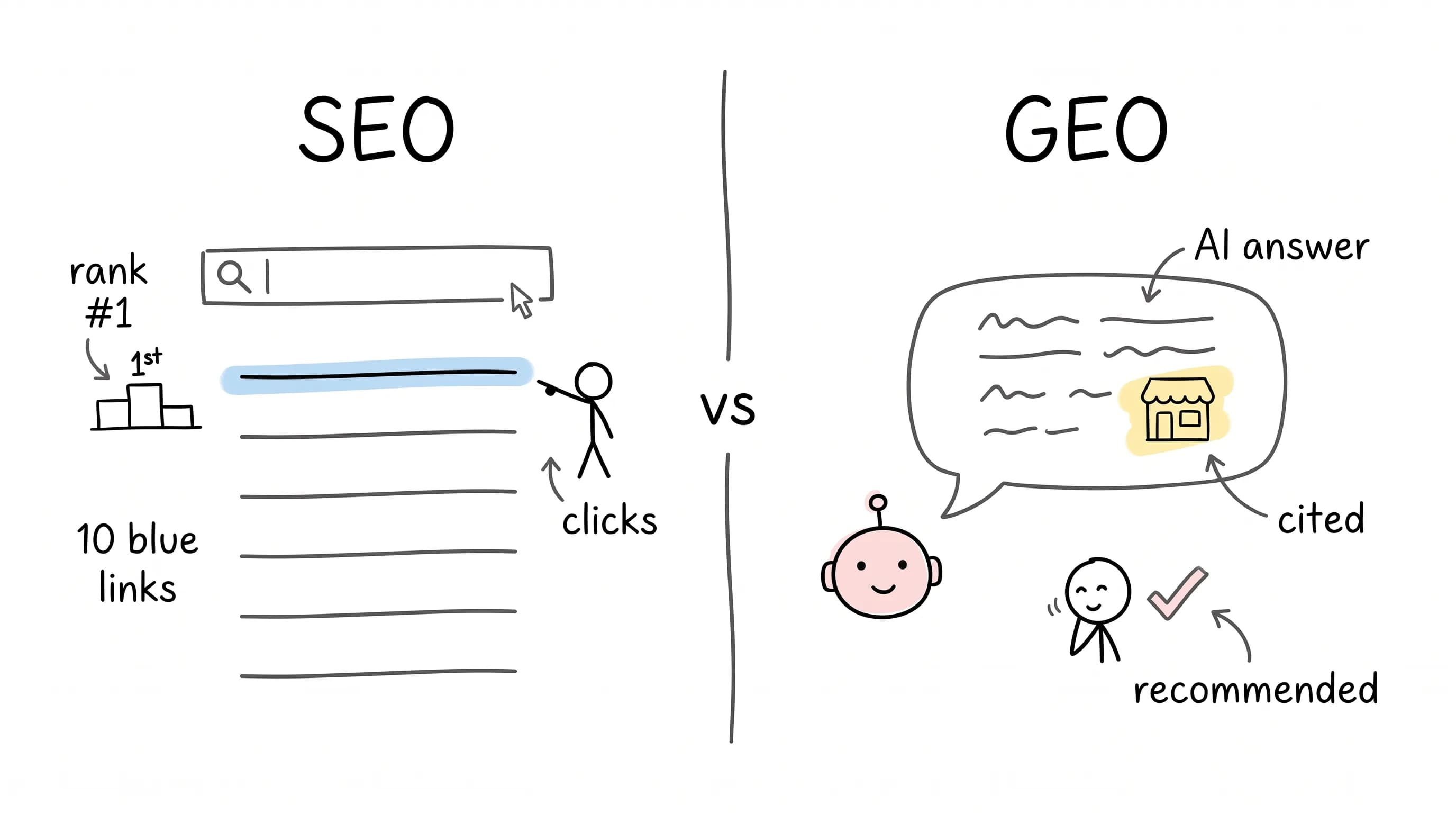
Put simply: SEO asks "how do I rank high on the search results page," while GEO asks "how do I get AI to want to cite me and recommend me when it answers questions."
The traditional SEO battle is fought over keyword rankings, click-through rates, and organic traffic. GEO competes for something different: the number of citations, the quality of mentions, and the weight your brand carries as a clearly defined "entity."
One study based on the GEO framework estimated that content applying these strategies can see its visibility in generative answers improve by as much as 40%. That's a huge lift.
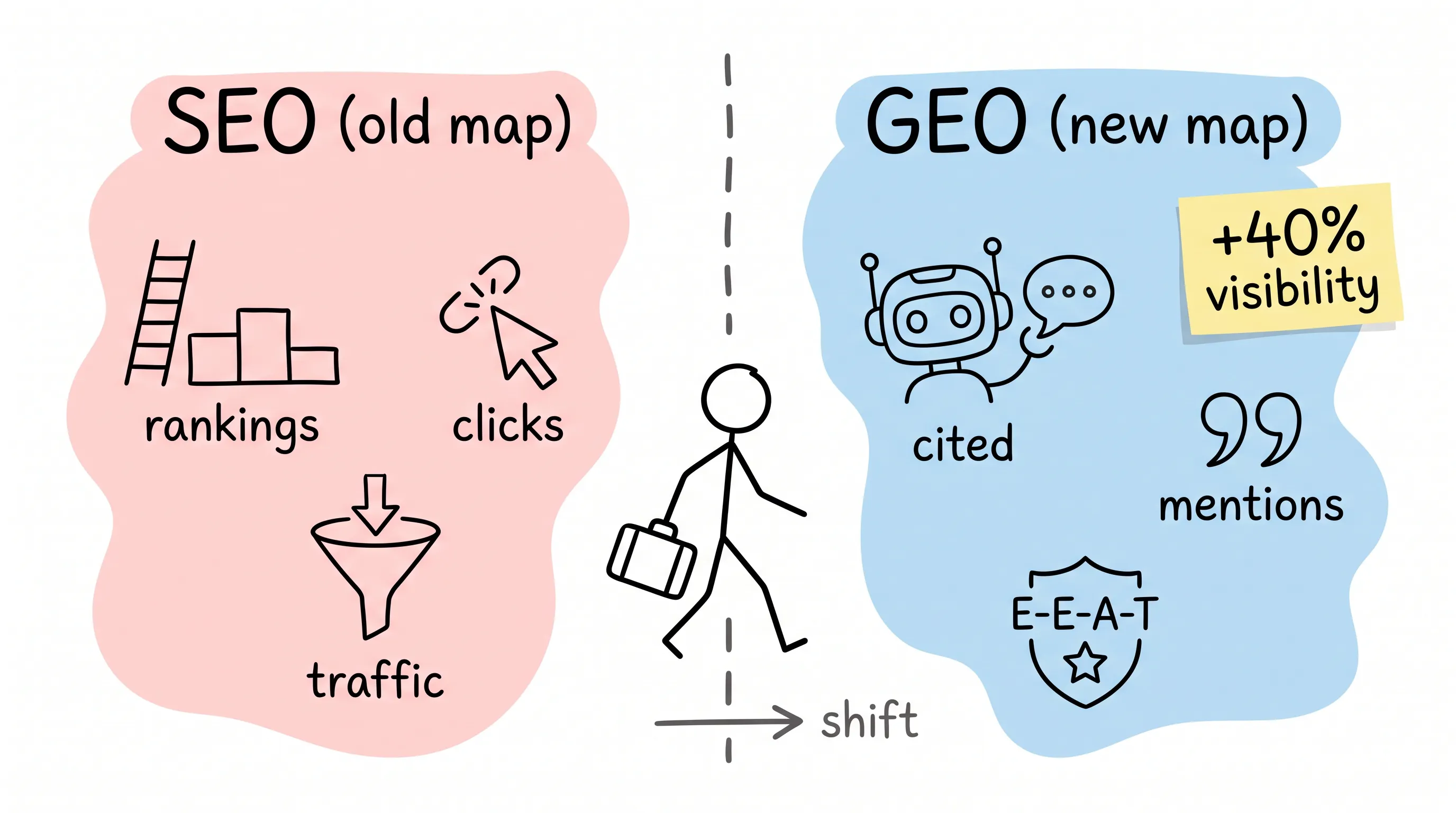
So when AI judges "whom to trust," what does it look at? Its criteria differ somewhat from a search engine's:
- Whether you're genuinely professional — whether you have real experience, expertise, authoritativeness, and trustworthiness, the much-cited E-E-A-T (Experience, Expertise, Authoritativeness, and Trustworthiness);
- Whether your content is easy to "cite" — clear structure, accurate facts, Q&A-style paragraphs it can grab with pinpoint accuracy;
- Whether your brand is a clear entity — whether it knows who you are, what you sell, and what others say about you;
- Whether any third party vouches for you — whether authoritative sources mention you.
Pay attention to that last one. Large-scale research has found a systematic bias in AI platforms: they favor third parties over a brand's own self-promotion.
And different AIs have different tastes. ChatGPT leans on reference sources like Wikipedia; Perplexity is especially fond of user-generated content — Reddit now accounts for roughly 40% of AI citations; Microsoft's Copilot prefers business media like Forbes.
What does this mean? You have to get Wikipedia, Reddit, and industry media willing to talk about you. Making your own website pretty is far from enough.
Here's a number I think should keep a lot of people up at night: roughly 47% of brands still have no decent GEO strategy. Translated: nearly half your competitors are still fighting with an old map. The first-mover advantage is sitting right there in plain sight.
Local Businesses Actually Have the Edge?
At this point you might be thinking: for small merchants and local businesses without big media resources, is the game lost?
Quite the opposite. This was the most surprising thing I took away from this round of change.
Local search, it turns out, holds up well. Why?
Because no matter how smart AI is, it can't "show up at the store" for you. When you search "which nearby repair shop can do maintenance right now," what you want isn't a paragraph — it's your car parked on the lift half an hour later. That's exactly why results with AI summaries appear rarely in local search: these searches lead to real-world actions — visiting the store, making a call, booking an appointment — and AI can't substitute for any of them.
The data backs this up: 76% of people who search locally actually make a trip within a day; visits driven by local search account for roughly a quarter of website traffic; 28% of local searches end in a purchase.
So the homework for brick-and-mortar businesses boils down to the unglamorous job of stating clearly "I exist, here's where I am, here's what I have in stock right now":
- Keep name, address, and phone number consistent across every platform;
- Set up structured markup like LocalBusiness so AI recognizes who you are at a glance;
- Write content that genuinely answers the neighbors' questions;
- Take reviews seriously — when someone leaves one, reply promptly;
- And for those selling cars, one more thing matters most: real-time inventory data must be hooked up, so what shows up in search results is the car that's in the store today at its listed price, not stale information scraped three months ago.
None of it is sexy. But every item answers the same question: does AI dare recommend you to someone else?
Why Has First-Party Data Become the Foundation?
Now let's go a layer deeper: why is everyone in the AI search era talking about "first-party data"?
First, two things to set the scene.
One is privacy. Regulations like GDPR and CCPA, plus browsers' squeeze on third-party cookies (Chrome has slowed its timeline, but the direction hasn't changed), have made the path of "buying other people's data" narrower and narrower.
The other is AI's appetite. AI search rewards precision, relevance, and authority — and all three are built on "you truly know your customers."
The situation becomes a paradox: usable signals are shrinking while the required precision keeps climbing. Only one way out remains: data you accumulate yourself. The customers in your CRM, the sales and service records in your DMS (Dealer Management System), real-time inventory — twist these together, then deploy them safely across channels. That is a first-party data strategy.
Within this space, Demand Local's approach is worth a mention. It's a marketing company that specializes in serving car dealerships and multi-location businesses, and it has a platform called LinkOne Data. What it does, stripped down to one sentence: weave the dealer's CRM, DMS, and inventory data into a single strand, and — behind encryption and secure APIs — activate it across channels like Meta, Google, Amazon, and The Trade Desk, spanning search, social, CTV (Connected TV), and programmatic digital out-of-home — all at once.
Think about it: while other dealers are still guessing, you can already turn "this car has been sitting in the store for 40 days" into a real-time advertising signal you push out. That's the gap.
Two Sets of Numbers
Two case studies — nothing is more intuitive than running the math.
The first. A mid-sized dealer group adopted Demand Local's Facebook and Google vehicle ad solutions: the system automatically generated carousel ads and Vehicle Listing Ads from the real-time inventory feed, then combined them with search ads. The result: cost per lead dropped 43%.
Why the drop? Because the ads displayed the car that was genuinely in the store at that moment at its listed price, pushed to high-intent buyers actively researching that model. Precision is savings.
The second. Another store was sitting on 12 electric vehicles that had lingered a long time, with the manufacturer's incentives about to expire — if they didn't sell soon, they'd be dead weight. Demand Local put together a combination for it: CTV and OTT (Over-The-Top streaming) ads for awareness, with dynamic display ads refreshing creative in real time by days-on-lot and price rules. Within a few weeks, all 12 were cleared.
What these two deals had in common wasn't brilliant creative — it was fat data pipes.
Beyond the Screen: Another Half of the Battlefield
There's one more judgment that's easy to overlook: AI search stopped happening only in the search box long ago.
Voice assistants, the big TV screen, the chat window on your phone, the outdoor screen down the street — wherever users are, that's where brands get discovered. And when AI decides whom to recommend, it factors in the signals from all of these touchpoints.
That's why first-party data must be activatable across screens. On CTV, you can run video ads targeted by model or even by VIN (Vehicle Identification Number); on digital outdoor, you can use geofencing to push ads to the few blocks around the dealership — the people who searched for you online will see you again on the big screen on their way home from work.
Searched, seen, walked in. This closed loop used to take several companies cooperating to piece together; now one data pipeline can connect it.
The Two Toughest Hurdles
Of course, this isn't as smooth as you'd hope. Two hurdles that almost every merchant will hit.
The first hurdle: data silos. CRM is CRM, DMS is DMS, and ad platforms are ad platforms — none of them talk to each other. Yet GEO demands precisely one complete understanding of the customer. The fix is secure APIs plus encryption, letting data flow under compliance.
The second hurdle: attribution. The "Great Decoupling" leaves its most painful scar here: with fewer clicks, the old "last-click" attribution model goes blind. A user might be sold by AI, then walk into the store two days later — without a single click in between.
So you have to keep the books a different way: sales retrospectives, cost per lead, page views on vehicle detail pages — piece these together, and only then can you see whether AI actually brought customers. What Demand Local equips dealers with is exactly such an attribution report, matching the money spent to the cars sold.
For the journeys you can't see, keep even more careful accounts.
Two Steps Further Ahead
One step is multimodality. AI no longer reads just text — images, video, voice, location, real-time context, it will take all of it in. Your content can no longer be text-only: there must be video, images must be standardized, audio must have descriptions — every sense must be legible to AI.
The other step is more fundamental: autonomous agents. Today's AI is "answering questions"; the next generation will be "getting things done for people" — comparing prices and placing orders on its own. What will it need that day? Structured product catalogs, real-time inventory and pricing, signals it can trust, and a smooth transaction loop.
Notice anything? All of these answers point in the same direction:
Whose data is more structured, more real-time, more trustworthy — that's who gets picked by AI. No matter what AI grows into tomorrow.
Back to That Dinner
After that dinner, my advice to my friend came down to three sentences:
- First, stop staring at rankings — go see, when AI talks about your industry, whether it mentions you and how it describes you;
- Second, state your "facts of existence" — address, inventory, reviews, structured data — in a way AI can read;
- Third, treat first-party data as an asset to cultivate, not a report to look at.
He later sent me a message: his team turned the inventory that had sat in the store for more than 40 days into a real-time advertising data source, and that very week sold a car that had been stuck for two months.
I was genuinely happy for him.
In the end, this change is not a traffic crisis — it's a rewrite of the rules of "being seen." Under the old rules, you fought for rankings; under the new rules, you accumulate trust — the kind of trust AI is willing to cite.
47% of brands haven't started yet. Start one day earlier, and you bank one more day of head start.
My wish for you: may you never find yourself standing at the foot of the traffic cliff before it occurs to you to repair the road.
Continue reading
Related articles
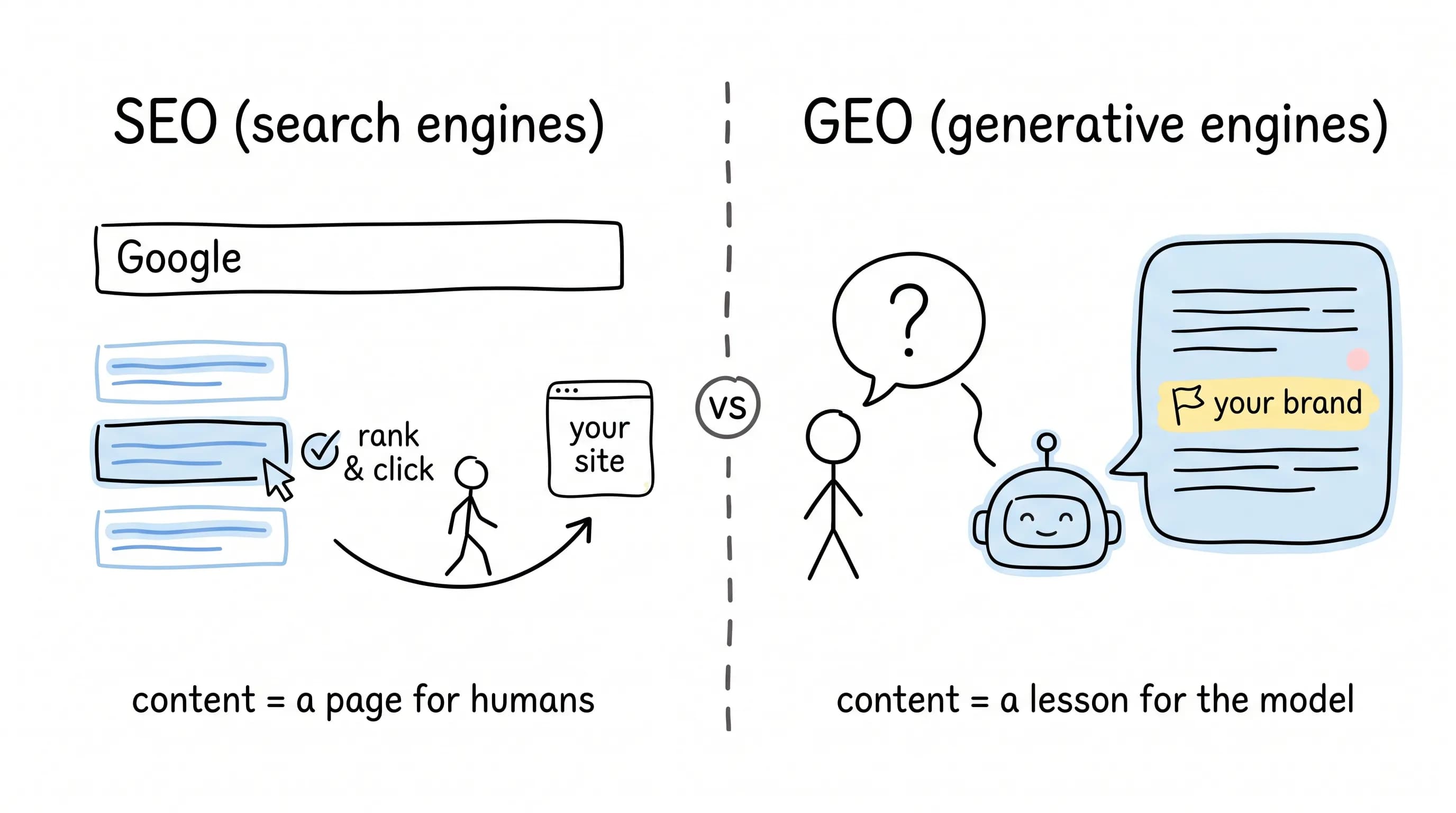
Does AI Know Your Brand? A Look at GEO, the New Craft
An explainer on GEO (Generative Engine Optimization): how AI engines like ChatGPT, Perplexity, and Gemini differ, how GEO goals and metrics diverge from SEO, and which SEO skills still carry over.
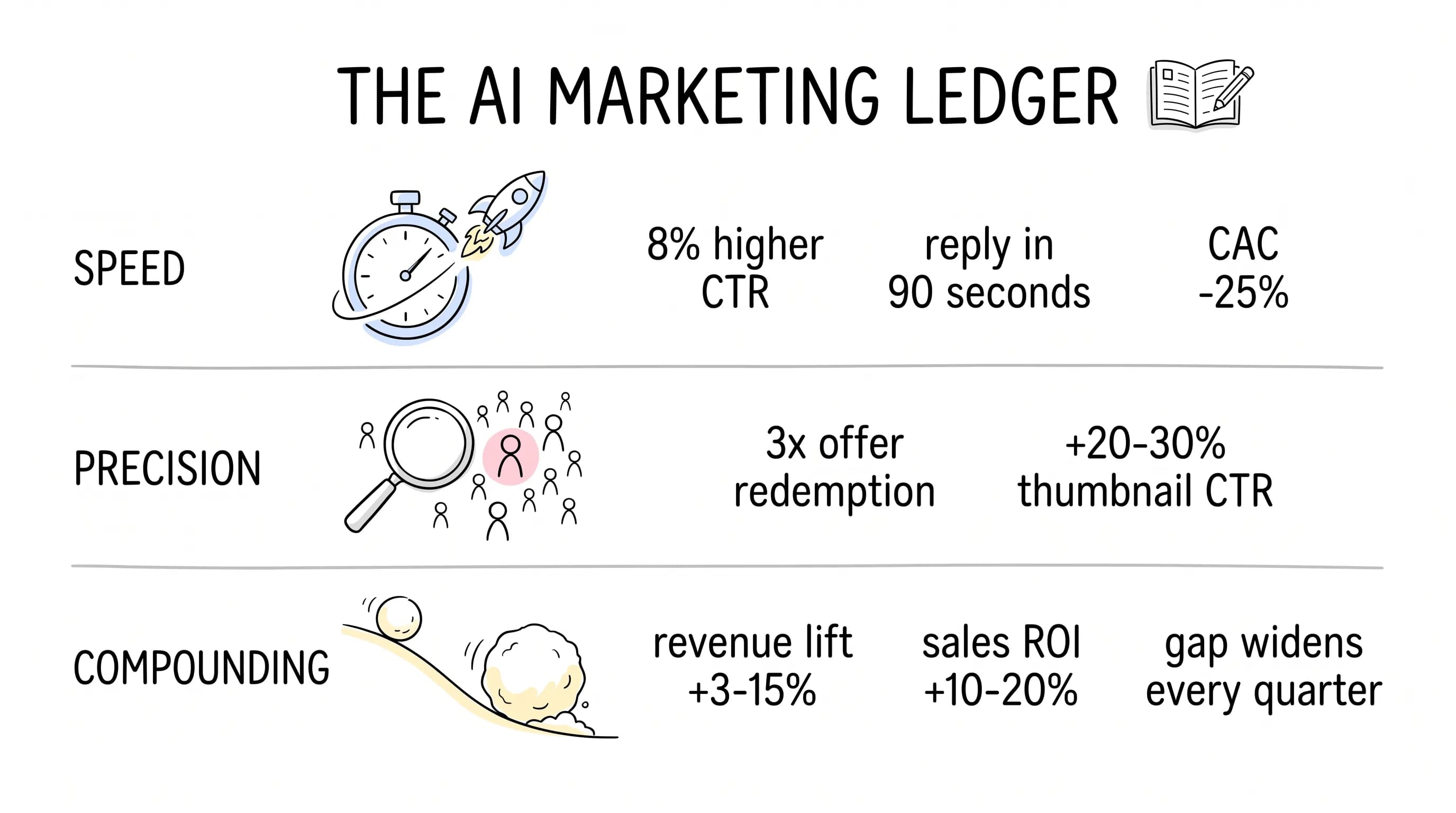
Does AI Marketing Actually Pay Off? Let Me Tell You 10 Stories — Each One Comes with a Ledger
A learn article retells ten AI marketing case studies—from Alibaba's Luban copy tool to JPMorgan Chase's Persado ad-copy tests—each paired with reported metrics, and closes with entry advice on SEO, GEO/AEO, faster lead response, and AI customer service.
Your Next Customer Might Not Be Human
This learn article explains GEO (Generative Engine Optimization): how brands get cited and recommended in AI answers instead of competing for search rankings, covering technical access, Schema, content consistency, and long-lasting model impressions.