
89% of Retailers Are Already Using AI. The Playbook for E-Commerce Has Changed
A learn article on AI in e-commerce: adoption context, use cases from recommendations, search, dynamic pricing, customer service, inventory, and fraud control, plus B2B applications, generative AI content, tool examples, pitfalls, and a six-step adoption path.
Think about this scene.
It's 2 a.m. The store is empty; customer service signed off hours ago. And yet, somewhere in the backend, the order notification goes off on its own.
An AI support agent has just talked a customer who'd been hesitating all evening from "just browsing" all the way to checkout.
This isn't imagination, and it isn't the future. This is the daily reality of many online stores today.
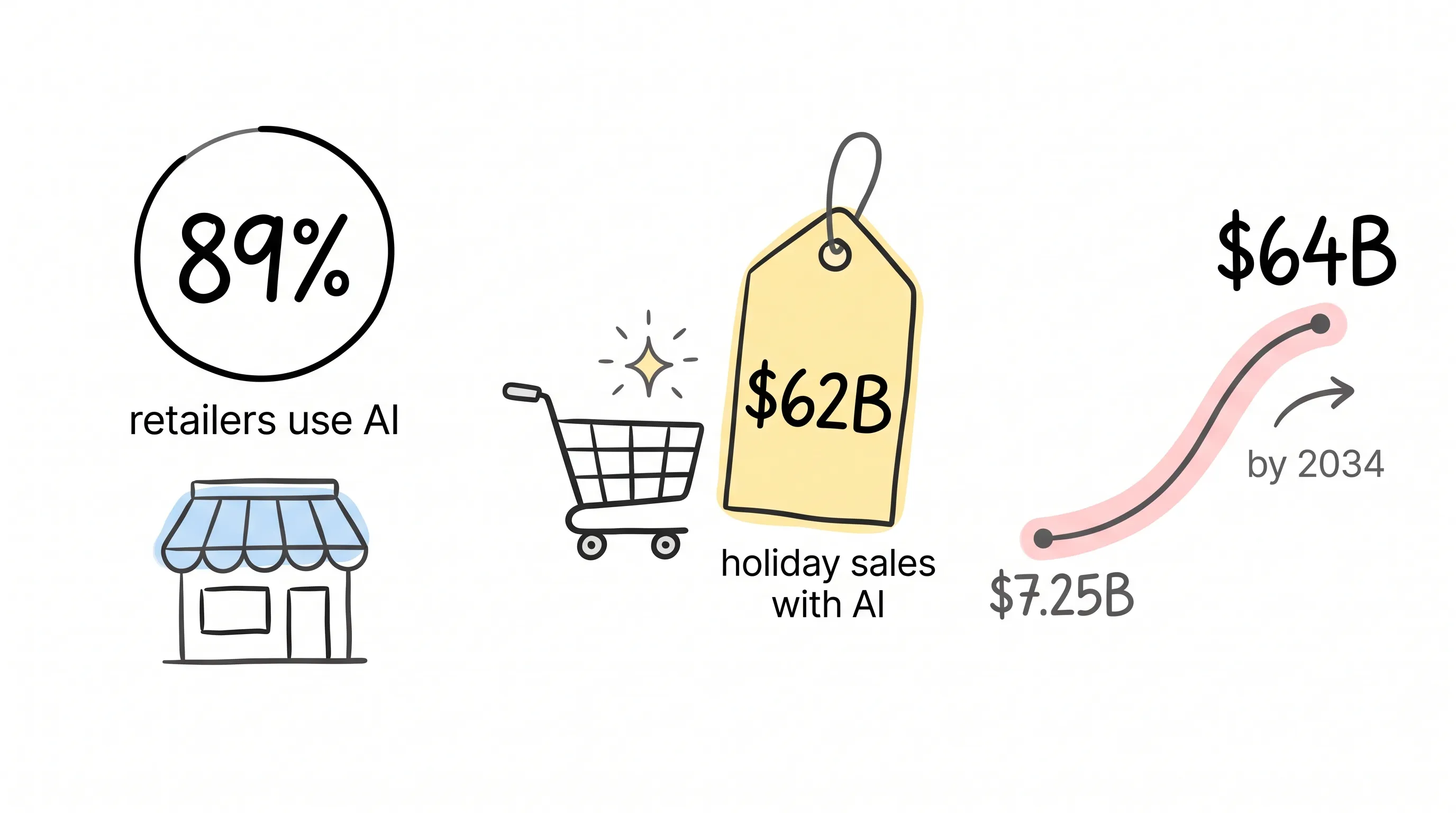
And the scale of this shift is far bigger than most people realize. 89% of retailers are already using AI in production, or at least running pilots. In the holiday shopping season just past, AI had a hand in more than $62 billion in U.S. sales. The global AI-in-e-commerce market was $7.25 billion in 2024 and is projected to top $64 billion by 2034 — a compound annual growth rate above 24%.
A lot of people still call AI e-commerce a "trend."
Wrong. It's the present tense.
What Is AI E-Commerce?
Don't let the term intimidate you. Simply put, it's applying machine learning, natural language processing, and computer vision to every part of running an online store: customer acquisition, recommendations, pricing, customer service, inventory, fraud control.
You encounter it every day, whether you know it or not.
That recommendation engine? AI. The fraud system that flags a suspicious order before it can even go through? AI. The pricing engine that watches the market and adjusts prices on its own? AI. The support bot that resolves most inquiries without a human? AI. Snap a photo and it finds you the same item — that's visual search, also AI.
So how did e-commerce run before?
On rules and on people. What goes on the homepage: a human decides. What email goes out after an abandoned cart: a human set it up. How deep the clearance discount goes: a human does the math.
What AI does is replace that rigid rulebook with living systems that learn on their own and get smarter the more they're used.
This isn't a patch job. It's a new engine.
Why Is Doing Nothing No Longer an Option?
Some people figure AI is a money-burning toy for big companies, and small sellers should just keep sharpening the fundamentals.
That assumption is getting more expensive by the day.
Start with consumers. A 2026 survey found 72% of consumers want an AI shopping assistant helping them out when they shop online; among people under 45, that figure tops 80%. They want instant answers and recommendations that actually fit. If you can't deliver that and your competitor can, your customers become their customers. It has little to do with how good your product is or how attractive your pricing.
Now look at the P&L. Companies already using AI are averaging revenue growth of 10% to 12%. The leaders are more extreme still: over a three-year period, their revenue grew 1.5 times faster than non-adopters, and shareholder returns were 1.6 times higher.
This isn't a gap of a couple of percentage points. It's a structural gap.
Finally, the barrier to entry. A few years ago, an e-commerce AI solution started at seven figures. Today, entry-level tools for small merchants cost less than $50 a month.
Money stopped being the obstacle a long time ago. What's in the way is not knowing where to start.
What Can AI Actually Do for You?
Let's start with the most familiar.
What is personalized recommendation? The machine takes a user's browsing, cart, and purchase history, tears it apart, and figures out what this person is most likely to buy next. At Amazon, roughly 35% of total revenue comes from the recommendation engine. Good grief — more than a third. Done well, personalization can lift conversion rates by as much as 23%. And it's not just product pages — email, homepage, search results, cross-sells at checkout, all of it counts.
What is intelligent search? Keyword search has a built-in flaw: users have to know what they want and be able to describe it. "Shoes I can stand in all day" — no brand name in that sentence, and probably nothing matching the product titles either, so keyword search mostly can't catch it. Natural language search understands how people actually talk. For browse-driven categories like apparel and home goods, visual search is even more direct: snap a photo, find the same item, and add-to-cart rates climb noticeably.
What is dynamic pricing? The pricing engine watches competitors' prices, your own inventory, and real-time demand, and adjusts prices automatically. Top retailers reprice every 10 minutes. McKinsey research says AI-driven pricing optimization can lift EBITDA by 2 to 5 percentage points. And note — this is not discounting without a floor. When demand is hot, it may even recommend you raise prices; when inventory is piling up, it finds the prices that should come down.
Customer service is where the change is most visible. Today's AI support is nothing like the "press 1 for a human" phone tree. It understands awkwardly phrased questions, looks up orders, processes returns, issues discount codes, and can talk a customer all the way to placing an order. Among brands using conversational AI, 96% deploy it for customer service, and the cost per call has dropped nearly in half. On Black Friday 2024, retailers using AI customer service saw conversion rates 15% higher than traditional channels. On the service team's side, generative AI copilots let agents resolve 14% more tickets per hour, with average handle time down 9%.
What about inventory? Overstock eats margin; stockouts destroy trust. AI forecasting models cut demand-forecast error by 20% to 50%. How? Seasonal patterns, promotion calendars, supplier lead times — even weather and macroeconomic data — all go into the math. For a high-volume business, holding a little less stock and suffering one fewer stockout goes straight to cash flow and gross margin.
Fraud control is where one system does the work of ten thousand people. Before a transaction completes, AI runs thousands of signals in milliseconds: device fingerprint, behavior patterns, whether the shipping address looks off, whether orders are coming in abnormally fast. It catches scammers rule-based systems miss, and it waives through good customers rule-based systems wrongly flag.
Marketing and cart-abandonment recovery went to the machines a while ago too. 67% of retailers already use AI for marketing and advertising — the machine decides who to target, what to say, which channel, and what time to send. Customers about to churn get identified early and win-back triggers fire automatically. As for abandoned carts: roughly 70% of shopping carts never reach checkout. AI watches what a user does right before leaving, and at the moment they're about to walk, serves up a nudge, a coupon, or free shipping.
That's money that was about to walk out the door — picked back up.
Run the Numbers Together
Each use case looks good on its own; stacked up, it's a little terrifying.
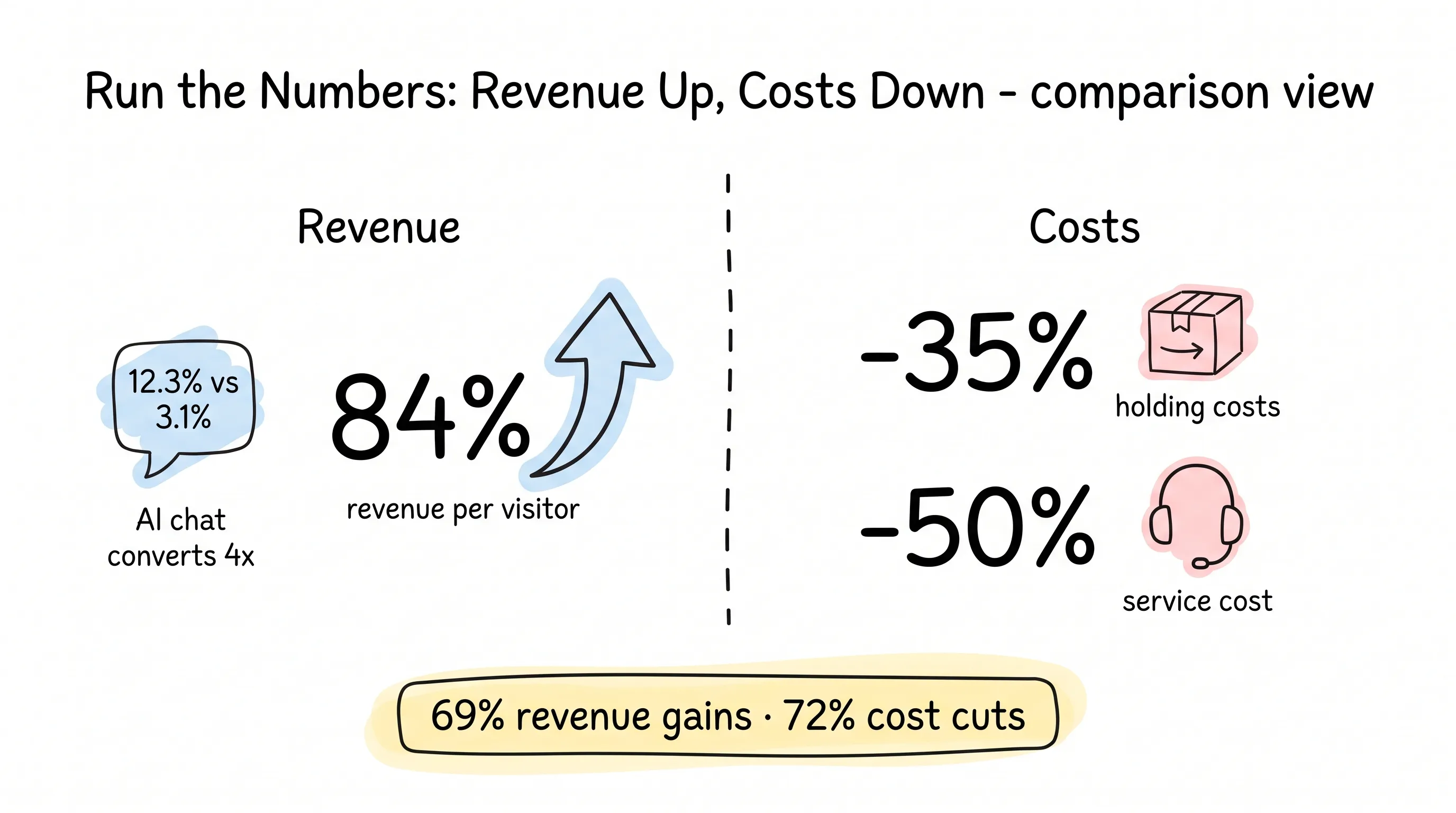
Revenue side: from January to July 2025, AI-driven revenue per visitor rose 84%. AI chat converts at 4 times the rate of unguided browsing — 12.3% versus 3.1%. Shoppers assisted by AI complete their purchases 47% faster.
Cost side: AI route planning and demand forecasting cut logistics costs by 15% on average — the best implementations cut them in half. Inventory optimization lowers holding costs by an average of 35%. Customer service automation saves up to 50% per interaction.
Results: among retailers that have deployed AI, 69% report revenue gains and 72% report cost reductions. And note — this isn't the pilot scorecard of a few big players. It's happening at companies of every size.
How Are the Big Names Playing It?
A few concrete examples.
Amazon, the benchmark. The recommendation engine contributes about 35% of revenue; dynamic pricing reportedly adjusts prices millions of times a day; fulfillment AI pre-positions stock in the warehouse nearest to you. Before you've even ordered, it has already guessed what you want.
Sephora. Chatbots handle product selection, bookings, and promotion questions; virtual try-on uses computer vision to layer lipstick and eyeshadow onto your photo in real time. Support costs fell, and engagement on product pages rose.
Walmart. AI manages assortment, the supply chain, all the way down to store-level demand forecasting. It throws sales data, weather, and local events into one calculation to make sure hot items land in the right stores. Less waste, fewer stockouts.
H&M. AI analyzes purchase behavior and social media trends to decide how stock should be allocated across stores. Not one national pile of inventory — a distinct assortment per store. The result: fewer clearance markdowns, fewer stockouts.
ASOS. The biggest profit killer in apparel e-commerce is returns. ASOS uses visual search and AI size recommendations so people feel surer about "does this fit me" before they buy. Fewer returns — and more confident orders.
Five companies, five playbooks. But one thing they all share: AI isn't a department in these businesses. It's something grown into the fabric of how they operate.
The B2B Half of the Battlefield Is Underrated
When people talk about AI e-commerce, they default to B2C. But the change on the B2B side may be even more dramatic.
The global B2B e-commerce market is projected to hit $36 trillion by 2026, growing 14.5% a year. Within it, 71% of B2B companies are already using AI. But here's the catch: only 33% of U.S. B2B companies have deployed AI end to end.
What does that mean? Whole swaths of this opportunity are still sitting there unclaimed.
Picture the scenario. An auto-parts distributor with millions of SKUs. Buyers used to climb stair by stair through the category tree; now they type one sentence: front brake pads for a 2018 model of this vehicle. The right part surfaces immediately. Fewer wrong orders, shorter procurement cycles, and sales and service freed up too.
Then there's customer-level pricing. This "different menu for different guests" work used to be doable only by a dedicated account manager. Now an AI rules engine does it automatically: contract pricing for loyal customers, volume discounts, custom catalogs — assigned to whoever qualifies, and at scale.
Sharper still is predictive replenishment. AI watches a customer's historical purchase rhythm and hands over a restocking suggestion before the customer has even noticed they're running low. For high-repeat-purchase businesses, this one feature alone is enough to lock in loyalty.
One step further is agentic AI: it generates quotes itself, processes purchase orders itself, and runs the entire order lifecycle itself. In March 2026, a Redpoint Ventures report confirmed that B2B technology spending is shifting from a pile of disconnected tools toward integrated AI platforms.
Generative AI: From "Guessing What You Like" to "Writing It for You"
Everything discussed so far is predictive AI: analyze existing data, guess an outcome.
Generative AI works the other way — it creates new things. Copy, images, product descriptions, fast and cheap.
Product descriptions. Copy for thousands of SKUs used to require a copywriting team on payroll. Now you feed it your brand voice and product data, and it drafts in minutes. Better descriptions help buyers understand what they're getting — and returns can drop.
Marketing content. Headlines, body copy, SMS, ad variants — what used to be a week of writing and testing now runs in hours, with a personalized version for every customer.
Images. Generative AI can produce lifestyle shots, scene variations, and model images directly, no photo crew needed. For categories that sell through imagery — apparel, home, beauty — content costs fall off a cliff.
Conversational shopping. Users stop typing keywords and just say what they want, in plain words or even by voice, and AI fields it like a knowledgeable store associate. Google's AI shopping experience and a wave of on-site implementations have already validated the engagement and conversion this unlocks.
So Many Tools — Where Do You Start?
The tools on the market are already quite mature. Here are a few standouts.
For personalized recommendations, Nosto fits mid-size to large merchants, while Dynamic Yield, now part of Mastercard, takes the enterprise omnichannel route. In customer service, Tidio's Lyro starts at $19 a month — small merchants can get on board; Gorgias is a helpdesk built specifically for e-commerce, a natural fit for brands with heavy ticket volumes; Intercom suits growth-stage brands that need a sophisticated customer-communication system. For inventory, Inventory Planner connects to the major platforms, Blue Yonder is the enterprise supply-chain play, and Linnworks fits multichannel sellers. In search, Algolia is the market leader and Constructor.io is designed for large-catalog e-commerce. For pricing, Prisync tracks competitor prices and reprices automatically, while Omnia Retail suits retailers with complex catalogs and markets.
Then there's the category where AI is built straight into the platform. Shopify ships Sidekick plus a stack of native AI features; BigCommerce wires AI into search, merchandising, and B2B workflows; Adobe Commerce, built on top of Magento, leans on Sensei for recommendations, customer segmentation, and predictive analytics.
One clear trend: companies that used to run 6 to 8 standalone point tools are consolidating down to 2 or 3 integrated platforms. Data has to flow together before the intelligence can compound.
The Pitfalls Are Real Too
To be honest, there's nothing about the hard parts of this road that should be hidden.
If your data is dirty, even the best AI can't save you. AI's ceiling is the quality of your data. Orders live in one system, customer records in another, behavioral data in a third. If it won't stitch together, the finest AI just spins its wheels.
Integration is skilled work. Legacy platforms and deeply customized systems need careful planning before you bolt new tools on — don't wreck the workflows you already have.
The biggest obstacle is not knowing. A 2025 survey of Shopify merchants found that among merchants not using AI, 29% don't know what AI tools can do, 29% don't know where to start, and 26% don't know which tool to pick. The most expensive thing isn't money. It's confusion.
ROI is hard to measure. Attribution was already e-commerce's oldest headache. To prove how much revenue a given recommendation engine actually drove, without a rigorous measurement framework you simply can't say.
Bias, security, loss of control. AI will learn the biases sitting in your historical data, and pricing and recommendations can produce discriminatory outcomes. Automation also amplifies errors: a human mistake hits one order; an AI mistake hits a whole batch. Governance and oversight — non-negotiable.
The Shortest Path for You
This isn't a technology problem. It's a strategy problem. Six steps, and I'll walk you through them.
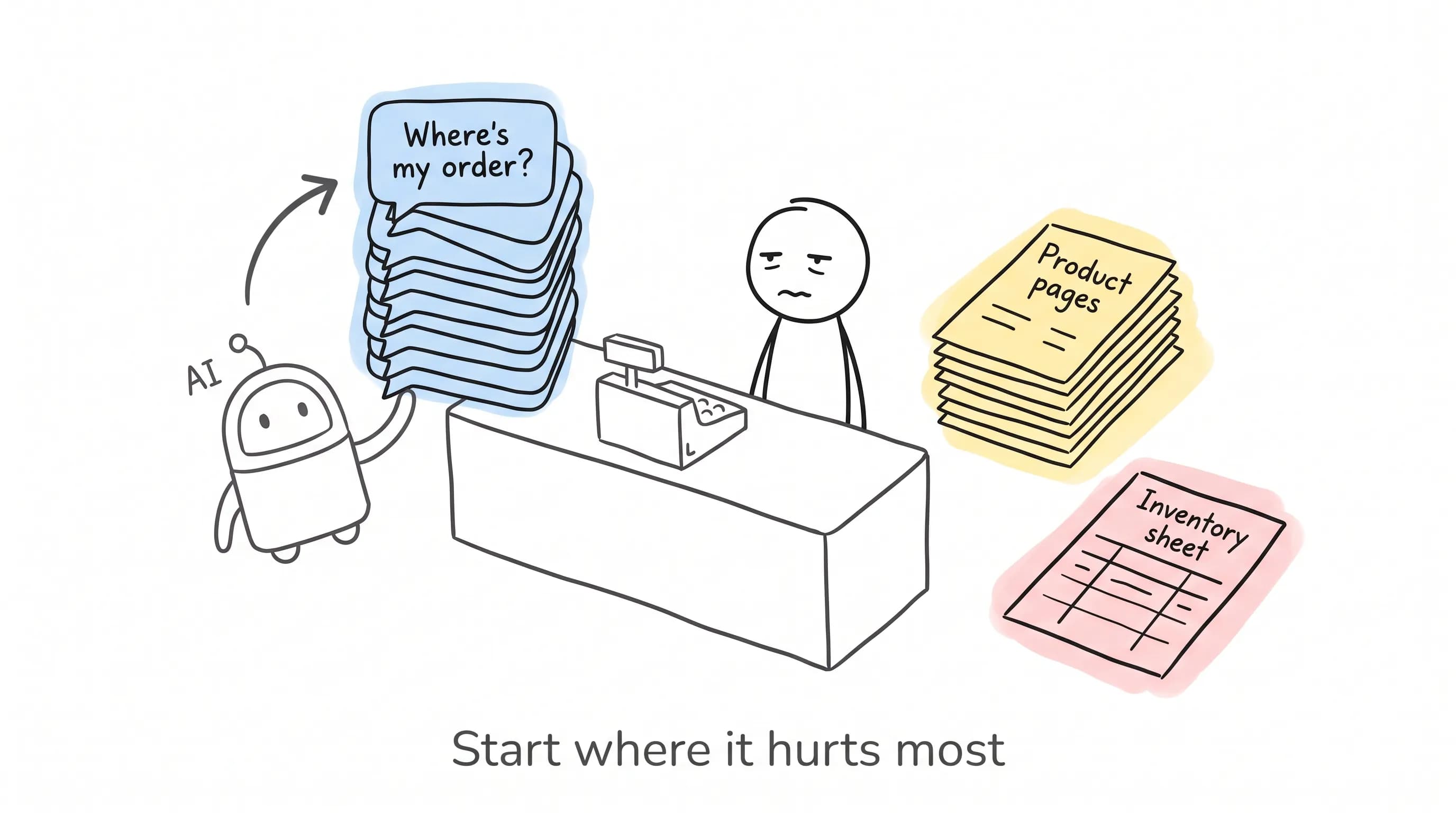
- Start where it hurts most. Don't try to fix everything at once. If support is crushing your team, bring in a support bot; if stockouts are bleeding revenue, start with demand forecasting. Pick one and go deep.
- Audit your data before you look at tools. What data you have, where it lives, how clean it is — you need to know this cold.
- Choose integrated, not piecemeal. As noted above, consolidating onto fewer platforms is the direction things are moving.
- Define metrics before you build. Conversion rate, average order value, ticket volume, inventory turnover, repeat purchases — decide what success looks like up front, or you'll never be able to account for it honestly.
- Test small; scale what validates. Trial with a slice of traffic or a subset of products, prove out the ROI, then roll it out.
- Keep a human in the loop. AI optimizes whatever metric you point it at. Whether that metric still lines up with the brand's bigger goals — that's something a human has to watch.
How Far Will This Fight Go?
Over the next year or two: conversational shopping matures — voice ordering, AI price comparison, completing payment inside a chat will all become ordinary. In livestream selling, AI will pick products and adjust the play in real time based on viewer signals. Agents will take over more of the operations — adjusting ad bids, processing refunds, replying to reviews — running on their own inside the boundaries merchants draw. These aren't experiments anymore; they're the daily routine of leading players.
Personalization will also go one level deeper: from "people like you" to "you, specifically" — the machine builds a preference model that genuinely belongs to each individual customer.
Farther out, some call it "autonomous commerce": merchandising, pricing, service, inventory — even negotiating with suppliers — all run by AI automatically. People retreat to brand strategy, creative direction, and relationship-building.
For those who move early, time is on their side. The more data AI uses, the smarter it gets — the advantage compounds. Move late, and today you're behind on performance; tomorrow you're behind on data. And that data gap only keeps widening.
One thing is now very clear: AI and e-commerce can no longer be pulled apart.
The question is no longer "whether to use it."
It's where to use it first — and how fast.
Back to that 2 a.m. scene from the opening. No human touched that sale. No overtime, no coffee. The system read the need on its own, quoted on its own, closed the deal on its own.
It's 2026, and this is just an ordinary night at some online stores.
Here's hoping you, too, get to sleep a night like that before long.
Continue reading
Related articles
It's 2026 — Which AI Tools Should You Actually Adopt as an E-commerce Seller?
A learn article walking e-commerce sellers through eight AI tool areas — customer service, email and SMS, copy, product images, inventory, pricing, on-site search, and analytics — and advising adoption one or two areas at a time, starting where the most time is lost.
Marketing Teams Are Rushing to Build AI Tools — So Who's Keeping Them Alive?
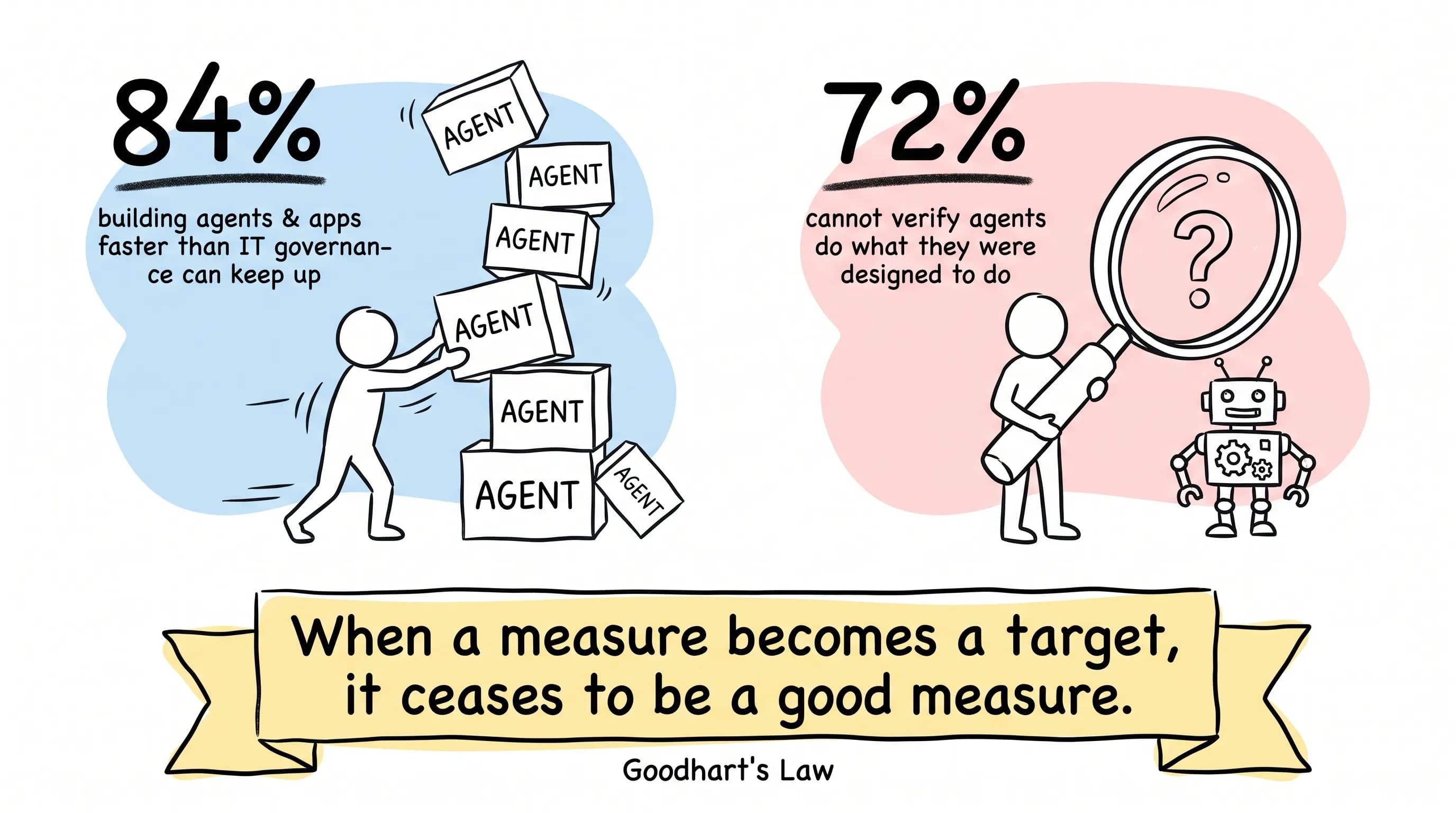
An opinion piece on AI adoption in marketing teams argues that rewarding only builders creates a monoculture, citing a Dataiku CIO survey on governance gaps. It describes four roles — builders, maintainers, monitors, users — and four questions to check what performance reviews actually reward.

Marketers at a Fork in the Road: Generative AI Stands Behind All the Disruption
A learn article explaining what generative AI is and how it helps marketers with content output, personalization, imagery, chatbots, A/B testing, and translation. It also covers risks like brand voice, copyright, and bias, cites brand case studies, and outlines four future directions.