
AI Budgets Are Getting Approved Fast — the Report Card Is Still Missing
A commentary on how dedicated AI budgets are approved fast while most teams still lack quantifiable evidence of financial return.
A few days ago I had dinner with an old friend who runs marketing.
The food hadn't even finished arriving before he let out a sigh. His company had just wrapped up its budget meetings, and the dedicated AI budget got approved without a single cut.
I said, that's good news.
He said, good? Nothing about it is good. The bigger the budget, the harder the year-end accounting. These days the first thing his boss says to him is: all this money we spent on AI — what did it actually earn the company?
He had no answer.
I tried to comfort him: you're not alone. I recently came across a report from The Martech Weekly, Enterprise Martech Outlook 2026, and my first reaction after reading it was: the dinner you're having, marketers all over the world are having it too.
What's going on? Let's lay out the numbers and go through them one by one.
The Money Comes In Faster Than the Evidence
Start with the spending side.
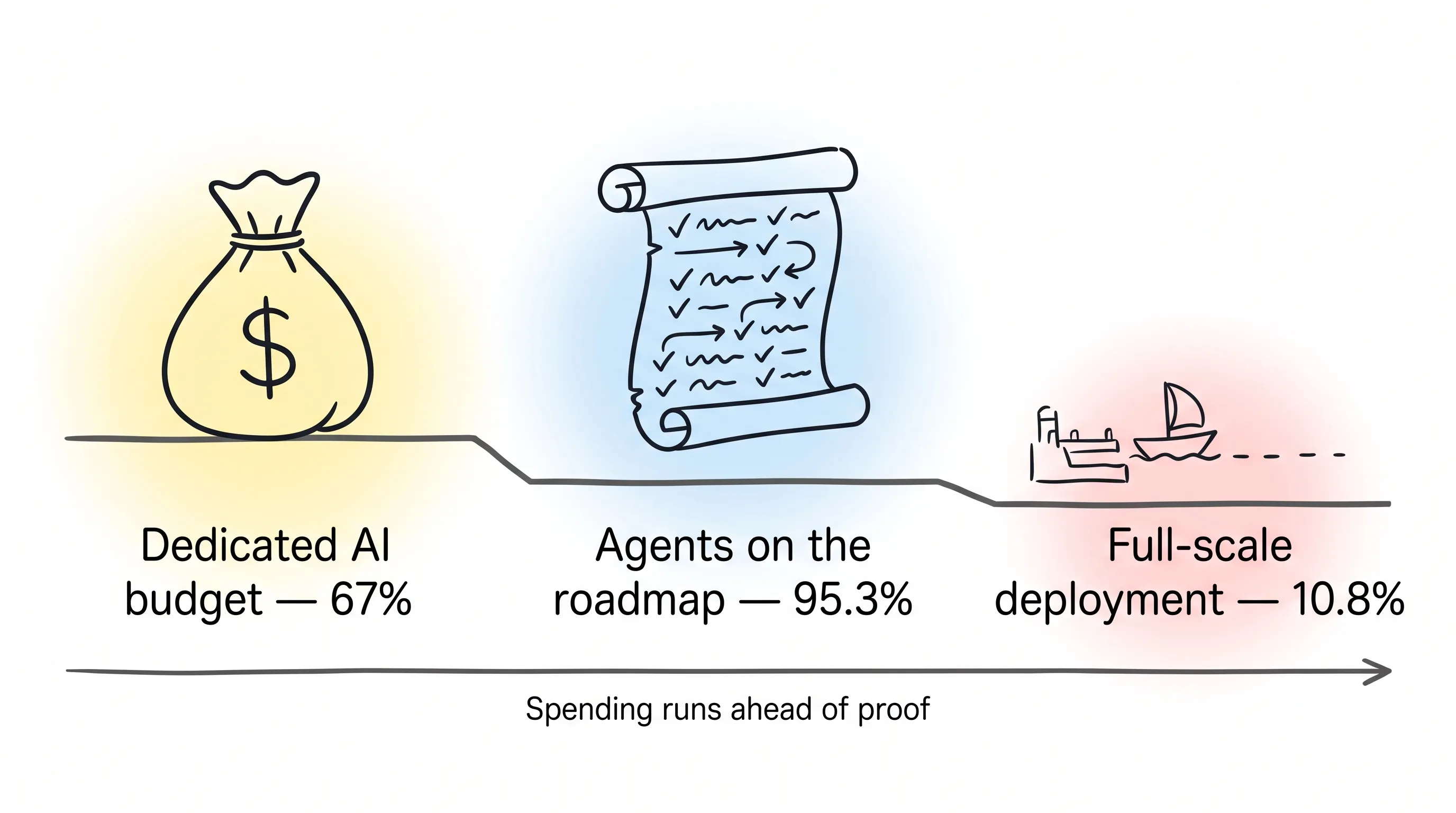
Two-thirds of enterprises have already set up a dedicated budget for AI. What's a dedicated budget? It's money booked on its own line, no longer competing with other projects for funds.
Then look at the planning side: 95.3% of enterprises have AI agents on their roadmap.
95.3% — that's basically "everyone is planning for this."
And deployment?
There's a number in the report I stared at for a long time: only 10.8% of agent projects have actually reached full-scale deployment.
It's stunning. Nearly nine in ten projects are still stuck writing proposals, running pilots, and doing small-scale runs.
The money is in place, the roadmap is fully drawn, and the output is nowhere in sight.
The speed of spending is running far ahead of the speed of proving value.
Why Marketing Feels the Benefits Internally First, While Customers Still Feel Nothing
Here's the interesting part: AI's impact shows up much more clearly inside the marketing function than on the customer side.
In the same survey, 69.3% of respondents said AI has already had a visible impact on their martech stack. Switch to customer experience, and only 59.9% say so.
Nearly a ten-point gap. Why?
Think about it: what is AI actually best at right now? Writing copy, editing drafts, doing analysis, producing reports, turning one set of assets into ten variations. All of that work happens inside the team: easy to test, easy to manage, and it slots right into workflows marketers already know.
Agents are the same — they mature in tiers. Out front are copilot-style assistance, copy editing, data management, data analysis, and video generation; these have already entered production, and the returns are visible. Trailing behind are journey optimization, decisioning, audience segmentation, campaign generation, attribution, loyalty optimization, and offer agents — all with a long way to go.
There's exactly one pattern: the more internal the work, the better AI performs at it; the more directly it faces the customer, the less ready AI is.
Nine in Ten Projects Are Stuck Halfway
So where exactly are they stuck?
A lot of people assume it's the technology. Getting an agent to do work isn't hard — ask it anything and it will give you an answer.
Wrong. The hard part isn't getting an answer out of it; it's confirming whether that answer is true or false.
Journey optimization, decisioning, attribution, campaign generation — these jobs share something in common: the moment an agent takes over, it inherits a tangle of data and processes that are unstable and unreliable at the best of times.
If the process itself is shaky, what is the agent even doing there?
Shaky ground just makes it fail faster.
That's why nearly nine in ten enterprises would rather stay at planning, piloting, and small-scale production than let things run loose. Autonomous marketing sounds great on paper; between here and actually landing it, there's still a long stretch of road.
Humans Are Still Bolted Tight Into the Loop
Enterprises are actually clear-eyed about AI: use it, use it heavily — but let AI face customers directly? Most companies don't dare.
The data is right there: only 1.6% of enterprises allow AI-generated content to go out fully automated, with no human pass in between.
43.3% of enterprises require AI content to be reviewed, edited, and fact-checked first, and only after clearing the human checkpoint can it face a customer.
Another 24.4% are even blunter: generative AI is for internal use only, external use is out of the question.
Look at that structure for a second: nearly seven in ten companies have wedged a human between AI and the customer.
But there's an account here that doesn't add up.
When the money for AI was approved, what was the rationale? Fewer people, less time, more efficiency.
And now? Production saves three hours, and verification spends three hours right back. Round trip — where exactly did the efficiency come from?
The hours saved get eaten right back by verification. Until that account balances, AI's investment story doesn't stand up.
The Final Gate: the Budget Meeting
At the end of the day, martech has an old chronic illness: the return on investment never quite gets explained. AI getting its own budget line doesn't mean the illness cured itself.
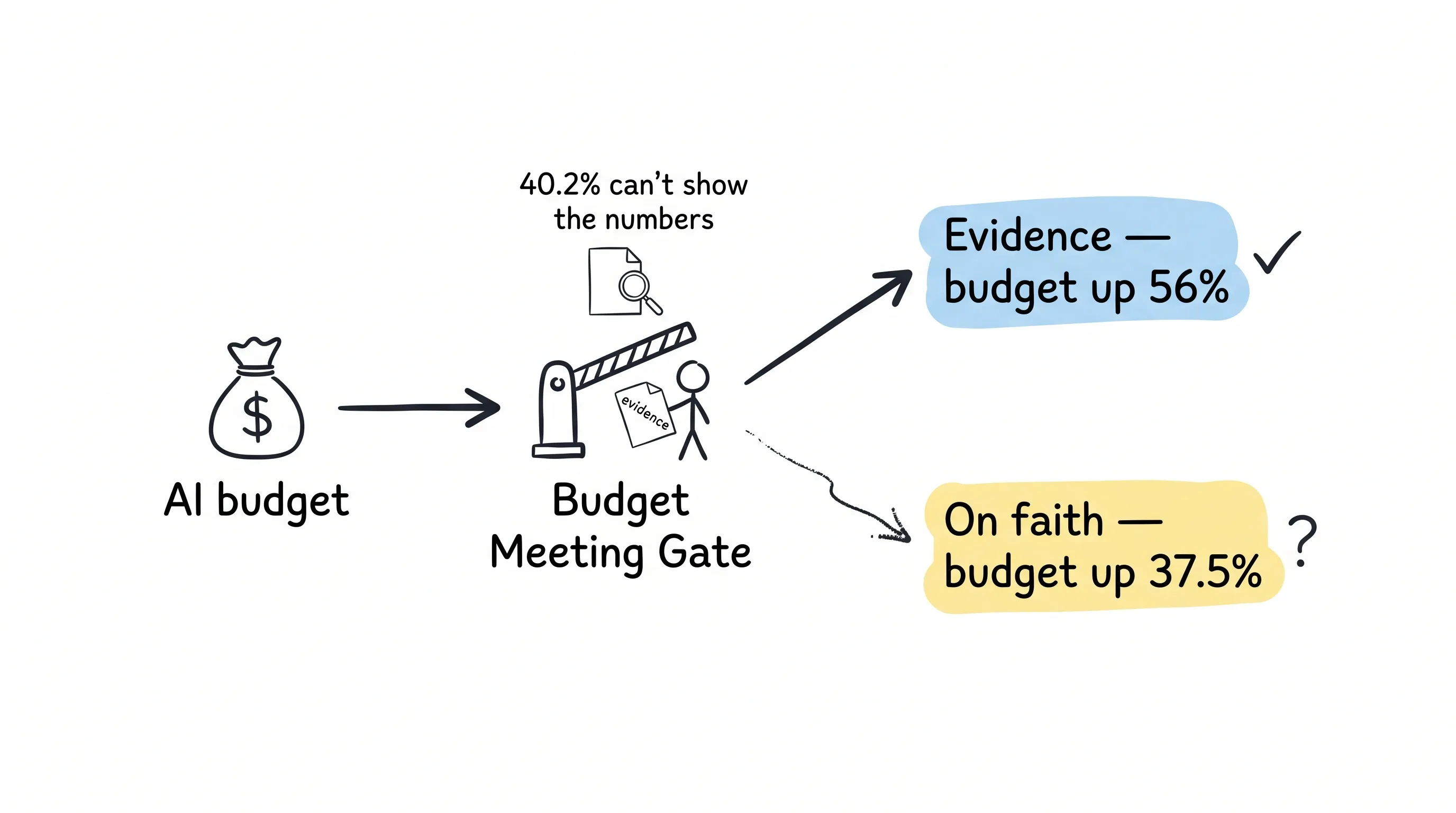
In the survey, 40.2% of martech leaders admitted: they cannot articulate a clear, quantifiable contribution of AI to financial goals — or even to a single accepted financial proxy metric.
40.2%. Nearly half of them can't say what the money bought.
So what kind of teams get bigger budgets? The answer is blunt: the teams that can produce evidence — 56% of them saw budgets rise. Teams proving value "on faith," meaning leaning on gut feel that "this thing must be useful" — only 37.5%.
Nearly a twenty-point gap. Budget meetings don't do sentiment: explain it clearly, the money comes; can't explain it, the money's at risk.
So the one thing now sitting on marketers' shoulders is really just this: tell two kinds of AI apart.
One kind makes the work better. Visible results, accounts that add up — this AI is the easiest to defend.
The other kind only makes the work bigger. Output doubles, value stays vague, and the moment you have to defend it, all that's left is "improved productivity," "drove transformation," "huge future potential." That kind of AI won't survive budget season.
Back to my friend.
When we wrapped up, I told him: a fast-approved budget means the company is willing to bet; but that year-end account, you're the one who has to go earn it.
Dedicated AI budgets are no longer rare. What's rare is evidence.
And here's wishing you, on the day of your year-end review, an account that adds up — and the confidence to walk in standing tall.
Continue reading
Related articles
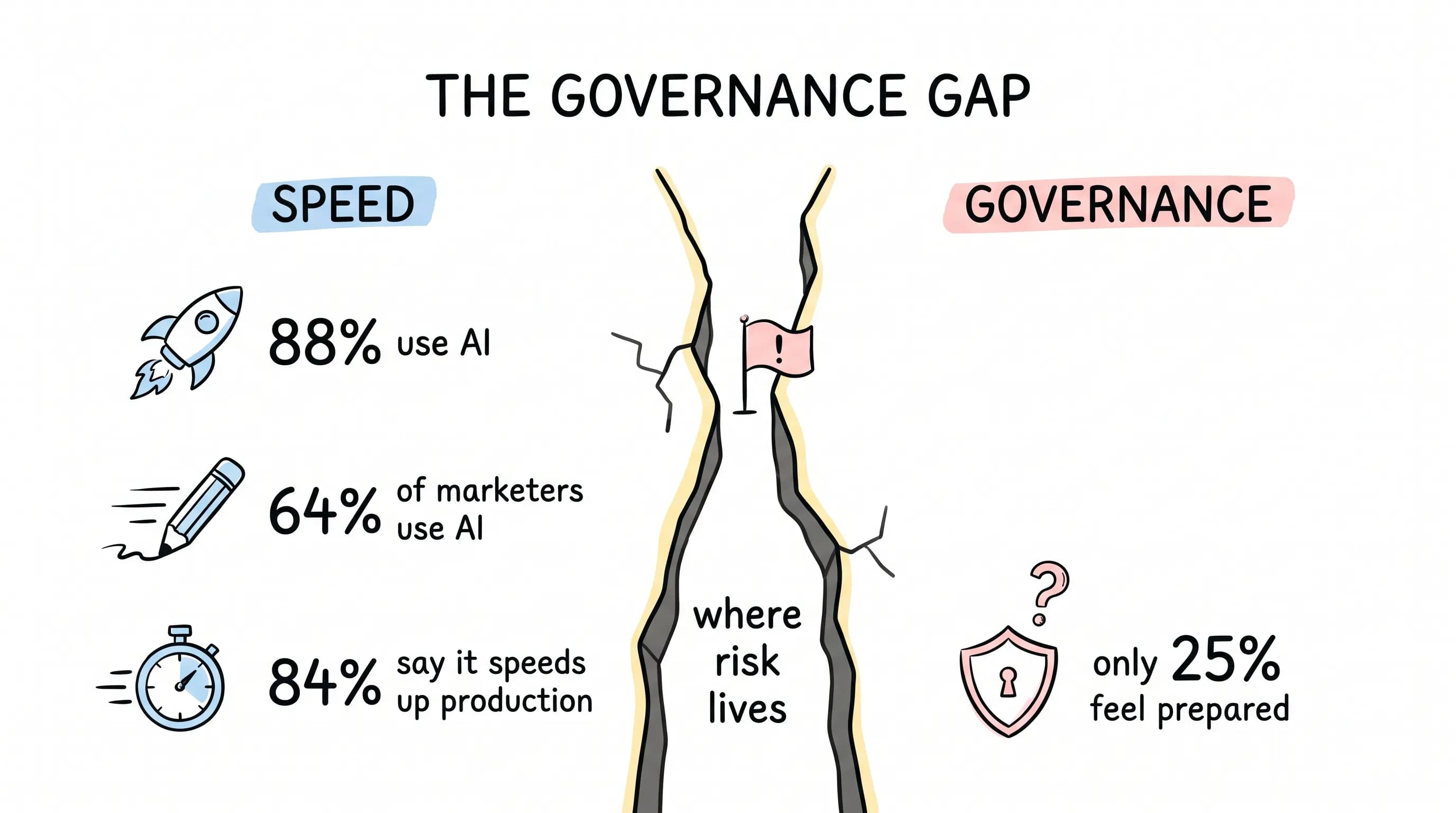
AI Makes Content at Lightning Speed — But Can You Answer "Who Approved This?"
This article looks at the gap between AI content speed and governance readiness in marketing teams, and outlines nine control points — prompt validation, brand guardrails, permissions, approval workflows, human review, versioning, IP checks, audit trails, and asset reuse — for brand-safe AI content.
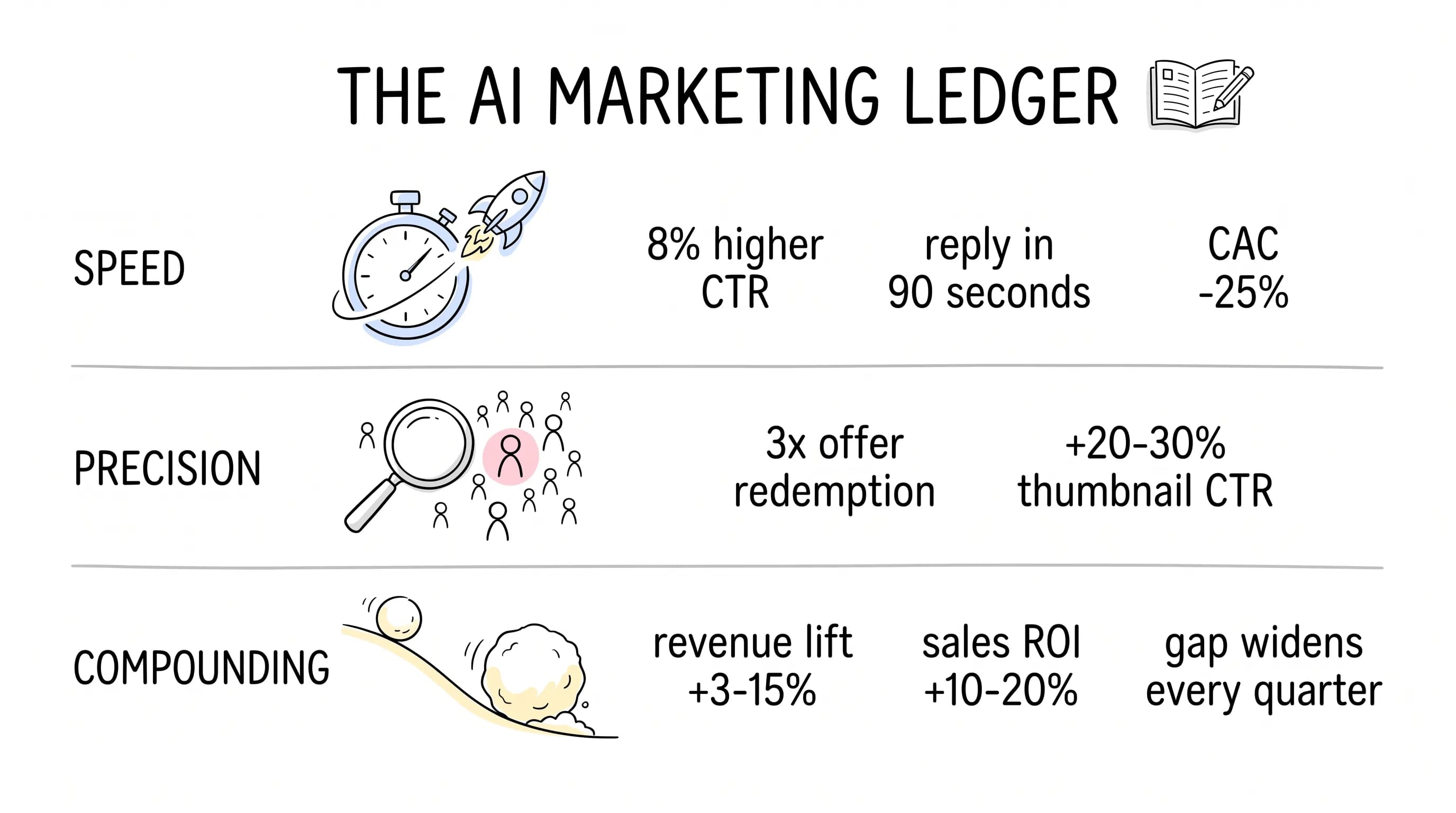
Does AI Marketing Actually Pay Off? Let Me Tell You 10 Stories — Each One Comes with a Ledger
A learn article retells ten AI marketing case studies—from Alibaba's Luban copy tool to JPMorgan Chase's Persado ad-copy tests—each paired with reported metrics, and closes with entry advice on SEO, GEO/AEO, faster lead response, and AI customer service.

Using Generative AI in Marketing: Install the Brakes Before You Step on the Gas
A learn article on brand safety when marketing teams adopt generative AI, outlining three risk areas — content, context, and data — and four safeguards: defining brand rules upfront, keeping human review in the loop, continuous monitoring, and careful selection of training data.