
AI Makes Content at Lightning Speed — But Can You Answer "Who Approved This?"
This article looks at the gap between AI content speed and governance readiness in marketing teams, and outlines nine control points — prompt validation, brand guardrails, permissions, approval workflows, human review, versioning, IP checks, audit trails, and asset reuse — for brand-safe AI content.
A few days ago, a friend who runs brand marketing vented to me about something.
Their team adopted an AI image-generation tool a couple of years ago, and production output multiplied several times over. For a campaign key visual last month, a designer generated the first draft with AI, made a couple of tweaks, and it went out the same day.
It looked great. Except three days after it went out, someone from legal dropped a question in the group chat: "Who approved this image?"
The group went quiet for the rest of the afternoon.
I told them: this isn't just your problem. AI has made "creating content" almost effortless — so effortless that most companies haven't figured out the other question: who's in charge of what it makes?
AI solved speed — and exposed governance along the way.
You're Not the Only One Moving Fast
Let's look at a few numbers first.
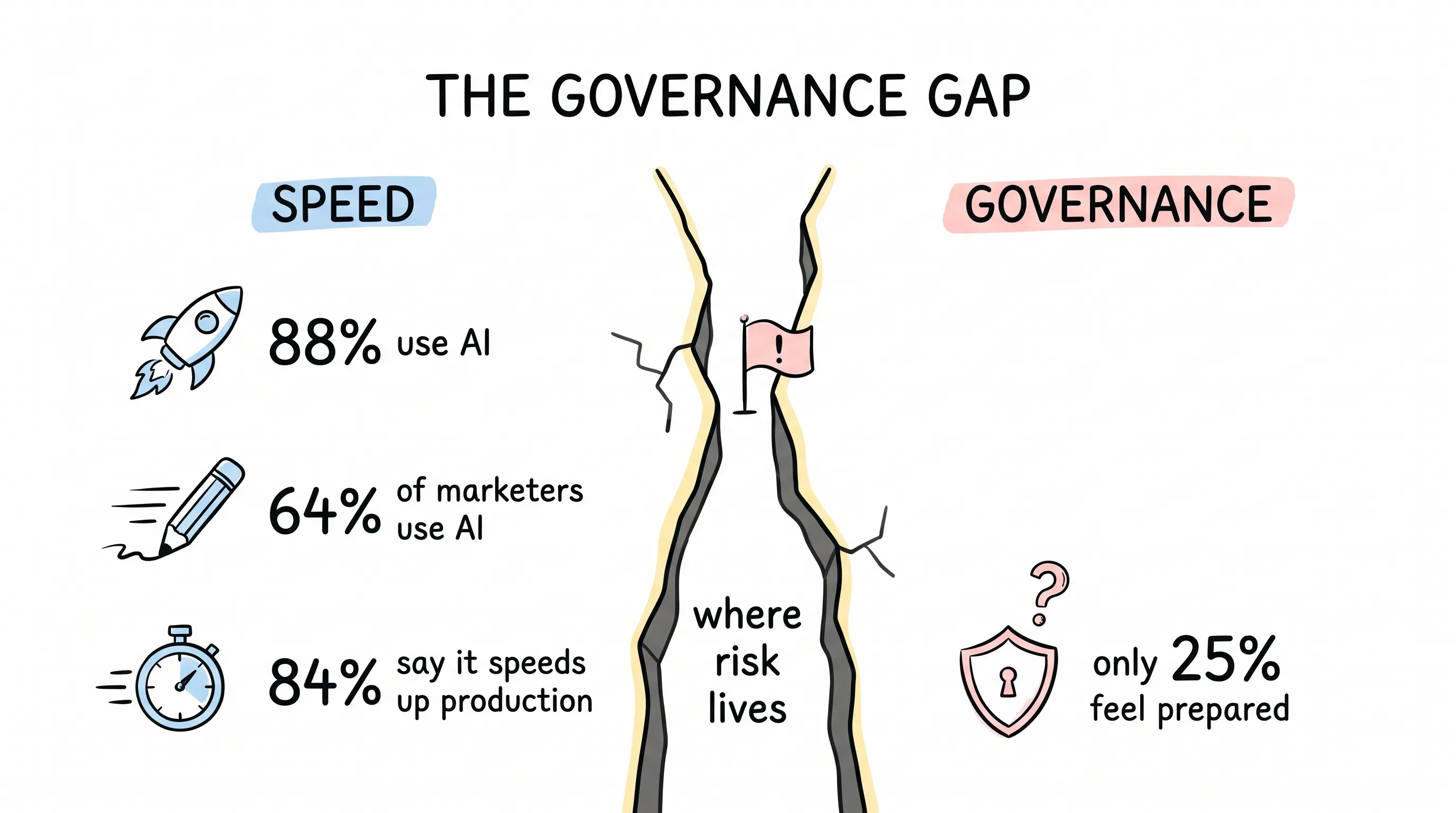
McKinsey found that 88% of organizations now use AI in at least one business function. Over at Forbes Advisor, 64% of content marketers regularly use AI on the job, and 84% admit it has genuinely sped up content production.
Now look at the other end. Deloitte research found that only 25% of leaders believe their organization is "well prepared" for the governance and risk of generative AI.
On one side: 88% of organizations rolling AI out everywhere, 84% of marketers agreeing it speeds things up. On the other: only 25% of leaders who feel governance is in place. The gap in between is exactly where risk lives.
Why? Think about it: AI no longer just helps draft a couple of paragraphs of copy. Campaign visuals, social media graphics, product shots, email banners, ad variations, video scripts — all of it can be generated, and generated in bulk. An unsupervised prompt can produce an off-brand image in a single shot; an unsupported claim can be a compliance exposure; and when a piece of collateral has no approval record, the moment legal, brand, and the boss come asking "who approved this?", nobody can answer.
Worse still, teams are operating in silos. One department uses a public text-to-image tool, another uses AI-powered design software, and someone is running AI-generated videos straight into paid ads. Without a shared layer of governance, what the organization ends up with is content speed — not content control.
Speed answers "can we make it?" Governance answers "do we dare ship it?"
These are two different things.
What Does Brand Safety Actually Mean?
Many people read "brand-safe AI content generation" as: use AI to make images, just don't make them too ugly.
That's not it.
Brand safety means every piece of AI-generated collateral can answer questions at every step, from prompt to publication.
What questions? For instance: Is the prompt itself compliant? Were brand rules actually applied? Have sensitive claims been checked? Have the right reviewers seen it? Where is every version stored? Can approved assets be safely reused next time?
Before a piece of collateral reaches a customer's eyes, all of these questions should have answers. If they don't, don't publish it yet.
That's the difference between using AI as a creative shortcut and treating AI as an enterprise-grade content capability.
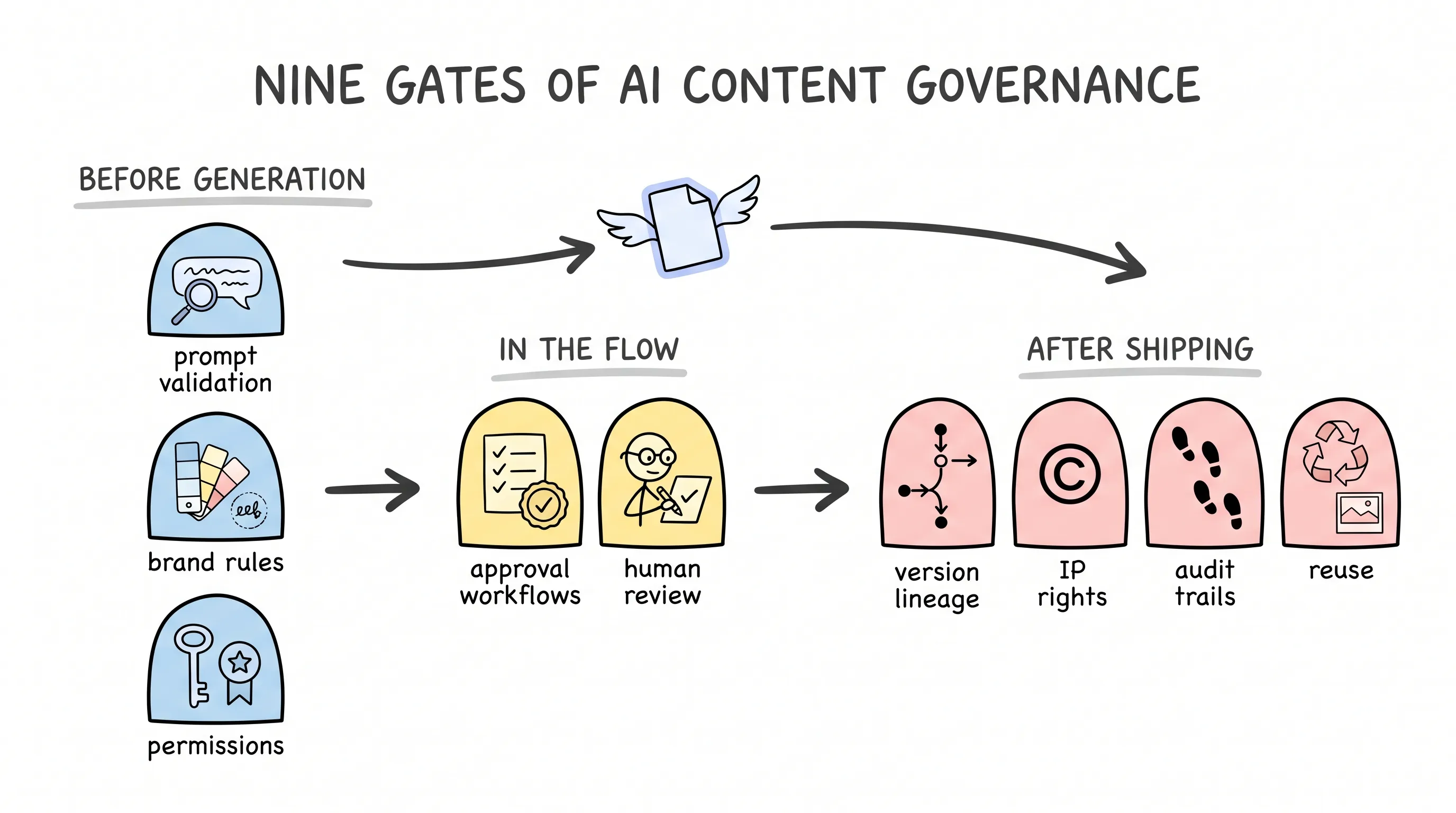
So how do you make sure you can answer those questions? I walked through the control points you need — nine in total. Let me walk through them one at a time.
Three Gates Before You Generate
The first three control points all sit before generation.
Gate one: prompt validation.
The first stop for risk isn't the finished product — it's the input. If the prompt already contains a legally indefensible claim, an unauthorized celebrity face, or a shadow of a competitor, the output was wrong before it was ever generated.
So validation has to happen up front: prohibited claims, sensitive information, unapproved competitor references, copyrighted imagery, risky visual themes, industry-restricted language, regional compliance issues, brand tone conflicts — all of these should be blocked or corrected before work begins. In industries like finance, healthcare, insurance, and retail, where collateral carries inherent legal and regulatory weight, this gate matters even more.
Stop risk before generation, and everyone downstream reviews with less pain.
Gate two: brand rules built in.
At many companies, brand guidelines are a PDF sitting in a shared drive. AI doesn't read PDFs.
The rules have to live inside the workflow: how the logo is used, which color palettes apply, what the typography rules are, how products are presented, what the tone of voice is, where the boundaries of photography and illustration styles lie, how to speak to different audiences. An AI image can be polished and still be completely wrong: the packaging angle is off, the colors are off, the people in the frame don't look like your customers. Visually, this is where it hurts most.
Once rules are embedded, teams actually play more boldly inside approved boundaries. The creative space didn't shrink — it just stopped being a minefield.
Gate three: permissions.
Not everyone should have the same power. Junior team members can draft, brand managers approve visual direction, legal only enters regulated projects, and external agencies only touch the projects assigned to them.
When it's clear who can generate, who can edit, who can approve, who can publish, who can change policy, and who can view logs, teams scattered across regions, departments, and agencies can finally run at full speed.
Notice something? None of these three gates restricts creativity. They govern accountability, not inspiration.
Two Gates in the Flow
The asset is generated. What happens next?
Gate four: structured approval workflows.
Stop relying on email chains and @-mentions in group chats. Every piece of collateral follows a clear pipeline based on content type, channel, risk level, and target audience: drafting, automated brand checks, automated compliance checks, brand review, legal review, stakeholder feedback, version comparison, final approval, publication, and record-keeping.
Note that not everything goes through the full set. A low-risk internal graphic takes the fast lane; a paid campaign for a financial product can't skip a single sign-off from brand, legal, compliance, and regional teams. The lower the risk, the faster you run; the higher the risk, the more stamps you collect.
Gate five: humans must review high-risk content.
AI can help generate, check, and tag, but for some things the judgment can't be handed over: product claims, health and financial messaging, legal disclaimers, customer-facing personalized content, content for regulated industries, sensitive groups, market comparisons, executive and investor communications.
Not everything needs a human reading from scratch, either. Layer it: low-risk social media variants pass through automated checks; medium-risk brand collateral gets approved by brand; high-risk regulated content gets signed off by legal and compliance.
AI provides the speed; humans keep the judgment. That pairing can't be replaced right now.
After It Ships, You Still Have to Account for It
The last four control points govern what happens after the fact.
Gate six: versioning and creative lineage.
AI content mutates fast. One prompt yields ten versions, each of which can be edited, regenerated, cropped to new sizes, and localized. Without version management, three weeks later no one remembers which version was approved.
The lineage has to be recorded in full: the original prompt, revised prompts, every generated version, edit instructions, which model was used, when, who operated it, review comments, approval decisions, and the final version that went out. If any piece of collateral is ever questioned, you can replay the whole journey from prompt to publication.
Gate seven: IP and usage rights.
Trademarks, celebrity likenesses, lookalikes of competitors, stock image licensing, distorted product depictions, regional usage restrictions, training data provenance, and reuse boundaries for approved assets — these must be handled during generation and approval, not patched up after something goes wrong.
Gate eight: audit trails.
In one sentence: if the organization can't explain how an AI asset was made, who reviewed it, and who approved it, there is no governance to speak of.
Who created it, what the prompt was, which checks it passed, which model and version, how many revisions, who approved, where it was published, and at what time — everything gets logged. In regulated industries above all: with these records, companies can adopt AI with confidence; without them, all that's left is hesitation.
Gate nine: search and reuse.
What many people don't realize is that governance comes with an easily overlooked dividend: stop producing things twice.
How many companies pay to recreate an image they already own, simply because they can't find it? They can't find it because assets can only be searched by file name, not by concept, style, product, or campaign context. With semantic search, similarity search, automatic tagging, and a library of approved assets — connected to DAM (digital asset management) and CMS — teams shift from "make another one" to "find that one, fine-tune it, and use it."
For large marketing organizations, reuse isn't just cost savings — it is governance in itself: every asset that gets reused again and again has already been approved.
This Already Exists as a Product
After hearing nine control points, you might think: I get the logic, but how big a system would this take to build?
Platforms are already shipping this logic as a product. Take Kagen EYE, an enterprise-grade visual intelligence platform that puts generation, editing, search, governance, approval, and tracking into a single controlled environment.
Before generation, it validates the prompt, blocking unapproved claims, restricted visual directions, sensitive data, and off-track instructions before work begins. During generation, brand guardrails keep output aligned with approved styles, tones, and logo rules. Editing happens in natural language, versions can be compared, and approvals run through structured workflows. Beyond generation, semantic and similarity search pull approved assets out for reuse. The enterprise capabilities are complete too: audit trails, role-based permissions, SSO (single sign-on), data isolation, Azure deployment, and integrations with DAM, CMS, and marketing platforms.
Simply put, it is exactly those nine control points, turned into a product.
A Final Word
Back to that question in the group chat at the start: "Who approved this image?"
Those nine control points exist to guarantee that this question always has someone who can answer it.
AI content production has moved from "should we use it?" to "how do we govern how we use it?" Everyone has the speed now; the gap is in governance. Prompt validation, brand guardrails, permissions, approval workflows, tiered human review, version lineage, IP protection, audit trails, and reuse — together, these nine things are not the brakes on AI.
They're what let you hit the gas.
Here's hoping that the next time someone asks "who approved this?", you can name the person in three seconds.
Continue reading
Related articles
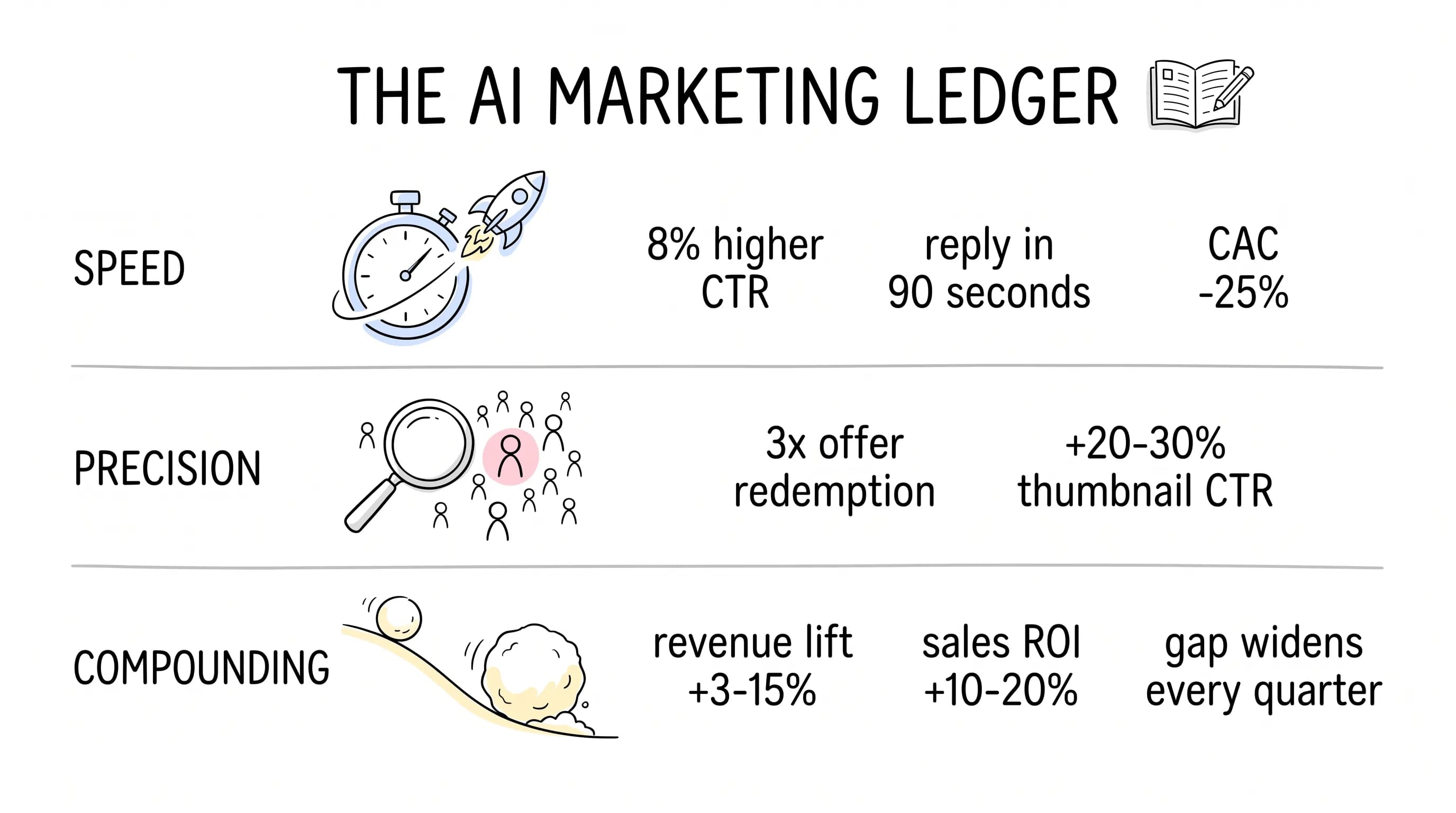
Does AI Marketing Actually Pay Off? Let Me Tell You 10 Stories — Each One Comes with a Ledger
A learn article retells ten AI marketing case studies—from Alibaba's Luban copy tool to JPMorgan Chase's Persado ad-copy tests—each paired with reported metrics, and closes with entry advice on SEO, GEO/AEO, faster lead response, and AI customer service.
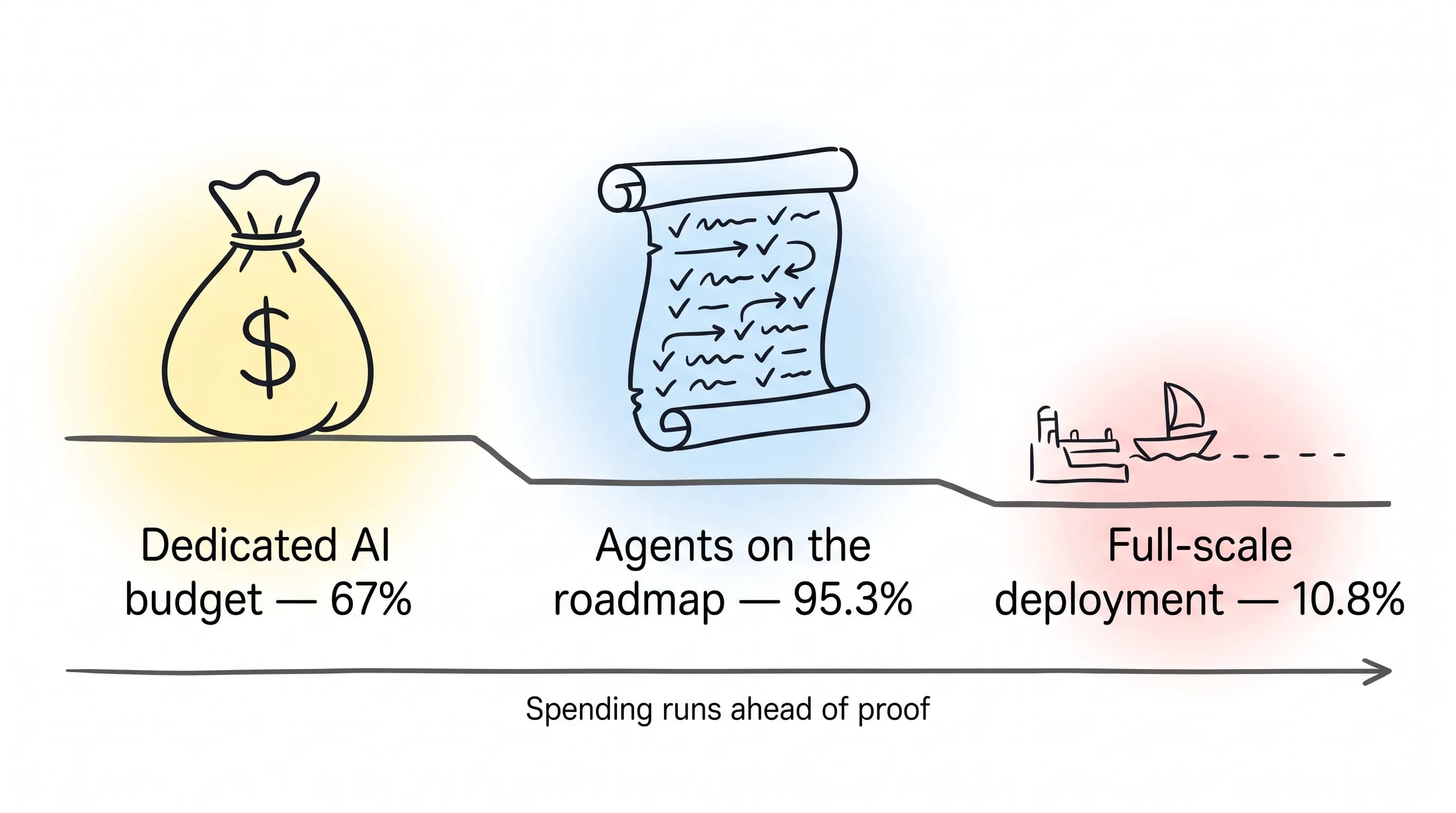
AI Budgets Are Getting Approved Fast — the Report Card Is Still Missing
A commentary on how dedicated AI budgets are approved fast while most teams still lack quantifiable evidence of financial return.

Using Generative AI in Marketing: Install the Brakes Before You Step on the Gas
A learn article on brand safety when marketing teams adopt generative AI, outlining three risk areas — content, context, and data — and four safeguards: defining brand rules upfront, keeping human review in the loop, continuous monitoring, and careful selection of training data.