
AI Marketing Daily · 2026-11-10
Today's theme is running the numbers: HubSpot's AEO guide on splitting branded vs non-branded prompt measurement, two verifiable AI marketing case compilations, HubSpot's 98% adoption survey, an SSRN field study of six cross-border sellers' AI spending shifts, and NEA's five predictions on how generative AI rewrites GT
Today's theme word is "the math." HubSpot's newly published AEO (Answer Engine Optimization) long-read teaches you how to measure AI visibility accurately — and its annual survey conveniently supplies a 98% adoption baseline. Two case-study compilations lay auditable numbers on the table. A venerable venture firm runs the math all the way down to pricing. And a field paper tallies the real spending changes at six cross-border sellers. None of today's six items is a new model launch; it's all implementation and number-checking work — exactly the reading you need most when planning for year-end. Finish these six, and you'll know where next year's budget should move.
🎯 Today's Lead
Stop tallying AI visibility as one big lump: branded and non-branded prompts need separate measurement
HubSpot's official blog published a hands-on AEO long-read on November 9 with a single thesis: branded prompts and non-branded prompts in AI search must be measured separately. A branded prompt is a user naming you by name — "Are Nike's running shoes good for marathons?" — and product names count too: if "Air Force 1" appears in the question, it's a branded prompt. A non-branded prompt is a user describing only the problem, in three flavors: category-type ("what email tool suits a small team?"), problem-type ("how do I raise my email open rate?"), and use-case-type ("which tool can automate a welcome email series?"). The former measures how AI describes you; the latter measures whether AI brings you up when nobody names you. The article calls out a popular mistake, the blended-score trap: suppose you track 500 answers with 90% branded-prompt visibility and only 20% non-branded visibility. Blend them and you get a respectable-looking 34% — when in reality strangers can find you only two times in ten. Add another 50 branded prompts to the library and the blended score keeps climbing while discoverability doesn't budge. The author offers an analogy: regulars walk in asking about today's specials, while newcomers ask where to eat nearby. Log both crowds into a single number, and you can never tell whether business improved because repeat customers multiplied or because new ones walked in.
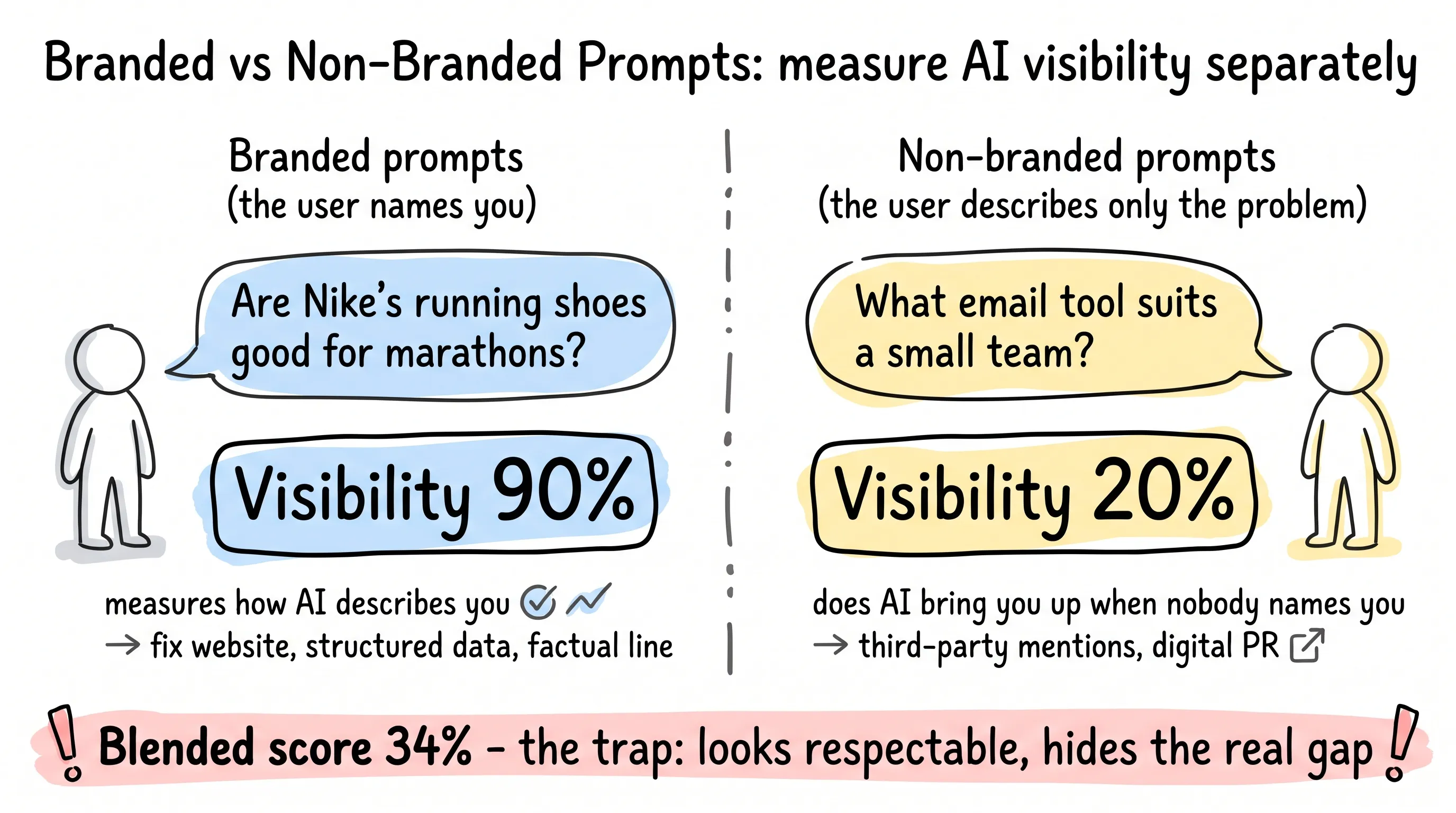
What gives this piece its weight is that it has a reference point. Traditional search made the same distinction long ago, and the article keeps query and prompt carefully apart: query is the general term for a search request, while prompt refers to the specific question you track one by one inside ChatGPT, Gemini, or Perplexity. In November 2025 Google already added a brand filter to Search Console that automatically separates the two kinds of queries — traditional search admitted first that these two traffic types must be viewed apart. AI search needs the same split, yet the method has been missing. And the trouble goes beyond classification: AI answers are themselves highly unstable. SparkToro and Gumshoe.ai ran tests: ask ChatGPT the same question twice, and the odds of getting the same brand list are under 1%; the odds of a fully identical ordering are about 1 in 1,000. This means any single-day snapshot is meaningless — conclusions can only rest on week-scale trends. Watch the four-week trajectory, not yesterday. One more commonly misread point: rank order is even less stable than presence frequency. Staring at where you rank is pointless; whether you appear at all is what deserves watching.
Down at the marketer's day-to-day level, the two prompt classes lead to entirely different diagnoses. When branded prompts underperform, the problem lies in information and positioning: AI is stating your selling points wrong, or recycling outdated descriptions. What needs fixing is your website, structured data, and the factual line you put out — then read the raw AI answers one by one to see which pages they cite. When non-branded prompts underperform, the problem lies in third-party mentions across the web: in no-name scenarios, AI can't recall you. The work is digital PR, review coverage, user word-of-mouth — the things that let third parties speak for you, landing on the third-party sites and content types the engines actually cite. For reporting, watch four metrics: branded visibility, prompt coverage, competitor share of voice, and citations. Citations and mentions are two independent metrics — content getting cited doesn't mean the brand gets named, and blending them in one report invites misjudgment.
For execution, follow the weekly workflow the article lays out. Step one: build the prompt library and deduplicate it, merging synonymous phrasings. Step two: tag each entry — branded or non-branded, whether competitors are named, buyer stage, target segment, geography; for multiple markets, write prompts separately and compare separately, because a buyer in Toronto and a buyer in Texas may get different answers. Step three: connect a tool to run prompts daily, with a human reviewing weekly. The article prescribes four review moves: sample five to ten raw answers and see who got named and how you were described; check citation sources to see which third-party pages and roundups the engines rely on; benchmark against competitors and note who shows up where you're absent; write down what to change this week, who owns it, and when to look back. If a prompt gets refused several days running, rewrite it or retire it; log empty results as gaps, not zeros. Step four: compute the branded-to-non-branded ratio — 90% versus 20% is 4.5 to 1 — and a falling ratio means discoverability is improving. When reporting, state the denominator for every ratio, attach the four-week trend, and append a log of what changed this week, so a rise can be credited to something. One more discipline: absolute counts mean nothing. Twelve appearances out of 15 and twelve out of 60 are two different things — always report numbers with their denominators attached. On library size, HubSpot's AEO standard tier caps at 25 prompts and the enterprise tier at 50 — spread a few across each of the four buyer stages, split evenly between branded and non-branded: enough to reveal patterns while staying hand-reviewable. HubSpot itself used this method to find a gap at the awareness stage, patched it with an FAQ glossary, and after AI started citing it, branded visibility for that stage rose 35 percentage points.
My take: the real signal here is that AEO has entered its measurement era. Used to be, people competed on who got mentioned; next, they'll compete on whose numbers are clean and credible. If the numbers can't stand up, the budget conversation goes nowhere. Start this week: re-tag your prompt library along four rows — brand, category, problem, use case — split the blended report into two columns, and bank a month of trend before talking optimization. The harm of the blended score isn't the inflated number itself; it's that it lures you into pouring ever more budget onto battlefields you've already won, while the battlefield that truly lacks you stays forever invisible on the report.
🔗 Further reading: Read the full article
🏷 Case Studies
Twelve AI marketing cases reviewed: winners won on systems, not models
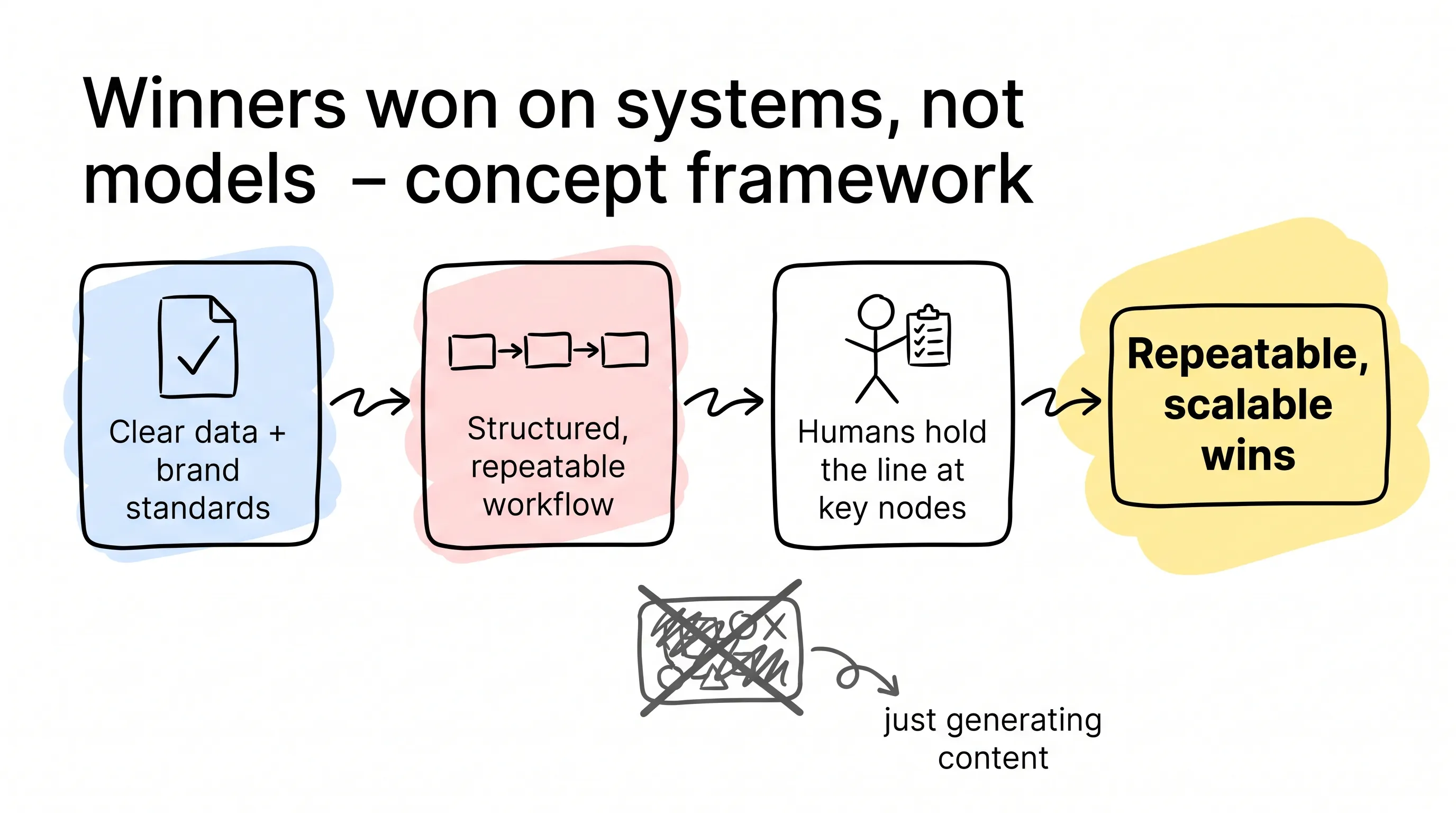
The agency adtek.agency compiled 12 AI marketing cases from 2014 to 2024, and the conclusion comes first: the winning brands won by embedding AI into controllable, repeatable, scalable operating systems. Concretely, three things done right: clear data sources and brand standards, structured and replicable workflows, and humans holding the line on strategy and final decisions at key nodes. The article separates the teams still winning in 2026 from the ones that treat AI as merely a content generator — the former maintain brand voice as infrastructure, use a structured prompt library, and pair it with review and governance standards.
Several sets of numbers are worth remembering. L'Oréal's ModiFace virtual try-on and skin diagnostics surpassed 1 billion cumulative visits by 2020, and after the site offered virtual try-on, conversion roughly tripled. Farfetch used Phrasee to optimize email subject lines and CTAs — against the background fatigue of overloaded subscriber inboxes — lifting promotional email open rates by 7% and automated emails by 31%, with click-through up as much as 38%; even mature channels hold untapped stock. Cadbury's "Not just a Cadbury ad" used generative AI to mass-produce over 130,000 localized videos featuring Shah Rukh Khan, each naming a local corner shop; YouTube engagement rose 60%, Facebook 90%, and Diwali-season sales 35%. Unilever's U-Studio, an in-house studio network plus AI system, had spread across 17 studios in 12 countries by 2018, cutting content costs about 30%, speeding output 30%, and doubling video completion rates and click-through.
The earlier cases show AI in marketing isn't new either. Domino's put its voice-ordering assistant Dom in the app back in June 2014 — one more convenient ordering channel, and proof of its tech-pioneer image. In early 2020 Coca-Cola brought Share a Coke to Alexa in Australia: say the word, and a Coke printed with your custom name got ordered and delivered to your door, free — the point wasn't direct conversion but emotional connection and buzz. From February 2023 BuzzFeed pushed Infinity Quizzes, using OpenAI's API to generate a bespoke result for every player: editors set the concept, AI produced the content — niche audiences once too costly to serve became worth serving. Sephora's Virtual Artist combined AI facial analysis with AR to let users try makeup in real time, dissolving the hesitation of buying beauty products online. In November 2018 Lexus had IBM Watson analyze 15 years of luxury-car advertising to write a script, then hired an Oscar-caliber director to shoot it — promoted as the world's first AI-scripted commercial, though no performance data was ever released. Starbucks' Deep Brew analyzes historical orders, time of day, weather, and location to proactively suggest what you might want in the app, lifting order frequency and average order value. Nike uses predictive AI that fuses app behavior, purchase history, and social signals for recommendations aimed at repeat purchase — likewise with no published lift figures. In October 2024, Hettich ran "Roast the Room" on Instagram India: first let netizens roast four AI-generated messy rooms, then used generative AI to remodel the rooms fitted with its own hardware — a B2B-flavored manufacturing brand buying presence through interaction.
The author also leaves an honest note: famous cases like Nike, Lexus, and Coca-Cola released no verifiable ROI figures, and the article faithfully separates lessons with numbers from narrative-only cases, noting that some figures are quoted secondhand and that the agency blog itself has lead-generation motives — read it with a healthy skepticism. The ending says plainly why most teams get stuck: they have the ambition and the tools but lack a repeatable system that produces successes at scale, sustainably. When output grows but rework cycles and internal trust don't improve, the answer usually isn't more prompts — it's building an operating system with review and governance alongside content production. The catch-up checklist is down to earth: map your content assets, write the brand voice into a document the team actually uses, build a structured prompt library, set a review scorecard, and put a 30-day activation plan in place.
💬 Don't hoard the list — pick one item and steal the playbook. Email is the cheapest starting point: tools like Phrasee can still dig roughly 30% click uplift out of mature channels, verifiable within a week. Before you start, take stock of two things: are your data sources clear, and is your brand standard written down? Miss either, and AI will only produce rework material faster. If you want Unilever's in-house content-factory route, secure a 30-day activation plan before you green-light the project. The case years skew old — what you're copying is the structure, not the recency.
🔗 Further reading: Read the full article
Five verifiable AI campaigns: Zipcar brand recall up 81%
On October 11, MarkGrid compiled five AI marketing cases with links to original reporting — every number traceable and checkable. Zipcar's "Zip If" generative campaign, June to September 2023, used the Supernatural agency's Merlyn tool to build synthetic audience personas and then tailor ad copy by segment: during the campaign, brand awareness rose 28%, brand recall 81%, and favorability 119%, while skipping audience research that normally drags on for months. Intuit Mailchimp's 2024 clustomer campaign applied AI at the ideation and concept-validation stage rather than just execution, landing in the top 5% of Ipsos ad testing. Foot Locker used generative AI to mass-produce over 10,000 customized product ads: click-through up 32%, cost per acquisition down. L'Oréal Biotherm used BENlabs to screen matching KOLs from a pool of 13 million creators, landing 4.5 million views and 200,000 impressions; the Aquasource Gel line's play was AI influencer selection guaranteeing fit, with creator content guaranteeing authenticity. Virgin Voyages in 2023 lifted bookings with an AI-plus-Jennifer-Lopez combination — CNBC covered the details — riding celebrity endorsement plus AI targeting.
The structure of the piece is interesting too: five cases sorted into five usage classes — synthetic audiences for personalization, predictive analytics for strategy, generated content for capacity, competitor intelligence for influencer selection — effectively a cheat sheet of AI marketing use patterns. The Zipcar entry has a background worth noting: synthetic personas and tailored copy deployed together compressed audience research that normally eats months into the campaign prep window. The Mailchimp entry's value lies in the stage: AI entered at ideation and concept validation, and the resulting campaign quality passed the third-party test, making Ipsos's top 5%. Foot Locker's 10,000 ads happened in 2024, answering rapidly shifting consumer demand — creative at scale bought agility. The BENlabs case is about picking people by match score from 13 million creators, the combo play of AI influencer selection plus influencer marketing. One thing to see clearly: it comes from an AI marketing tool vendor, funnels to its own product throughout, and ends by flexing its own share of mentions across major models — the page shows 34% in a ChatGPT context, 28% in Gemini, 41% in Perplexity. All cases are secondhand retellings, clustered in 2023–2024. Its value: every case carries its original source — Adweek, eMarketer, Smartly, CNBC and more — so the cost of verification is low.
💬 These two make a natural pair: one is about systems, the other hands you checkable numbers. Of the entries here, Foot Locker's route is easiest to copy: e-commerce teams with large SKU counts first use AI to mass-produce product ad creative, then feed it into A/B testing — volume ramps fastest. Zipcar's synthetic-audience approach can replace part of your focus-group spend before launch; worth a try for teams with tight research budgets, and brand metrics like awareness and recall can be tested along the way. One caution: all these numbers come from the brands' or agencies' own accounting — rerun a small-budget test before you commit a project.
🔗 Further reading: Read the full article
🏷 Industry Data
HubSpot annual survey: 98% of teams use AI; the highest-return use case is action, not volume
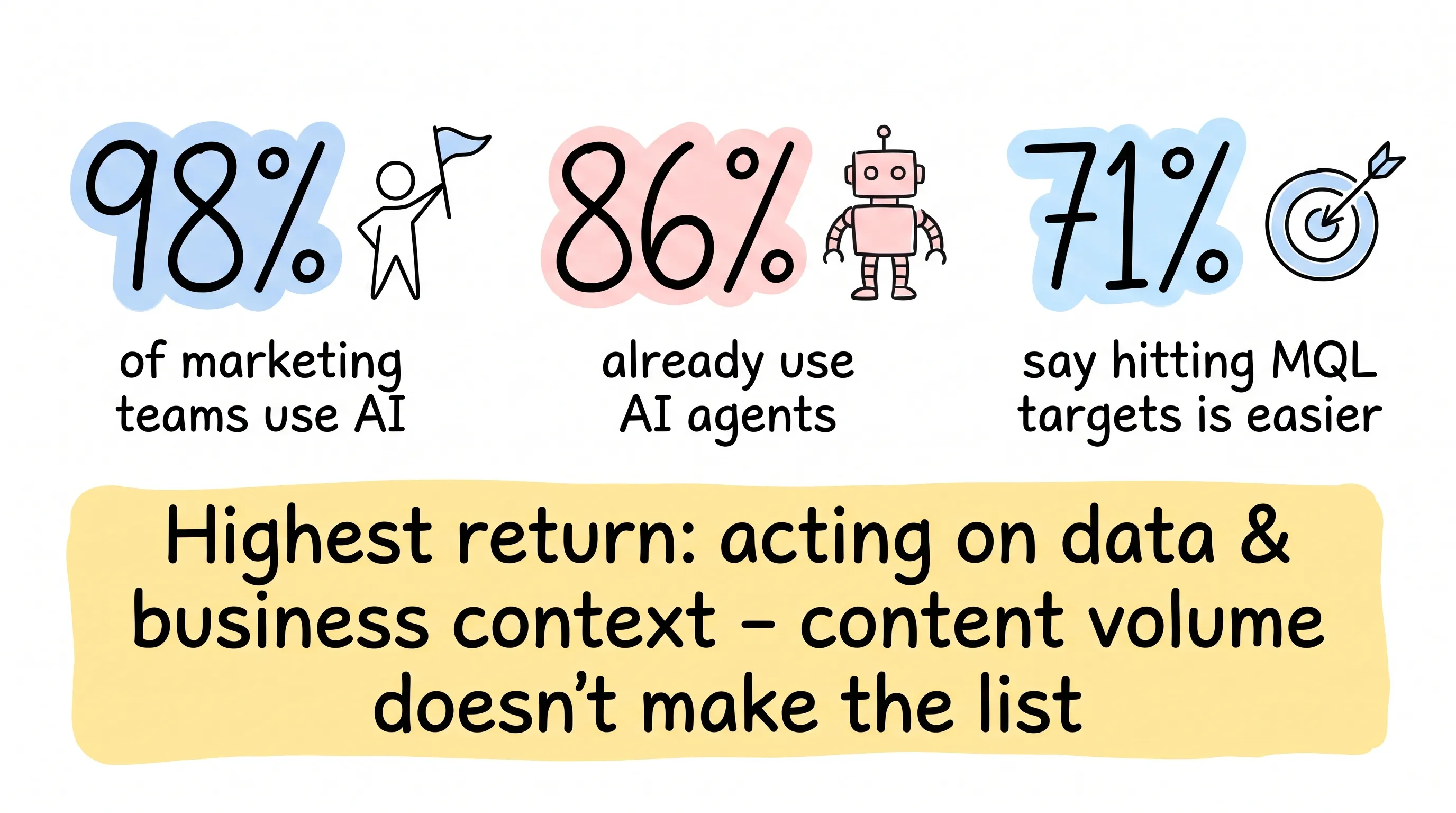
HubSpot's 2026 annual AI marketing report landing page has released the key figures from a survey of 1,700-plus marketers worldwide. 98% of marketing teams already use some form of AI, and marketing leads AI adoption among GTM (go-to-market) departments like sales and customer service — the page's framing is that marketers have become AI's front-runners, and respondents broadly reported that AI helped them hit or exceed their KPIs. 71% of marketers say AI made hitting MQL (marketing-qualified lead) targets easier — the link between AI and pipeline metrics is starting to show, no longer stuck in the efficiency narrative. The layered findings deserve a close read: the entry-level use case is content-generation assistance, but the highest-return use case is acting fast on data and business context — performance insights and campaign intelligence top the return rankings, while sheer content volume doesn't make the list. Agentic AI is 2026's main thread: 86% of marketers already use AI agents, 76% say usage has grown over the past six months, and the page's charts give a finer split — 75% increasing, 21% flat — while teams rolling out multi-agent autonomous workflows simultaneously report clear gains in speed, creativity, consistency, and goal attainment.
Two reservations. The full report is gated behind a lead-capture form, and the page is top-of-funnel material; the report's partners listed include Litmus, Rock Content, and Search Engine Journal. The surveyor's interests align with the seller's: the closing comparison figures for HubSpot's own customers — 284% more MQLs, 110% more contacts, 65% more opportunities — take with a grain of salt, and the reason is stated openly: their claim is that the data all lives in their own CRM, so their AI tools get the fullest context. When citing, note the source's conflicts of interest; don't treat a vendor comparison as an industry benchmark. One more thing the page doesn't elaborate but worth pressing on: the benefits multi-agent teams report — speed, creativity, consistency, goal attainment — are exactly the four places most teams fall apart when using single-point tools. If the full report contains layered data on this, it's worth trading your contact info for.
💬 98% means adoption is no longer the dividing line — what you use it for is. Next year's budget: shave the content-volume line and move it to scenarios where AI reads performance data and tells you the next move; the return gap is sitting right there in the survey. Agent usage grew 76% in six months, so orchestration rules must keep up: who reviews, who approves, who eats the cost when things break — write answers to those three questions before you scale. And if you need industry data for your annual plan, this 1,700-respondent sample is big enough to cite, as long as you flag the source.
🔗 Further reading: Read the full article
Six cross-border sellers' ledgers: AI saves outsourcing fees first, not payroll
Independent researcher Yu Tang submitted a working paper to SSRN on October 14 (revised October 19), interviewing six small and mid-sized Chinese cross-border e-commerce sellers — five owners plus one operations staffer — on the actual impact of external AI on procurement and jobs from 2025 to 2026, across four kinds of work: content preparation, service coordination, online research, and software development. The change showed up first in purchased services: 3 firms cut what they paid for translation, photography, and content services while employee base salaries stayed untouched; 1 firm bought different service categories before and after adoption, making direct comparison impossible; 1 employee was transferred to another role, with no drop in total company payroll. Spread out the substituted work and the pattern appears: tasks once paid to external providers shifted to employees working with AI — organizational cost adjustment clearly lags tool adoption.
Two details worth keeping. One seller tried WorkBuddy for two months and stopped: when the tool errored or ignored instructions, manual research was actually faster — AI's savings run into a reliability ceiling; past it, human research wins. An AliExpress seller built an inventory system with Claude in the first half of 2026, then stopped paying for Guanjiapo ERP (a Chinese SMB accounting/inventory ERP), while other tools and infrastructure spending stayed as before. Replacing traditional SaaS subscriptions with a general-purpose LLM plus lightweight self-built apps is a newly emerged shift in spending structure within this sample.
On method, the author discloses everything: the paper runs 14 pages, has no external funding, declares no conflicts of interest; interview subjects came from the author's existing network; company, store, and personal names are all anonymized as case codes; participants confirmed in writing via electronic message, after the fact, that they agreed to public use of the material; the numbers are approximations reported from memory, never reconciled against books; task coverage is uneven, so net returns or causal sales effects can't be estimated. The paper sits under SSRN's operations strategy and technology operations management category, posted mid-October, with zero citations and zero cited-by — a fresh-out-of-the-lab observation. Six firms make up the whole sample: this research records a direction, not a table of dollar amounts. Treat it as a trend signal, not statistical evidence.
💬 The signal is more useful than the conclusion. AI's impact lands first on the marginal spend going to service providers and freelancers; anyone in translation, photography, or content production should plan ahead and shift pricing from per-piece billing toward planning and editing — the parts AI can't easily replace. Cross-border sellers can run a quick calculation: which lightweight processes could a general model plus self-built scripts replace with a SaaS subscription, and do the saved annual fees cover the build hours? When citing this research, state the sample size plainly — and don't use it as evidence.
🔗 Further reading: Read the full article
🏷 Strategy & Trends
NEA's five predictions: how generative AI rewrites GTM's math
NEA partners Hilarie Koplow-McAdams (formerly president of sales operations at Salesforce) and Vanessa Larco offer five predictions. They open by steadying nerves: generative AI won't put creative people out of work, but the playbook will change for three GTM functions — marketing, sales, and customer service. The piece cites one startup sample: Tofu co-founder Elaine Zelby spent eight years in B2B GTM and, seeing the leap in large-model capability in 2021, left to start a company targeting the repetitive, soul-grinding steps of marketing campaigns. The first wave of value shows up in compressing information-gathering time: Salesforce research says marketers save roughly 5 hours a week, and Larco puts it more directly — today people spend 95% of their time figuring out what happened, leaving almost nothing for deciding what to do about it; AI should hand back twenty to thirty percent of that time for thinking. Tofu feeds company data into a knowledge graph and generates hundreds to thousands of hyper-personalized emails, landing pages, and white papers in one pass, all staying on brand. Orby AI, meanwhile, takes over back-office administrative flows like placing orders, routing items to legal for approval, and signing DocuSign.
Second, outbound sales needs rebuilding: by Operatix's figures, an average SDR (sales development rep) touches over 1,400 leads a month to land about 12 meetings, while a well-trained LLM can generate on-brand, zero-drift personalized content to replace spray-and-pray outbound. Koplow-McAdams says the old problem is that SDRs don't follow the script — AI, ironically, sticks to it word for word. Third, the time saved should go into prompt engineering and campaign retrospectives: McKinsey estimated generative AI could deliver a 10% productivity gain and $463 billion in annual savings — where that money goes depends on what you do with the freed-up time. More aggressive personalization plays are queuing up: NEA is looking at a company that can alter the mouth movements of a speaker in a marketing video so they appear to be saying the recipient's name — record it once and you've effectively recorded it a hundred times. Koplow-McAdams puts it plainly: human value lies in doing the human-centered work people are good at, more effectively.
Fourth, data is the moat: Treasure Data research says dirty data can eat as much as 38% of a marketing budget, building your own LLM costs roughly $100K to $500K, and the winner's combination is first-party data plus synthetic data plus augmented data. Fifth, pricing must shift from per-seat to usage-based or outcome-based: by 2022, 46% of SaaS companies had adopted some form of usage-based pricing with another 15% testing it — selling "help customers do more with fewer people" software by the seat is self-contradictory; hybrid pricing is a transitional fix; and when AI customer service handles 100 tickets in a tenth of the human time, per-ticket pricing is what matches the value. Larco warns that before switching pricing you must first rebuild the billing architecture so it can hold both subscription and usage models at once — her point, distilled to one line: the closer a pricing model binds to the customer's own outcome, the better it is. Zelby adds a founder-side footnote: today's number-one rule of startups is spend less money, hire a smaller team, use fewer tools. The piece closes with Gartner's prediction: within two years, 35% of CROs will stand up GenAI operations teams inside their GTM organizations.
Timing caution: the piece was written in early 2024, the cases carry a VC slant, and portfolio companies like Tofu appear throughout — check the dates before citing any figure.
💬 Of the five, the pricing prediction is where the math pays best: when procuring AI tools, negotiate for usage- or outcome-based pricing first, forcing the vendor's incentives to align with yours — and don't sign pure per-seat contracts lightly. The arithmetic of 1,400 leads for 12 meetings is one sales leaders should redo this quarter: swap the SDR follow-up templates for an on-brand generative pipeline before talking headcount. Read the data prediction in reverse: don't skimp on the data-cleaning budget — that's where the 38% waste hides. The piece is from 2024; the directional calls still hold, but refresh the numbers yourself.
🔗 Further reading: Read the full article
💡 Today's Synthesis
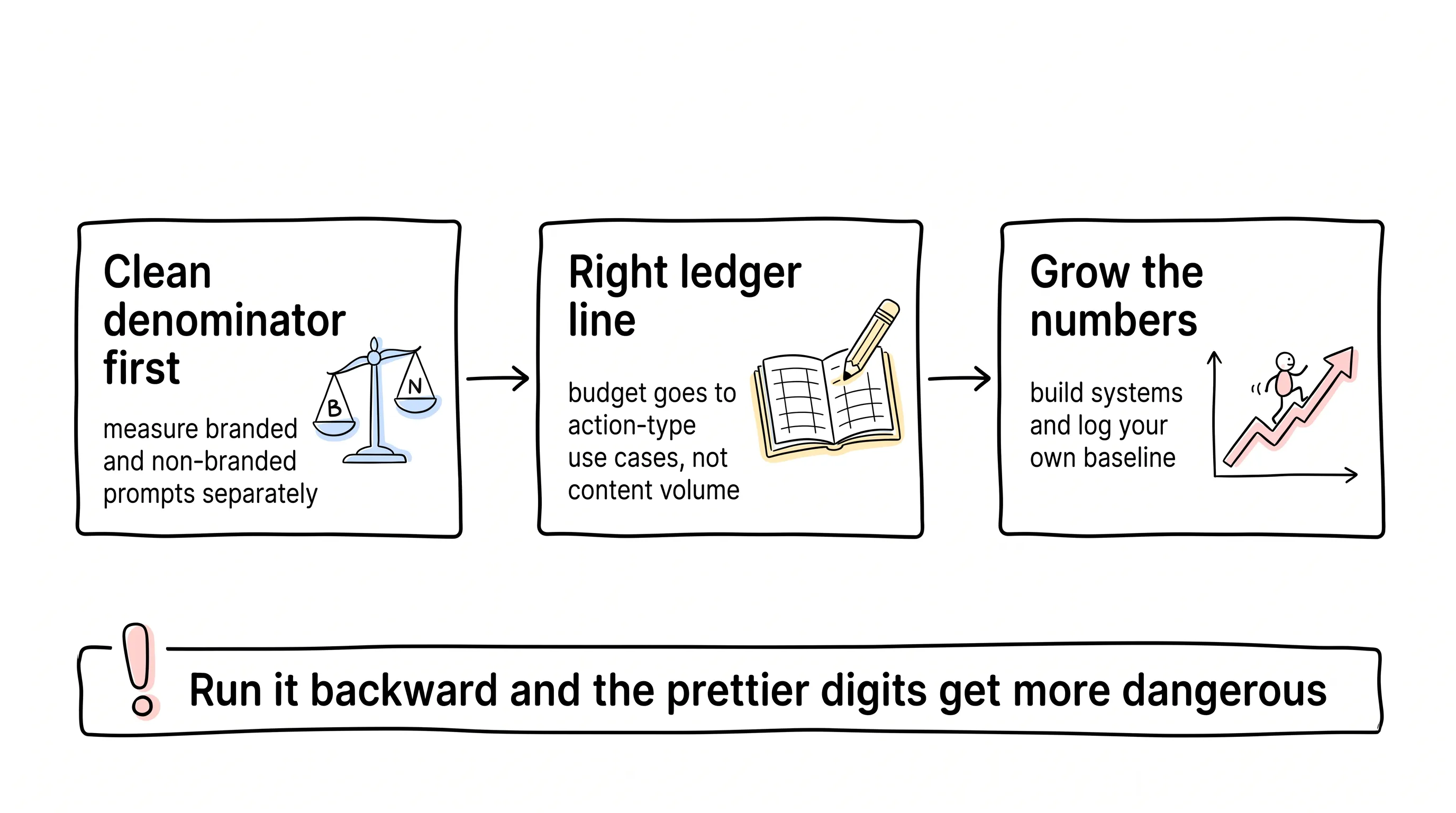
Put today's six items side by side and the through-line emerges: AI marketing has moved from "can we use it" to "how do we run the numbers." The lead story teaches you to measure the visibility math accurately — blend branded and non-branded prompts together, and the numbers will lie. HubSpot's survey tells you which line item the numbers belong in: action-type use cases out-earn content production, and 98% adoption has leveled the starting line. NEA runs the math all the way to the business model: per-seat pricing can't sustain a product that helps customers need fewer people. The SSRN field study shows where the ledger shrinks first — service procurement — with job and payroll adjustments trailing behind. And the two case compilations are the reminder: behind every campaign with glossy numbers sits a system built first and creativity second, a rule unchanged from Domino's 2014 voice ordering to Unilever's content factory. The order of the math matters too: first a clean denominator (the lead story), then the right ledger line (the survey), then growing the numbers (the cases and predictions). Run the order backward, and the prettier the digits, the more dangerous they are.
One more caution deserves its own paragraph: nearly every dazzling number today comes from a party with something to sell. HubSpot sells AEO tools, MarkGrid sells a content engine, NEA speaks for its portfolio, adtek is fishing for clients — even that academic paper rests on the author's self-reported figures. The numbers aren't unciteable; they just have to be cited together with their origins. Anyone budgeting for next year should hold two sets of figures: other people's published battle records, and a baseline you ran yourself. Start logging the latter today, and in four weeks you'll have a trend to read. The current window has one more use: four of today's six pieces teach you how to build your own measurement and process — the cases are only a reference frame, while your baseline and your prompt library are assets you actually own. Build the ledger now, while competitors are still busy showing off their case studies.
Continue reading
Related articles
AI Marketing Daily · 2026-11-22
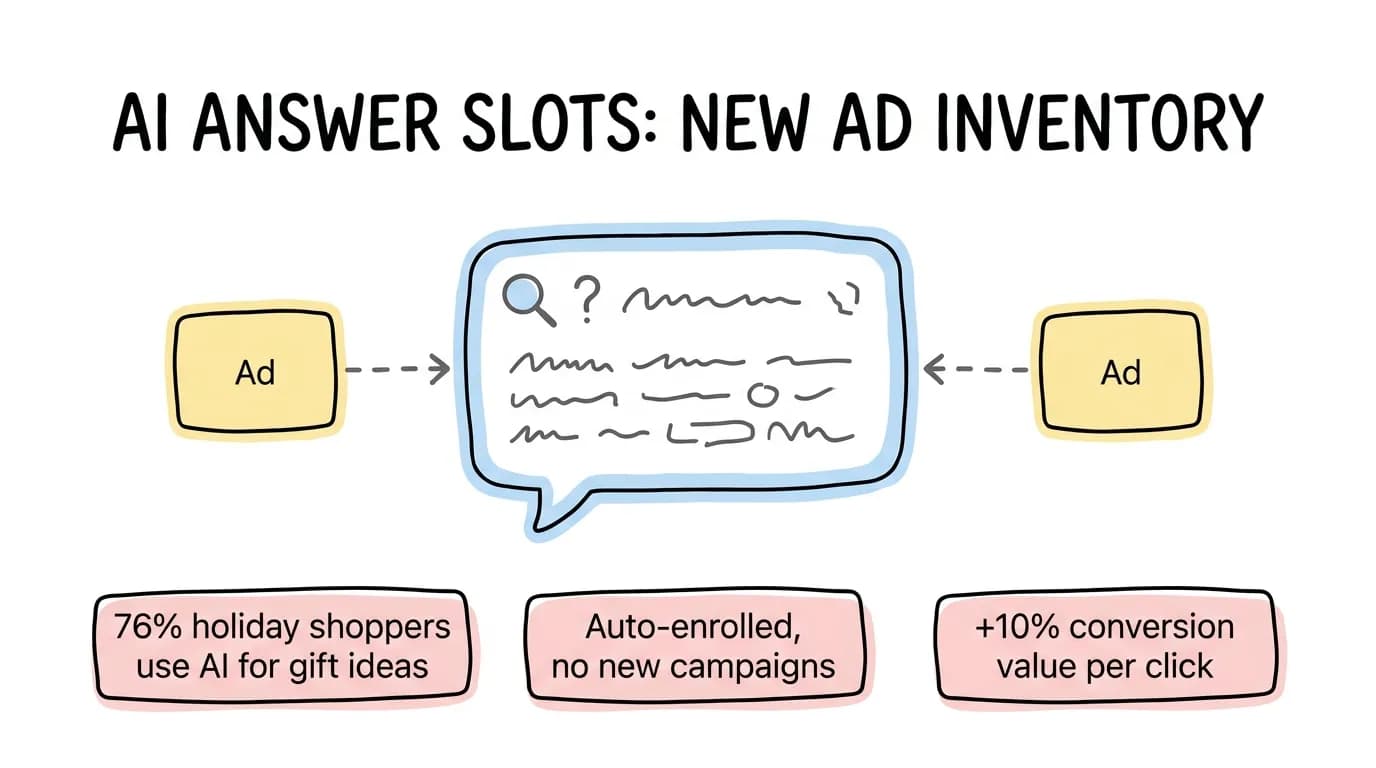
AI Marketing Daily for 2026-11-22 rounds up 20 items led by Microsoft opening Bing AI Overviews to ads and Google expanding AI Mode ads to ten countries, plus GEO guides, ad automation delegation guidance, AI Overviews CTR data, and a legal-risk checklist for AI-generated creative.
AI Marketing Daily · 2026-11-21
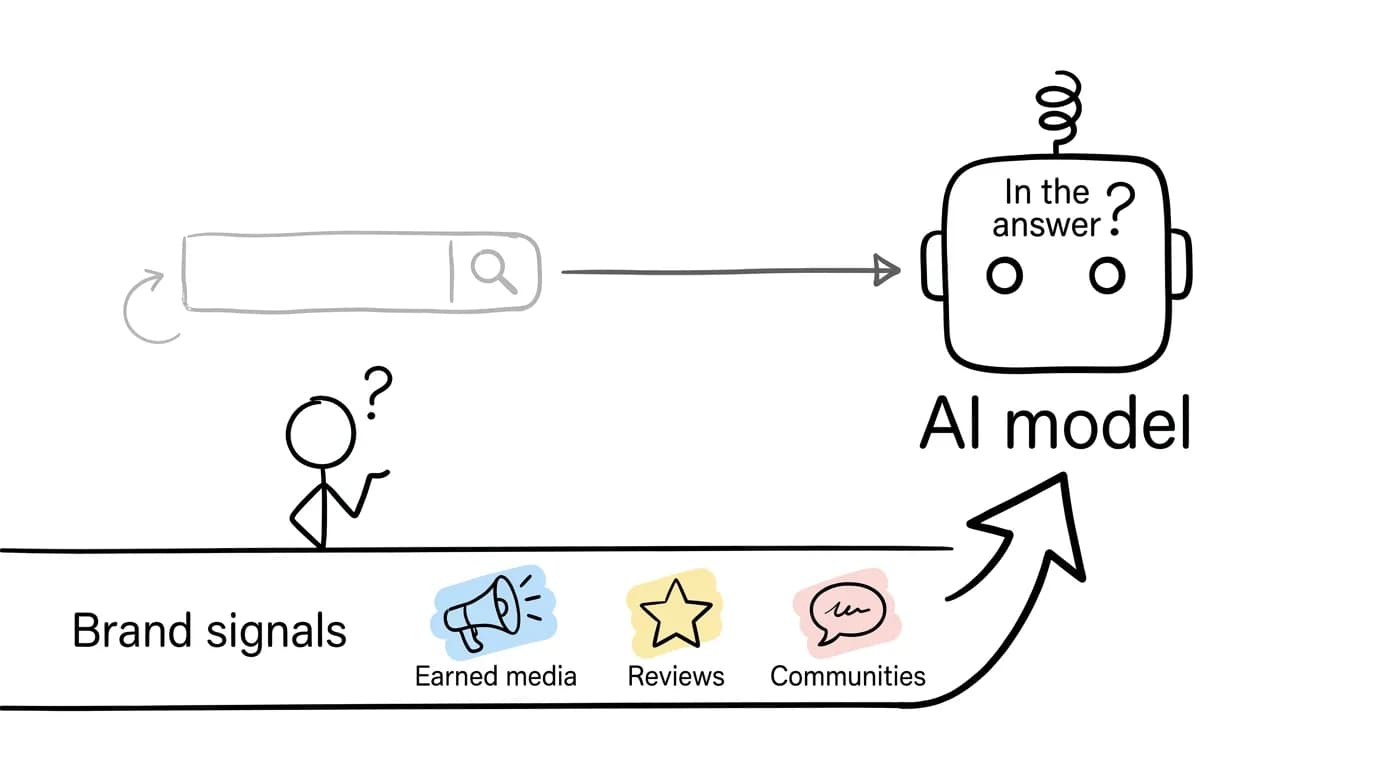
A November 21, 2026 AI-marketing daily covering AI search visibility, GEO methods, Google AI Mode ads expanding to ten countries, Meta's pre-Black Friday changes, agentic shopping, and industry adoption and ROI data.
AI Marketing Daily · 2026-11-20
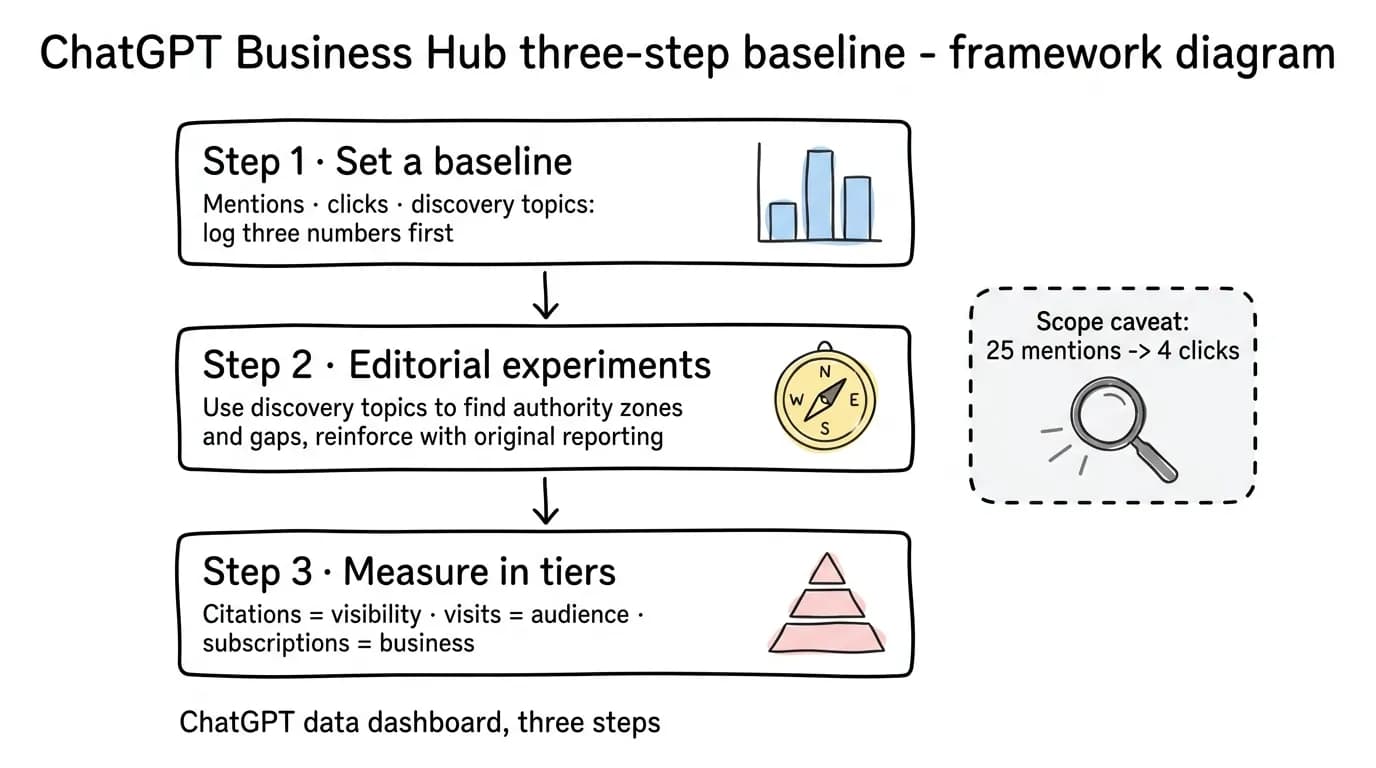
AI Marketing Daily for 2026-11-20 rounds up 19 items centered on measurement: OpenAI's ChatGPT Business Hub dashboard, EU rules for agent-mediated purchasing, Meta pausing four AI terms, and B2B data on shortlists and the dark funnel, each with action advice.