
98% of Marketing Teams Use AI. So Why Are Only a Few Actually Profiting?
This learn article discusses a HubSpot survey of marketers and argues that most teams use AI mainly to produce content, while stronger returns come from using AI to act on data and business context. It also covers agent adoption and the role of unified customer data in AI performance.
A while back, I had dinner with an old friend who works in marketing.
He poured out his frustrations. His team's KPIs this year were suffocating — not enough leads, and the boss pushing every single day. So I asked: are you guys using AI?
He said, of course. Writing copy, drafting headlines, making images, cutting videos — all of it.
I said, that might be exactly the problem.
Why do I say that? Because I recently came across a survey by HubSpot. They asked more than 1,700 marketers around the world how they use AI. After reading it, I came away with one feeling: when it comes to using AI, the difference between one way of using it and another? A whole era.
First, a number.
98%.
98% of marketing teams are using AI, to one degree or another. You might not have guessed it — marketing is actually the department where AI gets used the hardest in the whole company.
And this isn't chasing a fad. 71% of marketers say that since using AI, hitting their lead goals — that's the MQL (marketing qualified lead) — has gotten easier.
At this point, you might think: if everyone's using it, doesn't that even things out?
Quite the opposite.
Everyone Uses It — That's What Creates the Gap
Where's the difference? In how you use it.
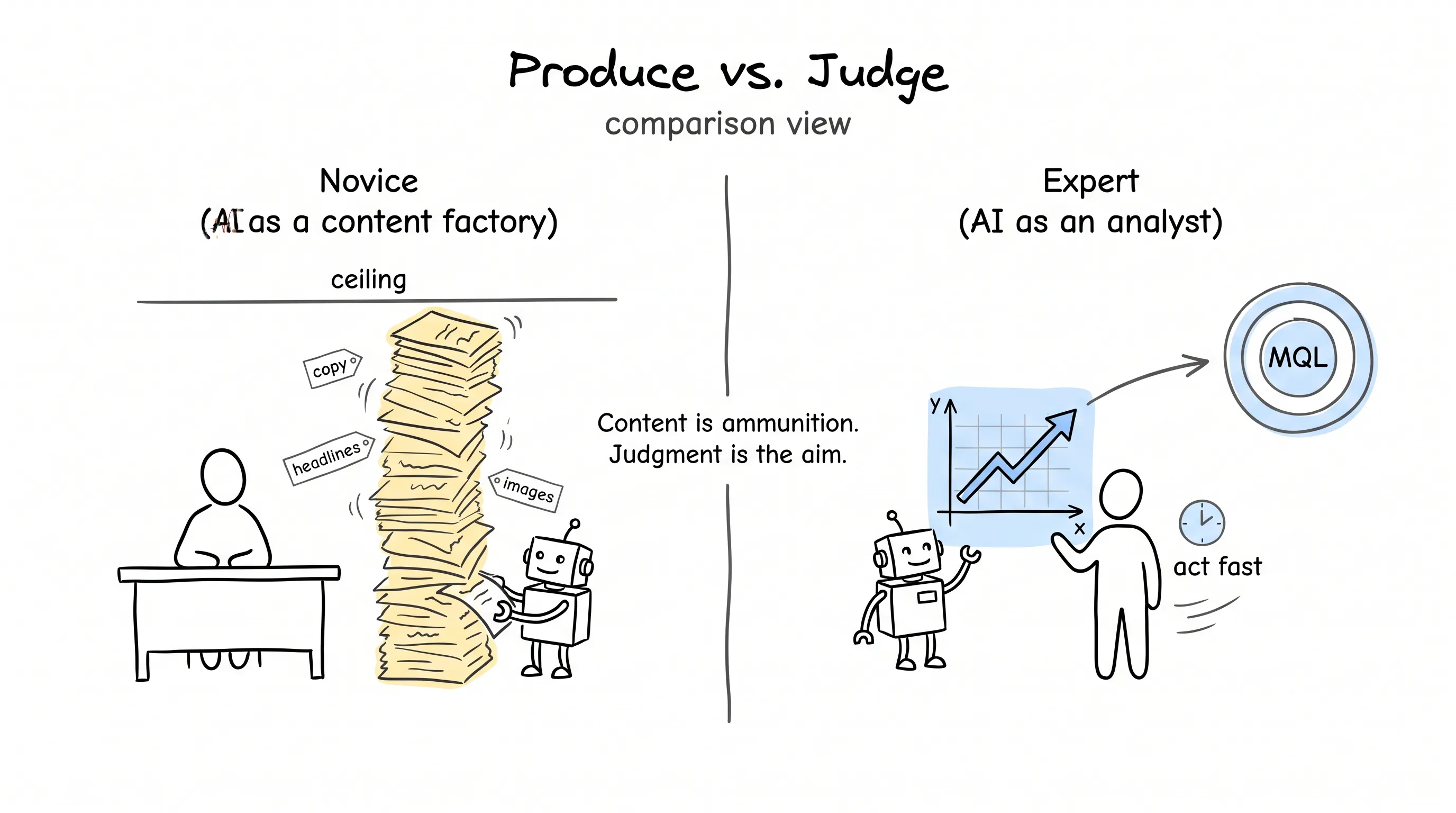
What does novice usage look like? Exactly like my friend: have AI write copy, polish headlines, generate images. That's where the vast majority start. Nothing wrong with it — but that's also where the ceiling sits.
So how do the experts use it?
They have AI read the data. Which ads have gone stale? Which campaign's lead quality is slipping? Then they move — right away. Put simply, novices use AI to produce things; experts use AI to make judgments.
Here's the interesting part: the returns come from the latter. In this survey, the uses with the most eye-catching ROI had nothing to do with writing more content. They all tied back to one thing: acting faster on data and business context.
Why? Think about it. More content doesn't mean more business. Content is ammunition. Judgment is the aim. If your aim is off, the more ammunition you stockpile, the more you waste.
So How Do You Aim Fast and Aim True?
That brings us to the biggest shift in the marketing world in 2026: agents.
What's an agent?
AI of the past was like an advisor on call. You ask a question, it answers. An agent is different. You give it a goal, and it breaks the work into steps, gets hands-on, and works through it, step by step.
And adoption is moving at a frightening pace. 86% of marketers are already using agents. Compared with six months ago, 76% say their usage keeps climbing.
And it delivers in hard numbers. Teams that upgraded their workflows from one agent to multiple agents working together clearly outpaced everyone else — on speed, creativity, consistency, and hitting goals.
At this point you might ask: so do I just buy the smartest agent and win?
Not yet.
The Gap Was Never in the Model
There's another set of numbers in this survey that I stared at for a long time.
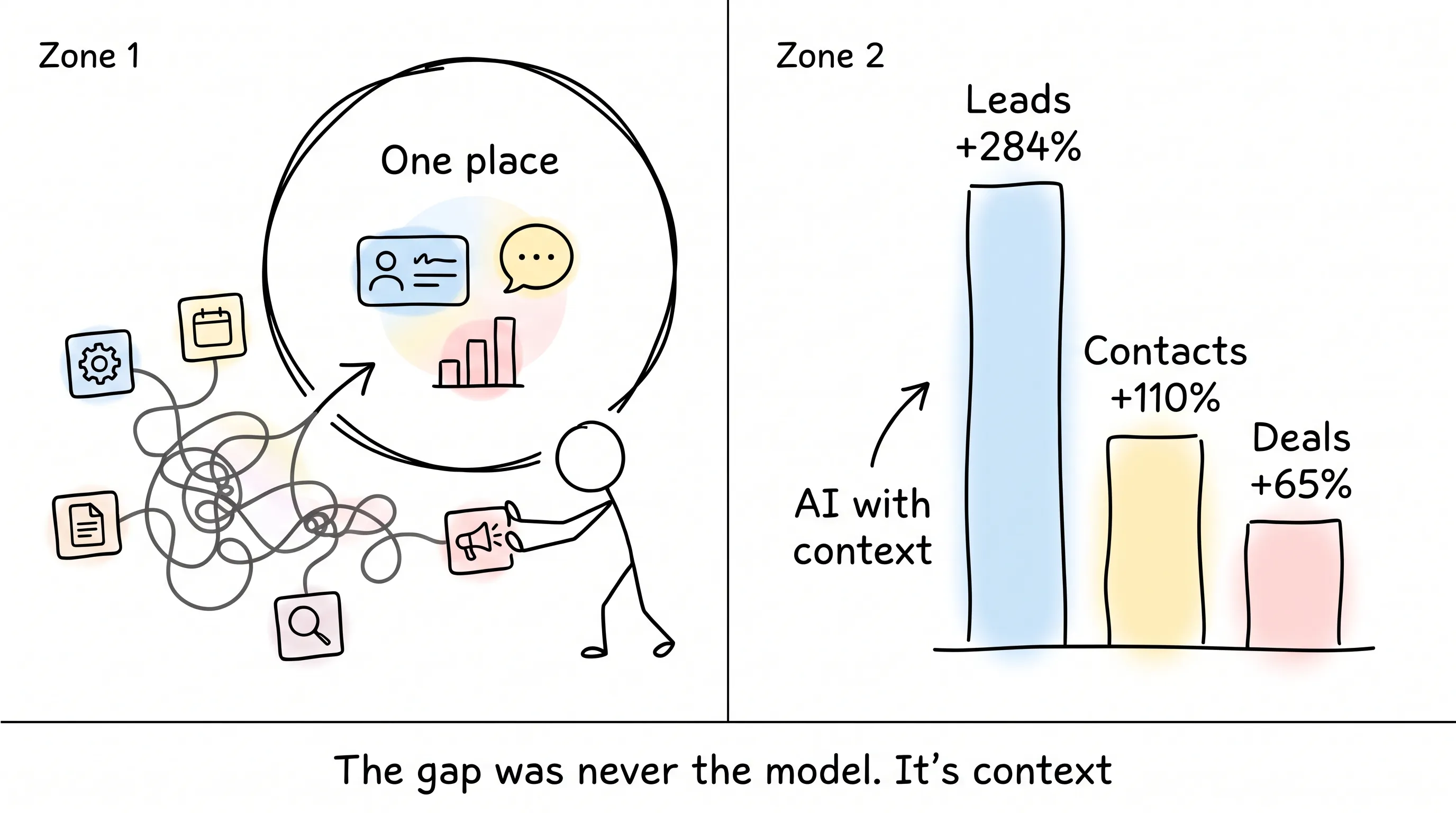
HubSpot put its own platform's customers who use AI side by side with those who don't. The result was lopsided:
Leads, up 284%. New contacts, up 110%. Deals, up 65%.
Why?
The answer is almost embarrassingly plain. These customers connected all the data and context AI needs to do its work in one single place: HubSpot's CRM.
Think about it. However smart the AI, it still has to know who you are, where this customer's conversation stands, how the last campaign performed. If that information is scattered across five tools, AI can only guess. Only when it's all in one place can it actually do the work.
So the AI gap was never about the model. It's about context.
Back to That Dinner
Later that evening, I walked my friend through this whole line of reasoning.
He went quiet for a moment, then said: no wonder. We've had AI cranking out content, but we never once let it look at our data.
I told him: you're already ahead of most people. Because now you know where to aim your changes.
Here's a wish, for you and for him alike: don't settle for AI as your writer.
Let it read your books.
Continue reading
Related articles

What Is AI Marketing Automation? It Starts With a 40-Point Gap
A learn article explaining what AI marketing automation is: how learning-based systems differ from rule-based automation, how AI decisioning optimizes message, channel, and timing choices, what data it depends on, and where it applies across the customer lifecycle.

Marketing Automation Is Shifting from "You Do It" to "You Say It"
This article explains how marketing automation is shifting from rule-based platforms that merely execute toward AI agents that plan, create, publish, and review campaigns, covering delegable tasks, underlying technologies, tool categories, adoption steps, and risks such as privacy and automating without strategy.

Rankings Are Taking a Dive, Customers Are Sprinting Ahead: This November, I Re-Ran the Numbers on AI Search
A learn article on how AI search reshapes marketing measurement, covering reported mismatches between rank-tracking tools and live Google results, ChatGPT's business profile test, single-page visitors as high-intent leads, and CRO plus GA4 tracking verification practices.