
12 AI Marketing Case Studies That Make One Point Crystal Clear: Stop Treating AI as a Tool
A learn article analyzing twelve brand AI marketing cases—from virtual try-on and voice ordering to AI-generated localized video ads—arguing that results come from building AI into structured workflows rather than using it as a writing tool.
A few days ago, an old friend of mine who runs an e-commerce business invited me out for tea. He said his team had been using AI like crazy—content output had tripled—but conversion rates hadn't budged, and the boss was starting to frown.
I told him this didn't surprise me. You've been treating AI as your copywriter. The brands that are actually making money have built AI into a system.
What do I mean by a system? Let's dig in.
First, an Uncomfortable Truth
For the past two years, whenever AI marketing comes up, nine out of ten people are talking about which model to use or which tool works best. But go study the brands that have actually delivered results, and you'll notice something interesting:
They didn't win because their knife was sharp. They won because their kitchen had method.
Long before AI took over everyone's feeds, some brands had quietly built AI into their operating workflows. Where the data comes from, how the brand message is defined, how content gets produced, who makes the final call—all crystal clear, repeatable, scalable.
And on the flip side, why do most AI marketing experiments go nowhere? The reason is almost always the same: they treat AI as a content generator and manage nothing else around it.
The teams that genuinely get results from AI all do three things right:
- Data sources are crystal clear, and brand standards are written down in black and white;
- Workflows are structured and can be repeated over and over;
- People sit at the key decision points, setting strategy and making the final calls.
Sound abstract? No worries. Let me tell you a few stories.
Let Me Tell You a Few Stories
Story One: The "Skin Analysis" That Tripled Conversion Rates
L'Oréal owns a technology called ModiFace, plus a tool called SkinConsult AI. What do they do? You take a photo, it tells you what condition your skin is in, and recommends products along the way; lipstick, hair color—you can try them all through the camera.
By 2020, these services had logged more than 1 billion cumulative visits. Even more striking: in 2019, L'Oréal published a figure—any website or app that offers virtual try-on sees conversion rates rise roughly threefold.
Think about it: a customer standing at the shelf agonizing over "does this shade suit me," versus seeing the effect on her own face through the camera—those are two completely different states of mind. What AI does is turn "I'm not sure" into "I've seen it."
Here, AI isn't doing any copywriting. It's a sales associate that never sleeps.
Story Two: A Voice Assistant Named Dom
In June 2014, Domino's did something almost nobody else was doing at the time: it slipped a voice assistant called Dom into its own app. You say a sentence to it, and the pizza's ordered.
Note the timing: 2014. Back then, most people hadn't even touched a smart speaker.
What did this do for Domino's? It added one more always-open ordering channel, and along the way earned the brand a "tech pioneer" persona. For a pizza company, the easier ordering gets, the more orders come in. Wire conversational AI into your core transaction, and you're wiring in money.
Story Three: Predicting When You'll Crave Coffee
Starbucks has an internal system called Deep Brew. It looks at your order history, the time, the weather, where you are—and then takes a guess: are you craving an iced Americano right now?
If the guess lands, you order without thinking. The more you use it, the better it guesses; the better it guesses, the more you use it. Once the flywheel spins up, this app is no longer an app. It's a habit.
We've all seen the results: order frequency went up, and so did average order value.
Nike runs the same play. It uses app usage data, purchase history, and social signals for personalized recommendations—like opening a private studio for every user. Nike never published the exact numbers, but the direction is clear: predictive AI turns data into repeat purchases, and repeat purchases into LTV (lifetime value). It's the kind of metric CFOs love.
Story Four: 130,000 Videos, Every One Naming a Local Shop
This one is my favorite.
Right before Diwali (the Indian festival of lights) in 2020, Cadbury did something in India: it used AI to synthesize the face and voice of Bollywood superstar Shah Rukh Khan and mass-produce video ads. Where's the genius? In every single video, the superstar says the name of one particular small local store.
The corner grocery store near your house, named by a superstar.
How many videos got generated in the end? More than 130,000. These are the numbers from the agency Ogilvy: YouTube engagement was 60% higher, Facebook 90% higher, and Cadbury Celebrations sales rose 35% over the previous Diwali.
In the past, "one ad per store" was unthinkable—the cost alone ruled it out. Then generative AI arrived, and suddenly emotional, hyper-localized storytelling could be mass-produced.
Story Five: Real Money Hiding in Email Subject Lines
You've probably received emails from the fashion e-commerce site Farfetch—so many that opening them long ago became something you do numbly. They hired a company called Phrasee to use AI to optimize the wording of email subject lines, preview text, and call-to-action buttons.
The results: promotional email open rates up 7%, automated email open rates up 31%, click-through rates up by as much as 38%.
You might say, "Seven percent is worth bragging about?" Do the math: email is an existing channel, the user base is already there, and without adding a single cent of spend, just changing the wording produced that many extra clicks.
The most mature channels often bury the most neglected gold mines.
The Rest, Quickly
In early 2020, Coca-Cola brought "Share a Coke" to Alexa in Australia. You say "Alexa, Share a Coke," and a bottle printed with the name you choose gets delivered to your door, free. A double win for engagement and word of mouth—and another round of "this brand knows how to play."
From February 2023, BuzzFeed ran Infinity Quizzes, using OpenAI's API to generate a personalized result for every quiz taker: editors set the concept, AI handles one version per person. In effect, it served every niche audience it could never before afford to serve.
Sephora's Virtual Artist stitches AI facial analysis together with AR to let customers try on makeup in real time. The biggest fear in beauty shopping—"it won't look good on my face"—got dismantled; conversion climbed, and so did trust.
In November 2018, Lexus had IBM Watson analyze 15 years of luxury car advertising and write a commercial script, then had an Oscar-winning director shoot it. They announced it as the world's first commercial scripted entirely by AI. The performance data? Not one word in the official press release. Sit with that: the value of this ad was always in "telling an innovation story," not in moving product.
In October 2024, the hardware brand Hettich—the "invisible business" that makes furniture hinges and drawer slides—ran "Roast The Room" on Instagram in India: AI first generated four messy rooms for people to roast, then generative AI renovated them one by one using the company's own storage hardware. It went viral, with massive participation. A B2B manufacturing brand broke out of its niche by "letting users roast rooms."
Unilever built its own U-Studio network—by 2018 it had spread to 17 studios across 12 countries—and later added a system for AI-generated ad content. Here's the math: content costs run about 30% lower than outsourcing; by 2025, they said AI had sped up asset production by 30%, and video completion rates and click-through rates had doubled.
See the Common Thread?
That's all twelve cases. Look back over them, and you'll find something more fundamental:
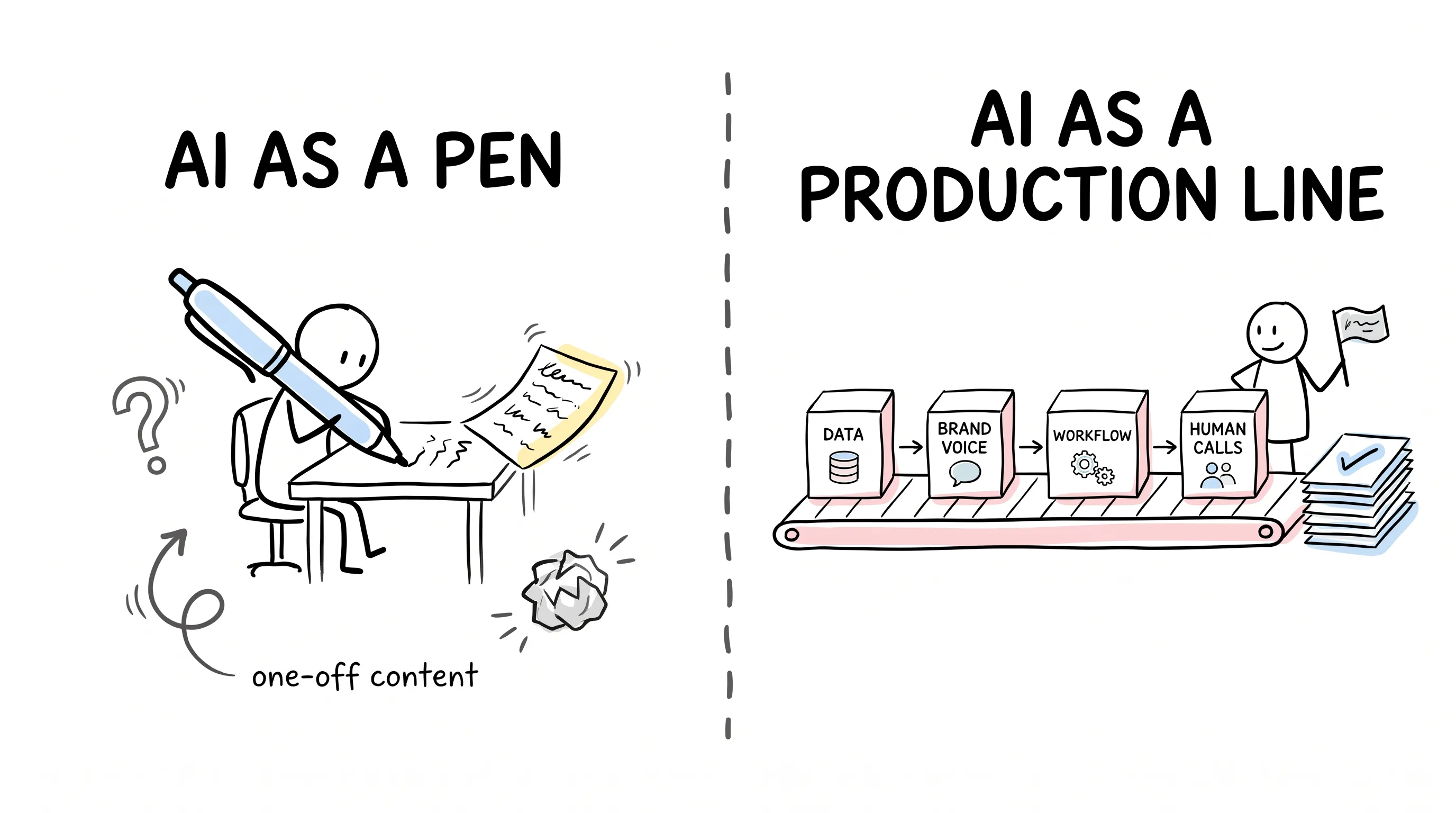
These brands didn't treat AI as a pen. They treated AI as a production line.
What is a production line? Where assets come from—there's a map. What the brand voice is—there's a document, and the team actually executes against it. Prompts are structured, not jotted down wherever inspiration strikes. Whether the output is good—there's a scorecard and governance standards.
In one sentence: for these brands, brand voice doesn't rest on feel. It rests on infrastructure.
Every successful campaign here moved past the "use AI to write faster" layer and built an entire operating system around content production. That's also why others can't copy them: you can copy their tools, but you can't copy their method.
Want to Copy the Homework? First See What the Homework Looks Like
Reading case studies is addictive; reproducing the results is hard. Where do most teams get stuck? The passion is there. The tools are there. The method isn't.
For a marketing team to go from scattershot AI experiments to a controllable, brand-safe content pipeline, it needs at least these things in place:
- An asset map—first take stock of what you already have that's usable;
- A brand voice document that is actually executed—not the one gathering dust in the cloud drive;
- A framework, plus a structured prompt library;
- A set of evaluation criteria, plus a QA scorecard;
- A 30-day launch plan.
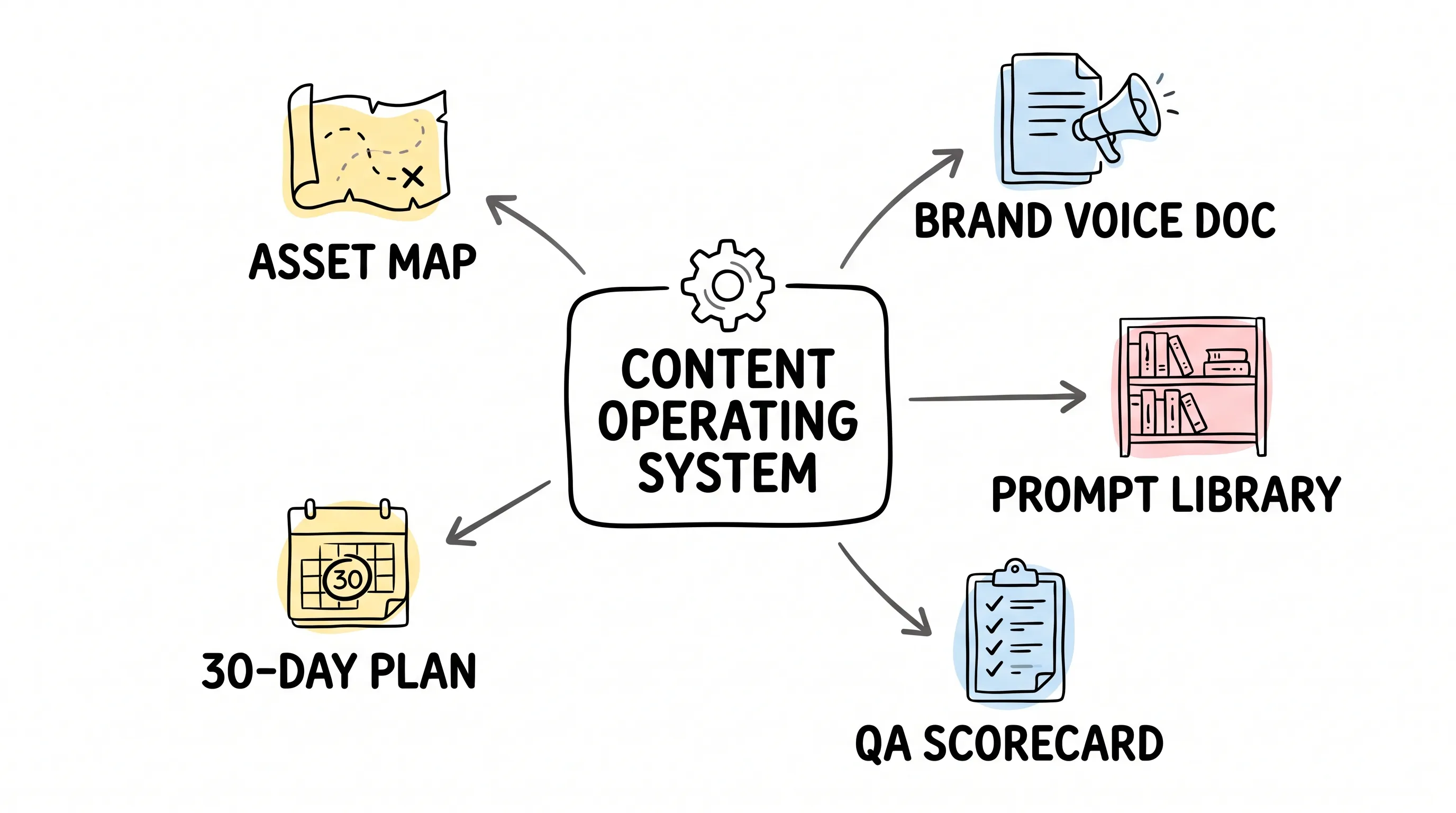
If your team looks like this right now—AI is producing more content, sure, but rework comes wave after wave, brand messaging swings up and down, and the boss doesn't dare use any of it directly—then no amount of prompts will save you. What you're missing is the operating system that runs alongside content production.
Back to My Tea-Drinking Friend
When we finished tea that day, the last thing I told him was: stop competing on whose model is newest. It's meaningless. Models are utilities—everyone has them.
The real gap lies in the system you build around it.
Tools will keep getting cheaper. The system is the moat.
Here's wishing you an early upgrade of your AI—from "the one who writes" to "the one who understands the business."
Continue reading
Related articles

When AI Does the Creative, Mistakes Come in Batches Too
A learn article on the risks of using generative AI for marketing creative across brand, legal, compliance, and operational layers, with case examples and seven practices for review, rights clearance, documentation, and vendor governance.
Which AI Should Your Startup Actually Use for Marketing?
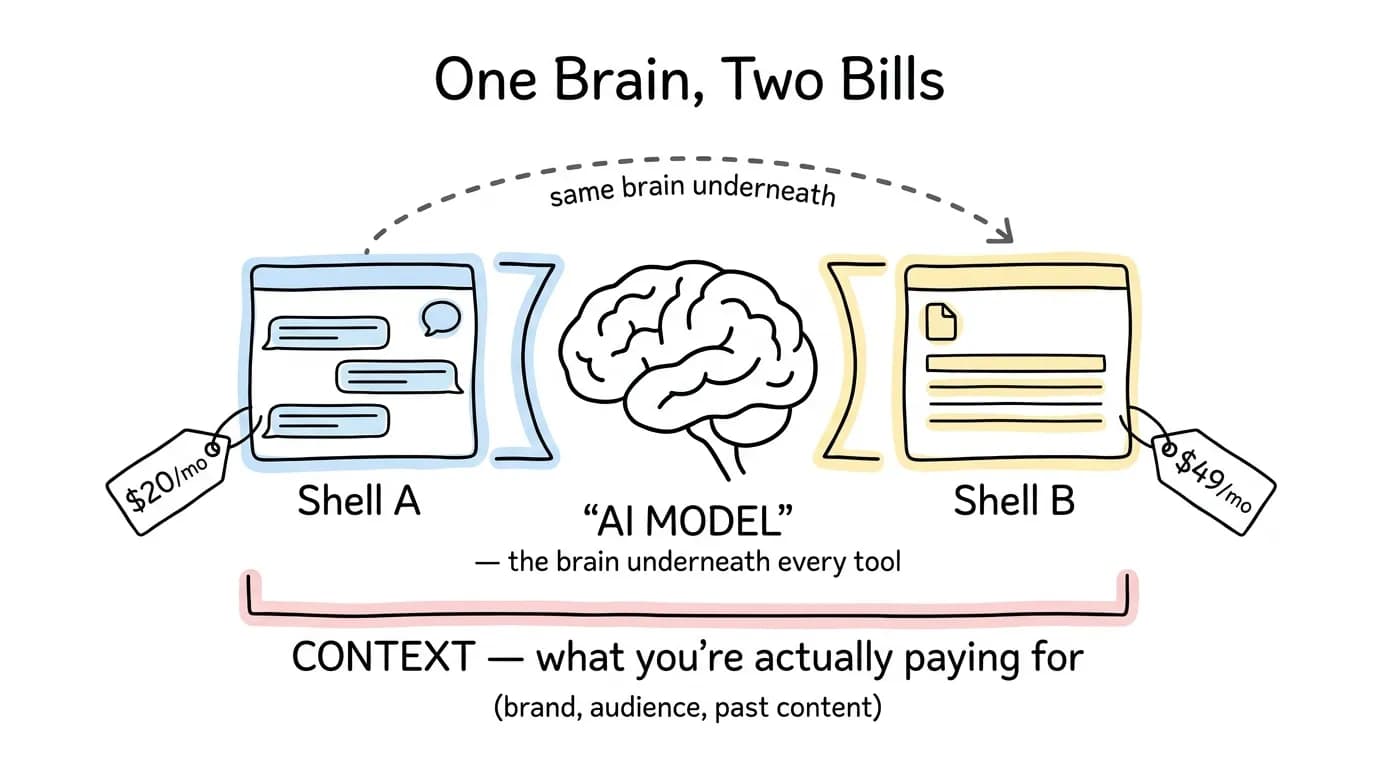
A startup marketing guide explaining the difference between AI models and tools, sorting tools by job (writing, research, design, leads, email, video ads), and outlining a 30-day test plan for choosing them. It also covers generative engine optimization and budget trade-offs.
31 AI Marketing Tools, Reviewed One by One: How Exactly Should You Spend the Money?
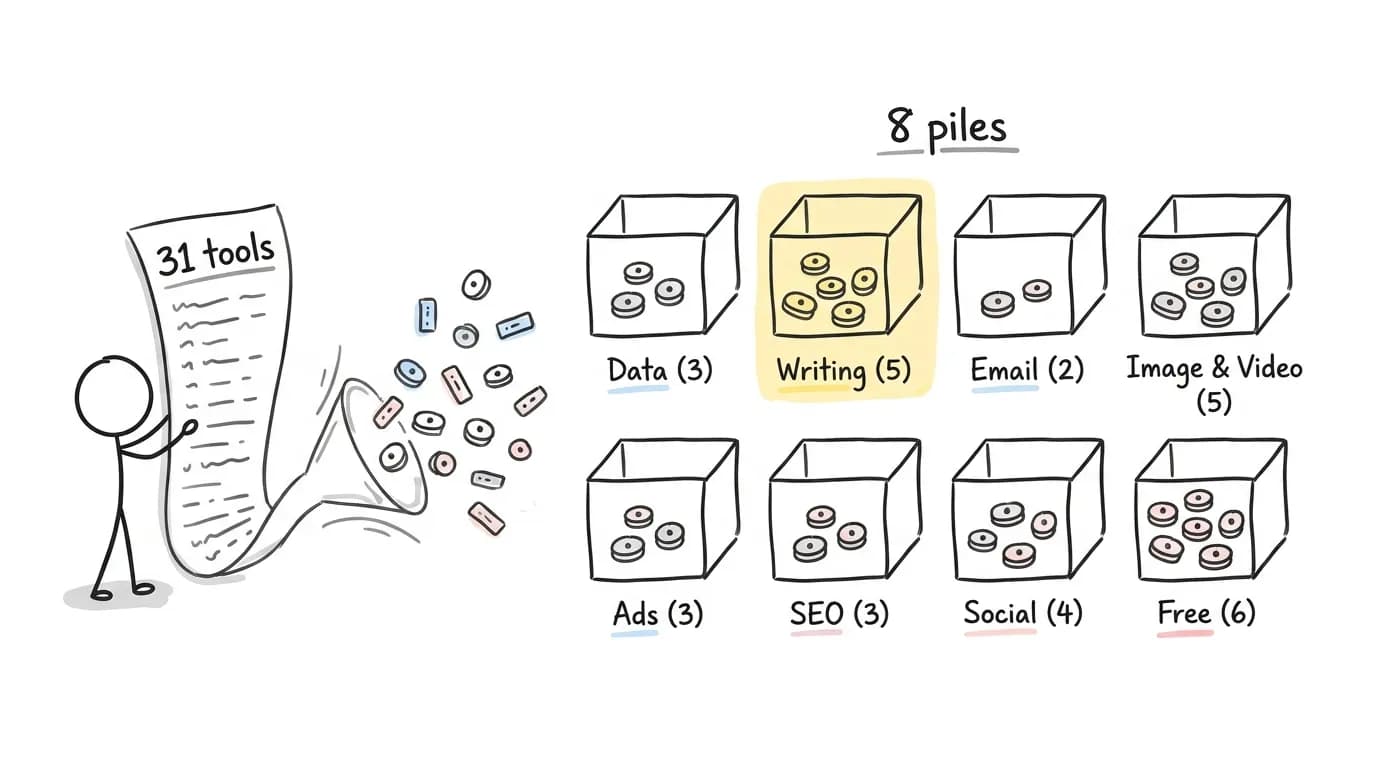
A review of 31 AI marketing tools grouped into eight categories, covering data, content, email, video, ads, SEO, social, and free options, with guidance on choosing one strong tool for your most frequent task and testing free tiers first.