
The Money AI Saves Doesn't Show Up on the Payroll
A commentary on a small qualitative study of six Chinese cross-border sellers: AI savings show up on outsourcing and software bills, not payroll. Includes practical advice on auditing tool costs and outsourcing spend.
A while back, I came across a rather unusual study.
The researchers did something refreshingly plain: they found six small and mid-sized Chinese sellers doing cross-border e-commerce, and sat down with five of the owners and one operations manager, one by one. No grand themes. Just one question: over 2025 and 2026, what changed in the work of preparing content, coordinating customer service, looking things up online, and sorting out software?
Six sellers, none of them big, and what they shared was mostly a running account of day-to-day details.
But read it through, and you'll find that this running account holds plenty of things you won't see in a big company's report.
First, a Tale of Two Tools
One seller bought a research tool called WorkBuddy. Paid for two months, then stopped.
Why?
Because the tool kept making mistakes and didn't take direction well. He gave it a fair try, and in the end discovered: rolling up his sleeves and doing the research himself was actually faster.
This, mind you, is not the script we're used to hearing. The script we always hear is "AI crushes human labor." But this seller voted with real money: in his specific scenario, the human beat the tool.
Another seller does business on AliExpress. In the first half of 2026, he had someone build him an inventory system with Claude. Once the system was up and running, he canceled his Guanjiapo ERP subscription (a long-running Chinese accounting and inventory software popular with small businesses).
Note what he canceled: the ERP subscription. The other tools, the servers — those expenses kept getting paid right on schedule.
You see, this is what a real bill looks like. When AI comes in, what gets saved is a very specific sum — the money that used to go to one particular piece of software. Not the imagined "we're saving on everything."
What Counts as External AI?
So what is external AI, exactly?
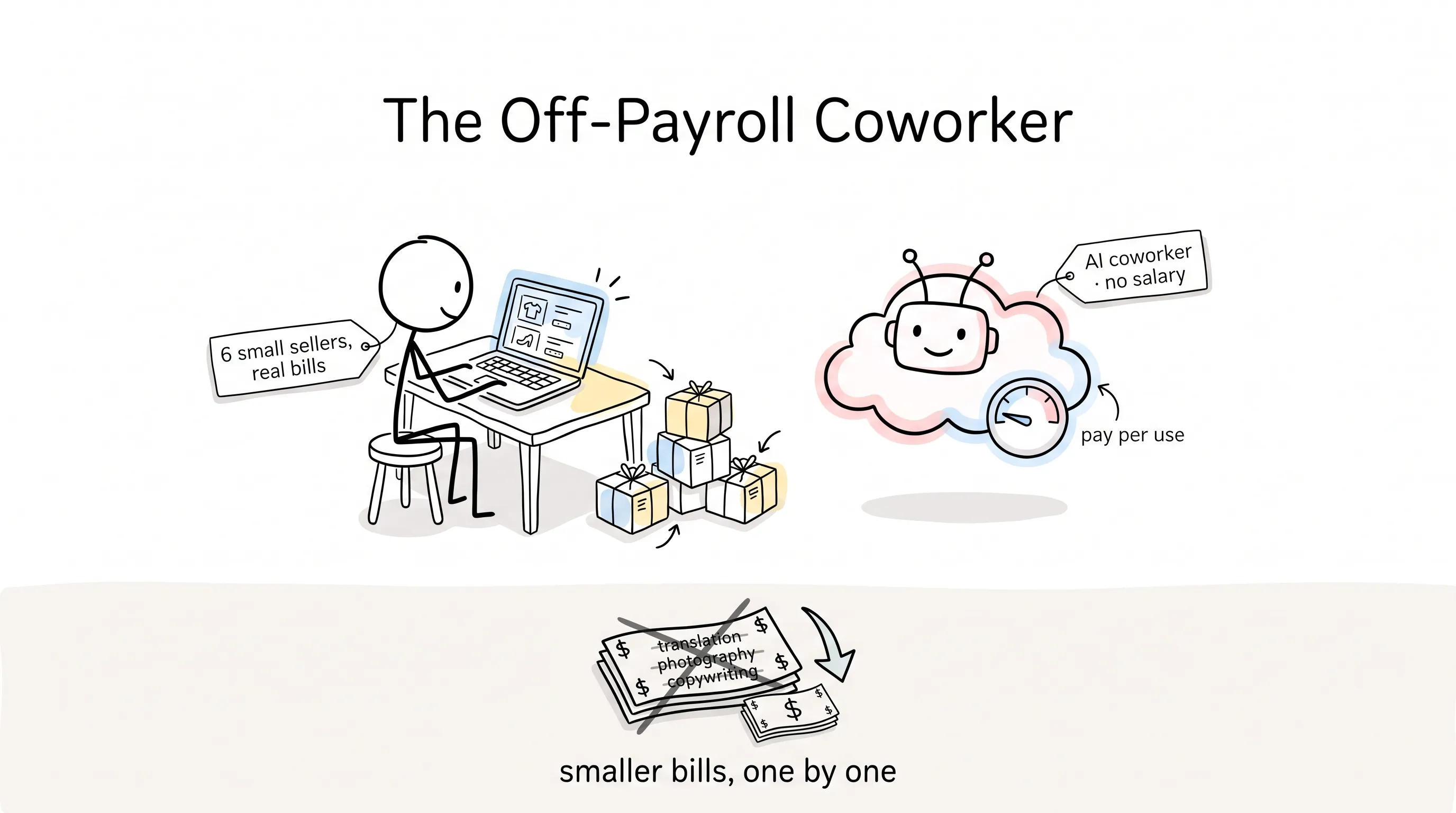
Plainly put: it's the "coworker" you never pay a salary. No benefits contributions, no desk, paid by usage — and a lot of that usage is simply free.
The most fascinating part of this study is watching how these sellers redrew the division of labor with this off-payroll coworker.
Three companies saw their spending on translation, photography, and content production go down. Note: what went down was outsourcing spending. The employees' base salaries didn't move by a cent.
At another company, the services bought before and after AI simply weren't the same batch — the spending can't be compared side by side.
And one employee, because AI took over the tasks, was reassigned to a different role. The company's total payroll didn't go down.
See the pattern?
The money AI saves doesn't sit on the payroll. It sits on the outsourcing bill.
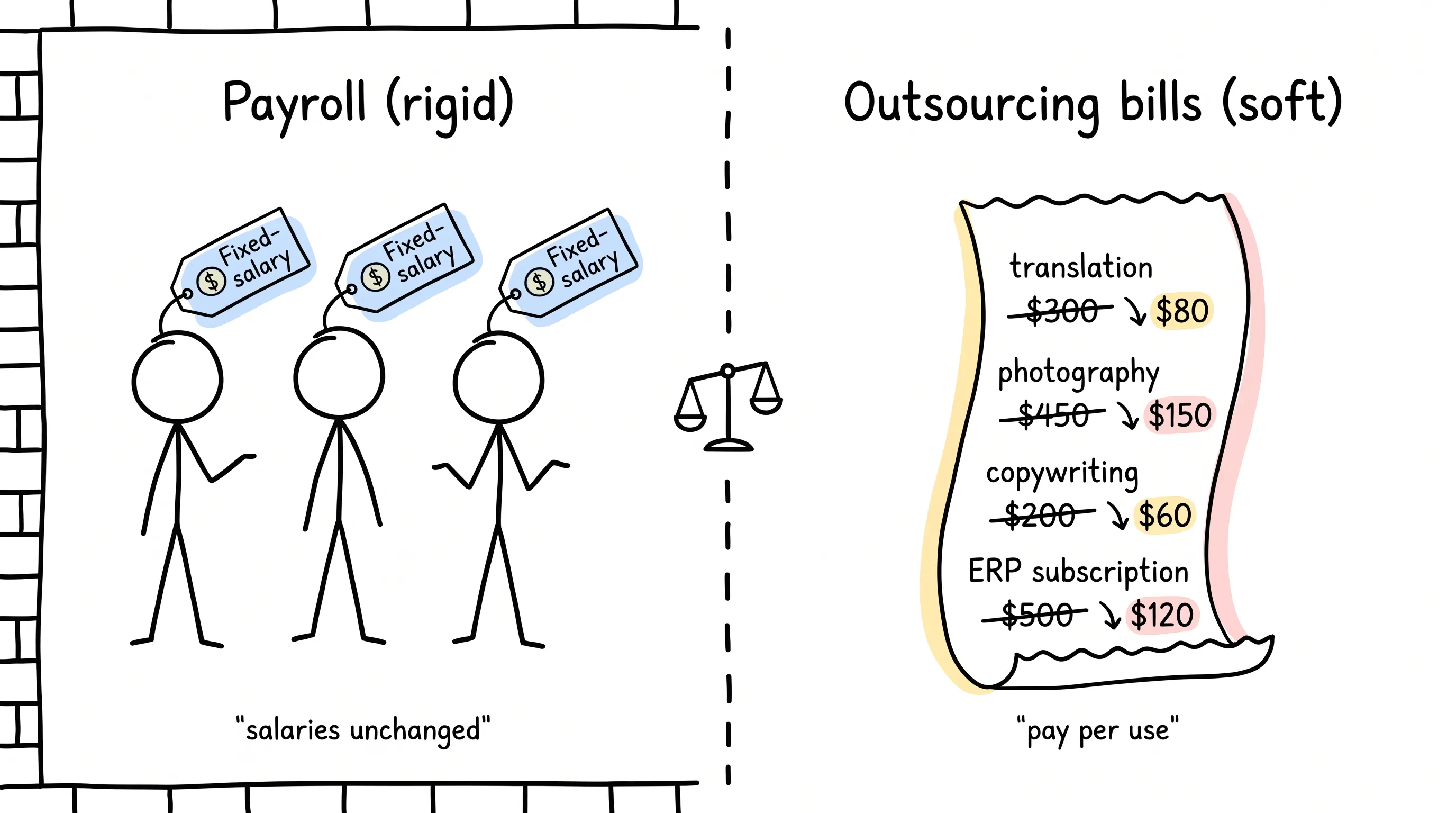
The cost-cutting many bosses imagine is layoffs. But the real sample these six sellers provide says otherwise: the first thing AI squeezes out is those pay-per-use external services. A translation job, a photo shoot, a piece of copy — that money used to leak out in small drips; now it's trickling back the same way.
Payroll is rigid. The people are already in place, and the work always needs someone to backstop it. Outsourcing is the soft spot.
Can This Ledger Actually Be Computed?
Honestly? No.
The researchers themselves were upfront about it: every number came from the sellers' own recollections — ballpark figures, never checked against invoices. How much each company handed over to AI also varied widely, so there's no way to force the finances into a "net return." As for whether AI brought in more orders, any causal conclusion is off the table.
Some might say this study is awfully rough.
I'd argue that's exactly what makes it valuable.
Think about it: if you asked a seller to open the books and match numbers, odds are he'd hand you a flattering version. A casual "so, roughly how much did you spend last month?" gets you closer to the truth. A lot of truths in the business world hide inside precisely these imprecise numbers.
And there's one detail I especially like: not one of these six sellers was picked off the street by the researchers. Every single one came through personal or business acquaintances.
What does that mean?
It means the sellers who are seriously figuring out "how to save money with AI" aren't necessarily watching videos to learn methodology. More often, they're at the dinner table or in peer group chats, passing along word of mouth: "What are you using? Does it actually work?" The way AI spreads through the small-seller circle is the way any "new business know-how" has always spread — through networks of acquaintances.
So How Should You Read This Ledger?
Let me give you three reminders, all bought with real money by these six sellers.
First, don't start with the grand total. Start with something unglamorous: list every job you used to outsource — translation, photography, copywriting, research. Once the list is done, look at which of those AI can take over. To understand these changes, you first have to understand what work the money used to buy, and what work employees have now taken over.
Second, give a tool two months of patience — but no more. That WorkBuddy seller paid for two months, found the tool error-prone and disobedient, realized a human was faster, and cut his losses without hesitation. If a tool doesn't work, swap it. Audit the bills often.
Third, the savings may hide in surprising places. What gets saved usually isn't "people" — it's software fees and outsourcing fees. The AliExpress seller canceling Guanjiapo ERP is a living example.
Finally, Back to Those Six Sellers
They have no grand narrative of "cost reduction and efficiency gains," no claims of efficiency leaping thirty or fifty percent overnight. They simply found: the translation bills got a little smaller, one piece of software no longer needs renewing, one employee can now go do more valuable work.
All small things.
But chain these small things together and a fact comes into view: AI entered small business with no fanfare, no drumroll — just small bills, one by one, quietly getting smaller.
Transformation never starts in a boardroom deck; it starts in a seller's bills.
These six sellers haven't done badly at all.
May you find, in your own bills, the few line items worth cutting.
Continue reading
Related articles

What Is an AI Marketing Agent? From "Using AI" to "Delegating to AI"
A learn article explaining what an AI marketing agent is, how it differs from rule-based automation, and which repetitive tasks such as lead qualification, reporting, and campaign monitoring can be delegated while humans keep key decisions.

Marketing Automation Is Shifting from "You Do It" to "You Say It"
This article explains how marketing automation is shifting from rule-based platforms that merely execute toward AI agents that plan, create, publish, and review campaigns, covering delegable tasks, underlying technologies, tool categories, adoption steps, and risks such as privacy and automating without strategy.

When AI Does the Creative, Mistakes Come in Batches Too
A learn article on the risks of using generative AI for marketing creative across brand, legal, compliance, and operational layers, with case examples and seven practices for review, rights clearance, documentation, and vendor governance.