
In AI Search, Keep Two Ledgers
A guide to tracking branded and unbranded queries separately in AI search, explaining visibility rates, prompt coverage, share of voice, citations, and a branded-to-unbranded ratio, with weekly review steps and a look at HubSpot's AEO tool.
Picture two people shopping for shoes.
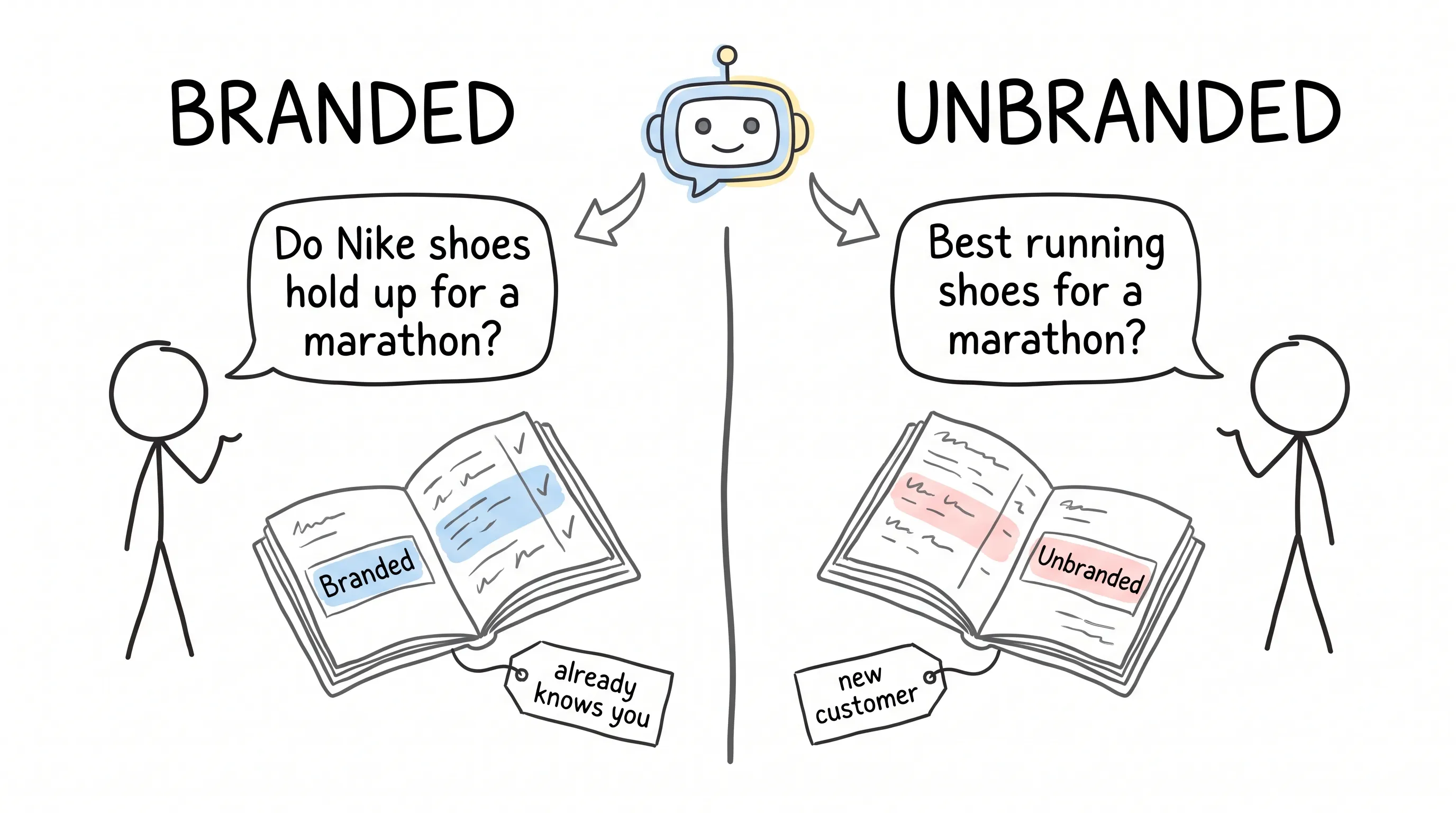
One asks ChatGPT: "Do Nike running shoes hold up for a full marathon?"
The other asks: "What are the best running shoes for a marathon?"
Both want a good pair of shoes. But look closer — these are two completely different kinds of customers.
The first came looking for you by name. The second — there's no telling who they'll end up with.
In AI search, these two kinds of questions belong in two separate ledgers. Lump them together, and you'll most likely end up fooling yourself.
First, Tell the Two Kinds of Questions Apart
What counts as a branded query?
Any question that contains your name. Company name, product name, even common misspellings. "Is Nike good for a full marathon?" is one. "How are the Air Force 1 running shoes?" is too, because a product name is a variant of the brand.
The value of these questions: this person already knows you. They're here to check the goods, compare prices, or have AI confirm before they pay — "I'm not choosing wrong, am I?"
What counts as an unbranded query?
A question with no brand name in it at all. They only mention the category, the pain point, the use case.
"What are the best shoes for a marathon?" — that's a category. "How do I get more people to open my emails?" — that's a pain point. "What tool can send welcome emails automatically?" — that's a use case.
The value of these questions: whoever the AI names is who steps into the new customer's line of sight. The AI doesn't name you? Then you may never even get on the field.
New customers almost always hide inside unbranded questions.
This isn't new to AI search. Traditional search drew this line long ago: in November 2025, Google added a branded-queries filter to Search Console that automatically splits the two kinds of queries apart. If traditional search takes this accounting this seriously, AI search has no excuse not to.
Oh, and there's a trap worth defusing up front. Some questions name only your competitors — "What are the alternatives to Mailchimp?", for instance. Branded, yes — but not with your brand. File those in a category of their own. Don't toss them into the unbranded pile, or the numbers will lie to you later.
Why You Can't Mix the Two
Here's a story about a restaurant.
A regular walks in and asks, "What's today's special?" A newcomer peers in from the doorway and asks, "Which place around here is worth eating at?"
If you log both groups into the same number, can you tell whether business improved because new customers started coming in, or because regulars started coming more often?
You can't.
AI search works exactly the same way. Let me run the numbers for you.
Say you track 500 AI answers:
Branded questions: you asked 100, and 90 of the answers mentioned you. Visibility rate: 90%.
Unbranded questions: you asked 400, and 80 mentioned you. Visibility rate: 20%.
Blend them together: 170 divided by 500. That's 34%.
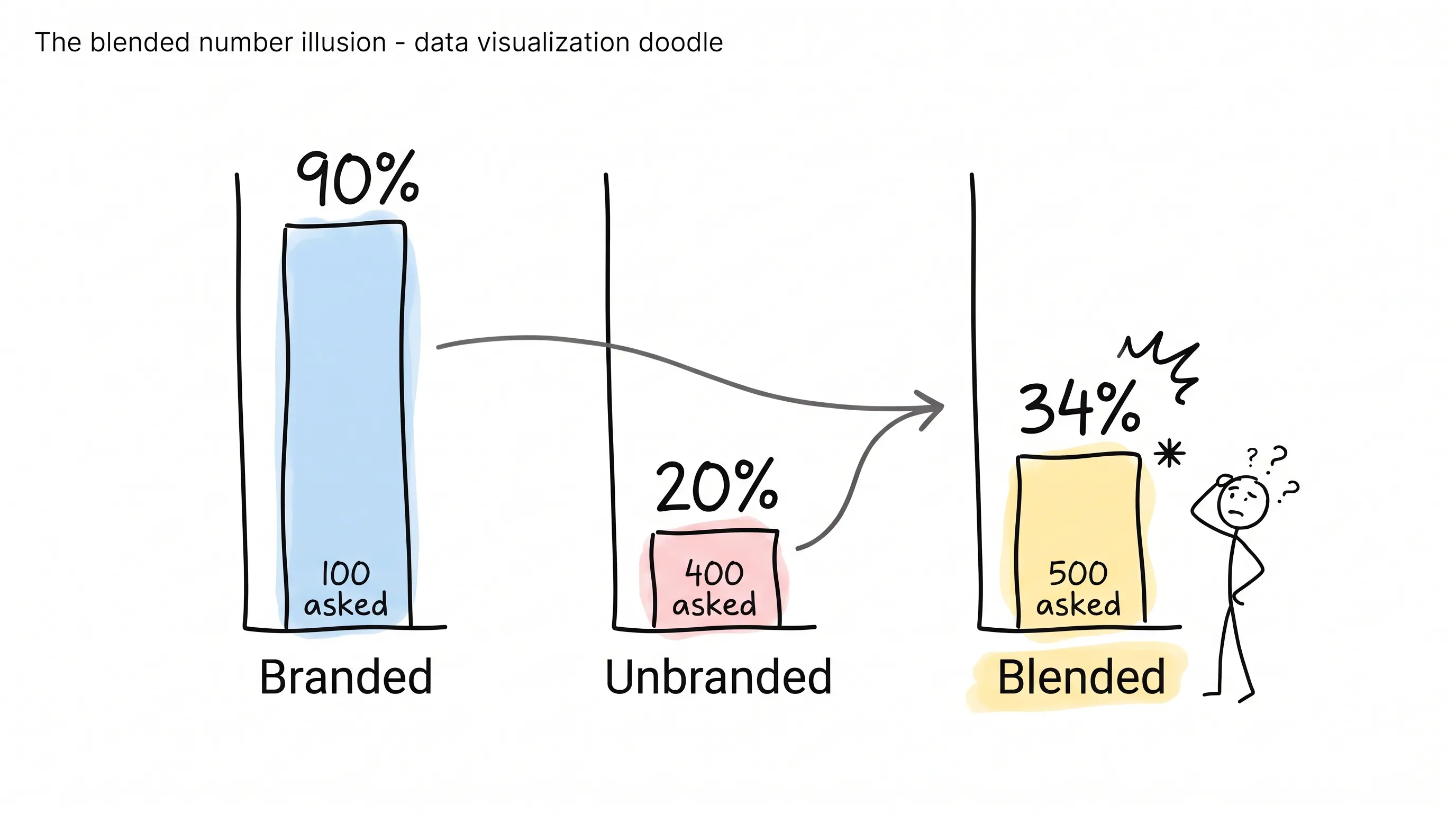
34%. Sounds pretty respectable, doesn't it?
Here's the truth: of the people who don't know you, only two out of ten will ever run into you. Now throw in 50 more branded questions — the overall number keeps climbing, and it looks great. New-customer discovery? Doesn't move an inch.
Growth measured on a blend is, more often than not, an illusion.
So How Do You Track It
Two layers. Tools run every day; you look every week.
Why run daily? Because AI answers are probabilistic. SparkToro and Gumshoe.ai ran a test: ask ChatGPT the same question twice, and the odds of getting the same brand list both times are less than one in a hundred. Same list and the same order? Roughly one in a thousand.
That's staggering. Which means the ranking you see today may look like a completely different picture tomorrow.
So a single day's numbers don't count — watch the trend over several weeks. And be mentally prepared: some engines, on some days, simply won't give you a usable answer. Record it as a gap, not a zero.
Four concrete steps. First, build the library:
- Merge prompts that are asking about the same thing.
- Tag every one: running or paused; which buying stage it belongs to; branded or unbranded; whether it names a competitor.
- Assign each one an audience segment and a region. A buyer in Toronto and a buyer in Texas may get different answers — don't mix them.
- Run it. Collect at least two weeks of data before you draw conclusions.
Then three fixed weekly chores: check for gaps; pull out the two visibility rates separately; compare against the past four weeks, not against yesterday.
And keep three rhythms in mind: results reviewed weekly, tags quality-checked monthly, the prompt library refreshed quarterly — the moment your product, audience, or competitors change, start early.
How is the visibility rate calculated? Take the number of answers that mention you, divided by the total number of answers in the batch. It's that simple.
How to Read the Numbers
Four terms. Learn to tell them apart first.
Branded visibility rate: of the answers to your branded questions, what share mention you. If 70 out of 100 do, that's 70%.
Prompt coverage: of all the questions you track, in how many did you show up at least once.
Share of voice: of all brand mentions, what share is yours. Yours plus your competitors' — together they make the denominator.
Citations: which web pages the AI pointed to when it answered. Note this: citing you is not the same as mentioning you. An article can cite your page without your name appearing even once. Two different things.
One more reminder: don't fall in love with rankings. That same study also found that the order in which brands appear is even less stable than how often they appear. Trust frequency a little. Take order with a grain of salt.
Once you can read the two rates separately, tie them together with one number:
Ratio = branded visibility ÷ unbranded visibility
For the example above: 90 divided by 20. 4.5 to 1.
What does the ratio tell you? A high ratio means most of the people finding you already know you. A falling ratio means new faces are showing up.
If the boss wants only one number, which one do you give? The unbranded one. It's the hardest to grow, and it says the most about whether new customers can find you. 34% says "we're doing fine." Split apart, it says "our regulars can always find us — strangers run into us two times out of ten." Which version better helps you decide your next move? I don't need to spell it out.
Here's a real example. When HubSpot's own team took stock, they found their visibility weak at the awareness stage. So they built an FAQ glossary aimed squarely at the generic industry terms at the top of the funnel. After AI engines started citing the glossary, the branded visibility rate on awareness-stage questions rose by 35 percentage points.
35 points. That's a result they ran themselves — not some pie in the sky. But it proves one thing: the unbranded gap points, quite specifically, at the content you should go build.
How to Run the Weekly Review
Four steps.
First, read a handful of raw answers — five to ten is plenty. Who got named? How does the AI describe you? Is the description accurate? Does it do you justice?
Then look at citations. Which websites do the engines lean on? How much of it is third-party content — reviews, listicles, that sort of thing?
Next, log the competitors. Who shows up in the places where you don't?
Finally, write the decision. What to change, who owns it, when to check back.
Before you send the report, run through this list: state the time range and the engines clearly; give a denominator with every percentage; report the two rates separately; include the ratio and a trend line of four weeks or more; flag any changes to the prompt library; list the most-cited domains and mark which ones are third-party; state the limitations — answers will shift, some runs come back empty; and for every finding, pair one action.
A report with no actions in it is entertainment for the boss.
Is a Spreadsheet Enough?
With 20 prompts, a spreadsheet is more than enough.
When the engines start handing you hundreds of answers a day, the spreadsheet starts to hurt. That's when you let tools take over the daily grind, and keep your own attention on decisions.
Take HubSpot's AEO tool. On the ChatGPT, Gemini, and Perplexity engines you pick, it runs your prompts every day; from the product and audience you enter, it suggests a batch of starter prompts, which you can edit or add to; it slices results by topic, stage, and engine with groups and filters; it shows you the raw text of every answer; it keeps calculating visibility, coverage, and sentiment for you; and it breaks citations down by domain, channel, and content type.
One detail I really like: the scores and the raw answers sit side by side. Before you send a report, you can spot-check any number at a glance — right down to where it came from.
One small trap: branded and unbranded are not built-in labels in the tool. You have to bake the label into your prompt naming convention, separate the two piles with groups, and then pull the two rates out yourself to compare.
Just remember two numbers: the Standard plan tracks 25 prompts; Marketing Hub Enterprise goes up to 50. The tool is still in beta — for what it can and can't do, the knowledge base is the word.
Finally
Back to those two shoe shoppers at the start.
The one asking about Nike is already your customer. Asking AI is just rubber-stamping the decision.
The one asking "what's the best running shoe" hasn't decided who to fall for yet. The few seconds the AI spends answering — that's your only chance to meet.
Your regulars will find their own way to your door. New customers depend on whether the AI opens it.
Don't wait. Pick a few branded questions and a few unbranded ones, start recording the two rates, and keep your eye on the ratio. The answers change every day — so judge by weeks, not by a day.
Here's to a door that always stays open.
Continue reading
Related articles

It's 2026: Stop "Buying" AI Tools for Your Marketing Team — Start "Hiring" AI Agents
This learn article explains how AI agents differ from standalone AI tools in marketing, outlines three agent categories — build-your-own platforms, CRM-native agents, and vertical tools — and covers use cases across SEO, social media, advertising, and reporting, plus criteria for choosing one.

What Is GEO? How Your Brand Gets "Mentioned" in the Age of AI Search
An explainer on GEO (Generative Engine Optimization) for e-commerce and DTC brands: how it differs from SEO and AEO, why AI answers shape brand visibility, and eight practices covering question-focused content, consistent brand messaging, structured pages, external evidence, comparisons, and AI mention tracking.

AI Is Already Making Decisions for Your Customers. Are You on the List?
A learn article explains GEO (Generative Engine Optimization): why AI-generated answers now shape which brands customers see, and how SEO fundamentals, entity clarity, citable evidence, and monthly measurement affect visibility in AI answers.