
What Jobs Can AI Actually Do in Marketing? I Broke Down 5 Real Cases
A learn article breaking down five real brand cases where AI handled marketing tasks such as audience research, ad creative production at scale, influencer selection, and personalized outreach, with the results reported for each case.
A couple of days ago, scrolling through WeChat Moments, I saw someone share a case-study poster: a brand used AI for marketing, growth of several hundred percent, and three exclamation points for good measure.
The comments section lit up. One camp said: see, this is the future. The other camp said: survivorship bias — you only see the ones that made it.
Both have a point. But arguing doesn't settle anything; the answer hides in the numbers.
So I dug out five real cases and took them apart one by one: what exactly did AI do for the marketers? What did it save, and what did it earn?
When I was done, I found that inside a marketing team, AI really only does five kinds of jobs.
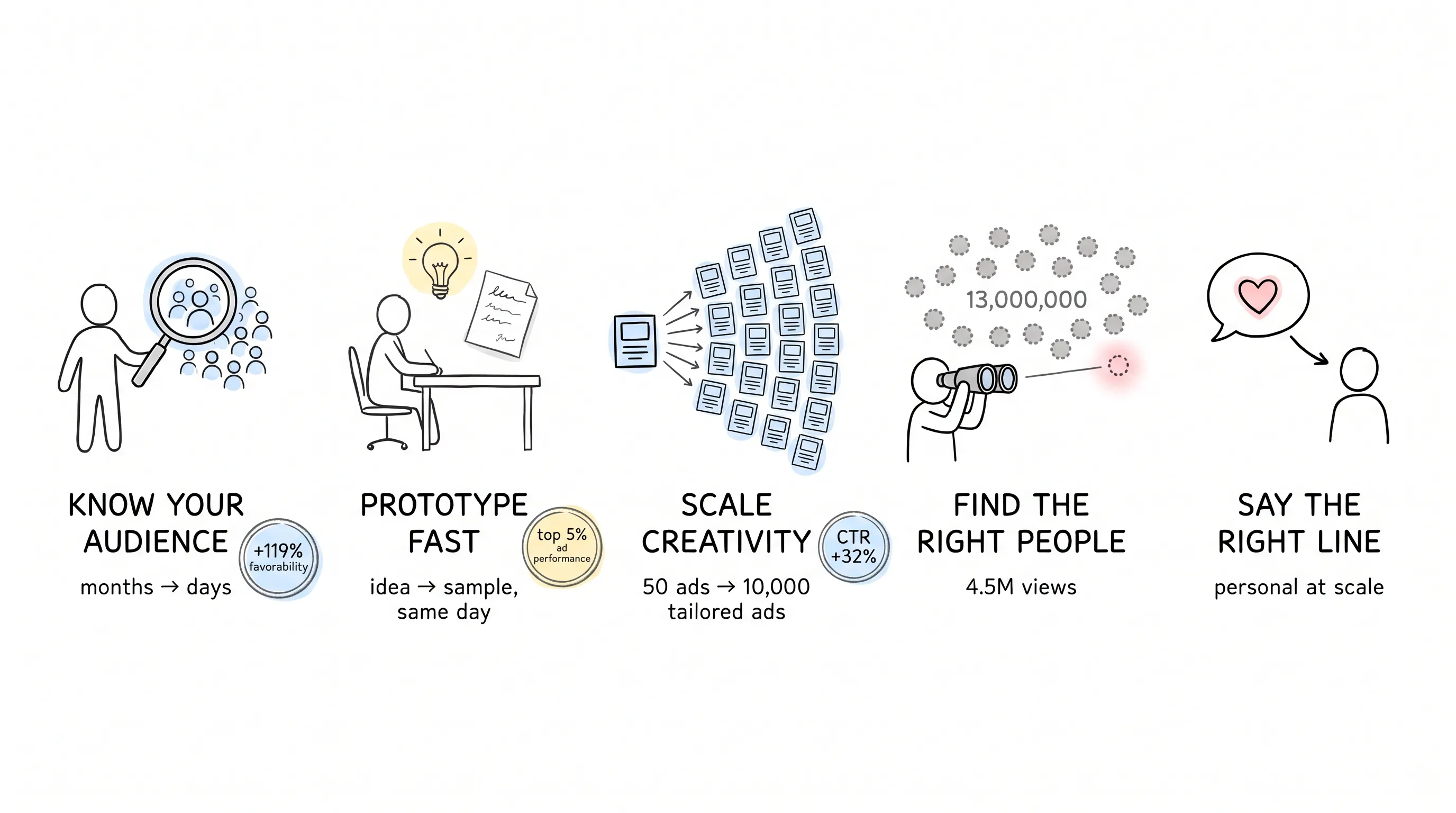
The First Job: Move Into Your Users' Heads for You
What's the first step in marketing? Studying people. The traditional way: run focus groups, send out surveys, and months later you get back a few pages of reports.
Zipcar, the car rental brand, did something different in 2023. They ran a campaign called "Zip If," powered by Merlyn, a tool built by the agency Supernatural. What does this tool do? It creates a crowd of virtual audience stand-ins — AI speaks on behalf of different typical users, then writes ad copy one line at a time in each of their voices.
The results? Brand awareness up 28%, brand recall up 81%, brand favorability up 119%.
You read that right. 119%.
Audience research that used to take months got compressed into a very short time. What's saved isn't just time — it's also that nagging feeling of "do I actually understand my users?"
The most valuable thing about AI isn't that it writes fast. It's that it turns "understanding your users" from a months-long job into a days-long one.
The Second Job: Turn Ideas Into Things You Can Look At, Fast
In 2024, Intuit Mailchimp ran a campaign called "clustomer," built to run targeted strategies for every kind of audience.
The way they used it is the interesting part: they didn't send AI straight to the front lines. They gave it two lighter jobs — coming up with ideas and building proof-of-concepts. Whenever the team had a direction, AI immediately produced the assets; whether they worked or not, try first and see.
Faster trial and error means sharper aim. This campaign's ad performance landed in the top 5% of Ipsos's database.
Think about it: how long did it used to take to go from kick-off to validation on a campaign? Now an idea can become a sample you can look at — the very same day. Every round of waiting you cut out is real money.
The Third Job: Turn One Ad Into Ten Thousand
The Foot Locker case is even more direct.
In 2024, it used generative AI to produce more than 10,000 product ads. Not 10,000 copies of the same ad — 10,000 tailored ones: different products, different audiences, each with its own pitch.
The result: click-through rate up 32%, while the cost of acquiring a single user actually went down.
The math here is simple. Before, you made 50 ads and gambled on which one would take off; now you make 10,000 and let the data pick out the ones that can actually run. Hit rate doesn't come from guessing. It comes from volume.
The bottleneck of creativity is shifting from "can't think of anything" to "can't ship fast enough."
The Fourth Job: Find the Right People Among 13 Million
When L'Oréal's Biotherm launched Aquasource Gel, it partnered with a company called BENlabs to do something that sounds simple: pick influencers.
From a database of 13 million people, AI picked out the group that matched this product best.
The results: 4.5 million views and 200,000 impressions.
Picking the right one person beats dumping a million on the wrong ones. Humans can do this too — it's just that AI reads data at a granularity no agent team can match. The media budget is only so big; find the right people, and every dollar goes where it cuts deepest.
The Fifth Job: Say the One Line They'll Actually Hear
The last one has the flashiest playbook.
Cruise line Virgin Voyages partnered with Jennifer Lopez and used AI to recreate a digital version of her, inviting guests out to sea — and bookings climbed.
Why does it work? Everyone wants to meet a big star, but a big star can't record a video for each one of you. With AI in the picture, "a message just for you" became something you can mass-produce.
The spectacle belongs to the star; the sincerity belongs to you alone. When those two feelings collide, conversion happens.
Five Jobs Done. Now for the Painful Part.
Look back at these five cases and you'll notice one thing: not a single brand won by saying "we used AI."
Zipcar used AI to understand users, Mailchimp used AI to speed up trial and error, Foot Locker used AI to scale volume, L'Oréal used AI to find people, Virgin Voyages used AI to speak. Five jobs, all old answers to old problems — AI just made the answers faster and cheaper.
So in those stories of "AI marketing failure," the problem usually isn't the AI.
It's in wanting AI to erase a step, without ever figuring out who that step existed for in the first place.
AI isn't magic; it's a lever. It only works if you know what you're trying to pry loose.
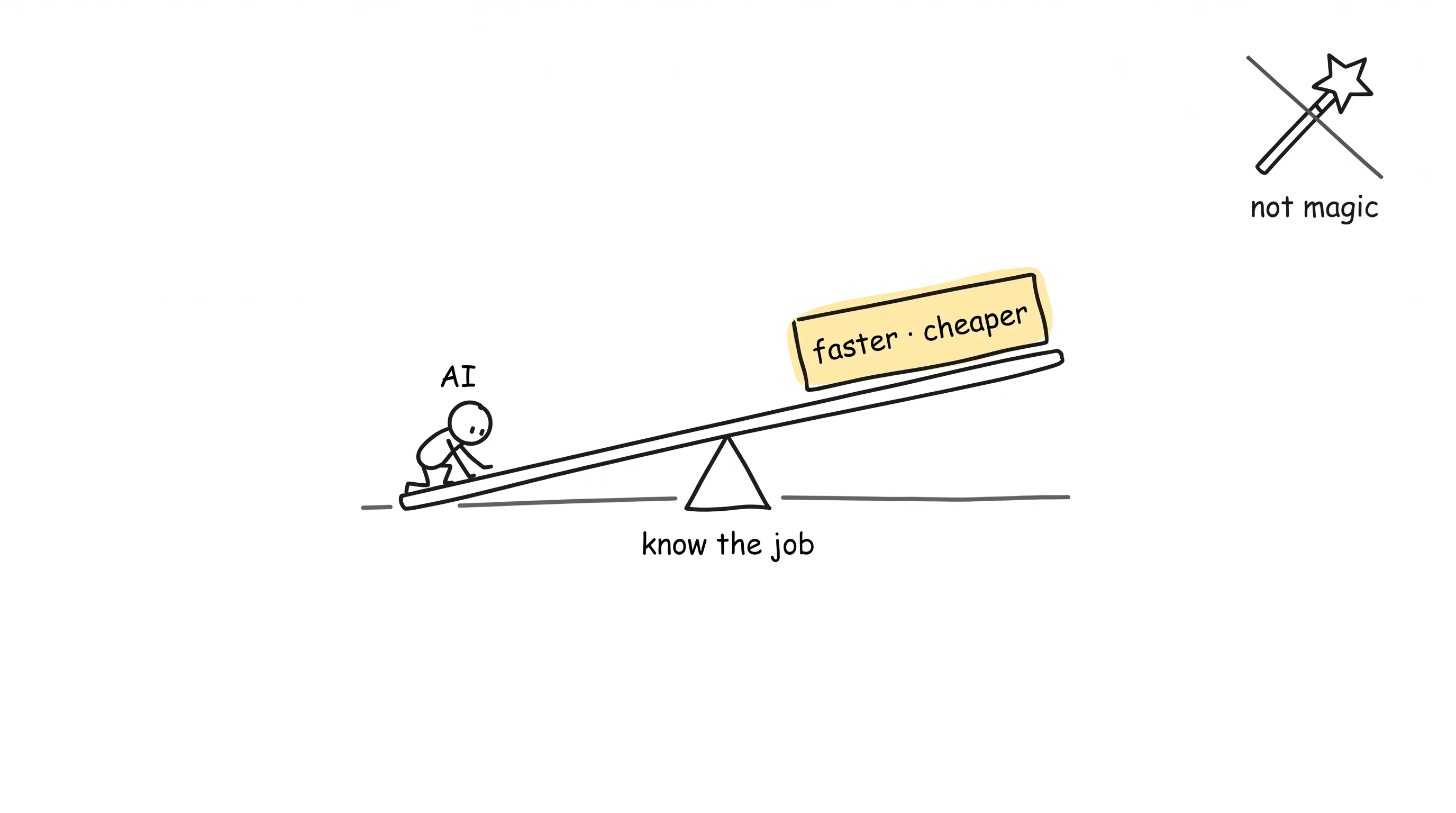
Next time you scroll past one of those "several hundred percent growth" posters, don't rush to pick a side. Ask one question first: what job did AI actually do for them?
Once that question is clear, the outline of your own playbook starts to take shape.
Continue reading
Related articles

It's 2026: Stop "Buying" AI Tools for Your Marketing Team — Start "Hiring" AI Agents
This learn article explains how AI agents differ from standalone AI tools in marketing, outlines three agent categories — build-your-own platforms, CRM-native agents, and vertical tools — and covers use cases across SEO, social media, advertising, and reporting, plus criteria for choosing one.

Did the Money You Spent on AI Marketing Ever Come Back?
A guide to measuring AI marketing ROI across three layers: ad reports, sales pipeline, and the financial ledger. Covers metrics such as ROAS and CPA, eight dashboard metrics, industry benchmarks, and common measurement mistakes.

How to Pick a Creative Automation Platform: First, Figure Out What These Eleven Actually Do
A learn article sorts eleven creative automation platforms — including Bannerflow, Celtra, Smartly.io, and Storyteq — into four functional groups and proposes five evaluation questions covering publishing reach, automation depth, ease of adoption, team fit, and verifiable evidence.