
Generative AI Is Rebuilding the Way We Sell—From Scratch
A learn article discussing how generative AI is reshaping go-to-market across four areas: time savings, customer acquisition, data investment, and software pricing, with examples of AI-driven marketing content generation and usage-based billing.
Not long ago, over dinner, I ran into an old friend who works in B2B marketing. He vented to me: one whitepaper, and sales wants it to send to customers, marketing wants a version for events, and the customer success team needs its own talk track. Same thing, three teams, three versions, endlessly revised.
Here's the thing, I told him: someone got fed up with this back in 2021.
Her name is Elaine Zelby. She ran B2B growth teams for eight years and knew exactly how much time and money a single marketing campaign could waste. So when large language models (LLMs) started galloping forward, she made a decision: start a company. It's called Tofu.
What Tofu does boils down to one sentence: feed your company's own data into the system, build an AI knowledge graph, then let AI generate marketing content in bulk. Need a few hundred emails, each one tailored to a different person? Done. Dozens of landing pages? Done. Whitepapers, ebooks? All of it. And in her words, every piece of content stays planted on your brand voice and core messaging at all times—never drifting off course.
Scale and personalization are no longer an either-or choice.
Of course, you might ask: Tofu is just one company's business—on what grounds can we say an entire industry is being rebuilt?
On the grounds that the path has been proven. As early as 2023, a Statista survey found that 73% of companies surveyed were already using generative AI. Three years later, you'd be hard-pressed to find a company that has never touched it.
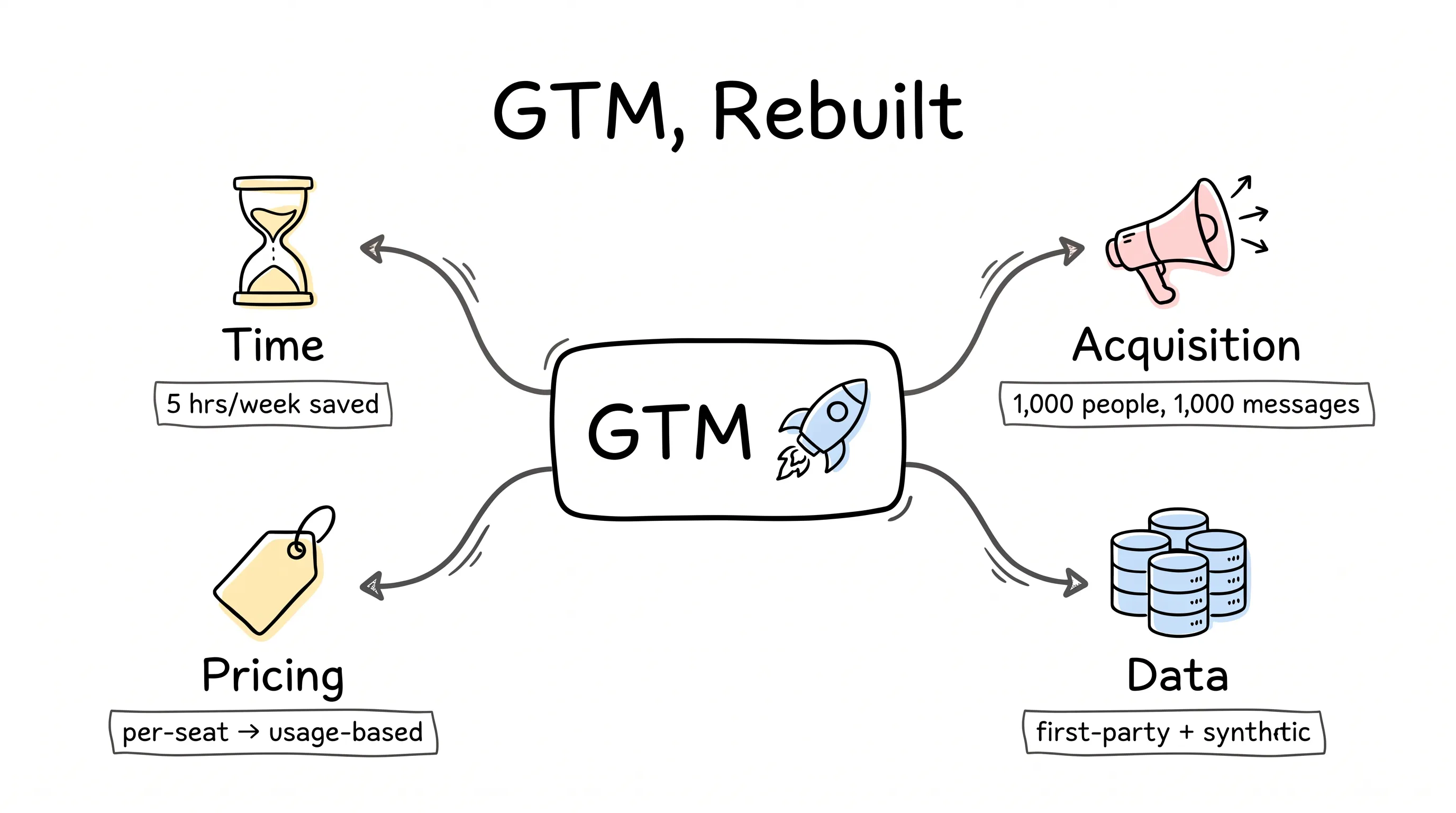
So how exactly will generative AI rewrite Go-To-Market? GTM is the entire path a company takes to sell its product and serve its customers. Watching these three years unfold, what has truly been pried loose comes down to four things: time, customer acquisition, data, and pricing.
Let's take them one at a time.
First, Pull People Out of "Figuring Out What's Going On"
A marketer's most expensive cost isn't in the writing. It's in the searching.
Think about a marketer's typical day: digging through user data, reading usage reports, going through verbatim transcripts of customer interviews, chasing industry news. By day's end, the material has piled up across the desk, and hardly any time is left for the actual doing.
And this is exactly what generative AI is best at. Salesforce ran a study: hand this kind of work to LLMs, and each marketer saves roughly five hours a week.
Five hours—doesn't sound like much? A company called Orby AI wants to take over even more of the tedious grunt work: after sales closes a deal, someone used to log it in the CRM, send it off to legal for review, then route it through e-signature. Orby handles all of that quietly in the background.
So where do the saved hours go? That's the real question. Someone ran the numbers: most practitioners spend 95% of their time figuring out what happened, and only a leftover sliver deciding what to do about it. Free up twenty to thirty percent of that time and put it into thinking, and you come out way ahead. Thinking is precisely the part where humans can't be replaced.
Machines can't take your judgment away. They just give you back the time you spent hunting for information.
Next, Swap "Cast a Wide Net" for "A Thousand People, a Thousand Messages"
Now, customer acquisition.
Every company running outbound sales knows the headache: hire a batch of young SDRs (Sales Development Reps) to make calls, send emails, fire off messages. Plenty of enthusiasm, short on experience.
Run the numbers. Operatix put out a figure: one SDR reaches more than 1,400 prospects a month, and in exchange lands about 12 meetings. What about the remaining 1,388? How many of them ended up blocking this kind of crude outreach? Nobody can say for sure.
This is the classic cast-a-wide-net-and-pray-for-fish play.
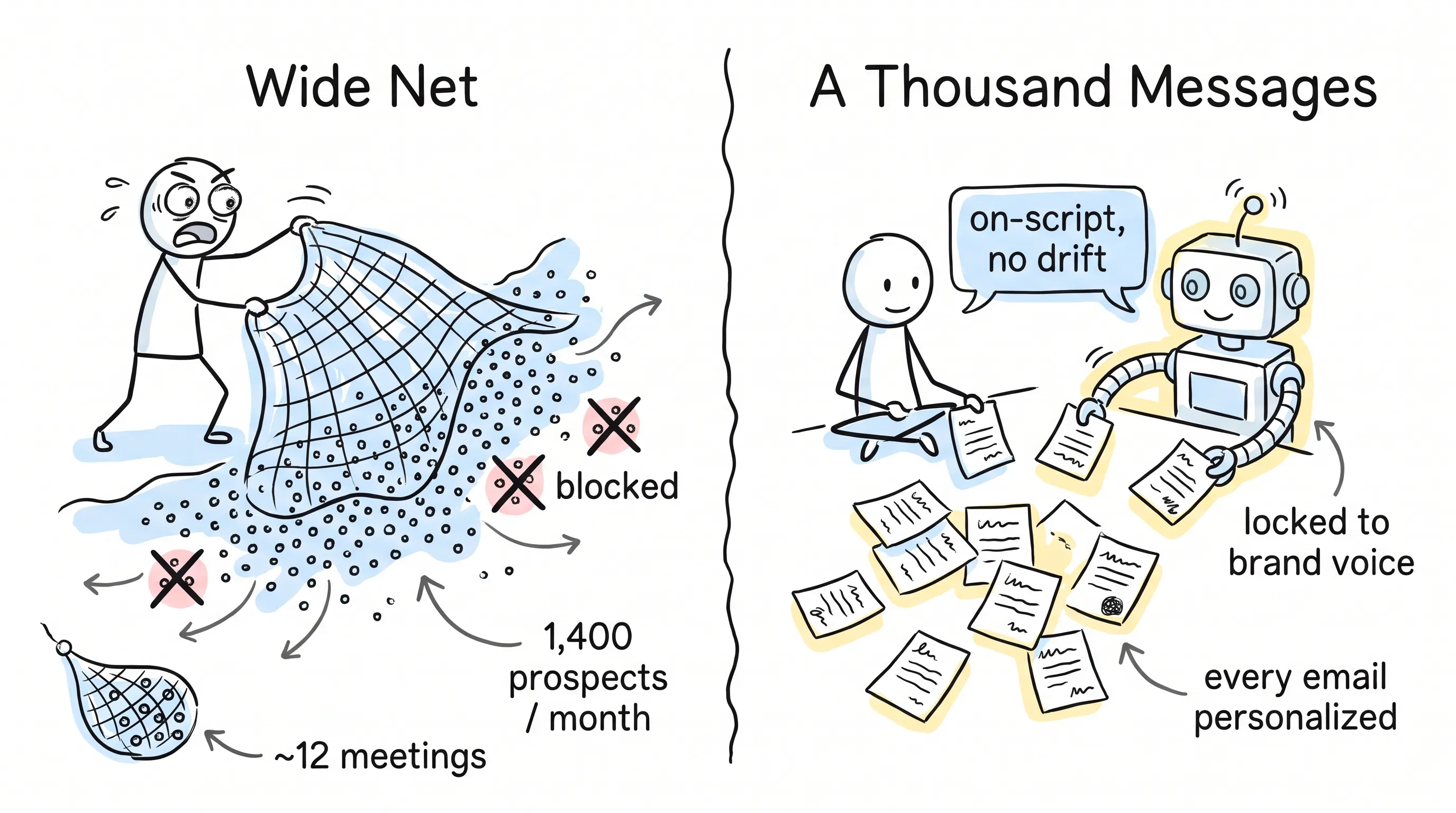
Once LLMs entered the field, this playbook started to loosen up. A trained model doesn't misspell a customer's name, its industry news is always up to date, and it strictly holds to the messaging your company set—never going off script from start to finish. And if you've ever tried to keep a young salesperson on script, you know how hard that used to be. Now, every AI-generated email and every AI-generated video is locked to the standard your product marketing team approved—no drift, not a single version off.
The video part is even wilder. A while back, a startup did this: altered the speaker's lip movements so the person in the video looked like they were calling out the recipient's name. The first time I saw it, only one word came to mind: wow. One recording, and it looked like a hundred. By now, tricks like this are nothing special.
For founders, there's a more practical layer hidden in here. One line from Elaine Zelby stuck with me: the first rule of survival now is spend less money, hire fewer people, buy fewer tools.
The generative AI game is about helping your team do more with less.
Take the Time You Save and Ask the Right Questions
McKinsey once projected that generative AI could bring marketers an efficiency gain of about 10%, which works out to $463 billion in savings a year.
Today, that the money gets saved is more or less settled. The question is: that extra hour each day—what do you do with it?
The options are on the table. One: cut the budget outright and pocket the gain. Two: go full throttle and produce more content. Three: invest the time back into yourself and build the craft of the AI era—write better prompts, do a solid retrospective on the last campaign, set up the analytics you should have set up long ago, read customer feedback line by line, and then actually do something about it.
My call? Take the third path. The dividend from efficiency belongs only to those who reallocate their time. If the time you saved goes right back into grinding out output, you saved it for nothing.
Where to Spend More: Data
But don't assume generative AI only saves you money. First, it asks you to spend it.
On what? Data.
If you want the model to truly understand your business, you can't rely on the general-purpose models floating around the public internet. The winner will be whoever holds the most complete data: your own first-party data, plus synthetic data you can generate, plus external data bought to fill the blind spots. Wherever a piece is missing, that's where the model starts talking nonsense.
That bill wasn't cheap at the time, either. Someone estimated that building your own large model costs between $100,000 and $500,000. And it doesn't end there: first you have to pull the data in, clean it up, and get it in order. As for "dirty data"—outdated, unstructured, or just plain wrong—per Treasure Data's research, at worst it can eat up 38% of a marketing company's budget, all wasted on mistargeting and leads that slip away.
The good news: in the past few years, foundation model vendors have been locked in a brawl, and usage costs have kept falling; fine-tuning tools keep getting better, so even people who can't write code can get a model to behave. That $100,000–$500,000 bill, recalculated today, comes out a lot smaller.
There's no getting around the data gate. Sort it out early, benefit early.
Finally, Stop Selling Software by the "Seat"
This one is for everyone who sells software.
What's the underlying temptation of generative AI? Doing more with fewer people. Note—people included.
But look at how most software is priced: by the seat. By "how many people are allowed to use it." That's twisted: your product clearly helps customers cut headcount, while your revenue depends on customers hiring more. This model is destined to be rewritten.
The move started long ago. Back in 2022, 46% of SaaS companies had already adopted some form of usage-based billing, with another 15% testing the waters on a small scale. Today, when pricing AI products, usage-based billing is nearly the default option.
The logic isn't hard to grasp. If your AI handles 100 support requests a day for customer service, at ten times the speed of a human, why would the customer keep paying for "seats"? Charge by usage: you get paid for each thing you actually get done for the customer.
You earn revenue only when you create value. And that puts you and your customer on the same side. The better the customer uses it, the more they pay—and renewals and upsells actually get steadier.
Of course, per-seat won't disappear right away. In some scenarios, per-use billing is too noisy and doesn't align with value anyway—those keep the subscription. The more realistic approach is hybrid billing: legacy products hold the subscription line, new products go by usage. So your billing system needs to grow this capability ahead of time—don't wait for the day your invoices stop making sense to catch up.
In one sentence: pick whichever pricing model keeps your interests pressed closest to your customer's.
Back to That Dinner
At the end of that dinner, I asked my friend: have you started on any of this?
He said, we agree on the direction—we just keep feeling we can wait a little longer.
I didn't press further. But watching these three years, time, acquisition, data, pricing—all four have been pried open. Those who moved first have quietly pulled ahead. Wait until every peer has finished the run and then chase, and what you're chasing is no longer a head start. It's remedial class.
And may you be the one who gets the data in order first—and takes the time you save and turns it into thinking.
Continue reading
Related articles

What Is AI Marketing Automation? It Starts With a 40-Point Gap
A learn article explaining what AI marketing automation is: how learning-based systems differ from rule-based automation, how AI decisioning optimizes message, channel, and timing choices, what data it depends on, and where it applies across the customer lifecycle.

Marketing Automation Is Shifting from "You Do It" to "You Say It"
This article explains how marketing automation is shifting from rule-based platforms that merely execute toward AI agents that plan, create, publish, and review campaigns, covering delegable tasks, underlying technologies, tool categories, adoption steps, and risks such as privacy and automating without strategy.

Rankings Are Taking a Dive, Customers Are Sprinting Ahead: This November, I Re-Ran the Numbers on AI Search
A learn article on how AI search reshapes marketing measurement, covering reported mismatches between rank-tracking tools and live Google results, ChatGPT's business profile test, single-page visitors as high-intent leads, and CRO plus GA4 tracking verification practices.