
AI Marketing Daily · 2026-10-17
AI marketing daily digest focused on methods and data: a self-corrected guide to citing AI marketing statistics, Gartner budget findings on labor costs and the skills gap, consumer distrust evidence, an email-industry governance framework for AI, and a role-based AI content tool selection guide.
Today's throughline is doing the math. A statistics blog has publicly retracted its own AI-marketing numbers that couldn't hold up; Gartner's budget survey puts labor costs and the skills gap on the table; consumer distrust of AI content gains fresh evidence; and two long-form pieces deliver a governance framework and a tool-selection checklist. Read the six items together and one message emerges: AI marketing has moved from a scramble for tools into a reconciliation stage — the money spent, the hours saved, and the content shipped now have to start adding up. No new products, no funding rounds today — all methods and data. That, in itself, is a signal.
🎯 Today's Top Story
How to Use AI Marketing Statistics Without Getting Burned: A Self-Correcting Evidence Guide
On October 4, the marketing blog Digital Applied published a rare correction notice. It pulled the unsupported benchmark series, return multiples, headcount estimates, and adoption forecasts from its original article, and rewrote the entire AI-marketing statistics guide as an evidence inventory: dated survey findings, the author's own recommendations, and purely fictional worked examples — three categories, separately labeled. Every number kept in the new version carries a source and a collection date; publication dates are preserved as-is. The author states the thesis up front: this is an evidence guide, not a primary survey, and certainly not a census of marketing teams. The percentages describe only the named studies and their scope — they cannot be relabeled and passed off as real-time market measurement.
Each of the retained numbers has its own provenance. The Salesforce State of Marketing was published on February 19, 2026, with 4,450 marketing decision-makers participating; fieldwork ran from October 8 to November 17, 2025, covering North America, Latin America, Asia-Pacific, and Europe, and reported a 75% AI adoption rate. The CMI and MarketingProfs B2B report came out on October 8, 2025, with fieldwork running from June 24 to August 14 and 1,015 B2B marketers surveyed; it gives a 95% organization-level usage rate, with another 68% in the exploring-or-early-implementation stage. McKinsey's 2026 report covered 1,719 respondents across 97 countries, weighted by each country's GDP contribution; 37% of enterprises self-report a positive AI contribution to EBIT. The same page also carries CMI's 28% figure for agent experimentation. Four sets of numbers, four different sources, methodologies, and time windows.
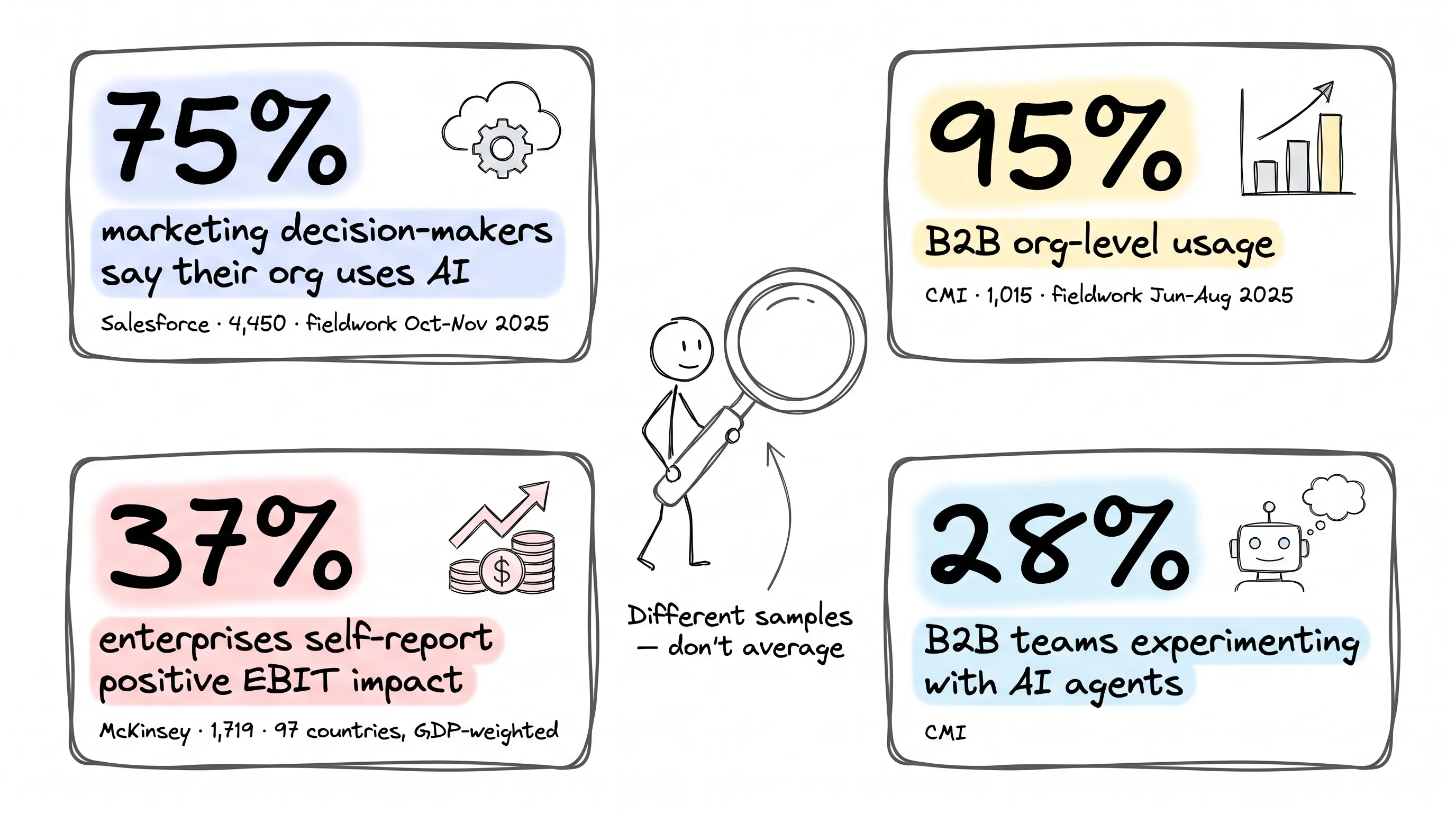
Why does this deserve a top-story slot of its own? These percentages often end up on the same slide, used to prove that AI marketing's dominance is a settled matter. They actually answer several different questions: the 75% refers to surveyed marketing decision-makers reporting that their organizations use AI; the 95% refers to organization-level usage among B2B content teams; the 37% is an enterprise-level self-assessment of financial impact. Different samples, different question wording, different collection periods — averaging them, subtracting one from another, or reading them as an industry gap all collapse under scrutiny. A respondent can say their organization uses some AI application while rarely touching it personally; another survey asks whether a tool has been adopted and never requires evidence of production-scale use. What's rarer still is that the author chose to self-correct — proactively pulling the unsourced numbers, and spelling out which sentence is a survey finding, which is a recommendation, and which is a fictional example. That kind of self-correction is a scarce commodity in statistics-roundup content. For marketers who quote data to justify projects and write internal reports every day, what they've been missing is precisely this citation discipline.
The practical fallout lands in two places. The first is citation. If you take the 20-point spread between 75% and 95% to claim that B2B lags the industry by 20 percentage points, or convert the 37% positive EBIT contribution into an expected return on a single investment, that's a methodology error — and any knowledgeable reviewer will tear it apart on the spot. The right approach is to keep the unit of measurement right next to the number: who answered, what question they answered, and when it was collected. The second is the math itself. The article's fictional worked example separates the benefit-cost ratio from net ROI: a workflow costing $2,000 a month brings $1,200 in actual outsourcing savings plus $1,800 in incremental gross profit — a benefit-cost ratio of 1.5x and a net ROI of 50%. But if that $1,200 is merely salary-time saved, with no real cash outlay reduced, it must be stripped out of the cash-benefit column; the books immediately swing from a $1,000 monthly gain to a $200 monthly loss, and net ROI turns to negative 10%. Capacity still matters, but a faster task is not the same as cash savings. Booking saved hours directly as cash is the most common inflation trick in internal reporting.
The article offers three operating frameworks you can apply directly. To audit adoption, use the three-tier test: who has a license, who actually uses it to complete tasks, and whether the output can pass review equal to that applied to other work. Track the three tiers separately — that keeps the loosest tier from being used to pad the numbers, and keeps teams facing stricter review from looking like laggards on adoption. Manage use cases in layers — content drafting, research, personalization, lead qualification — and set acceptance criteria for each layer before talking usage rates. For the content layer, for instance, drafts must answer the brief and pass fact, brand, and copyright checks; for the research layer, distinguish organizing existing evidence from gathering new evidence, and treat AI-generated user personas as hypotheses to be verified — not as interviews, and not as demand estimates. For measurement, divide completed tasks by eligible tasks; fix the observation window in advance, and count retries and discarded drafts in the cost numerator — otherwise an unreliable workflow looks efficient simply because its failed attempts vanish from the record. The guidance on quality is just as concrete: among CMI respondents, 58% said AI improved content quality and 12% said it got worse — but that's perception, not measured rankings or conversions; and how many words were edited says even less. Heavy edits may have missed the real errors; light edits may have happened to fix exactly what mattered. Evaluate agents starting from complete tasks: can they pull the right data, compute the right results, and state their limitations; when they err, can they stop before crossing a boundary; and the time spent supervising and recovering must be counted into the cost. The same goes for AI search performance — don't dump every fluctuation in total traffic onto AI summaries; compare against a like-for-like cohort before drawing conclusions.
My take: what makes this guide most valuable is that it demonstrates a way of being skeptical about statistics. Marketing teams in 2026 don't lack AI data — they lack people willing to state the methodology plainly inside their own organizations. My recommendation: lift the three-tier test and the ROI worked example straight into your quarterly review template, and before citing any external percentage, first ask who the sample was. An author willing to publicly retract deserves a bookmark more than a roundup that won't admit fault.
🔗 Further reading: Read the full article
🏷 Industry Data
Skills Gap or Hours Gap: The Problem AI and Headcount Can't Fix
MarTech's October 16 column splits a marketing team's shortfall into two kinds: a skills gap and an hours gap — and asserts that neither AI nor added headcount cures the former. Author Gene De Libero opens with a familiar script: the team asks for two more heads this budget cycle; finance approves a suite of AI licenses instead, expecting the same people to produce more. Six months later, draft output is at an all-time high — but the team's best person now spends a large chunk of every week fixing drafts. Before the request went in, nobody asked the basic question: does this team lack skills, lack people, or lack both?
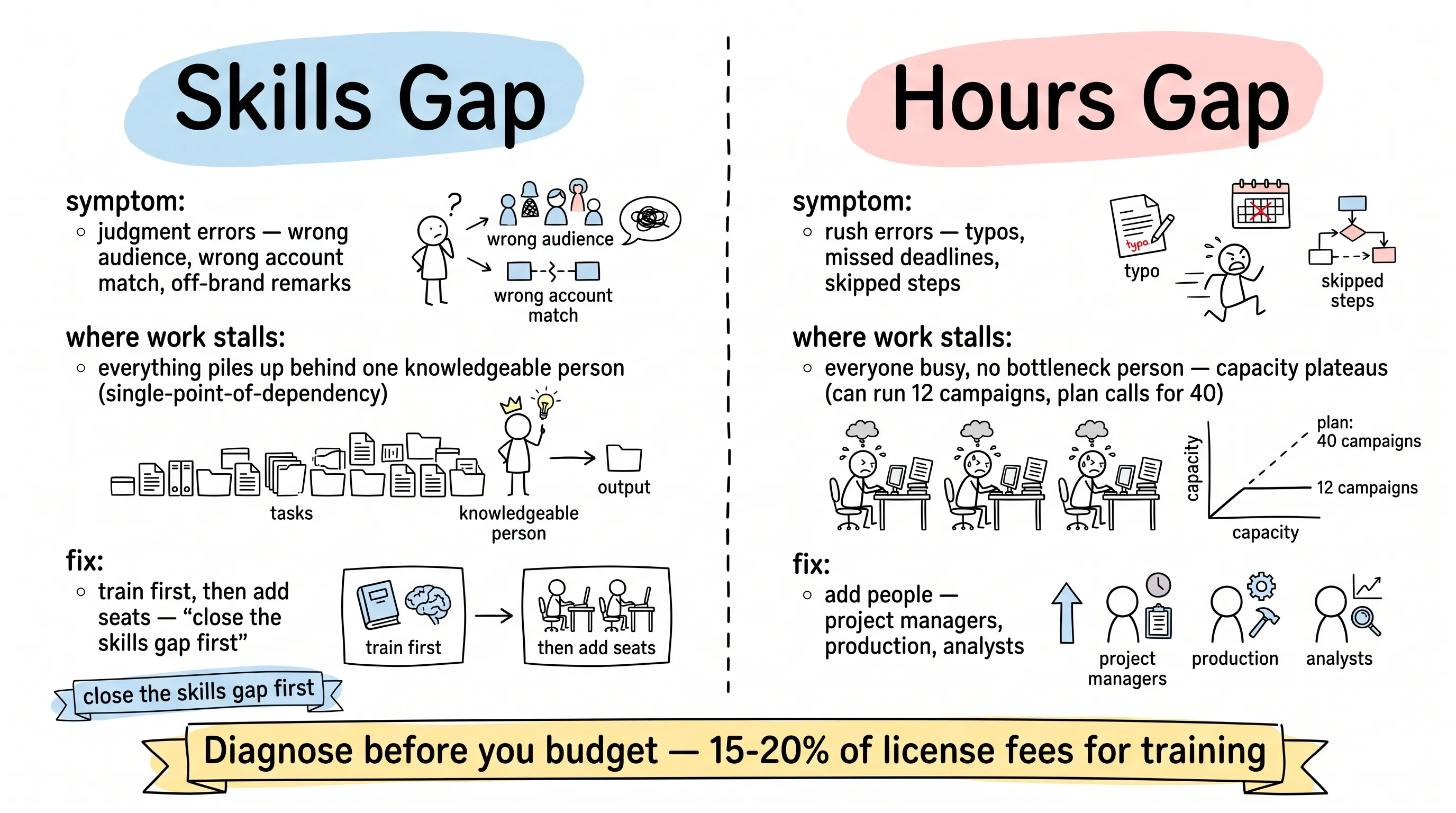
The two gaps are clearly defined. The skills gap is the distance between what the work demands and what the team can actually deliver with its current tools in a production environment: the team may still be working the way it did on the old stack, vendor training stops at scheduled emails and never reaches behavioral scoring, and when AI tools arrive, no one teaches people how to write a brief that gets usable output, or how to verify what the AI hands back. The hours gap is a team that knows how to do the work but lacks the time: it can run 12 campaigns at once with quality intact, but the plan calls for 40; however much you streamline processes or automate reporting, capacity climbs a bit and plateaus — hitting the target means adding project managers, content production, and analysts, and training courses can't fix that. Confuse the two and the money goes to the wrong place: train people already running at full load, and they have no time to use what they learned; hire new staff for a team that lacks skills, and the newcomers learn the same make-do workarounds everyone else uses.
The data comes from two surveys. Gartner's 2026 CMO Spend Survey (401 marketing leaders): labor's share of the marketing budget rose from 21.9% in 2025 to 24.5% in 2026, and 38% of respondents named the lack of internal AI expertise as the top obstacle to AI-driven productivity gains — in the research lead's own words, you can't get around marketing competence itself when it comes to AI. The same survey shows 56% of CMOs lack the budget to execute their 2026 strategy, and 54% report insufficient resources. A 2,003-person survey commissioned by Optimizely and run by Savanta supplies the execution-layer evidence: 76% of marketing leaders spend 3+ hours a week editing, verifying, or correcting AI output; 54% believe management underestimates the labor needed to make AI output usable; 39% are so busy managing workflows they have no time for strategic thinking; 46% worry that heavy AI reliance will stunt junior marketers' skill growth. Verifying output is itself a skill — someone who doesn't understand segmentation can't catch a wrong segmentation. What AI raises is the bar at the sign-off gate.
The article prescribes three self-checks. Look at what the team is fixing: judgment errors (wrong audience, wrong account match, off-color remarks) point to a skills gap; rush errors (typos, missed deadlines, skipped steps) point to an hours gap. Look at where work gets stuck: if it piles up behind one knowledgeable person, that's a skills gap — and a single-point-of-dependency risk; when everyone is busy, that's an hours gap. Then pause one routine project for a month: if the quality and volume of everything else rise, the team is short on people; if nothing changes, it's short on skills. When both gaps exist, close the skills gap first — it manufactures rework and disguises itself as a headcount shortage. Only after skills are fixed does every additional seat and every additional AI license generate real leverage. The author's budget rules of thumb: reserve 15% to 20% of license fees for training — a $100,000 AI license needs a $15,000-to-$20,000 training line; and when hiring, prioritize a seasoned doer who can also teach — one extra pair of hands now, and six months later, one extra coach who can lead.
💬 How marketers can use this: Next time you submit an AI procurement request to finance, add a line stating whether the money closes a skills gap or an hours gap — if you can't answer, run the three self-checks first. Writing the 15% to 20% training ratio into your budget template will save capacity more effectively than one more license. The error-type audit can be done this week, with results in a day.
🔗 Further reading: Read the full article
2026 AI Marketing Numbers Roundup: Check Who's Selling Before You Cite
Carly's AI-marketing statistics roundup covers 2025-to-2026 data, tagging every figure with its source, sample size, and vendor stance; the author warns up front that most of the numbers come from companies selling marketing software. A few groups are worth recording.
Adoption, in layers: 86.4% of marketing teams say they use AI in at least some marketing activities, while only 1.7% don't use it and don't plan to (HubSpot, survey of 1,500+); Duke CMO Survey's numbers run much colder — AI is involved in 24.2% of marketing activities, nearly double 2024's 13.1%, with surveyed leaders expecting 55.9% within three years (308 U.S. marketing leaders). Where it's used: 73.9% of companies use AI for content creation, up from 49.2% in fall 2023; content personalization 65.4%; marketing automation 48.9%. Time saved: about a third of marketers say AI saves their team 10 to 14 hours a week, and another third say 15+ hours (HubSpot); sales productivity up 14.1%, marketing overhead down 14.6% (CMO Survey).
Budget side: CMOs direct 15.3% of the marketing budget to AI (Gartner, 401 respondents, mostly from companies with $1B+ revenue); the total marketing budget is 7.8% of company revenue, essentially flat versus last year's 7.7% — the AI money is being squeezed out of the existing pot. Only 30% of CMOs consider themselves mature enough to scale AI; organizations that call themselves AI-ready put 21.3% of budget into it. Consumer side: 50% of U.S. consumers are more willing to buy from brands that don't use generative AI in consumer-facing content (Gartner, October 2025 survey of 1,539); in IAB's survey, 82% of ad executives believe young consumers feel positive about AI ads, but only 45% actually do — the perception gap has widened from 32 percentage points in 2024 to 37; 76% of Americans care about being able to tell whether content is AI-made, and 53% admit they can't tell (Pew, 5,023). Search side: when an AI summary appears on the results page, 8% of users click traditional results, versus 15% when none appears (Pew); Salesforce says 88% of marketers are optimizing for AI search, while the vendor-neutral CMO Survey puts it at 41.5%. Capability vs. expectations: 68% of marketers get no company-provided AI training, down slightly from 75% a year ago; training budget is 3.8% of the marketing budget, below the pre-pandemic 5.8%; 53% believe AI will net-reduce more marketing jobs than it creates within three years, though only 9% consider their own role at risk. Content side: of 900,000 new web pages Ahrefs sampled, 74.2% contain AI-generated content, only 2.5% are purely AI, and roughly 70% are hybrid creations.
💬 How marketers can use this: In project proposals, cite vendor-neutral sources first — Duke CMO Survey and Pew at the top — and label vendor numbers from the likes of Salesforce and HubSpot before using them. The two methodology gaps (88% vs. 41.5%; 82% vs. 45%) are themselves the most persuasive material for a report: build them into a side-by-side slide, which shuts down challenges far better than throwing out a single percentage. Small teams have another data point to note: AI use in marketing among U.S. small businesses climbed from 26% in 2023 to 87% by April 2026 — a catch-up pace above the overall market.
🔗 Further reading: Read the full article
🏷 Policy & Governance
Email's Twenty-Year Governance History: Homework AI Can Copy
MarTech's October 16 column by veteran email marketer Ryan Phelan uses the email industry's governance history to set rules for AI. In its ungoverned era, the email industry all but descended into chaos over address scraping and bulk spam; practitioners, ESPs, and MarTech vendors spent more than two decades distilling de facto standards, and only later did Congress pass the CAN-SPAM Act. Today that rulebook has sedimented into law, the acceptable-use policies of ESPs and MarTech platforms, blocklist mechanisms, and organization-level codes of conduct, plus a body of books, courses, and industry talks. The author judges that AI is evolving far faster than email did — the idea-to-artifact cycle is so short there's no precedent; waiting for industry-wide rules will take too long, so self-regulation must come first. He also concedes AI's speed cuts both ways: coming back from a dog walk to find a full proposal drafted by AI is the upside; usage patterns evolving faster than our understanding of their impact is the risk.
The debate itself is just as fractured, with opinion swinging between the extremes of AI-saves-everything and AI-ruins-everything. The author proposes starting the ethics conversation there, with a 3A framework. Attribution: AI Overviews can accurately restate "mocial," a term Loren McDonald coined in 2011, and Kath Pay's "holistic email marketing" concept — without crediting their creators; you have to click through layers of links to find the names. Write with AI without asking where the information came from, and you build layer upon layer of downstream plagiarism; your article can then be mistaken by an LLM for an authority and spread further, carrying outdated or even wrong claims with it. The definition of plagiarism itself needs rewriting: if you put your name on an AI-written article and the AI lifted someone's key passages, whose plagiarism is that? Accuracy: while building an agentic model, the author caught one agent overstating the number of project interviews — and it had made it into a client report. From then on, his rule: nothing unsupported by facts goes into a deliverable; every prompt requires the AI to list its cited sources and explain how it found them, followed by line-by-line checks for fabrication. Authenticity: disclose AI's involvement in client deliverables, stating where it influenced the output; his practice is not to enumerate every source cited, but to flag the stages where AI may have influenced judgment. The author's whole argument comes down to one reminder: everyone has twenty-plus years of accumulated articles, white papers, talks, and client guides; AI digests them into smooth answers and hands them out, and the original creators don't even get a byline. If the industry doesn't self-regulate before governments and vendors set the rules, the bill for the chaos will still come due from practitioners.
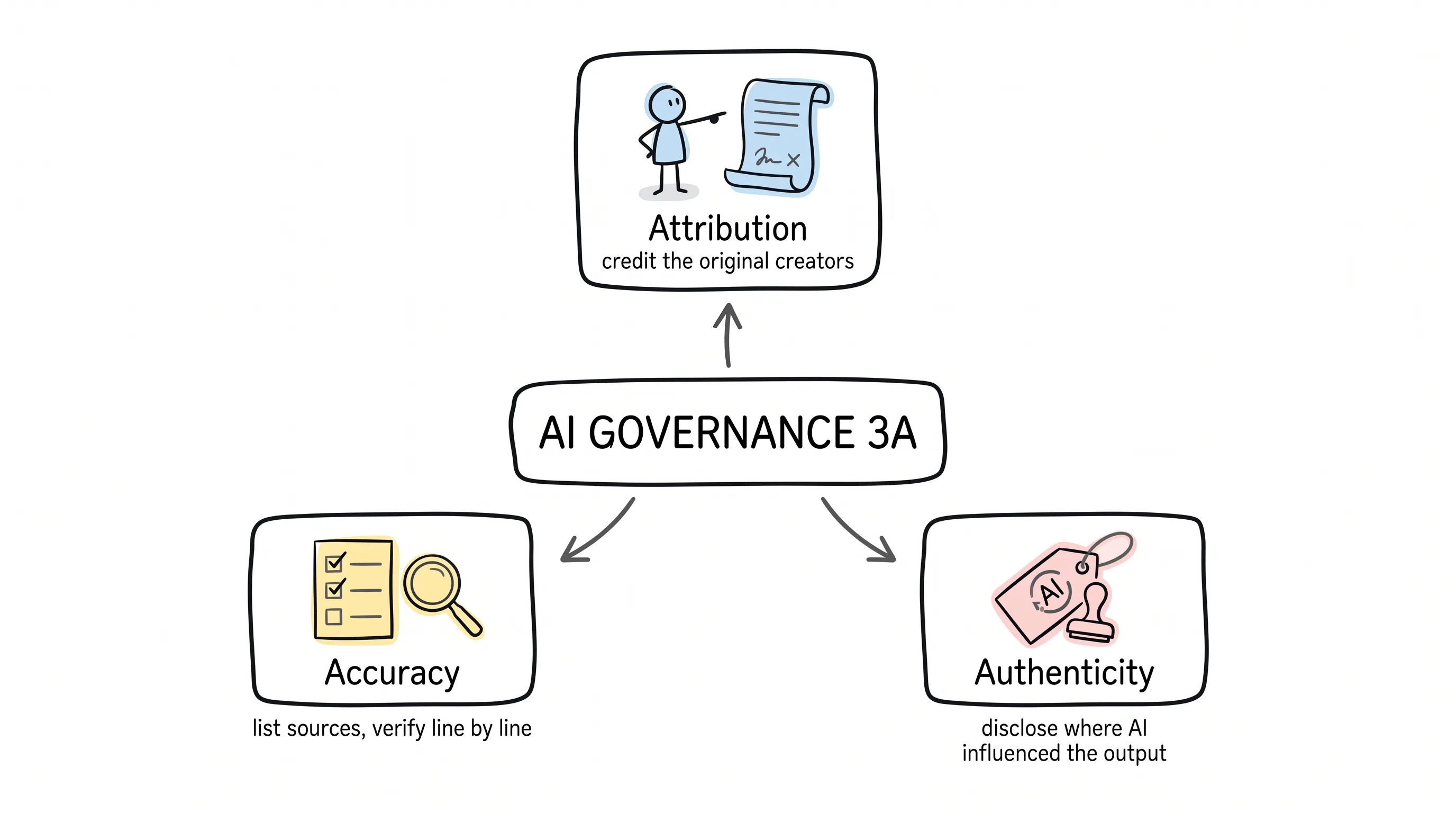
💬 How marketers can use this: Write "the AI must list its sources" into your team's prompt templates — zero cost, effective today. Add one delivery discipline for content teams: an AI-involvement statement goes on the deliverables checklist. When citing industry concepts, trace them back to the original creators by hand — that keeps you compliant and keeps your own authority signal from being swallowed by the next layer of LLMs.
🔗 Further reading: Read the full article
🏷 Marketing Tools
Choosing 2026 AI Content Tools: Pick by Role, Not by Hype
Canada Create's AI content-marketing tools guide, updated last week, sorts tools by function. General assistants (ChatGPT, Gemini, Claude, Copilot) suit brainstorming and first drafts; they'll fabricate facts with total confidence, know nothing about your clients, pricing, or closed deals, and depend on you to feed them. Marketing writing platforms (Jasper, Copy.ai, Writer) are strong on brand voice and multi-person collaboration — a fit for teams where many people produce copy and consistency is stretched thin. SEO tools (Surfer, Clearscope, MarketMuse, Frase) should serve as coverage references; content written to game optimization scores is usually hard to read, and search engines and AI answers reward pages that genuinely answer the question, show real experience, and keep updating. Editing and polish go to tools like Grammarly and Hemingway. Images (Firefly, Canva, Midjourney, Ideogram) and video repurposing (Descript, CapCut, Opus Clip, Synthesia, HeyGen) each have their limits: before publishing AI images, check the commercial-use terms and avoid real people's likenesses, and brand-story videos still call for real people on camera.
The guide lays out a nine-step workflow: define the audience and the questions to answer; gather real material (your own data, customer questions, sales-call recordings, expert interviews); after the AI produces an outline, manually cut the generic passages and add the information only you know; draft section by section with the material you feed in; rewrite in a human voice; verify facts line by line; then do SEO, multi-channel repurposing, and measurement updates. Measurement follows content's classic metrics — target keyword rankings, organic traffic, leads, and deals — plus production metrics: hours per piece, rework count, and errors caught in review; if output rises while quality falls, slow down. The pre-publish checklist has six items: accuracy, originality, first-hand detail, machine-generated tone, expert review for regulated industries, and AI disclosure.
On whether Google penalizes AI content, the guide's answer is that the tool itself triggers no penalty — what crosses the line is producing thin content at scale, which maps to the scaled content abuse policy. Three compliance reminders: don't put confidential information into consumer-grade plans that may retain data for training — business plans usually offer a training opt-out; confirm who owns the copyright to outputs and the commercial-use terms; and purely AI-generated content has limited copyright protection in many jurisdictions, so anything you want protected needs substantial human authorship. Internally, land a brief AI policy stating approved tools, permitted data, review steps, and disclosure rules. On tool selection: pick one per category, test with real content rather than demo prompts, confirm integrations with your CMS, design tools, and analytics stack, and review subscriptions quarterly — overlapping AI tools are one of the fastest-growing software costs for marketing teams. For prompts, the workable recipe has four elements: role and audience, objective, input material, and tone constraints; ask for an outline first, and draft section by section only after approval.
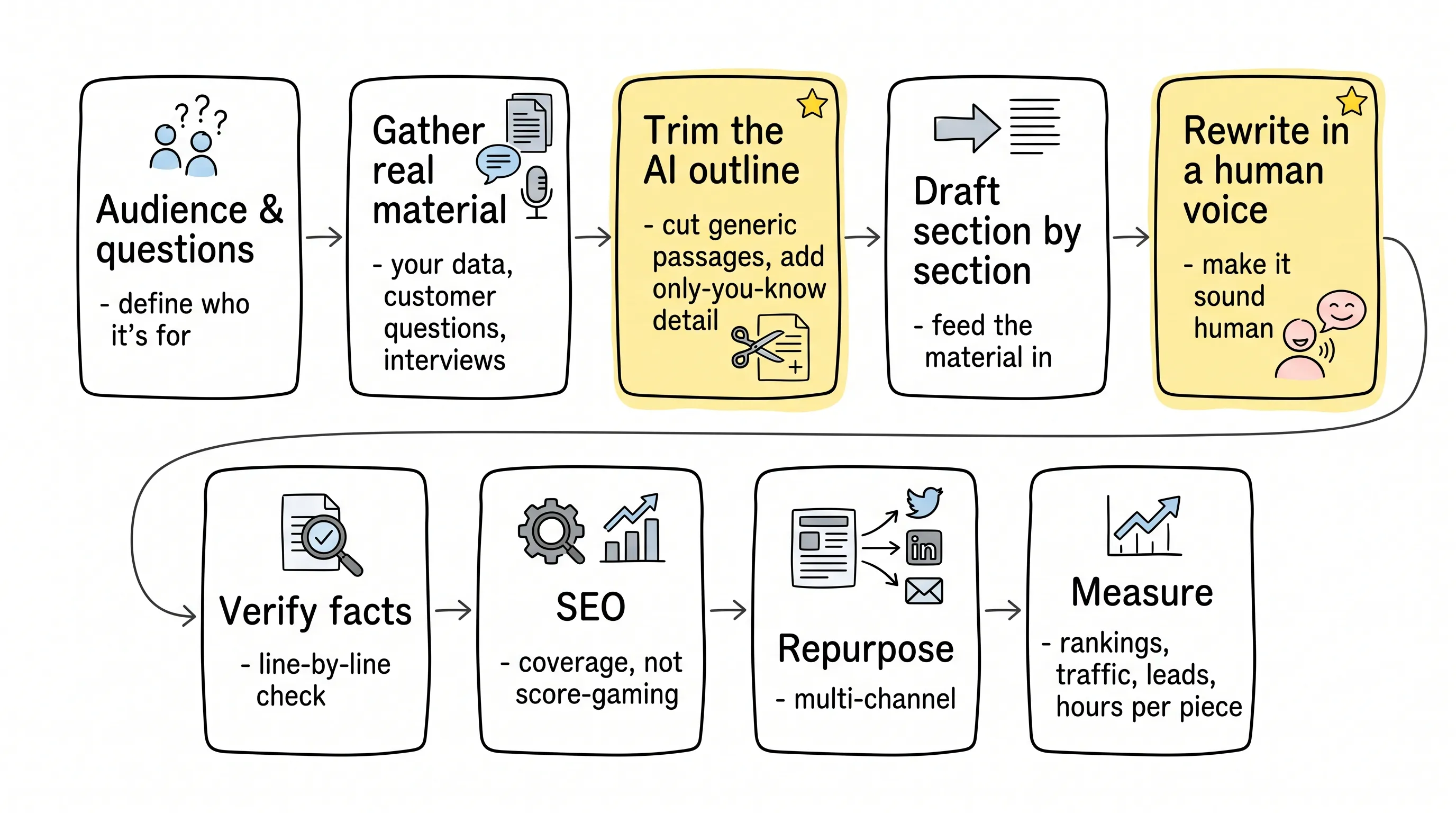
💬 How marketers can use this: First list your monthly content output and the steps that bleed time, then pick tools against the table — one per category. In the nine-step workflow, steps three and five carry the most value: manually trimming the AI outline and rewriting in a human voice — those two steps decide whether the content has a human touch. Put the quarterly subscription review on the calendar; it usually cuts one or two duplicate seats.
🔗 Further reading: Read the full article
🏷 LLM Updates
A Panoramic Survey of Generative AI in Marketing: Five Opportunity Classes, Four Risk Traps
Vineesh Rohini's survey of generative AI in digital marketing, published this January, is a mental-framework piece. It traces the evolution from automated email replies and rule-based chatbots through keyword-driven content generators. As multimodal models advanced, generative AI in 2026 can already analyze user behavior across channels, generate campaign creative, personalize in real time, and optimize placements in near real time — marketing has shifted from passive execution to data-driven, proactive decision-making.
The opportunities fall into five classes. Scaled content production spanning blogs, social copy, ad lines, email sequences, product descriptions, and scripts — small teams no longer depend on a large content group. Hyper-personalization based on behavioral data, browsing history, and interaction patterns, with dynamic web content, personalized email narratives, and adaptive ad creative generated in real time, acting directly on conversion rate and customer lifetime value. Rapid creative testing that turns out multiple variants in minutes — headlines, visuals, and call-to-action styles can all be batch-tested, compressing a campaign concept that once took weeks into a same-day exercise. Around-the-clock conversational service and guided selling across websites, messaging apps, and voice interfaces — faster responses, lower service costs, plus after-sales engagement. And predictive marketing for demand forecasting and budget optimization — catching market-turn signals early, identifying content gaps, and replacing gut-feel budget allocation with models.
The risk side lists four traps. Homogenized output: when many brands run on the same class of models, content becomes indistinguishable, brand sameness sets in and authenticity erodes, and users can sense the missing originality and emotional depth. Hallucination and misinformation, highest-risk in regulated industries like finance, healthcare, and education. Data privacy and consent management: personalization runs on data, and misused authorizations mean fines and reputational damage at once. And over-reliance on tools that atrophies the team's strategic thinking and creativity — the strongest combination is always AI efficiency plus human judgment. The article also raises the problem of unclear IP ownership: the rights status of purely AI-generated content remains unsettled in most jurisdictions, tool terms usually grant users rights to the output, and training data containing copyrighted material can still spark disputes — read the licensing terms before using AI-generated assets. The author's read on future trends: multimodality deepens, fusing text, visual, audio, and interactive experiences; personalization moves from reactive customization to anticipatory outreach; regulation and ethics standards tighten in step, and transparency and accountability become the threshold for responsible AI use. The prescribed response is a structured framework: set objectives first, establish brand guidelines to constrain tone and values, build governance with clear accountability and review processes, then evaluate continuously. The conclusion: treat authenticity as the differentiated asset of 2026. The piece contains no original data or cases — use it to build a framework, not to cite numbers.
💬 How marketers can use this: The informational payload is limited, which makes it a perfect self-audit checklist. Take the five opportunity classes and four risk traps against your team's current AI usage and tick them one by one. Watch the skill-atrophy item closely: if junior teammates only know how to have AI write and never how to have it revise, a year from now the team will be down one person who can independently sign off on reviews.
🔗 Further reading: Read the full article
💡 The Big Picture
Read the six items as one thread and today's theme is that AI marketing has entered the reconciliation stage. The top story — that self-correcting statistics guide — teaches how to do the math; Carly's roundup reminds you that behind every number may stand a company trying to sell software; Gartner's budget data shows the money has already been spent, only three in ten teams claim they can scale, and labor's share of the budget keeps rising. The skills-gap diagnostic framework and email's governance history answer the other half of the question: once the books are clear, how do you fill in the people and the rules?
For an individual team, two things can happen this week: bring the three-tier adoption test into the quarterly review, separating who is licensed, who actually uses it, and whose output passes review; and add a methodology line to every AI procurement request stating whether it closes a skills gap or an hours gap — if you can't answer, diagnose first and spend later. Neither requires new budget; what they save is the real money lost to blown presentations and dead subscriptions.
Don't ignore the signal from consumers, either. Half of U.S. consumers prefer brands that don't use generative AI in consumer-facing content, the perception gap between ad executives and young consumers keeps widening, and 53% admit they can't tell AI content apart. There's no need to stop using AI — but your AI output has to pass the user's test, and if it can't, don't put the brand's name on it. 2026's differentiated position belongs to teams willing to state their methodology in public, willing to spend on training, and committed to human review.
No product launches, no funding rounds among today's six — all methods and data. That combination is itself a reminder: what marketing teams lack right now is precisely the ability to use the tools they already have, correctly. Tools, models, and data are all on the shelf; the variable that separates winners is back to the same old three: honest methodology, solid skills, and standing rules. None of the three is expensive to fix — but push it to next year, and the price is no longer just a training budget.
Continue reading
Related articles
AI Marketing Daily · 2026-11-22
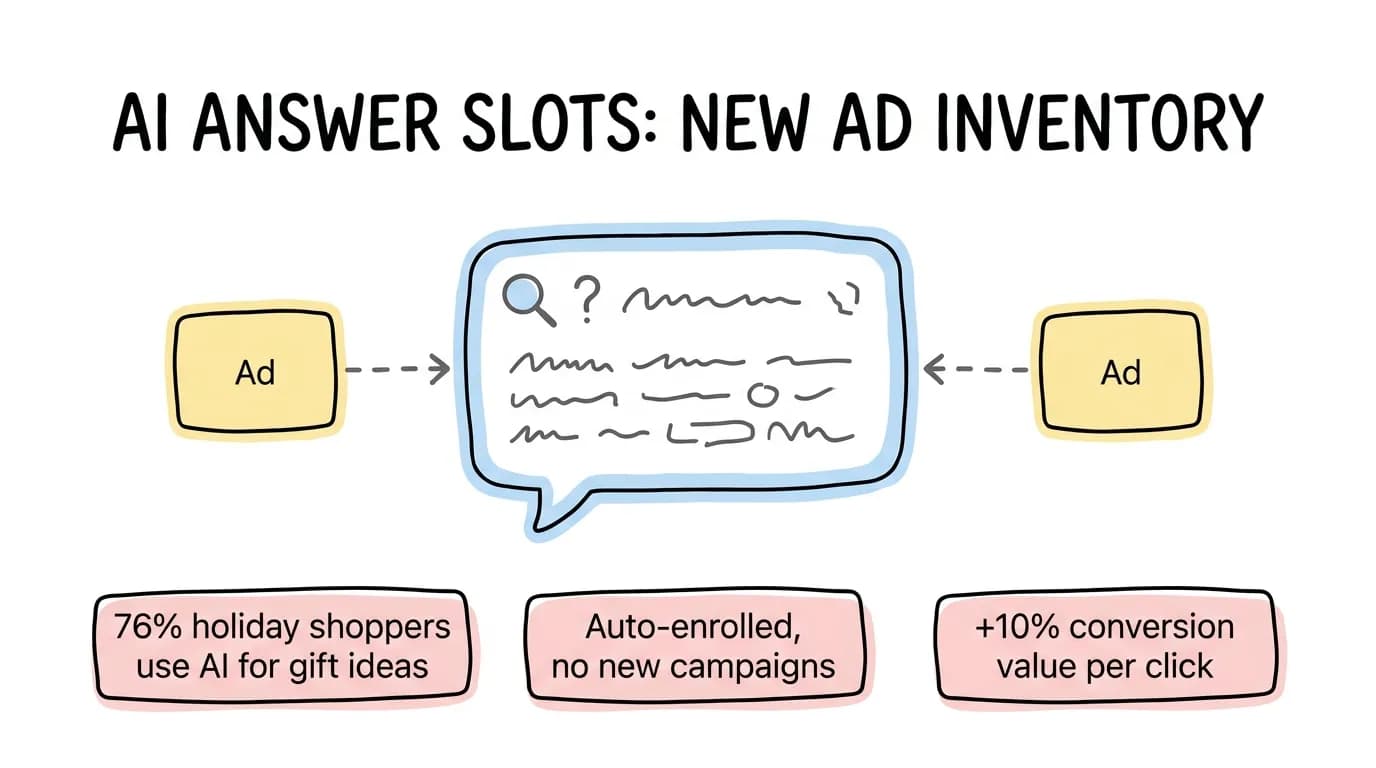
AI Marketing Daily for 2026-11-22 rounds up 20 items led by Microsoft opening Bing AI Overviews to ads and Google expanding AI Mode ads to ten countries, plus GEO guides, ad automation delegation guidance, AI Overviews CTR data, and a legal-risk checklist for AI-generated creative.
AI Marketing Daily · 2026-11-21
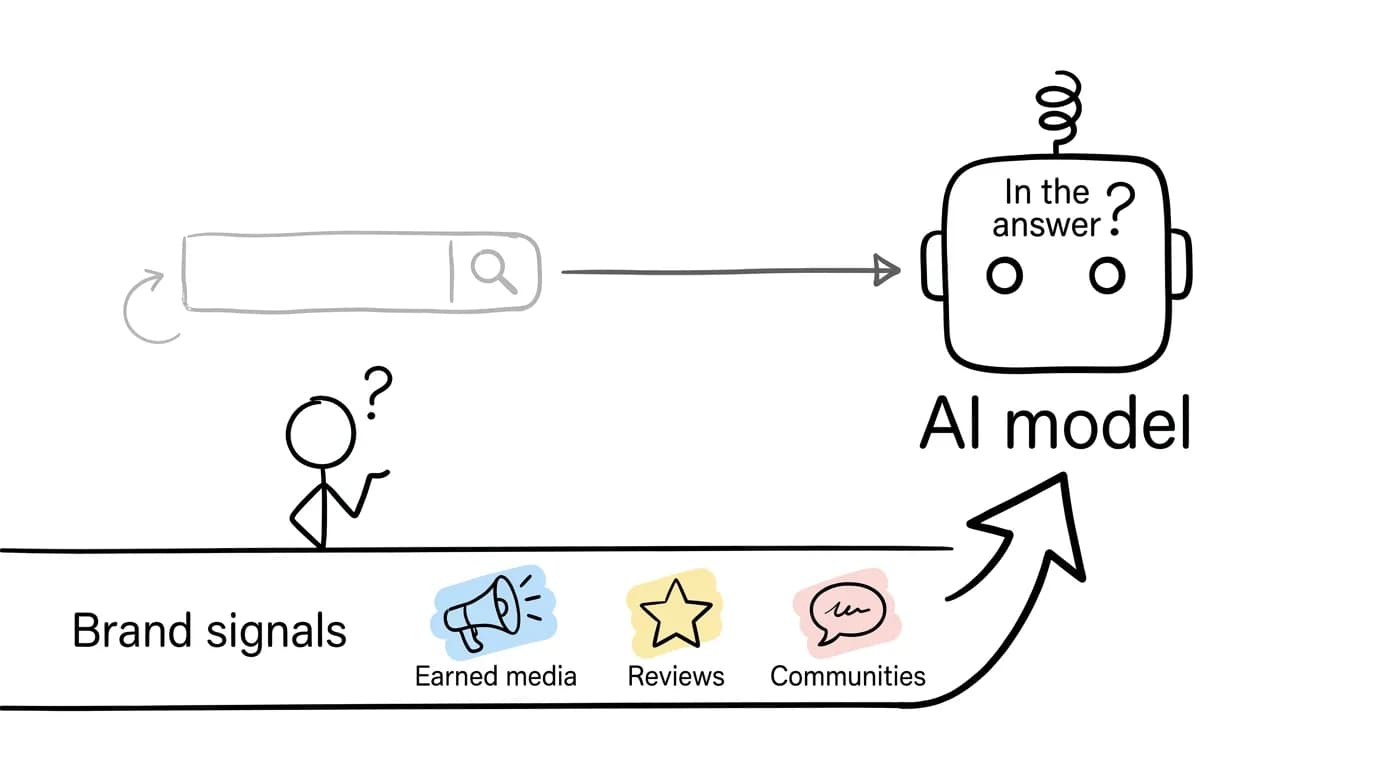
A November 21, 2026 AI-marketing daily covering AI search visibility, GEO methods, Google AI Mode ads expanding to ten countries, Meta's pre-Black Friday changes, agentic shopping, and industry adoption and ROI data.
AI Marketing Daily · 2026-11-20
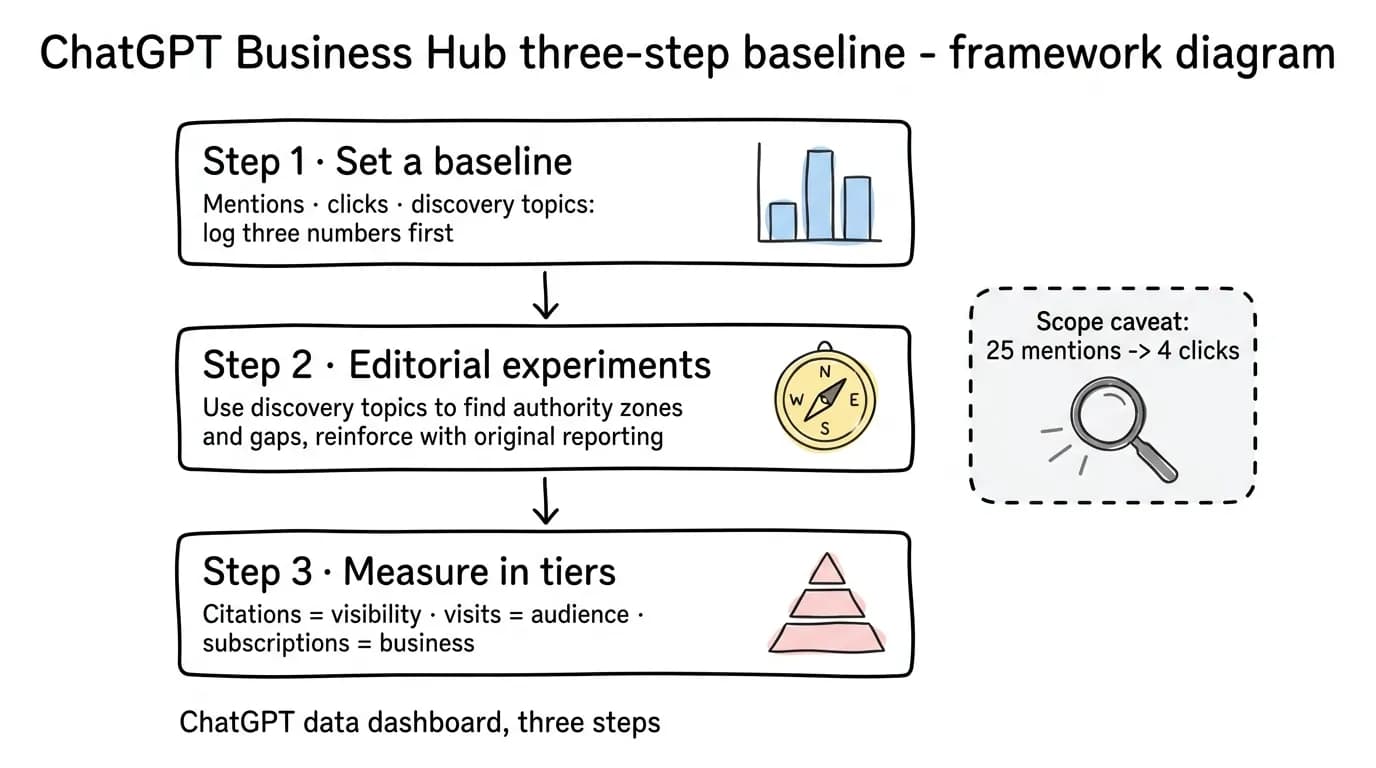
AI Marketing Daily for 2026-11-20 rounds up 19 items centered on measurement: OpenAI's ChatGPT Business Hub dashboard, EU rules for agent-mediated purchasing, Meta pausing four AI terms, and B2B data on shortlists and the dark funnel, each with action advice.