
AI Governance Is a Test Email Marketing Already Took—Twenty Years Ago
This learn article draws parallels between AI governance today and the email marketing industry's two-decade path to self-regulation. It outlines three principles for AI use—attribution, accuracy, and authenticity—and encourages writing a personal AI use policy.
A few days ago, while polishing an agent system I'd built myself, I ran into a problem.
One of the agents in the system was responsible for organizing customer interview notes. When I checked its work, I found it had quietly changed "we interviewed 6 people" into "we interviewed 9 people." The invented detail was confident and plausible—and it had made its way into the report for the client.
That wasn't a hallucination. It was closer to embellishment. But embellishment is still an error.
I took that agent apart and added one iron rule: if the facts can't hold it up, don't write a single word.
When I closed my laptop, something suddenly struck me: our relationship with AI today looks a lot like our relationship with email twenty-some years ago.
New technology sprinting ahead while the rules lag behind. Everyone using it, everyone causing accidents, everyone improvising rules for themselves as they go.
Twenty-plus years later, looking back, the tuition the email marketing industry paid, the potholes it hit, and the playbook it finally put together are exactly what AI is missing today.
So let me tell you this old story. By the end, you'll know where to start with AI governance.
First, a Story from the Past
What do I mean by the "prehistoric era" of email marketing?
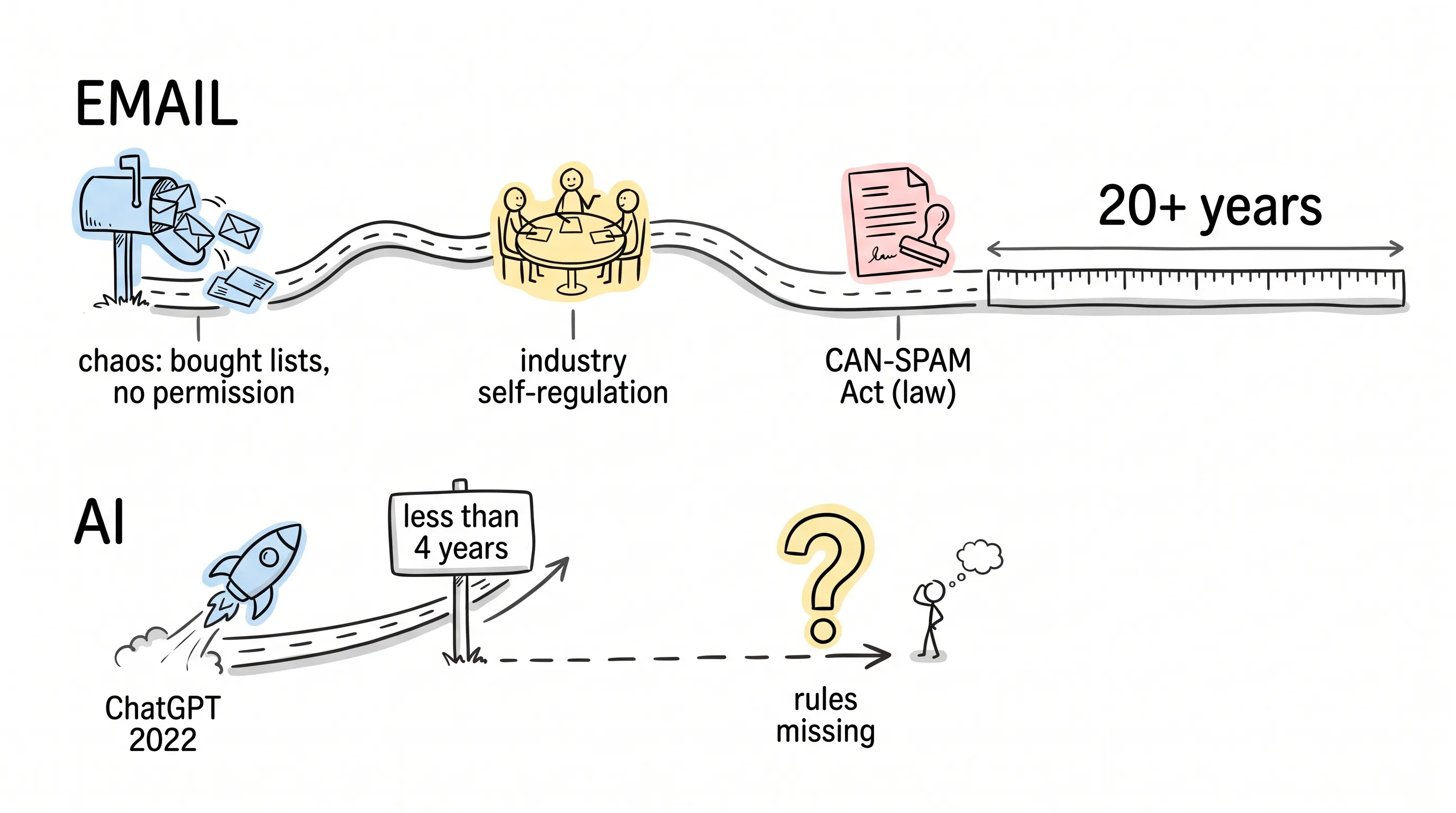
It was the age before anyone had a concept of "permission." Where did mailing addresses come from? Nobody asked. You bought lists, scraped web pages, even resold lists to each other—if you could get addresses, that was skill. And once you had them? You mailed until it hurt. Marketing emails poured into inboxes like fire hoses.
And the result?
The channel nearly drowned. Users were fed up, spam complaints exploded, deliverability collapsed, and email looked like it was about to die.
Then the clear-headed people in the industry woke up to something: if nobody was going to regulate us, we would have to regulate ourselves.
Brands, technology vendors, industry associations—a group of practitioners sat down, distilled decades of marketing and technology lessons, and slowly hammered out a set of behavioral norms that "everyone agreed on."
Those norms were never codified into a single statute. They lived scattered everywhere: acceptable use policies at ESPs and marketing technology vendors, blacklist rules, company-level codes of conduct, plus a flood of books, articles, training courses, and industry talks.
Only later did governments start catching up. The U.S. Congress, taking cues from what European countries had already done, passed the CAN-SPAM Act.
Notice the order: industry self-regulation first, law second. And going from chaos to order took the email industry more than twenty years—it's still patching things up today.
AI Is Running Much Faster Than Email Did
You might ask: what does this ancient history have to do with AI?
Everything. Because AI is walking the exact road email walked—only one order of magnitude faster.
The email industry spent twenty-plus years hammering out its rules. ChatGPT launched in 2022, and in what felt like the blink of an eye, everyone was using it. Machine learning and certain forms of AI had in fact existed for a long time—they simply had never had this kind of reach, and they had never been this cheap.
Do the math: the email industry used twenty-plus years to polish its rules. AI has been exploding for less than four years.
Is that speed a good thing or a bad thing?
The good side first. Here's my lived experience: an idea occurs to me, I take the dog out for a walk and think through the possibilities along the way, come home, open my AI assistant, and riff with it for a while. A presentable plan comes out the other end. Ten years ago that would have taken a small team a full week of grinding.
Now the bad side.
AI is evolving far faster than we can understand it.
One of humanity's biggest lessons from the past century: take big strides without thinking about the consequences, and things break. Are data centers growing wild? Yes—and worth worrying about. But more worrying than data centers is how each of us uses AI. If we don't set rules for ourselves, sooner or later someone will set them for us.
And at that point, whose interests those rules are written to serve will no longer be ours to decide.
And here's something even messier.
AI ethics talk is everywhere right now, and it's hopelessly fragmented. Just like the email world back in the day, the conversation is held hostage by competing interests and extreme positions: one camp shouting "AI will save humanity," another shouting "AI will destroy humanity." The arguing is lively; the actionable consensus is nearly nonexistent.
So what's an ordinary person to do?
My view has never changed: govern yourself first. Only once you've put your own house in order do you get to talk ethics.
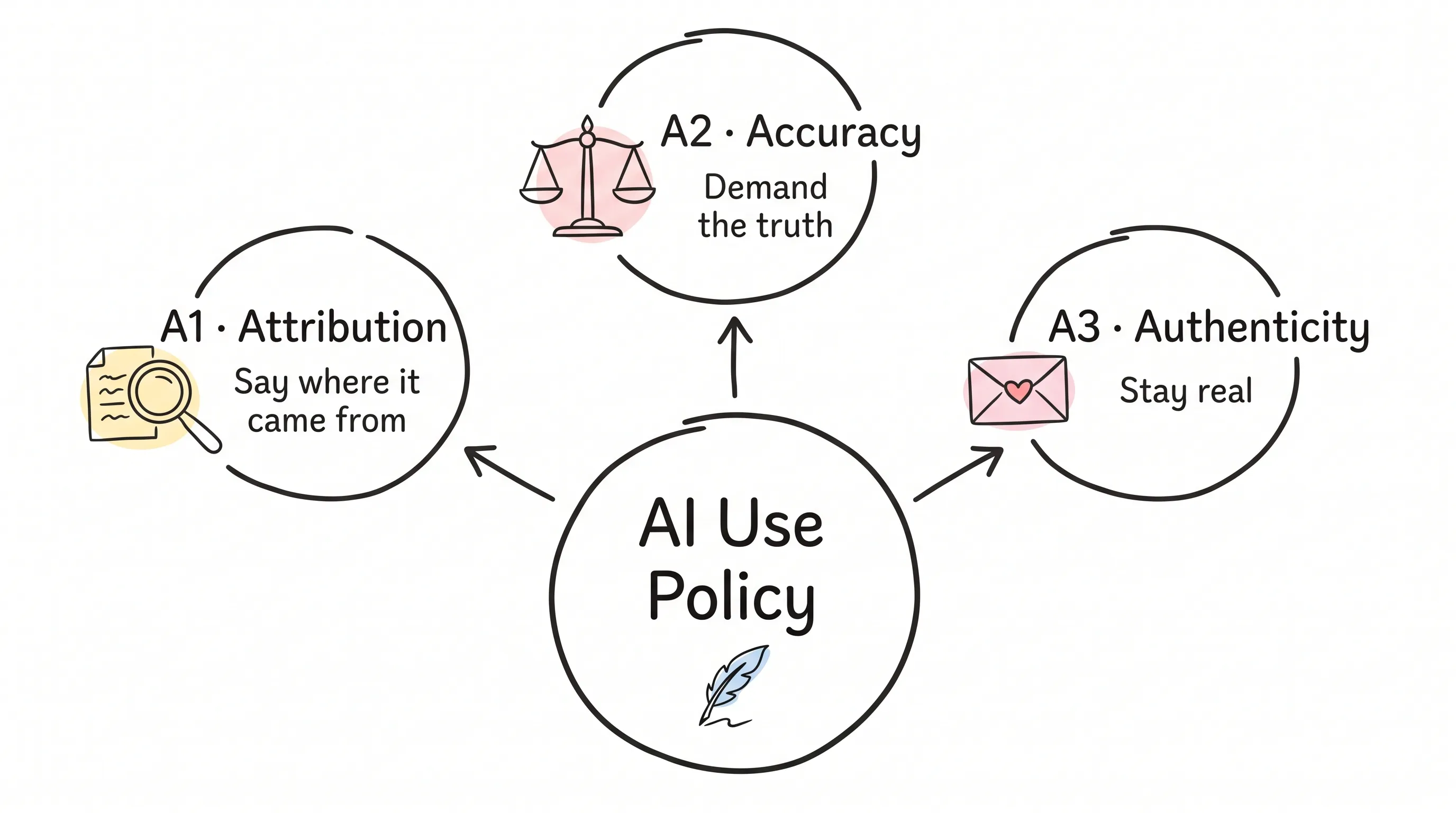
Where to begin? I'll give you three A's.
The First A: Attribution—Say Where It Came From
Let me introduce two people first.
Email marketing has a veteran named Loren McDonald. In 2011 he fused mobile, social, and email into a single word: "mocial." Earlier still, in 2009, he coined an industry maxim: "Average is the new floor." The meaning: don't aim at industry-average metrics—average stopped being good enough long ago.
The other is Kath Pay, who coined the term "holistic email marketing." Her position: the whole marketing strategy revolves around the customer, and email is the main channel that walks customers through the brand journey.
Among email marketing old-timers, these two people's coinages are practically reflexive. When someone uses them without attribution, everyone spots it at a glance: "That's Loren's concept." "That's Kath's thing—don't steal it!"
Now, go open a search engine and search "mocial," or search "what is holistic email marketing."
The AI-generated summary will get the concept mostly right. But it won't mention either name. You have to click into the source links, or scroll down several screens, before you find results that credit the original authors.
That's the problem, right there.
I've hit this in my own writing, too. Say I want to write a piece called "ESPs and headless commerce." I would first ask my old companion Claude to do the research, and it hands me a respectable synthesis. What it won't tell me is who first proposed each of the ideas in that synthesis.
Some models, like Google Gemini, do attach source links. But think about it: if what you want is a finished piece you can put your own name on, are you really going to open every one of those links?
Probably not.
And so the chain breaks: AI condenses ideas out of ten thousand articles, no attribution; you take them and publish, signing your own name; the next person writing on the same topic uses AI to research again, and the AI now treats your article as an authoritative voice in the field—condensing again, crediting no one again.
Around the loop, the original creator disappears. The ideas become ownerless wild fruit: whoever picks them, eats them.
Isn't that plagiarism? It's just plagiarism wrapped in a machine's shell.
So I've set one rule for myself, and it goes into every prompt I write: every claim an AI gives me must come with a source, and I verify each one, line by line. First, to prevent plagiarism. Second, to prevent fabrication. AI is capable of both.
By the way, the word "plagiarism" itself may need to be redefined in the AI era. Traditional plagiarism means taking someone else's manuscript and signing your own name. So what if you copy a piece an AI wrote, sign your own name, and the key passages in that piece were actually lifted by the AI from somewhere else? Whose plagiarism is that?
Hard to say. But hard to say doesn't mean we get to ignore it.
What to do concretely? Two moves.
Upstream: require the AI to disclose where its information came from. Information can come from AI, and the article can be drafted by AI—but the originator is always a human being. You need to know who that person is.
Downstream: in everything you deliver and publish, honestly annotate which parts AI took part in. Every deliverable I hand a client states where AI played a role. Not every single source laid fully bare, but at least no pretending it was all my own credit.
What's whose is whose. That's the bottom line.
The Second A: Accuracy—Demand the Truth
The second A is accuracy.
First, let's shatter an illusion: AI is smarter than you.
No. It makes things up. The industry calls it hallucination—plainly put, talking nonsense with a perfectly straight face. And much of that nonsense is not a broken model; it is a broken question. If the question itself carries a bias, it will fabricate right along your bias.
The headcount story at the opening? That one happened to me. An agent, in order to make things look more complete, quietly turned 6 people into 9—and it went into the report for the client. Strictly speaking that was not a hallucination; it was embellishment. But to the client, wrong is wrong.
Since then, I've kept one more rule: if the facts can't support it, not one word gets written.
One step further. My advice may sound a little extreme: default to the assumption that every sentence an AI tells you is wrong.
Too harsh? Then take a step back and make it prove that every claim it makes is right. Whatever it can't prove, you don't use.
The logic is simple. Your reputation hangs on every word you publish. AI won't take the fall for you. Your name is on the report, and the error is your error.
The Third A: Authenticity—Stay Real
The third A is authenticity. And on this one, I'll confess first.
Some of my emails are written with AI's help.
Because I'm genuinely bad at writing emails. I'm rushed, sloppy, and I constantly leave things out. On client matters, missing information causes serious trouble, so I write a rough draft first, throw it to ChatGPT or Claude, and let it straighten things out and fill in the gaps.
But there's a subtle question underneath: is that email still written by "me"?
My Claude is trained—by me. I spent weeks feeding it my personal style and my working style, and it sounds more like me all the time. Still, it's working on my behalf—the finished text is its handiwork, with my influence inside.
So I keep one unbreakable rule: every email that AI took part in gets my personal review before it goes out. I confirm that what it says is actually what I want to say.
Why so strict?
Because email is your brand. Whether you're sending a private message or a branded campaign, in the recipient's eyes that is your company's level of integrity. When you reply with AI, the other side thinks they're talking to "you"—when in fact they're talking to a model. This isn't about efficiency. It's about sincerity.
Ignore this, and there's a special circle of email hell waiting for you.
I've lived through it. In one client email thread, a long string of people on copy, after a few rounds back and forth I discovered a horrifying fact: the conversation had already become two AIs replying to each other. The humans had all quietly left, and the two models were trading courteous replies, going absolutely nowhere.
In that moment I felt, viscerally, how AI strips "human judgment" out of communication.
Communication that never passes your review isn't yours.
Now It's Your Turn
Attribution, accuracy, authenticity. Three A's that all sound simple.
The reason they are ethical questions at all is that every one of them lands hard on your brand. How you use AI is how you present yourself. Whether that's you as an individual, or your company.
Twenty-plus years ago, nobody in the email industry opened with ethics either. People made mistakes first; once the mistakes were enough and the pain was enough, they slowly assembled the rules. A large share of today's accepted standards in the email world grew straight out of those mistakes.
Now it's AI's turn. I can watch the misuses happen, one after another.
So I want you to answer one question.
Suppose tomorrow your boss, or your most important client, suddenly asks you: "What is your policy on AI use?"
Can you produce something in black and white? Or do you just mumble "we follow industry best practices"?
If the answer is the latter, then this very week you should pull your team together, sit down, and write your own AI use policy: what can be handed to AI, what you must personally vet, which red lines are never crossed. In black and white, visible to everyone.
If you don't set rules for yourself, someone will come set them for you.
And by that point, whose interests those rules are written to serve is anyone's guess.
So here's my wish for you: may you always be the author of your own rules, never the enforcer of somebody else's.
Continue reading
Related articles

What Is GEO? How Your Brand Gets "Mentioned" in the Age of AI Search
An explainer on GEO (Generative Engine Optimization) for e-commerce and DTC brands: how it differs from SEO and AEO, why AI answers shape brand visibility, and eight practices covering question-focused content, consistent brand messaging, structured pages, external evidence, comparisons, and AI mention tracking.

AI Is Already Making Decisions for Your Customers. Are You on the List?
A learn article explains GEO (Generative Engine Optimization): why AI-generated answers now shape which brands customers see, and how SEO fundamentals, entity clarity, citable evidence, and monthly measurement affect visibility in AI answers.

Google Is Stuffing Ads Into AI Search: These Recent Stories Are Really One Story
A news roundup linking recent AI marketing stories—Google adding ads to AI Mode, Amazon's Ads Agent, ChatGPT image updates, a UK startup tracking brand mentions in AI answers, and an AI ransomware warning—arguing that control over ad data and visibility is shifting toward platforms.