
Adding People Doesn't Help. Neither Does AI? First, Figure Out Whether Your Team Lacks People or Skills
This article explains how to tell whether a marketing team lacks people or skills before spending on hiring or AI tools. It defines skills and headcount gaps, cites Gartner and Optimizely survey data, offers three diagnostic tests, and advises fixing skills first.
A few days ago, a friend who runs a marketing team invited me out for tea to vent about budget.
This budget cycle, his team asked for two additional heads. What finance approved instead was a handful of AI tool licenses.
The team was told to do more work with the same crew. Six months on, draft output is at an all-time high. But the most capable person on that team now spends a big chunk of every week fixing AI-generated drafts.
I asked him: when you filed that request for more people, did anyone first ask the basic question? What you're short on — is it people, or is it skill?
He stopped for a second.
If you never get that question answered, then hiring and buying AI are both ways of paying for the wrong answer.
Patch what's missing. Patch the wrong thing, and the money's wasted.
What Is a Skills Gap? What Is a Headcount Gap?
Skills first.
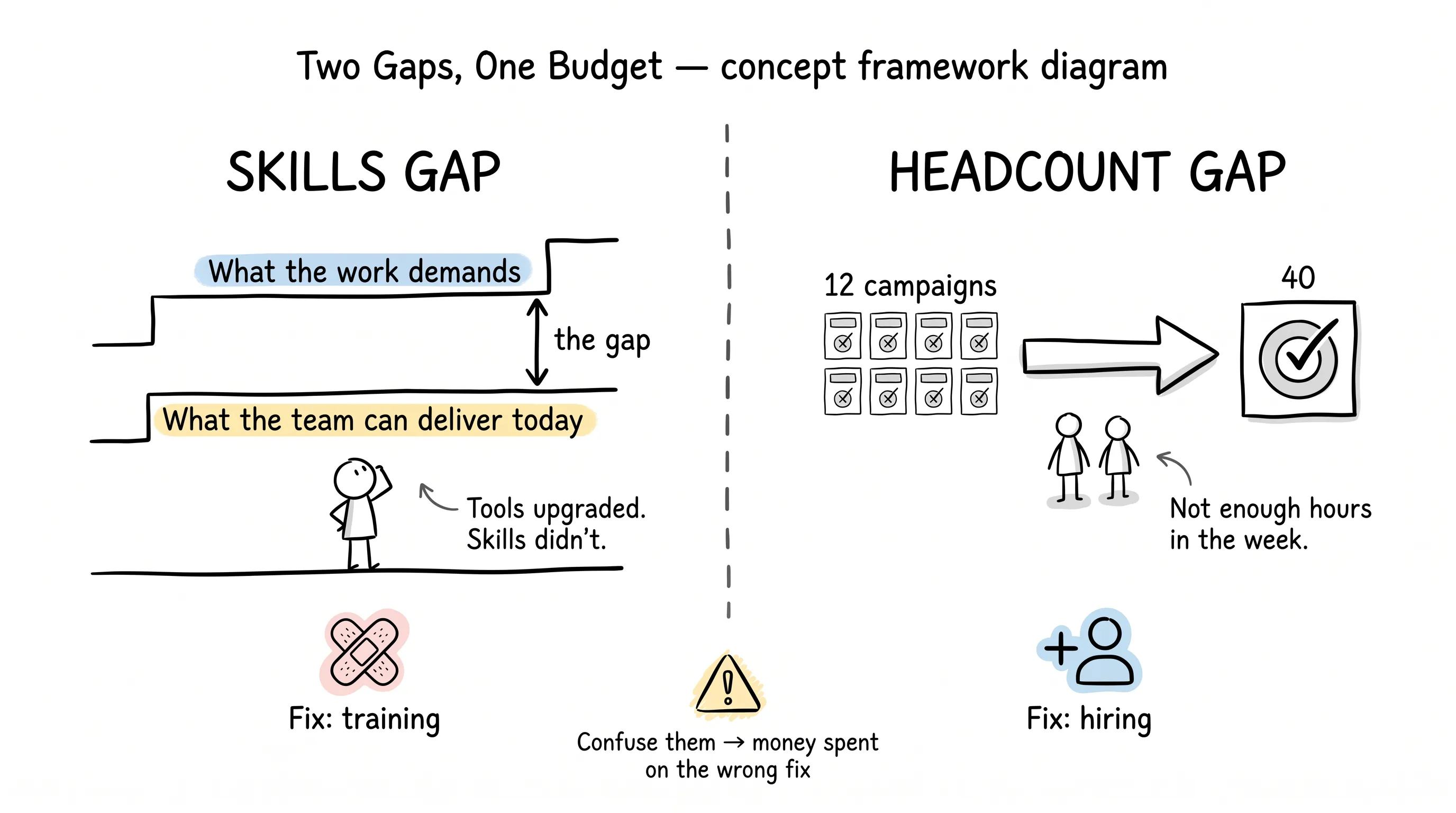
A skills gap is the distance between what the work demands and what the team can actually deliver today with the tools it has.
Where does that distance come from? Usually, the team learned the craft on older tools. Vendor training stopped at scheduled email sends — behavioral scoring was never touched. Then AI tools arrived, and nobody taught people how to write briefs that would get usable work out of the machine, and nobody taught them how to review what the AI handed back.
The tools moved up a generation; the skills stayed on the previous one. That distance is the skills gap.
Now, headcount.
A headcount gap is when the team knows how to do the work — there just isn't enough time.
An example. The team is running 12 marketing campaigns at once, at full quality. The plan calls for 40. You can streamline the approval process, automate the reporting, and each round of optimization squeezes out a bit more capacity — then it stalls, still far from 40. Closing that distance takes project managers, content producers, analysts: people you don't currently have.
A training course won't fill that hole.
Confuse the two gaps and the money goes to the wrong place. Train people who are already at full capacity, and once they've learned, they still have no time to use it. Stuff more bodies into a team that lacks skills, and the first thing the new hires learn is the workarounds the veterans already use.
Why Has AI Muddied This?
Because AI has been sold both ways. One pitch says it can do the work of an analyst; another says it's a few extra pairs of hands.
So how are companies actually spending real money on it?
Gartner's 2026 CMO Spend Survey asked 401 marketing leaders. Labor's share of the marketing budget rose from 21.9% in 2025 to 24.5% in 2026. The wider AI spreads, the more people they hire. And the top barrier to AI delivering efficiency? 38% gave the same answer: not enough internal AI talent.
Ewan McIntyre, who leads marketing research at Gartner, put it in one line: AI is no shortcut around marketing capability.
Put plainly: AI is an amplifier. What the amplifier magnifies depends on what you press it onto.
Press it onto a skills gap and you get three things.
First: output goes up, quality stays the same. Second: a brand-new job appears — checking. Optimizely commissioned Savanta to run a survey of 2,003 marketing leaders. 76% spend at least three hours a week editing, verifying, and repairing AI output. 54% say leadership underestimates how much human labor it takes to turn AI output into something usable.
Third, and the most hidden: checking is itself a skill. Someone who doesn't understand segmentation can't spot a wrong segmentation, no matter how fast the tool is. So AI hasn't lowered the bar — it has raised the bar at the approval step.
And there's a harsher one. In the same survey, 39% are so busy managing processes and output that they have no time to think about strategy; 46% worry that heavy AI use will erode junior marketers' skills. The teams hoping AI will fill their skills gap are precisely the ones whose skill-building AI is holding back.
What about pressing it onto a headcount gap?
A completely different picture. A team that knows the craft knows what good looks like, reviews fast, and the time AI saves is genuinely saved. AI can also take over part of the workload from capable hands. There's just one thing it can't replace: the project managers in the distance between 12 campaigns and 40 — AI can't conjure them.
Which Gap Is Yours? Three Tests
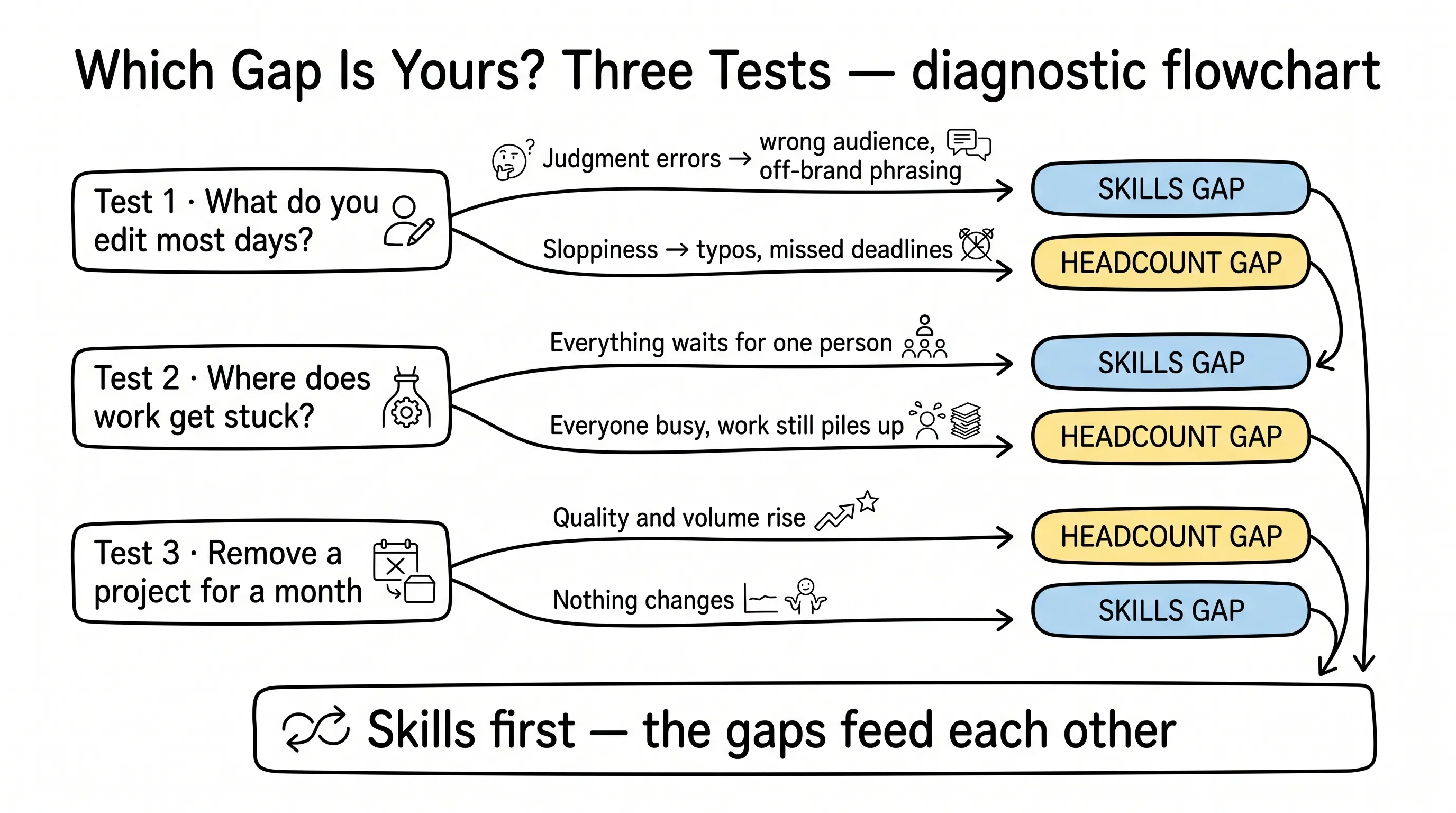
Test one: look at what you edit.
Ask whoever reviews the work — regardless of whether it was AI-produced — what they change most days. If it's judgment errors: wrong audience picked, wrong customer attached to the wrong record, phrasing off-brand. That's a skills problem. If it's sloppiness: typos, missed deadlines, skipped steps. That's a time problem.
Test two: look at where work gets stuck.
Work queues up, waiting for one person — the only one who can build the user journey, the only one who can create segmentation. That's a skills gap, and it's concentrated on a single person. It's also a risk: when that person leaves, the skill leaves with them. If instead everyone is busy but anyone could do the work and it's simply piling up, that's a headcount gap.
Test three: take a piece of work away for a month.
Pull one recurring project off the team's plate and watch for a month. If everything else goes up in both quality and volume, the constraint was time. If nothing changes, the constraint was skills — no amount of extra time will manufacture capability.
This test has a cost: you lose a month of progress on that project. So pick one you can afford to lose.
Missing Both? Fix Skills First
Plenty of teams have both holes at once. My advice is blunt: fix skills first.
Because the two holes feed each other. A team short on skills burns enormous time on rework and workarounds — which is why a skills gap so often disguises itself as a headcount gap. Close the skills gap, and the headcount gap shrinks on its own.
But be honest about the price. Training is measured in months; production targets wait for no one, and part of this year's output may have to be traded for next year's. Most teams couldn't fill both holes at once anyway. The same Gartner survey: 56% of CMOs say their budget can't support the 2026 strategy; 54% say resources fall short.
There is one way to cover both at once: give your next headcount requisition to a seasoned practitioner who trains people. Hire someone who has done the work and whose job description says "teach others." You gain a pair of hands immediately — and six months later, a team that has been properly trained.
There's a budget rule of thumb here, too. Set training spend at 15% to 20% of annual license fees; staff one process operations role for every three or four core platforms. The same rule applies to AI: for $100K of AI tool licenses, there should be a $15K–$20K training line.
So before the next AI purchase request goes to finance, add one line: does this money buy skills or hands? And how do you know?
If you can't answer, go back and run the three checks first. No rush.
AI tools will still be on the shelf next quarter. Skills won't be.
Continue reading
Related articles

What Is an AI Marketing Agent? From "Using AI" to "Delegating to AI"
A learn article explaining what an AI marketing agent is, how it differs from rule-based automation, and which repetitive tasks such as lead qualification, reporting, and campaign monitoring can be delegated while humans keep key decisions.

Marketing Automation Is Shifting from "You Do It" to "You Say It"
This article explains how marketing automation is shifting from rule-based platforms that merely execute toward AI agents that plan, create, publish, and review campaigns, covering delegable tasks, underlying technologies, tool categories, adoption steps, and risks such as privacy and automating without strategy.

When AI Does the Creative, Mistakes Come in Batches Too
A learn article on the risks of using generative AI for marketing creative across brand, legal, compliance, and operational layers, with case examples and seven practices for review, rights clearance, documentation, and vendor governance.