
AI did the marketing department's job — now what?
An educational overview of generative AI in marketing: how it speeds content production, personalization, A/B testing, and customer service, and the risks of sameness, factual errors, privacy issues, and unclear copyright. Advises setting goals and brand boundaries, and keeping human review before publishing.
A while back, I sat down for tea with an old friend who runs an e-commerce business.
His team is five people. Writing a single piece of product copy used to take them a full day of grinding. Now he opens an AI tool and twenty drafts pop out in a minute, in three different tones.
I expected him to be excited. Instead, he sighed: "I used to worry about not having enough content. Now I worry about having too much."
I kept turning that line over in my head for a long time after.
Put simply, the question has changed. A few years ago everyone was asking: can AI actually do the work? Today the question is: it did all the work — so now what?
What is generative AI?
First, let's translate the term into plain language.
What is generative AI? It's AI that has evolved from "helping you search" to "helping you write." You give it a prompt, it hands you content: copy, images, videos, emails, landing pages — even the scripts for customer-service replies.
And note — this is not the same thing as early automation.
Marketing has had machines doing work for years: auto-reply emails, rule-based chatbots, article generators stitching together keywords. They were like robotic arms on an assembly line — repeating the same motions, never understanding the product, let alone the human being.
Today's generative AI is different. It can read a brand's voice, gauge what a user actually wants, take one message apart and break it down, then retell it five times in five different platform voices.
From robotic arm to apprentice — that's the essential difference.
The opportunity: what is it actually doing for you?
Let me walk you through a few things.
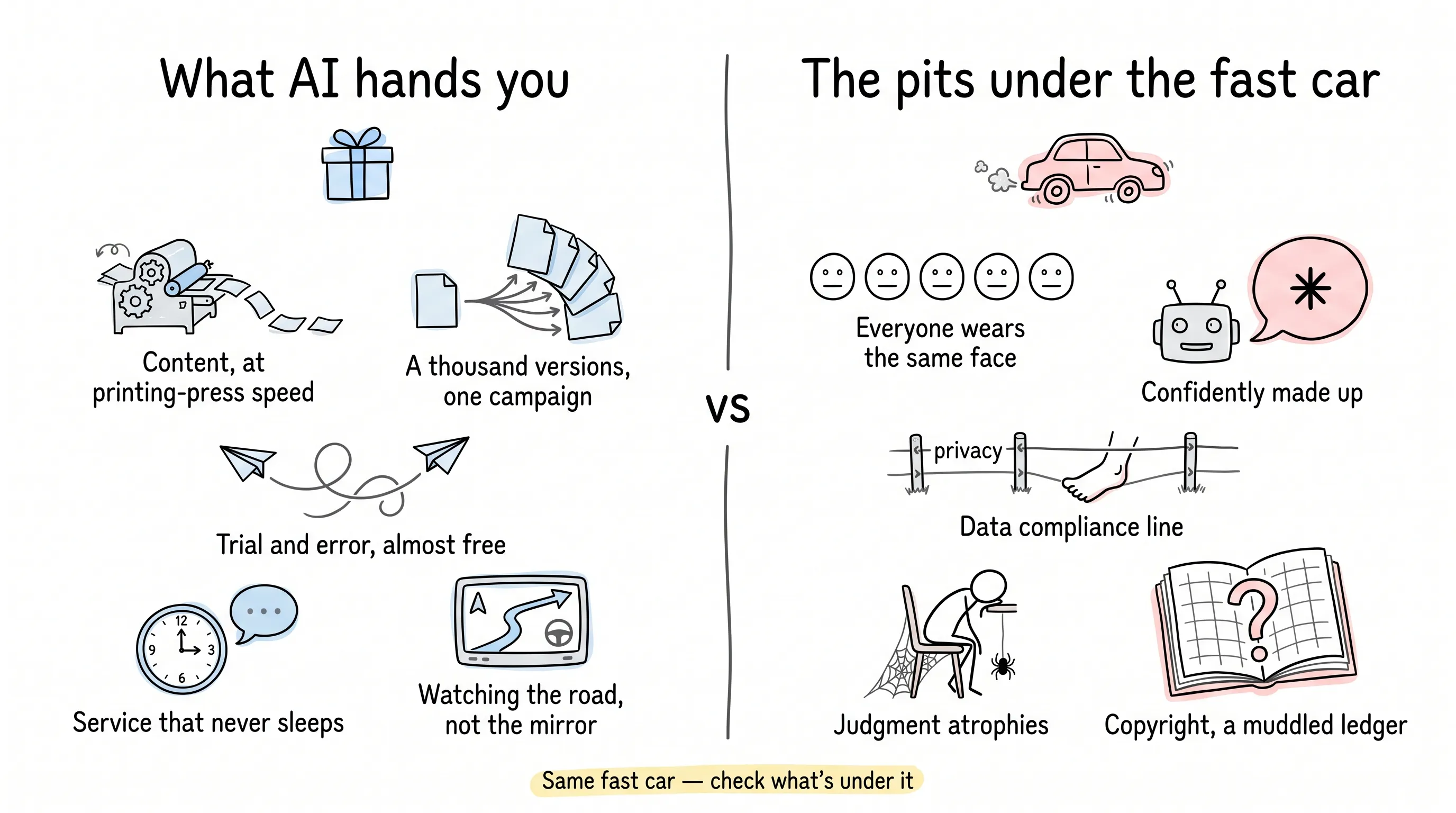
First, content production went from hand-copying to the printing press.
How many places does a brand need to show up today? Website, WeChat official account (WeChat's publishing platform), short video, livestream rooms, email, store product pages. Every one of them needs content — and not the same copy-pasted line everywhere.
In the past, that took a large content team. Today, a small team can hold the whole line. A five-person company can field a presence that used to take fifty people.
That knocked the barrier down. It used to be a budget game; now it's a game of how deeply you understand your users.
Second, personalization went from "calling your name" to "actually knowing you."
What did personalization used to look like? An email that opened with "Dear Mr. Wang." Everyone knew it was just variable substitution.
Now it's different. AI can take one user's browsing trail, purchase history, and interaction habits, and generate, on the spot, a message written only for them. One campaign, a thousand users, a thousand versions — and every version feels like it was written just for the person reading it.
Some of you reading this will say: that's almost too well-targeted. Yes — exactly that well. It knows you well enough to lift conversion, and well enough to send a chill down your spine. That chill — I'll get to it later.
Third, trial and error has become almost free.
Polishing one ad concept used to take weeks from pitch to final sign-off. Now? A batch of versions in minutes — different headlines, different visuals, different selling points — thrown straight to the market, letting the data vote.
A/B testing went from a big-company luxury to everyone's daily move. Less guessing, more calculating.
Fourth, customer service stopped needing sleep.
Conversational AI wears the brand's voice, stays online 24/7, and does it all: answering questions, recommending products, following up after the sale. Faster responses, lower costs, and instant replies at 3 a.m.
Fifth, from the rearview mirror to the navigation screen.
AI doesn't just produce; it computes. It watches campaign data, user behavior, and market movements, and tells you where the content gaps are, which direction is about to go cold, and where the budget should shift.
Marketing has moved one step forward: from "reviewing after the fact" to "watching the road while you drive."
So far, it's all good news. Efficiency is up, costs are down, and small teams finally get to hold their heads high.
But everything has a flip side.
The risk: the pits under this fast car
Pit one: everyone starts wearing the same face.
Think about it. The whole industry runs on the same few models, trained on the same internet. Today you have AI write your copy; your competitor next door has AI write theirs.
So what's the result?
A whole class copying from the same essay collection, turning in forty papers that look exactly alike.
Once content has no distinct identity, the brand loses its face. When users scroll past you, and scroll past everyone else, they feel nothing. AI can give you volume; it cannot give you a face. The face is something you have to define clearly yourself first — then let AI execute it.
Pit two: it will make things up with a perfectly straight face.
Models learn from oceans of data. The data contains bias, expired information, and mismatches. And when the model gets something wrong, it sounds utterly certain.
For an everyday social media post, you fix the error and move on. But in finance, healthcare, education — one false statement is an incident, and regulators and lawsuits are not joking around.
So every piece of AI output needs human eyes on it before it ships. AI marketing without a review step is driving without touching the brakes.
Pit three: data and privacy.
That "knowing you" from earlier — what does it run on? User data.
The deeper you use the data, the closer you edge to the compliance line. Data-protection rules around the world have been tightening for years. Cross the wrong one, and at best it's a fine; at worst, you lose the trust of your entire customer base.
Trust takes a decade to build, and one news story to collapse.
Pit four: people get lazy.
This is the most hidden pit of all.
Let AI do the creative, let AI make the recommendations, let AI write the summary too. Three months later you look around and realize nobody on the team raises objections anymore. Judgment, left unused, atrophies.
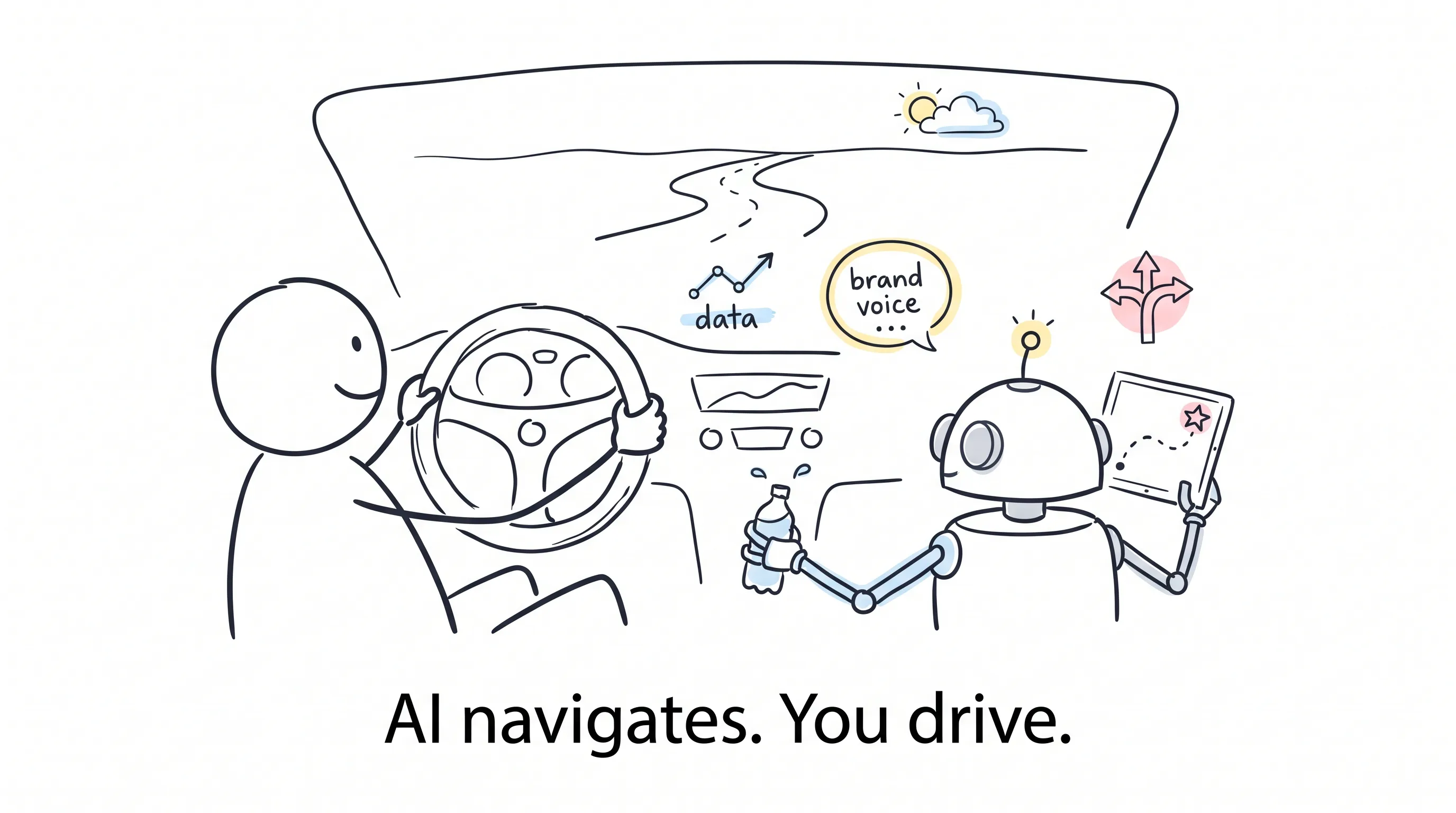
AI is the co-pilot: it navigates, watches the road, hands you water. But the steering wheel — you don't let go of that.
Pit five: copyright is a muddled ledger.
Who owns AI-generated content? The brand that used it? The platform? The vendor that trained the model?
There is no fully settled answer today. And because models were trained on vast oceans of public works, they occasionally "recite" something copyrighted. Before you take any generated asset into commercial use, read the licensing terms carefully.
Leave this ledger untangled now, and someone will very likely pay for it later.
So how should you actually use it?
Don't rush to hoard tools. Get three things straight first.
Get clear on the goal: what is AI here to do for you — raise output, raise conversion, or fill a staffing gap? Without a clear goal, the tools will just manufacture piles of useless content.
Set the boundaries: the brand's tone, its values, the things it must never say — write them down in black and white. AI can write beautifully, but it doesn't know "who you are." You have to tell it first.
Guard the gate: every piece of outward-facing content passes human review. Wherever numbers, promises, or regulations are involved, not a single word slips through.
None of these three things is sexy. They're grunt work. But most things in marketing that keep working over the long run are exactly that: grunt work.
Where do people fit?
Reading this far, some of you are feeling that chill: if AI can do all this, where do people stand?
My answer is very clear: stand where AI cannot.
AI runs on patterns, and the essence of creativity is precisely to break patterns. AI can imitate "moving," but it can't touch the moment that genuinely moved you. Empathy, aesthetic judgment, the feel for the right degree — these are still human territory.
The strongest play has always been: let machines do what machines are good at — volume, speed, coverage. Let people do what people are good at — judgment, story, a feel for nuance.
AI's job is to make you faster. Your job is not to get dumber.
Back to where we started
Remember that friend I had tea with at the beginning?
He told me later that his team set a rule: every single piece of AI-generated content must have someone willing to sign their own name to it before it goes out.
I think that's a wonderful rule.
Tools will keep changing — next year is bound to be fiercer than this year. But one thing won't change: in the end, what users remember is the brand with a point of view, with warmth, that talks like a human being.
AI gives you the output. You give the brand its soul.
May your content always be worth signing your name to.
Continue reading
Related articles

It's 2026: Stop "Buying" AI Tools for Your Marketing Team — Start "Hiring" AI Agents
This learn article explains how AI agents differ from standalone AI tools in marketing, outlines three agent categories — build-your-own platforms, CRM-native agents, and vertical tools — and covers use cases across SEO, social media, advertising, and reporting, plus criteria for choosing one.

Did the Money You Spent on AI Marketing Ever Come Back?
A guide to measuring AI marketing ROI across three layers: ad reports, sales pipeline, and the financial ledger. Covers metrics such as ROAS and CPA, eight dashboard metrics, industry benchmarks, and common measurement mistakes.

How to Pick a Creative Automation Platform: First, Figure Out What These Eleven Actually Do
A learn article sorts eleven creative automation platforms — including Bannerflow, Celtra, Smartly.io, and Storyteq — into four functional groups and proposes five evaluation questions covering publishing reach, automation depth, ease of adoption, team fit, and verifiable evidence.