
75% of Marketing Teams Use AI — So Why Do Half of Consumers Want to Hide From It?
A review of recent industry surveys finds marketers widely adopting AI while many consumers stay wary, covering budget share, content creation use, trust in AI-generated ads, AI Overviews' effect on search clicks, and low training investment.
A few days ago, I had dinner with an old friend who runs an e-commerce business. He was thrilled: his marketing team now uses AI for everything from writing copy to producing images, and their efficiency has doubled.
I said congratulations. Then I asked him one question: do your customers know this content was written by AI?
He froze.
That frozen look was worth something. Over the past couple of days I went through a pile of survey data sitting on my desk, and I found that the whole industry's attitude toward AI is stuck between two very different pictures: on one side, marketers are embracing AI with real enthusiasm; on the other, consumers are quietly frowning.
Let's look at the pictures one at a time.
1. 75% Are Using It? First, Ask Who's Telling You
What does it even mean for a "marketing organization to be using AI"?
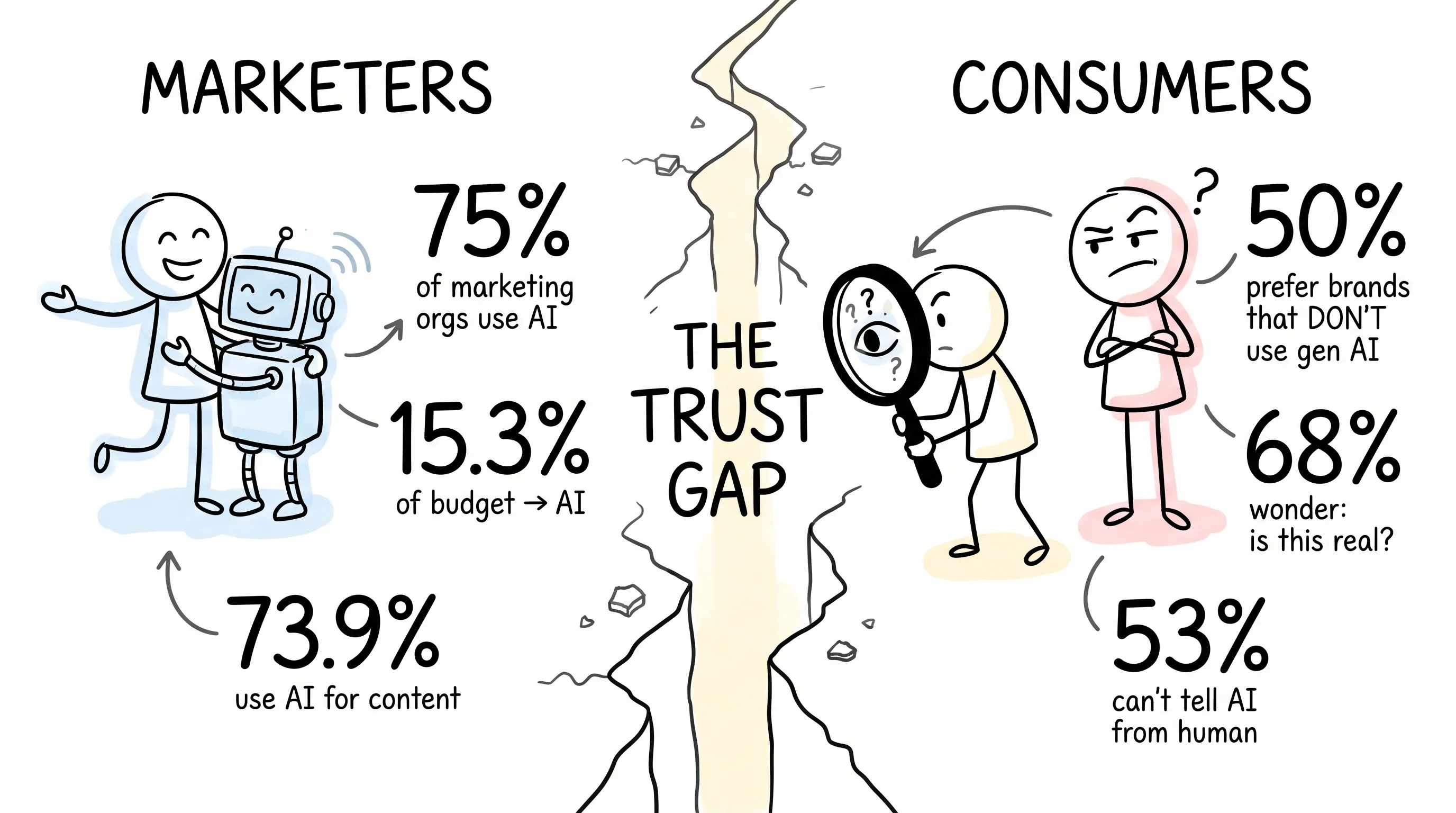
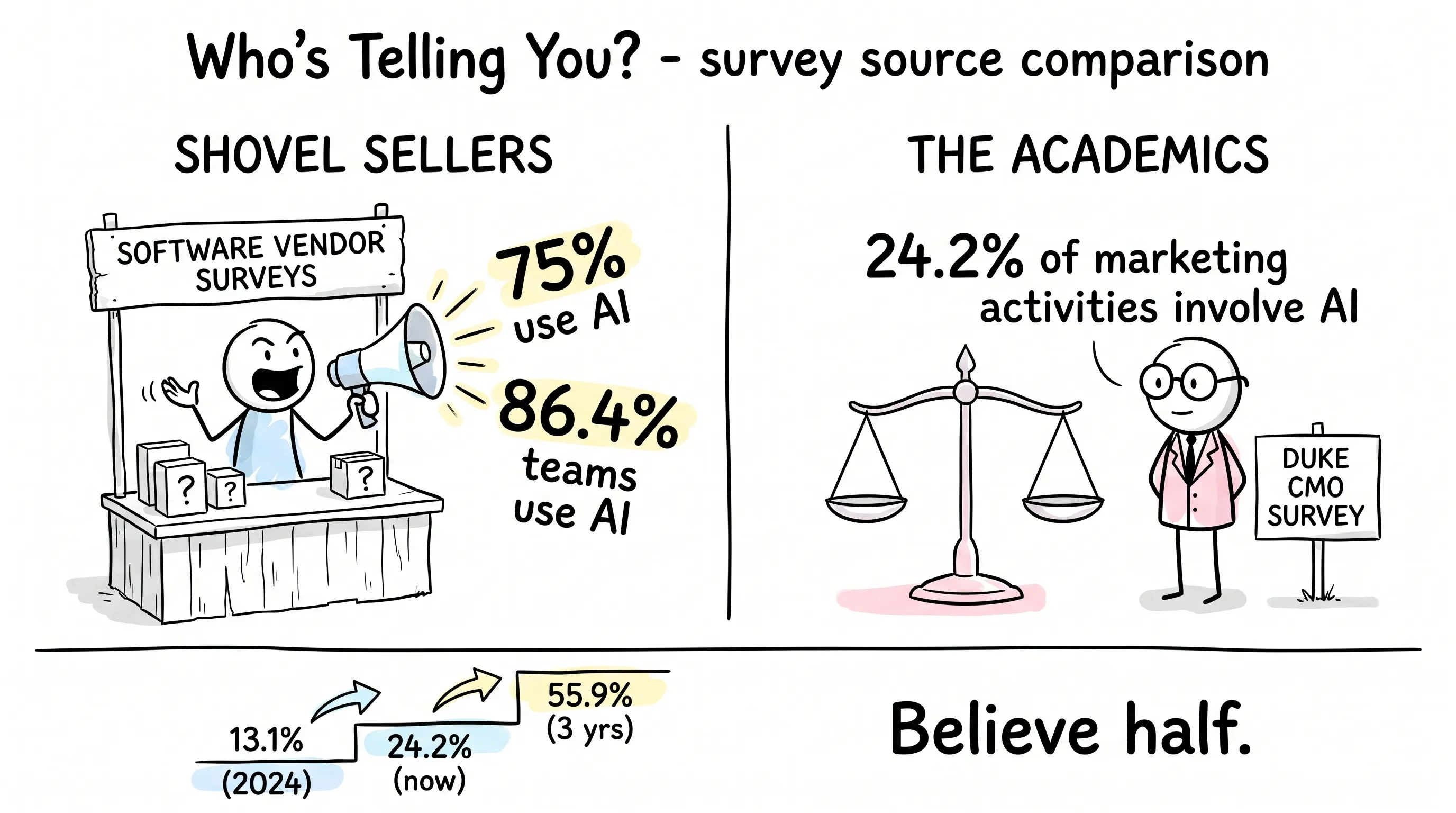
In Salesforce's 2026 State of Marketing report (covering 4,450 marketers), 75% of marketing organizations use at least some form of AI. HubSpot's survey the same year (1,500-plus marketers) went further: 86.4% of teams said they use AI in at least a few parts of their work, and only 1.7% neither use it nor plan to.
Sounds like the wildfire has already spread.
But in the same year, the CMO Survey from Duke University's Fuqua School of Business (308 US marketing leaders) came back with a different number: AI is involved in just 24.2% of marketing activities. That's nearly double the 13.1% of 2024, but still far from "sweeping the field." Those same leaders estimate it will reach 55.9% three years from now.
Why is the gap between these two sets of numbers so wide?
You have to look at who's talking. Salesforce sells marketing software and AI agents. So does HubSpot. When the people selling shovels tell you the gold rush is booming, believe half of it. The academics have no product to sell, and their count is closer to the ground: most teams have indeed "adopted" AI, but the work it actually touches amounts to only about a quarter. The share truly running agents is just 13%.
Between "we've adopted it" and "we can't live without it" lies a wide gulf.
2. The Money Is Real — but the Pie Isn't Growing
So what about the money? Money doesn't lie.
Gartner's 2026 CMO Spend Survey (401 marketing executives, most from companies with annual revenue above $1 billion): CMOs are putting 15.3% of their marketing budgets into AI projects.
What does 15.3% mean in context? The entire marketing budget pie sits at 7.8% of company revenue, essentially flat versus 7.7% in 2025.
The pie didn't grow, but the AI slice keeps expanding. What does that tell you? The money is being clawed out of somewhere else. Outsourced copywriting? Traditional ad buying? Something is being moved aside.
The gap between vision and reality is interesting too: 70% of CMOs list "becoming an AI leader" as a key goal for 2026, but only 30% say their organization's AI maturity is actually taking shape. And the organizations that are genuinely AI-ready are putting 21.3% of budget into AI.
In plain terms: plenty of people want to lead the charge; not many have put on the armor. Whoever suits up first eats first.
3. Inside Marketing, AI Eats Content First
So what is AI actually doing all day?
The CMO Survey's answer is clear: 73.9% of companies use AI for content creation. In the fall of 2023, that figure was only 49.2%. Two years, nearly 25 percentage points. Behind it come content personalization (65.4%), marketing automation (48.9%), data analysis (46.3%), and targeting decisions (45.2%).
The time saved is real too. In HubSpot's survey, about a third of respondents said AI saves their team 10 to 14 hours a week; another third said 15 hours or more; just under a third, one to nine hours.
Good grief — at the top end, that's three free days a week.
The output shows up on the ledger as well: marketing leaders credit AI with a 14.1% improvement in sales efficiency, up from just 8.6% a year earlier; customer satisfaction rose 10.8%, and marketing costs fell 14.6%.
And then you get Ahrefs' numbers: in April 2025, they scanned 900,000 newly published web pages, and 74.2% contained AI-generated content. Purely AI-generated was only 2.5%; in more than seven out of ten cases, AI and humans wrote it together. By the way, Ahrefs sells the detection tool itself, so treat the exact figures with caution — but the direction won't be wrong.
On the B2B side, Content Marketing Institute asked more than a thousand B2B marketers in 2025: among those using AI, 41% use it for SEO tools, 38% for social media, and 36% for email marketing. Only 16% use it for ad optimization.
Content is going to keep multiplying — more of it, faster, and increasingly alike.
And then what?
And then comes the part I most want to talk about today.
4. On the Consumer Side, the Temperature Is Dropping
Gartner ran a consumer survey in 2026 — 1,539 US consumers, fielded in October 2025. The result: 50% said they are more willing to give their business to brands that do not use generative AI in consumer-facing content or advertising.
Half.
Not a fringe — a full half.
Another 68% regularly wonder: is this thing I'm looking at real?
Pew's 2025 survey (5,023 US adults) twisted the knife: 76% say it's very important to be able to tell whether an image, a video, or a piece of text was made by a human or a machine — yet 53% admit they aren't confident they can tell.
You're supposed to tell them apart, but you can't, so what do you do? Doubt everything. That is the price of content inflation: production costs have sunk to the floor, while the cost of trust has climbed to the ceiling.
The most painful number is this comparison. In IAB's 2026 survey, two groups were asked: advertisers believed that 82% of young consumers (Gen Z and millennials) feel favorable toward AI-generated ads; when the young people themselves were asked, only 45% felt that way.
Executives guessed 82. The real number was 45. A 37-point perception gap — wider than the 32 points of a year earlier.
The consumer you imagine in the conference room and the consumer out in the world are not the same person at all.
But there's a twist: in that same survey, 73% of young consumers said that knowing an ad was made by AI would make them more willing to buy — or at least no less.
So what young people resent may not be AI itself; it's being conned. 71% said they had already encountered ads made by AI, up from 54% a year earlier. Seen often enough, the con stops working.
5. The Foundation Under Search Is Shifting Too
How consumers find information is changing as well.
Pew's 2025 data: among users who saw Google's AI Overviews, only 8% of visits ended in a click on traditional search results; for those who didn't see an AI Overview, it was 15%.
Nearly cut in half. Your ranking is still there, but an AI summary now stands between you and the door.
So what are marketers doing about it? In Salesforce's survey, 88% said they are optimizing for AI search, and 85% said AI is reshaping their SEO strategy. The software vendor again. The CMO Survey, which has no product to sell, puts the number at 41.5% of companies genuinely doing generative engine optimization (GEO).
88% say they're doing it; 41.5% actually are. Old rule: believe half.
6. The People Using AI Haven't Learned to Use AI
Marketing AI Institute's 2025 survey found that 68% of marketers receive no AI training from their companies at all. Better than the 75% of a year earlier, but 68% is still an ugly number. 62% rank "lack of education and training" as the number-one obstacle to adopting AI.
The budget irony is sharper: only 3.8% of marketing budgets go to training and talent development. Before the pandemic, that figure was 5.8%.
Shouting about AI transformation on one side, cutting training budgets from 5.8 to 3.8 on the other. It's like buying a race car and refusing to pay for driving lessons.
There's a mindset datapoint too: 53% of marketers believe AI will eliminate more marketing jobs than it creates over the next three years. In 2023, that number was 40%. Yet only 9% are seriously worried about their own position.
Everyone can see the knife swinging — nobody thinks they're the one on the chopping block.
7. The Fastest Movers Turn Out to Be the Little Shops
Who is using AI most aggressively? Not the big companies.
Constant Contact's April 2026 survey: 87% of US small businesses are using AI tools for marketing. In 2023, that number was 26%. Three years, from a quarter to nearly nine in ten. 40% of small businesses lean on AI and automation to carry their marketing load single-handedly. (Another company that sells email marketing software — but a jump this big can't be pinned entirely on self-interest.)
The logic is simple. Big companies have processes, budgets, and headcount; they can afford to go slow. The owner of a small shop is still answering customer messages at 1 a.m. — an hour saved is an hour earned.
Online intensity widens the gap further: in the CMO Survey's data, online-only companies use AI in 31.4% of their marketing activities, while companies with limited online sales sit at 17.5%. The more you live off the internet, the less you can do without it.
Epilogue
Back to that friend from the beginning.
Later I told him: go ahead and use AI — offloading the repetitive work is exactly right. In Marketing AI Institute's survey, 82% of marketers want AI precisely to do less repetitive labor. But one line you must not cross: when you speak to consumers, don't let the machine fake it for you. Half of them are holding a magnifying glass over your content, checking whether it's sincere.
Your competitors won't lose to you just because you use AI — sooner or later, everyone will have it. What actually decides the game is whether consumers believe you.
May your AI save you enough time to go tell the truth.
Continue reading
Related articles

It's 2026: Stop "Buying" AI Tools for Your Marketing Team — Start "Hiring" AI Agents
This learn article explains how AI agents differ from standalone AI tools in marketing, outlines three agent categories — build-your-own platforms, CRM-native agents, and vertical tools — and covers use cases across SEO, social media, advertising, and reporting, plus criteria for choosing one.

What Is GEO? How Your Brand Gets "Mentioned" in the Age of AI Search
An explainer on GEO (Generative Engine Optimization) for e-commerce and DTC brands: how it differs from SEO and AEO, why AI answers shape brand visibility, and eight practices covering question-focused content, consistent brand messaging, structured pages, external evidence, comparisons, and AI mention tracking.

AI Is Already Making Decisions for Your Customers. Are You on the List?
A learn article explains GEO (Generative Engine Optimization): why AI-generated answers now shape which brands customers see, and how SEO fundamentals, entity clarity, citable evidence, and monthly measurement affect visibility in AI answers.