
AI Marketing Daily · 2026-11-02
Daily AI marketing digest covering AI-driven shifts in search and shopping journeys, ad budget reallocation toward CTV and AI content optimization, workflow-first case playbooks, and EU AI Act Article 50 disclosure guidance, compiled from cited surveys and case collections.
One word runs through today's briefing: disconnect. Citing McKinsey data, the WEF notes that nearly 60% of marketers use AI multiple times a week, yet fewer than 10% are capturing value in end-to-end workflows; Mediaocean's survey backs this up — search ad spend is down 22% over six months, and budgets are flowing toward AI optimization and CTV (connected TV). Tools are spreading; the process hasn't moved. That is the background hum behind all 12 stories today. On the practitioner side it's a harvest day too: Omnisend's ten-case ledger and Pragmatic's five workflow conditions are both precise enough to lift straight into your own plans. And one for cross-border teams to bookmark: a ground-level readout on EU AI Act Article 50, effective since August.
🎯 Today's Top Story
WEF: AI now stands between brands and consumers — campaign mode needs a new clock
On September 30, the World Economic Forum published a strategic outlook piece whose title, translated plainly, reads: AI is changing how people buy, and marketing has to catch up. The article cites McKinsey survey data for the baseline: more than half of consumers already use AI search somewhere in their buying journey — 73% use it early on to learn about product categories, and over 60% use it later to compare products and digest reviews. The opening example is vivid: a woman preparing for a 10K run asks an AI assistant for running-shoe recommendations; within seconds the assistant scans hundreds of reviews and serves up matching options, filters out the promo emails sportswear brands keep blasting her with, and outright excludes retailers with poor return policies. Campaigns that brands schedule weeks in advance barely get a look in on this journey. The article's diagnosis: campaign mode runs on the calendar, and the buying journey it was designed for no longer exists. Over the past decade the number of purchase channels consumers use has doubled, and a single conversation with an AI assistant can compress hours of search-and-compare into seconds — brand messages go live on schedule, but the deal closes somewhere else.
A second set of McKinsey numbers explains why the industry has been slow to catch up: nearly 60% of marketers use AI multiple times a week, but fewer than 10% believe AI creates value in end-to-end workflows, and only 28% of marketing organizations are pursuing fundamental process re-architecture. Put the three numbers side by side and the problem is no longer tool adoption — it's process re-architecture lagging behind. Drafting with AI and analyzing results faster won't make the rest of the pipeline move any quicker: the time saved flows straight into the same old approval queues and handoffs, AI's output gets eaten by legacy process, and the P&L shows nothing for it. Most companies are stuck at the bolt-on stage, hanging AI off existing processes — in the article's words, with almost nothing showing up on the income statement.
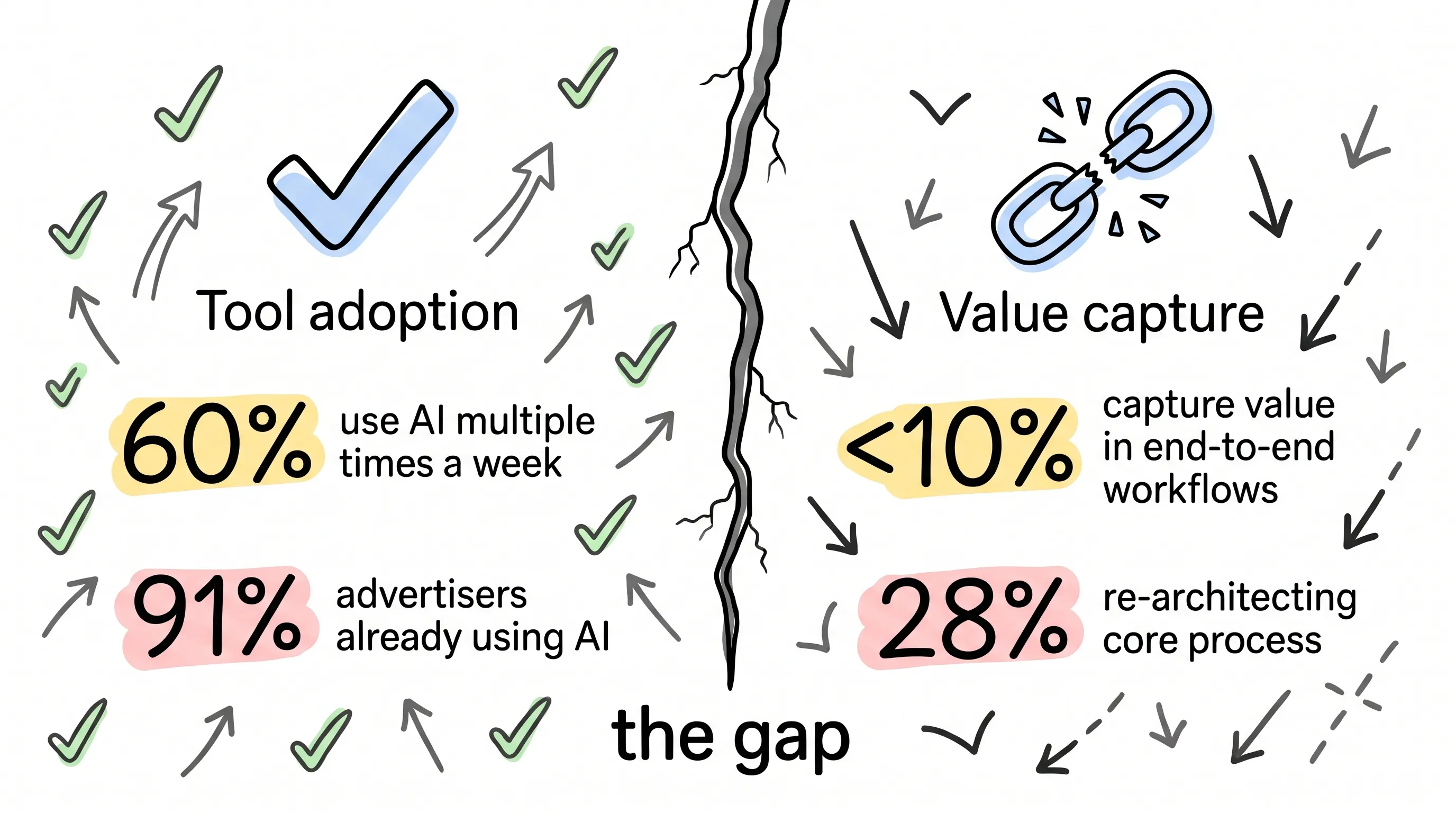
For marketers, the impact lands in three places. First, AI search has intermediated the brand-consumer encounter: the question shifts from media scheduling to whether an AI assistant will put you into a consumer's consideration set, which makes GEO (generative engine optimization) and AEO (answer engine optimization) the new compulsory coursework. Second, organizational rhythm has to move from campaign beats to always-on operations, with insight, creative, and execution pulled onto a single assembly line. AI really is compressing cycles: McKinsey observes campaign timelines shrinking from six-to-ten weeks down to same-day execution, content from days to hours, with synthetic user personas available to pre-test creative — no more scheduling traditional focus groups. Third, people's roles are changing: AI takes execution, while humans direct the AI, interpret its output, and judge whether quality is fit to face the customer — reskilling belongs on the schedule now. The article also runs the organizational math: if AI compresses a day's work into a morning, the freed-up afternoon goes to studying customer behavior and pushing promising ideas; multiplied across a whole team, that's more than a few saved hours.
Two actionable moves. One: run an end-to-end inventory the way the global food company in the article did — after re-architecting its content process, that company cut campaign costs by roughly 80% and sped up production by about 90%, turning out localized versions faster and more accurately, with gains running across the entire content supply chain. First map the full path from customer signal to media decision, marking which segments AI can take over and where human judgment stays — then start changing things. Two: put the freed-up capacity to work — the time once spent queuing for approvals goes to watching customer behavior signals and pushing promising ideas while the information is still fresh. And don't forget the people side of the redesign: who directs the AI, who answers for the results — write it into the re-architecture plan, or when something breaks, nobody owns it.
My take: the most valuable thing this article does is shift the unit of change from tools to workflows. Buying tools without touching the process is fitting new parts into an old engine. In 2026, the exam question for most marketing organizations will shift from "do you use AI" to "do you dare touch the approval chain and the handoffs." Campaigns won't disappear — but they can no longer serve as the clock marketing runs on. That sentence belongs taped next to every planning board.
🔗 Further reading: Read the full article
🏷 LLM Watch
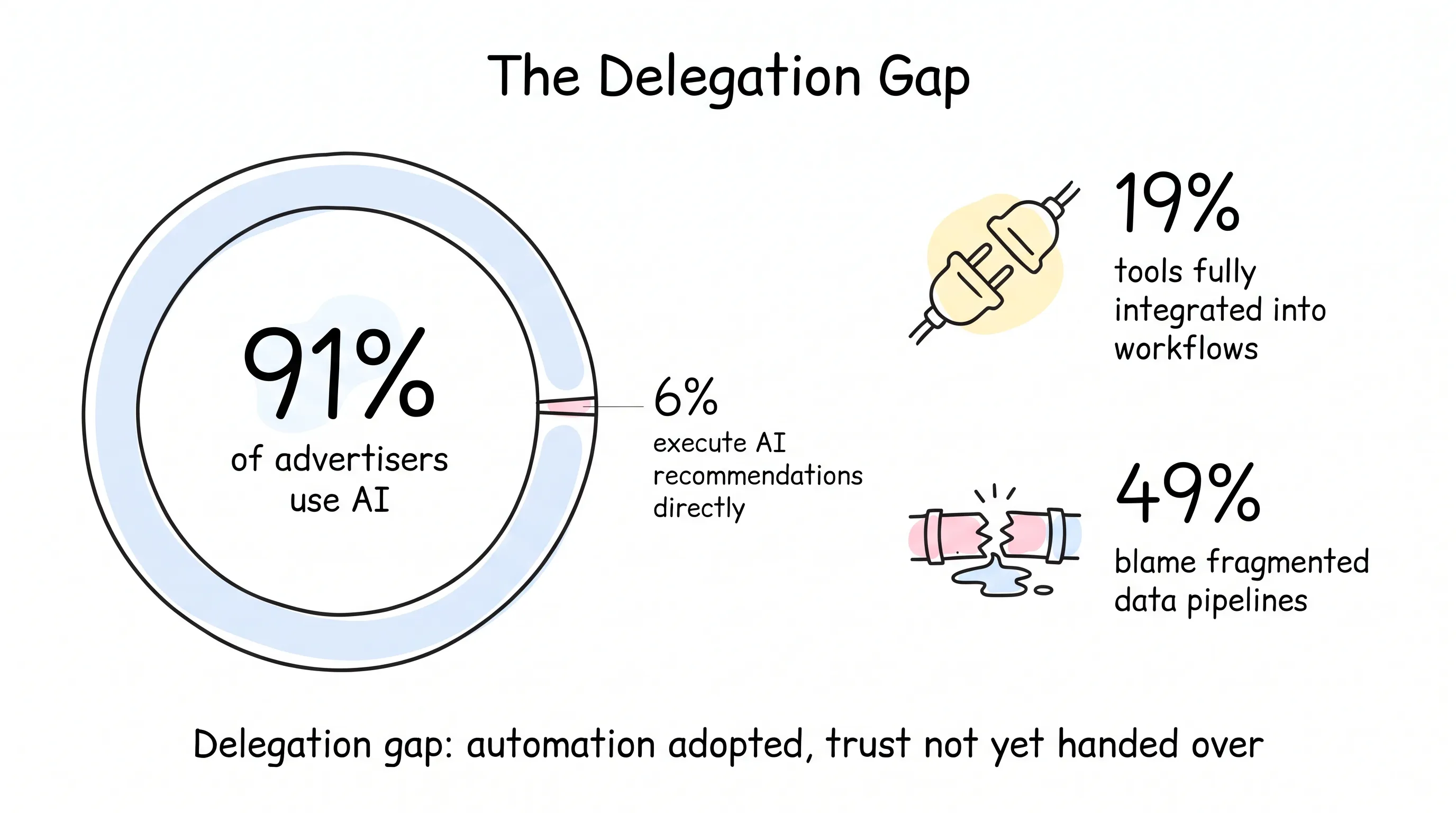
StackAdapt survey: 91% of advertisers use AI, but only 6% dare to execute platform recommendations directly
StackAdapt's survey, published in August 2026, gives the latest baseline on advertiser AI use: 91% of marketers surveyed already use AI in marketing or advertising, 86% use it routinely, and 88% report performance gains. The division of labor: 69% use it for creative development, 77% for report summarization, 74% for performance analysis; 62% say AI has cut manual optimization time, 56% have sped up campaign launches, and 53% have shortened optimization cycles. The way teams use generative AI is moving up a level — from writing single assets to building creative systems: the article describes its own creative team producing 50 headlines in one pass at the speed it used to take to produce one, with humans doing the curating and the polishing; the piece cites McKinsey's estimate that AI marketing capabilities can deliver two-to-three-fold productivity gains and cut 60–70% of executional work. The study's most interesting finding is what it calls the delegation gap: across the 687 respondents, only 6% almost always execute in-platform AI recommendations — advertisers clearly prefer automation with a human in the loop. The article cites Gartner's forecast that by 2028, 33% of enterprise software will embed agentic AI and 15% of day-to-day work decisions will be made autonomously by agents; it also cites arXiv research showing that AI agents "read" ads differently from humans — they consume keywords and structured data, not visual-emotional cues — so ad systems need to become structured and explainable. The report's role is inverting too: from a post-campaign retrospective to an in-flight starting point for action — 41% of respondents want AI to flag risks in advance, 39% want recommendations tied to campaign goals, and 35% want AI to explain why performance changed. Integration remains the choke point: only 19% of respondents say AI tools are fully integrated into their workflows; 49% blame fragmented data pipelines and 41% point to first-party data never wired into ad platforms. The article also positions ChatGPT-style LLM environments as a new discovery layer, where LLM advertising must be orchestrated alongside search, social, display, video, and email.
💬 The 6% delegation gap belongs in your retrospective doc more than the 91% adoption rate does. Bind KPIs to platform AI recommendations, require a stated rationale, and set a human-approval line for high-risk changes — all doable this week. Only after those two steps is it safe to let automation run loose.
🔗 Further reading: Read the full article
LAP Global: cross-border operations enter the agent era — catalog optimization is the new SEO
LAP Global's blog post traces how AI's role in cross-border e-commerce has shifted since 2023. First it draws a line: tools act on request; agents, once given a goal, keep monitoring data, making decisions, and executing actions, escalating to humans only when needed — the difference is autonomy. By that standard, cross-border operations are moving from the tool era into the agent era, with five landing points: listing creation and localization; ad bidding and budget optimization (watching ACOS/TACOS — advertising cost of sales — in real time); competitor monitoring and dynamic pricing; multilingual around-the-clock customer service; and decision support across data sources. The buy-side shift matters just as much: Amazon Rufus, ChatGPT, Perplexity, and Google AI Mode are becoming the new recommendation gateways — only listings with complete attributes, sharp selling points, and genuine review depth get picked by AI assistants, and the author judges this homework to be as important as traditional SEO. In cross-border, replenishment cycles run in weeks and a stockout costs you ranking outright, so demand forecasting and inventory planning matter more internationally than in domestic e-commerce. The article's prescribed one-two punch: AI agents running around the clock, human account managers with local experience, and a real-time centralized dashboard working in combination — AI doesn't replace business judgment, it moves people off repetitive tasks onto strategy; the piece also claims clients enter new markets in 45 days on average, a vendor self-reported figure.
💬 If you run cross-border, pick the most painful of the five areas and pilot an agent there — bid monitoring usually pays back first: call a human only when ACOS swings past threshold, and automate the rest. Then assign one person this week to walk through how your top products show up inside Rufus; the reasons an AI assistant does not recommend you are a free list of traffic fixes.
🔗 Further reading: Read the full article
🏷 Marketing Tools & Playbooks
Omnisend case collection: AI marketing ledgers from 10 brands, every number labeled by provenance
Omnisend's Bernard Meyer updated his case collection on October 26, opening with McKinsey's 2026 survey: 37% of respondents attribute revenue growth to AI use in marketing and sales. Four use-case groups, each with hard numbers. Generative content: Coca-Cola's Project Fizzion with Adobe has AI learn the design team's decision rules — not just the brand book — and sped localized content production up to 10x; Heinz's AI-ketchup participatory campaign pulled 850 million impressions, worth roughly 25x the media spend, with 38% higher engagement — though those are award-submission figures; Unigloves worked with Superside to generate 250 scenario-specific product images, saving 57% of design hours; Farfetch used Phrasee to optimize email copy, lifting triggered-email open rates 31.1% and clicks 37.9%, against just 7.4% for mass sends — a contrast that reveals a structural pattern. Personalization: Zalando built its sizing AI on more than 1 million real body measurements, lifting add-to-cart 13% while cutting size-related returns by more than 8%; Adidas homepage recommendations lifted conversion 13%, but with no disclosed baseline and only one month of testing; Spotify DJ interaction rose 20%, and Wrapped year-end playlists were shared more than 620 million times. Conversational shopping: Avis's WhatsApp AI handles over 70% of inquiries at 39% annual cost savings; Amazon Rufus has 300 million users, with an estimated nearly $12 billion in incremental annual sales — self-estimated, with attribution that cannot be separated out. Predictive advertising: Pegasus Airlines lifted audience ROAS (return on ad spend) 17% in two months. The rare part: every number is labeled with its source type — vendor case, self-estimate, award submission, or audited data — kept clearly apart, flaws stated openly; the piece also reminds personalization players to watch return rates at the same time.
💬 Don't bookmark the whole thing — steal its five-step checklist: pick one measurable problem, confirm you have the data, restrict the pilot to one small workflow, human-review every output, and log results against a baseline. For a first pilot, go with triggered email copy — Farfetch's numbers show that's where the payback is richest.
🔗 Further reading: Read the full article
Pragmatic dissects 2026 cases: with all five workflow conditions in place, AI amplifies advantage
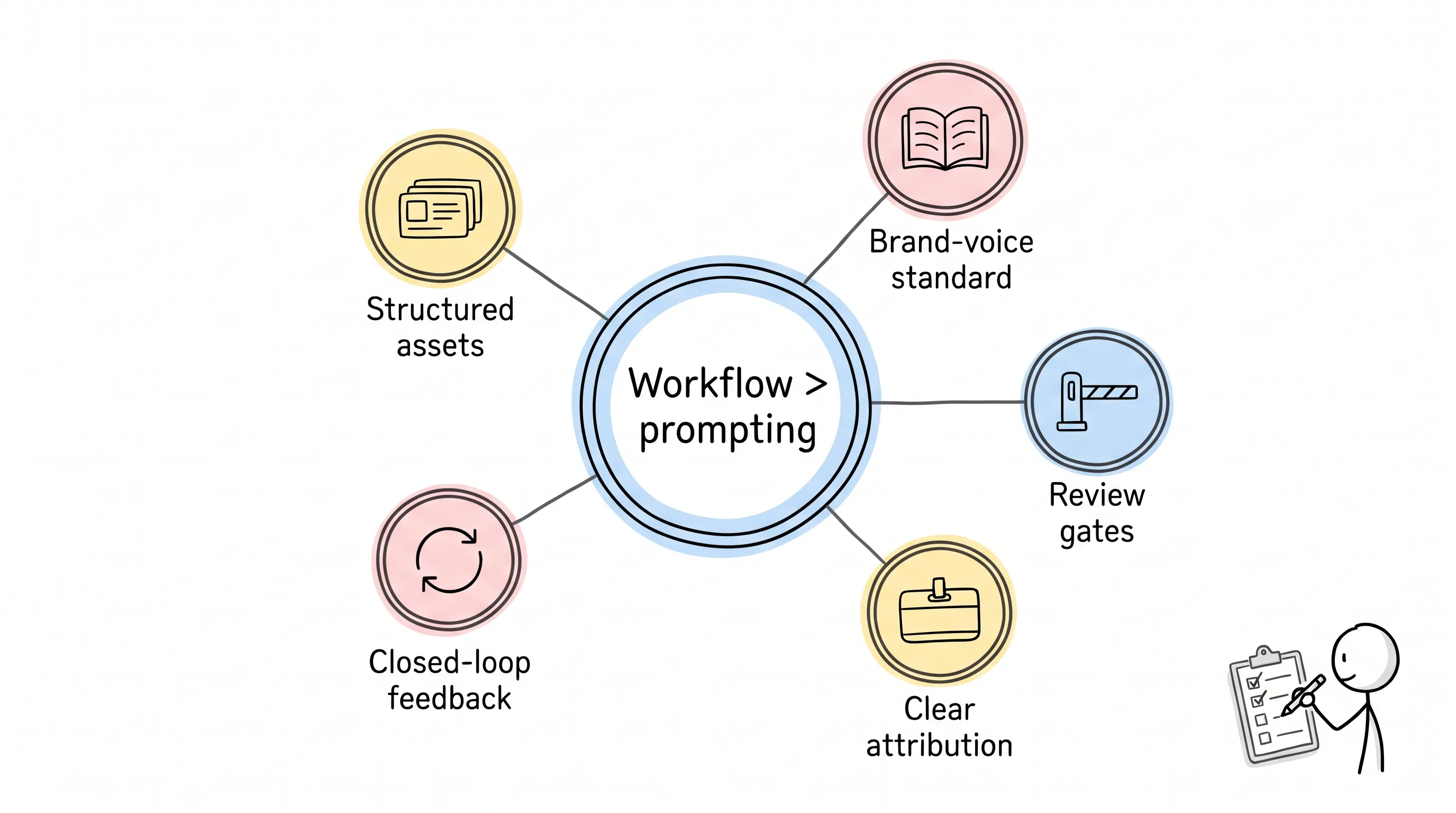
Consultancy Pragmatic's Susan Westwater published a cross-case review on October 19 arguing that the winners rarely use the newest models — they win on the workflows built around the models. Measurable gains cluster in four zones: production speed, review efficiency, brand consistency, and performance gains tied to testing infrastructure. The case numbers all carry source boundaries: JPMorgan Chase partnered with Persado to generate copy within pre-approved language parameters plus human review, lifting digital ad click-through 450% over human versions — compliance constraints, it turns out, are what made AI copy scalable; American Express built a compliance-review flow; lingerie brand Cosabella used Albert to replace its media agency on Google and Meta budget allocation, lifting ROAS 336% and paid search revenue 155% in testing — note that Albert handles budgets only, it doesn't write ads; Stitch Fix ran an explicit AI-drafts, stylist-reviews, then-sends process, achieving personalization at a scale humans alone could never staff. On the retail side there is also Sephora's personalized recommendations, H&M's demand forecasting, and Nike's dynamic creative optimization. The article distills five preconditions: structured assets, a written brand-voice standard, explicit review gates, clear attribution, and closed-loop feedback — plus seven effective workflow patterns. One line to close: workflow beats prompting; when conditions are missing, AI only produces more output, not better marketing. What AI replaces is execution work — variant generation, budget allocation, send scheduling; what to say, where the brand stands, and what counts as quality remain human responsibilities.
💬 Score your own team against the five conditions first, then fill whichever gaps you find. If there is no written brand-voice standard, don't rush into generative content — spend a week setting the standard first. That is the entire prerequisite for keeping AI on-brand, and it costs far less than rework.
🔗 Further reading: Read the full article
DigitalDefynd compiles 25 AI marketing cases: turning users into a distribution engine is the most copyable pattern
DigitalDefynd has compiled 25 global brand AI cases from 2022 to 2025, each presented in four parts: goal, approach, results, lessons. The reusable ones: Klarna's AI content generation saves roughly $10 million a year in marketing costs, with image production cycles compressed from about 6 weeks to about 7 days; the Barbie selfie generator was used 13 million times, with users organically spreading free exposure for the studio; Burger King's Million Dollar Whopper used AI previews to turn every piece of UGC into a shareable asset; Cadbury used AI to generate Shah Rukh Khan personalized ads for more than 2,500 small retailers, reaching about 140 million people; Nike and AKQA's Serena cross-era showdown content landed 1,082% organic view growth; Mango ran a fully AI-generated campaign for its teen product line; Dove released its Real Beauty Prompt Playbook, pledging not to use AI to depict real women — turning ethics into differentiation. Revenue and inventory metrics too: Netflix's recommendations drive about 80% of watch time, with thumbnail A/B testing lifting clicks 20–30%; H&M's AI inventory forecasting cut unsold inventory 21% year over year while full-price sales grew 10%. On testing and content supply: Euroflorist ran large-scale multivariate testing with Evolv AI, lifting conversion 4.3%; the Washington Post's Heliograf produces 850-plus stories a year, with click-through on AI-pushed stories up 17%; Tomorrow Sleep used MarketMuse to grow organic traffic from 4,000 to 400,000 monthly visitors within a year. The shortfalls, stated plainly: this is a secondhand compilation, some numbers lack first-hand verification, and it is padded with links funneling you back to its own site — use it as a sourcebook, not an authority.
💬 When a proposal stalls, dig through this library — find a same-industry comp and lift the structure. User-co-creation plays (selfie generators, UGC previews) are one route even small budgets can afford: start by getting users to generate one shareable piece of content; the cost order of magnitude is nothing like buying exposure.
🔗 Further reading: Read the full article
Case studies need a new shape too: from static PDFs to predictive blueprints and failure-case libraries
A viewpoint piece from creativeadslab discusses what marketing case studies should look like in 2026. Claim one: connect the campaign to the business outcome — ROI, CAC, and CLV replace impressions and likes, or all you have is a story. Claim two: use AI to turn thousands of historical campaigns into predictive models, upgrading the case study from retrospective report to a living document that can forecast a new campaign's probability of success. Claim three: systematically dissect failures, writing them up as forensic-style files in six steps — goal, hypothesis, execution, data, root cause, lesson — and build an in-house failure-case library; failed campaigns are the more valuable training data. Claim four: the format shifts from static PDFs to Tableau- and Looker Studio-style live dashboards, supporting drill-downs by channel and time with near-real-time updates. The piece also lists disclosed data sources, anonymization processes, and attribution models as hard standards of case credibility. One caveat: the piece names no verifiable brands or data sources, and its client stories cannot be confirmed — read it as methodology, don't cite the numbers.
💬 A failure-case library can start this week at near-zero cost: write up last quarter's most painful campaign as a six-step file, and the gap in your team's retrospective quality will show immediately. Put the attribution methodology in the file too — it saves the argument at the next meeting.
🔗 Further reading: Read the full article
Markteer personalization primer: four technology types, four scenarios, plus two red lines on trust
Agency Markteer's introductory survey maps AI-driven personalized marketing. Four technology families: machine learning for behavior prediction, NLP for dynamic copy and sentiment analysis, computer vision serving the visual-first social-media generation, and speech recognition powering voice shopping — citing OC&C's forecast that US voice shopping will reach $40 billion. Four scenario families: content and product recommendations (the piece cites Netflix's and Spotify's recommendation mechanics), programmatic advertising, email and SMS automation (citing Experian: personalized emails drive 6x higher transaction rates), and AI chatbots converting in real time. Anchor numbers: McKinsey says personalization leaders generate 40% more revenue than their peers, Accenture says 91% of consumers would rather buy from brands that offer relevant recommendations, and Salesforce research says 84% of customers want to be treated as people. On the risk side it gives two: GDPR and CCPA compliance constraints, and the backlash triggered by over-personalization — citing PEW data, 79% of users worry about how their data is used. The outlook section mentions omnichannel consistency, AR/VR/IoT convergence, and predictive lifecycle marketing (churn alerts, reactivation, upsell automation). No proprietary plays here — highly interchangeable with similar surveys, and the tail pivots to selling its own services; fine as training material for junior teams, don't expect depth.
💬 The most practical use of PEW's 79% is internal calibration: add a restraint check to personalized pushes — behavioral data users never handed over voluntarily does not go into the copy. Trust, once lost, costs far more than one skipped push.
🔗 Further reading: Read the full article
🏷 Industry Data
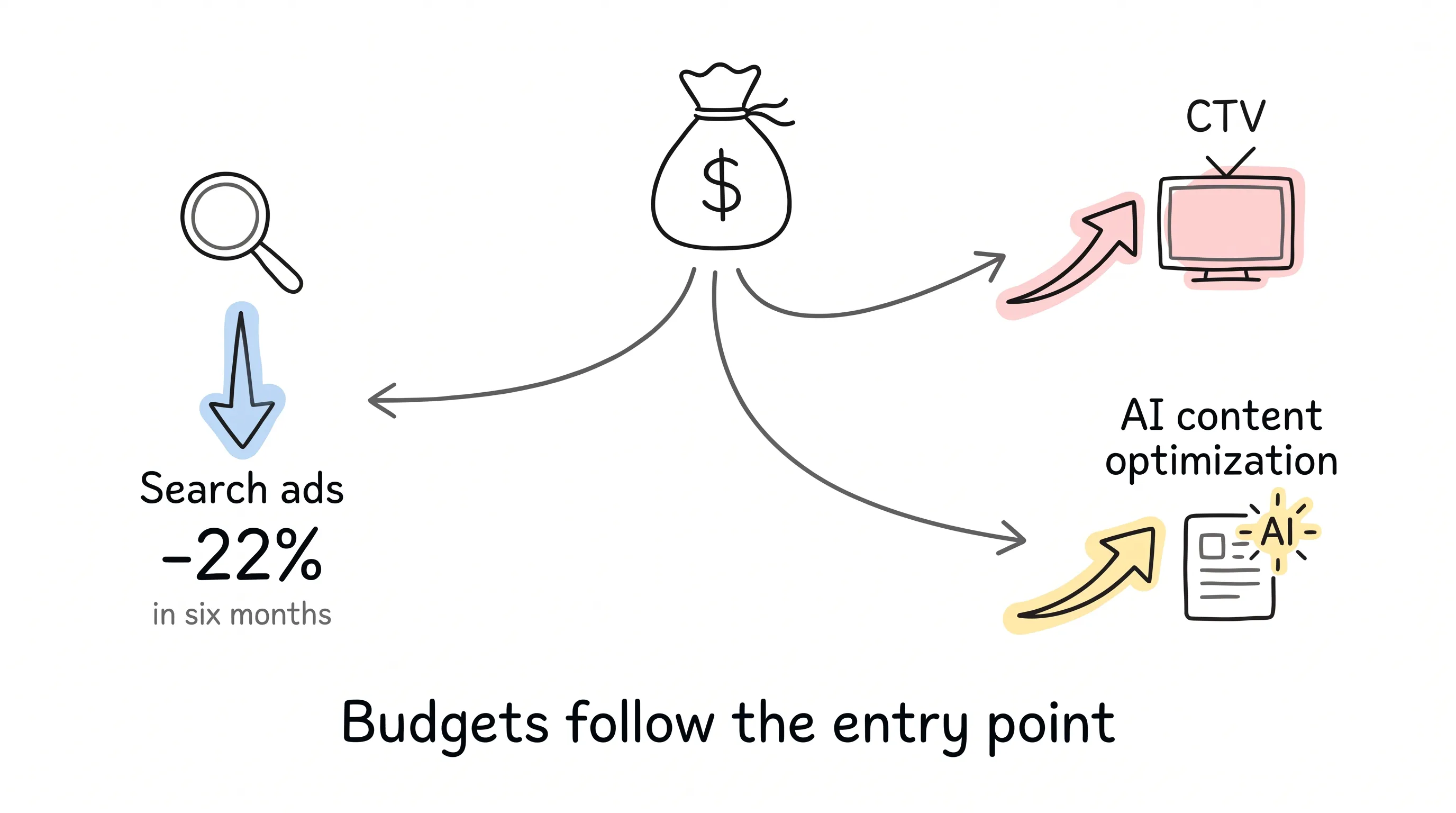
Mediaocean half-year report: search ad spend down 22% in six months, CTV the biggest budget destination
MarketingTechNews reports on Mediaocean's eighth H2 market outlook (a survey of 500-plus practitioners): nearly three-quarters of respondents rank AI as a priority, with uses concentrated in creative, copywriting, media planning, data analysis, and campaign optimization. The most eye-catching number: search advertising spend fell 22% versus the first half, driven directly by AI answer pages displacing traditional SERPs, pushing marketers beyond keyword-and-backlink SEO toward AI content optimization. It even reaches into engineering territory — think migrating JavaScript rendering to server-side rendering — already past the edge of traditional marketing's job description. At the other end of the budget, CTV attracted the most tilt thanks to multi-platform supply plus better user identification, with precision targeting replacing spray-and-pray. Identity resolution is shifting to a mix of first-party data, third-party data, and probabilistic models, while privacy compliance actually slid in priority, displaced by proactive identity solutions — that is a risk signal. The report judges AI, CTV, and multi-ID to be out of the experimental phase, with cross-platform data unification still the industry's biggest technical bottleneck.
💬 Teams still betting on pure SEO playbooks: move 10% of budget into AI content optimization and a CTV test. On the technical side, book one meeting with engineering — server-side rendering rework runs on a monthly timeline, and the earlier the project is scoped, the less you'll be at the mercy of the clock. This one can't wait.
🔗 Further reading: Read the full article
State of AI Marketing 2026 report circulating: the numbers look good, the provenance is questionable — cross-check before you cite
A summary of a State of AI Marketing 2026 report claiming to be based on a survey of 2,500 marketing practitioners is making the rounds: 87% of enterprise marketing teams already use AI, with small teams past the 50% mark too; AI's share of total marketing budget rose from 11% in 2025 to 18%; use-case penetration runs content creation 78%, email marketing 65%, social media 62%, analytics and reporting 58%, SEO 45%; teams tracking ROI report an average 3.2x return, peaking at 4.1x for content creation; the four big implementation challenges are quality control 62%, team training 54%, system integration 47%, and ROI measurement 41%, with those addressing them systematically seeing 2.3x higher ROI. The report claims mid-sized companies are growing fastest and often skip point tools to go straight to platforms. Its trend outlook mentions AI orchestration platforms, dedicated marketing agents, and rising governance and compliance, recommending you start with high-ROI use cases like content creation and email optimization, invest in formal training, and stand up a governance framework early. But discount the credibility first: the publisher, ai-cmo.net, is of unknown identity; only the summary pages of the 45-page report have leaked; the sampling frame and questionnaire methodology cannot be verified; the numbers are suspiciously round; and its relationship to published figures from Gartner, HubSpot, and McKinsey is unclear — there is a real chance this is an AI-generated or spun report.
💬 The right way to use this report is as a thermometer for industry sentiment, not as a data source. Before you put its adoption or budget numbers into any material, check them against Gartner's and HubSpot's published figures first — a number like 87% must survive a source check before it goes anywhere near a board deck.
🔗 Further reading: Read the full article
🏷 Policy & Funding
EU AI Act Article 50 now in force: how to rule on chatbot disclosure, deepfake ads, and AI testimonials
US law firm TEIL Firms has published a primer for companies expanding into Europe on the transparency obligations of EU AI Act Article 50 (effective August 2, 2026; outputs used in Europe trigger extraterritorial effect — the article warns that the disappearance of digital marketing's geographic borders does not mean the disappearance of regulation). The key judgment: using AI does not automatically mean you must disclose — what matters is what the AI actually created or altered and how it is presented to the audience; routine editorial uses (rewriting, grammar, retouching) are explicitly exempt from technical-marking requirements. Rules by scenario: AI chatbots must let users know they are talking to an AI at first interaction — using a third-party vendor does not remove this obligation; deepfake ads must be disclosed if they could be mistaken for a real person or real events, with flexibility for artistic, satirical, and fictional content; providers of generative systems must apply machine-readable marking (watermarking, provenance) — which is a separate matter from consumer-facing visible disclosure, and buyers should verify the marking survives editing, downloading, and cross-platform forwarding; among AI-written copy, only public-interest information carries a disclosure obligation, and copy that passes human editorial review with an accountable owner can be exempted — ordinary product copy does not automatically trigger it, though advertising law, consumer protection law, and IP law still apply as usual; AI virtual brand ambassadors making testimonial-style endorsements carry the heaviest risk, with existing endorsement and misleading-claims rules stacked on top, and the judgment must be made before publication. Outsourcing to an agency does not transfer legal liability; contracts should state clearly how AI use is disclosed, who owns disclosure responsibility, and what provenance records are kept, with stringency proportionate to campaign risk. The firm frames transparency as a trust and business issue — disclosure is only the floor.
💬 For teams serving European markets, turning this scenario list into internal policy takes two moves: first risk-rank your existing chatbots and virtual ambassadors, then patch the AI clauses in your agency contracts. Make the disclosure judgment before publication — the trust damage of a synthetic testimonial being exposed costs far more than disclosing it would have.
🔗 Further reading: Read the full article
Germany pushes a major AVMSD overhaul: platforms, influencers, and some AI services may face stricter media obligations
MLex's EU policy correspondent Júlia Tar relayed on LinkedIn a non-paper obtained by MLex: Germany is advocating a major overhaul of the EU's Audiovisual Media Services Directive (AVMSD) that would bring platforms, influencers, and some AI services under stricter media obligations while loosening outdated restrictions on traditional broadcasters, arguing the current directive no longer reflects how people consume news and entertainment via social media, search engines, and AI tools. The document touches advertising rules, AI-generated content, child protection, and age verification, and also raises the visibility of news media content on online platforms — a point that runs in the same direction as the GEO agenda and deserves attention from teams working on AI search optimization. The cold water still needs pouring: this is an informal position paper, not yet a formal draft; the original reporting sits behind a paywall; the post's engagement is tiny (a dozen-odd likes, one comment); and the legislative path is uncertain — read it as a signal, nothing more.
💬 Treat this as a monitoring lead, not a reason to redo your compliance plan. Teams running EU influencer campaigns and AI-generated advertising should put the AVMSD revision on their monthly compliance-scan checklist and reassess once a formal draft lands.
🔗 Further reading: Read the full article
💡 Today's Synthesis
Put today's 12 items side by side and the throughline is two faces of the same thing: the adoption numbers climb daily — StackAdapt's 91%, the circulating report's 87% — while the value-capture numbers stay flat: McKinsey's fewer-than-10%, the delegation gap's 6%, the integration rate's 19%. The disconnect is not in willingness, nor in budget — it is in process: the approval queues are unchanged, the handoff chains are unchanged, and KPIs are not tied to AI recommendations. Several of today's authors prescribe different sides of the same cure: the WEF says the unit of change is the workflow, Pragmatic lists five workflow preconditions, and StackAdapt says automation's form will be delegated-but-supervised, with humans kept on to approve high-risk changes. By that consensus, the smoother your AI runs, the more you should worry that all you've done is produce a pile of things nobody has finished approving — faster.
The second shift is the entry point. Mediaocean's search spend down 22%, the AI shopping assistants LAP Global flagged, and the AI-search intermediation in the top story all describe consumer paths bypassing traditional touchpoints. Ad budgets follow the entry point: CTV benefits first, catalog and content structure become new ranking factors, and GEO has gone from concept to a budget line item. Today's case collections happen to supply the matching playbook: triggered emails first, watch return rates while personalizing, and complete catalog information until AI assistants can read it.
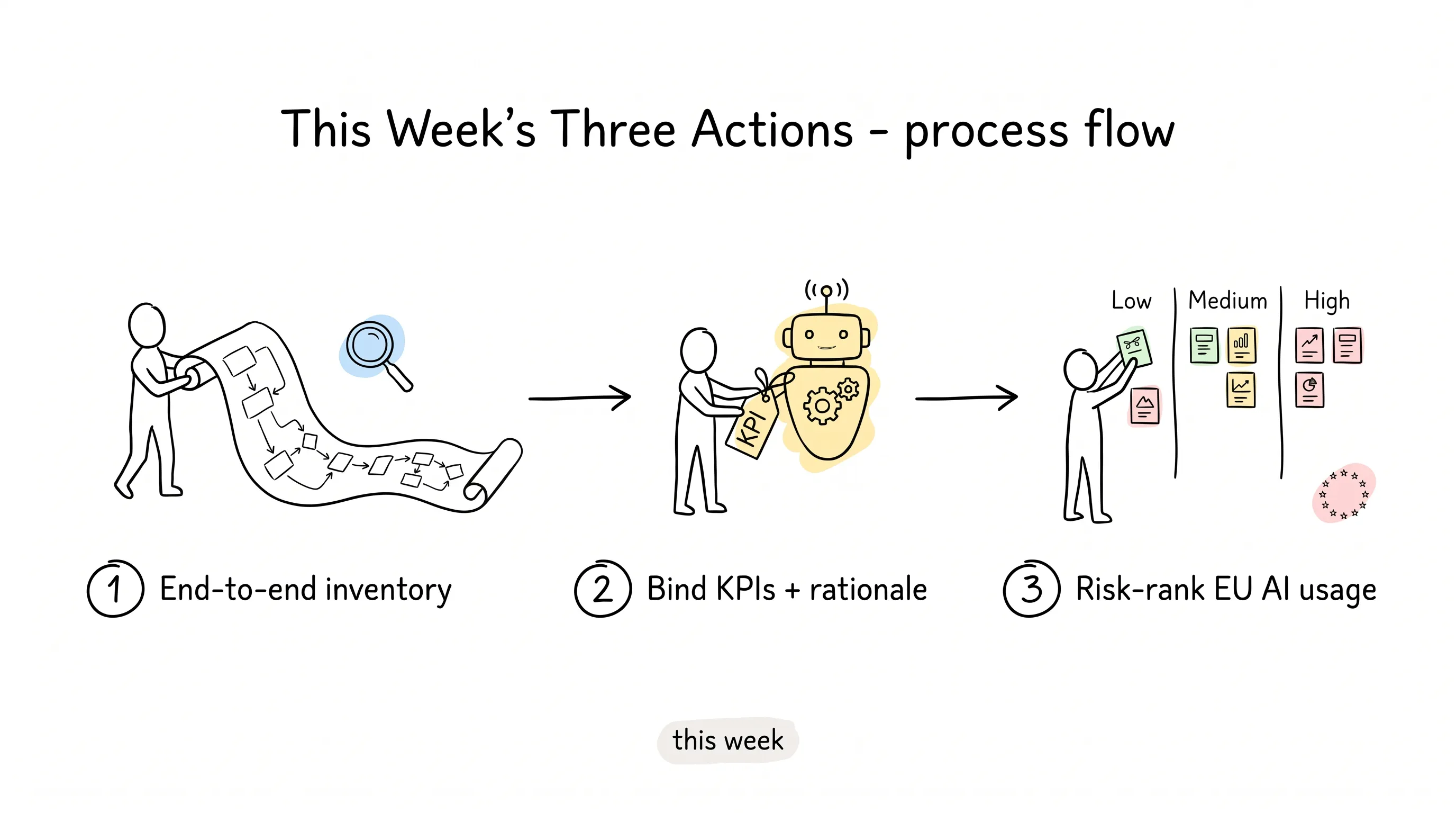
The third thread is compliance catching up. EU AI Act Article 50 took effect in August, Germany is pushing a major AVMSD overhaul, and disclosure obligations now land on concrete scenarios — chatbots, deepfake ads, AI testimonials — turning the compliance bar from abstract principle into a pre-publication checklist item that needs a signature. Leave three actions for this week: run an end-to-end inventory of one high-frequency workflow, bind KPIs and stated rationales to platform AI recommendations, and risk-rank the AI usage across your European business. The tools have had their moment in the spotlight; the second act belongs to process and trust.
Continue reading
Related articles
AI Marketing Daily · 2026-11-22
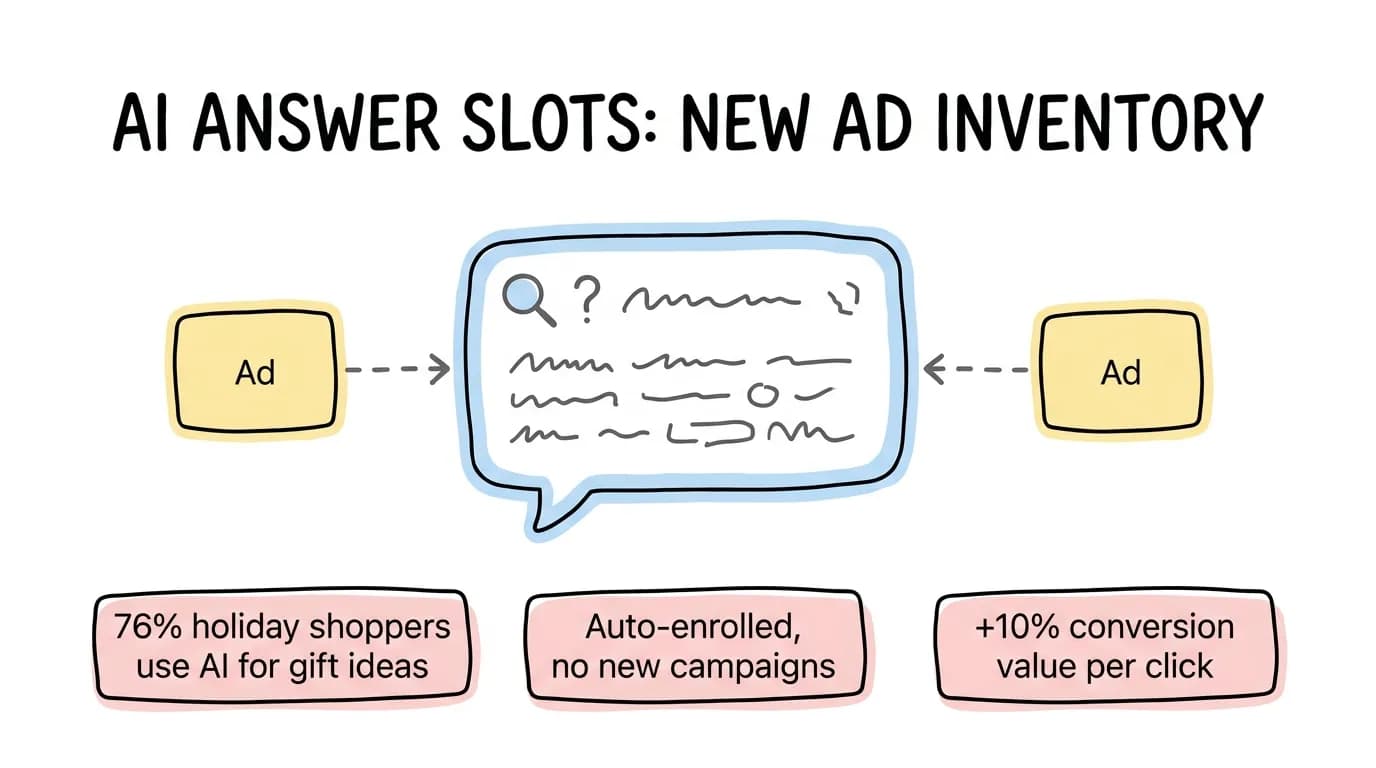
AI Marketing Daily for 2026-11-22 rounds up 20 items led by Microsoft opening Bing AI Overviews to ads and Google expanding AI Mode ads to ten countries, plus GEO guides, ad automation delegation guidance, AI Overviews CTR data, and a legal-risk checklist for AI-generated creative.
AI Marketing Daily · 2026-11-21
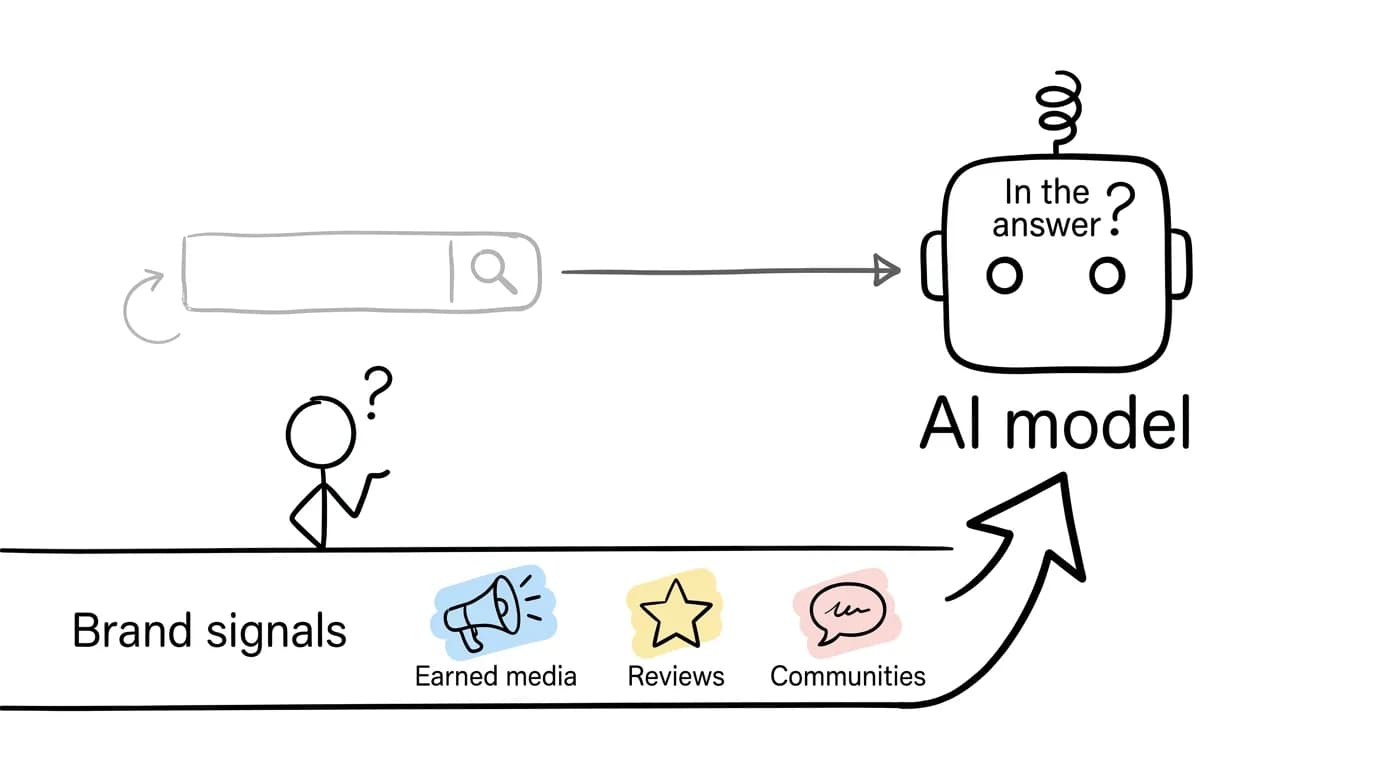
A November 21, 2026 AI-marketing daily covering AI search visibility, GEO methods, Google AI Mode ads expanding to ten countries, Meta's pre-Black Friday changes, agentic shopping, and industry adoption and ROI data.
AI Marketing Daily · 2026-11-20
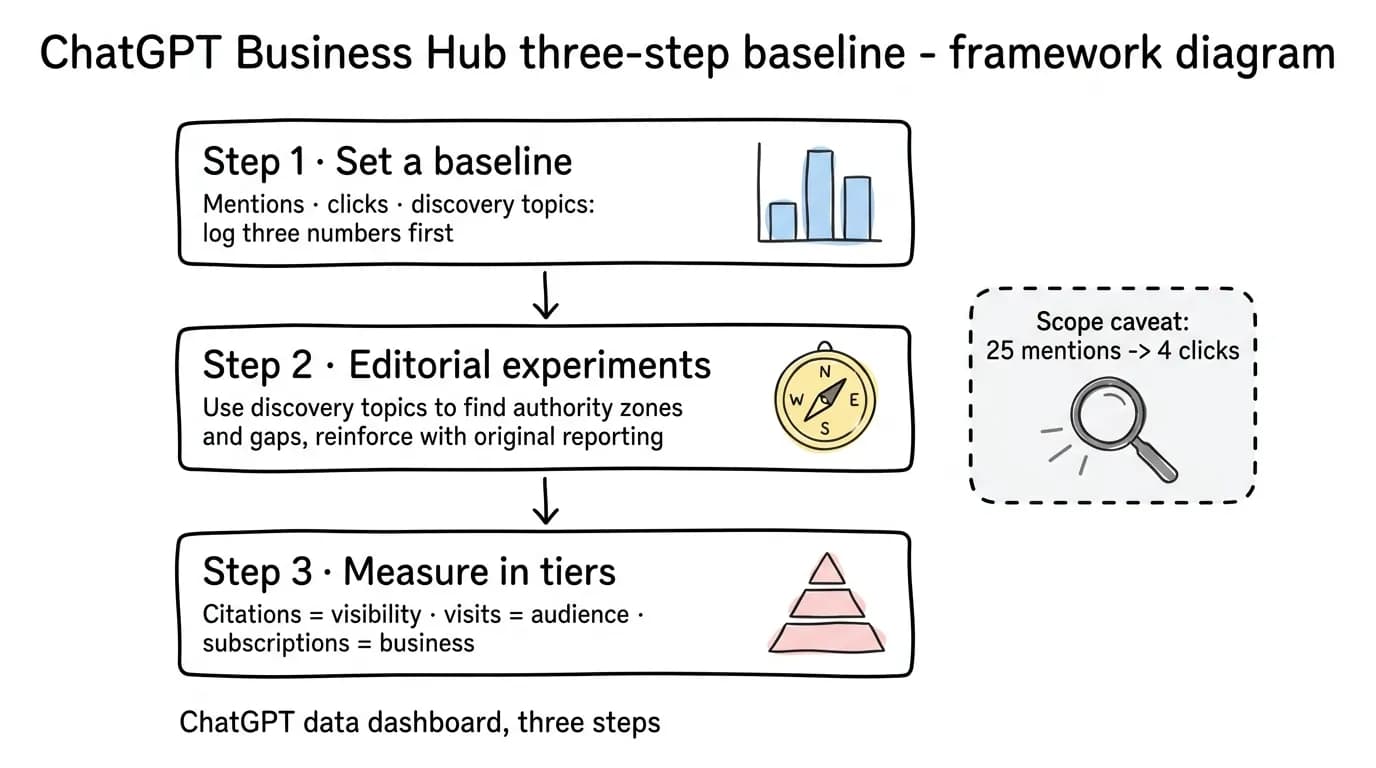
AI Marketing Daily for 2026-11-20 rounds up 19 items centered on measurement: OpenAI's ChatGPT Business Hub dashboard, EU rules for agent-mediated purchasing, Meta pausing four AI terms, and B2B data on shortlists and the dark funnel, each with action advice.