
AI No Longer Helps You Work — It's Starting to Do the Work for You
A learn article explaining the difference between AI tools and AI agents in cross-border e-commerce, covering listings, ads, pricing, inventory, and customer service monitoring. It also notes that buyers increasingly use AI shopping assistants when researching products.
A few days ago, a friend who runs a cross-border e-commerce business came over for tea.
He sells on Amazon, and across Latin America too — a few hundred products spread across storefronts in several countries. I asked him: how's business lately?
He didn't answer directly. He pulled out his phone and showed me his dashboard: at 3 a.m., the ad bids had been adjusted; a hot-selling product had been restocked; and a question from a Brazilian buyer had already been answered — in Portuguese.
He didn't do a single one of these things.
An AI agent did it for him.
Wow. Suddenly I was all ears.
What's a tool? What's an agent?
This has to be told from the beginning.
Back in 2023, when people talked about what AI could do for cross-border commerce, the most obvious answer was: write copy. Quite a few platforms had "Optimize with AI" buttons — click it, and within seconds the keywords in your listing were swapped for a better batch. You ask, it answers. Pretty handy.
But — and pay attention here — it was always waiting for your orders.
That's a tool. Its defining trait: you don't move, it doesn't move. Tell it to write a title, it writes a title; tell it to translate a description, it translates a passage; tell it to summarize a thousand reviews, it hands you the summary. It's very capable, but it has no ideas of its own.
An agent is different.
What's an agent? Simply put: you give it a goal, and it keeps watch and does the work on its own. It reads the data on its own, makes decisions within the rules on its own, does the executing on its own — and when it runs into something it can't call, that's when it comes to find you.
One is an employee waiting for instructions; the other is a partner who's actually in the room.
Tools wait for instructions. Agents commit to goals.
The gap between these two is worth a lot of money.
What things can it watch for you?
Think about it: what's the most exhausting part of cross-border commerce?
Not product selection, not negotiation — it's the watching. A few hundred products spread across several countries and several platforms, and every platform's rules are different. Who could watch it all?
An agent can. And it keeps an eye on more than you'd think.
First, listings. Sell in the US, write English; sell in Mexico, you have to write Spanish; get to Brazil, and it's Portuguese again. But translation alone isn't enough — localization is its own discipline: the words Americans use to search for something are often not the same as the words Mexicans use to search for the very same item. Every attribute of a listing has platform requirements, and missing any of them hurts your visibility. In the past, this kind of work meant keeping an operations team that knew several languages. Now, an agent generates, optimizes, and completes attributes to each platform's requirements — and once a product has been proven on one platform, it can move the whole thing to another without starting from scratch.
Then there's advertising. Anyone who's run ad campaigns knows metrics like ACOS (Advertising Cost of Sales) and TACOS (Total ACOS). How did you watch them before? Pull a report once a week, glance at it, tweak a little. Now it's continuous: this keyword isn't converting, pause it; a new search term pops up over there, add it in; bids and budgets adjust in real time along with profit. Twenty-four hours a day, no dozing off.
Pricing and inventory are the very life-or-death line of cross-border commerce. An agent watches competitors' prices and automatically adjusts yours within the profit line you've drawn; it also does demand forecasting and plans restocking ahead of time. Why is this especially deadly across borders? Because a shipment sent to another country takes weeks on the road. Once you run out of stock, your ranking slides down, and climbing back takes another few weeks. A stockout doesn't cost you stock — it costs you your ranking.
And customer service? American buyers ask questions in the middle of the night; Brazilian buyers ask in the afternoon. You can't work three shifts yourself. Now, buyers ask in their own language, and in any time zone, at any hour, someone can pick it up. Well — not a someone.
Finally, decisions. E-commerce produces more data every day than anyone could ever finish reading. An agent pulls this data together and turns it into concrete recommendations: which product deserves a push, which market is worth entering, where profit is leaking.
In the past, these were the jobs of five roles. Now they're the jobs of five agents.
But buyers are using AI too
Here's the interesting part: don't assume only sellers are using AI.
Buyers are using it too.
On Amazon there's a shopping assistant called Rufus, and buyers can ask it directly: which one should I buy? Beyond Rufus, there's ChatGPT, there's Perplexity, and there's Google's AI Mode. More and more buyers ask AI first and click links second.
What does this mean for sellers?
It means your product information has to be something AI can understand and trust. Are the attributes filled in completely? Are the selling points written clearly? Are the reviews real? For AI to recommend a product, it first has to "read" that product clearly. Products with incomplete information, vague descriptions, and terrible reviews — the AI won't put in a good word for them.
So you see: in the past, everyone competed on search rankings — that game was SEO. Now there's a new course you have to compete in too: getting shopping AI assistants willing to recommend you.
Class is already in session.
So what about people?
At this point, you might ask: so can people just kick back now?
My answer is very clear: no — and you shouldn't.
Choosing which market to enter first is judgment, not calculation. Negotiating with suppliers — that feel for the room, AI can't learn it. Building a brand requires first knowing who you are. And if you ever get into a complicated dispute with a platform, the person making the final call has to be a seasoned insider who knows the business.
What AI replaces is repetition. Those still take a human.
The combination that actually works is AI plus people: agents watch listings, ads, pricing, and inventory around the clock; people spend their time on strategy. I've even seen teams turn this playbook into a service — agents run the operations, each market gets an experienced account manager, and one dashboard shows the whole picture. They've run the numbers: entering a new market with this playbook takes an average of 45 days.
45 days. Not long ago, just moving a few hundred listings into a new country would probably have taken more than that.
Back to that cup of tea
As our tea chat came to an end, I asked my friend: so what do you do every day now?
He thought for a moment and said: I used to be like a firefighter — wherever smoke appeared, I rushed there. Now I'm more like a general manager: look at data, make decisions, set rules.
This is the change AI has brought to cross-border commerce. It's no longer just another wrench in the toolbox.
It's an employee who doesn't need sleep. And your job is to learn to command it.
Here's to putting AI on the night shift — sooner rather than later.
Continue reading
Related articles
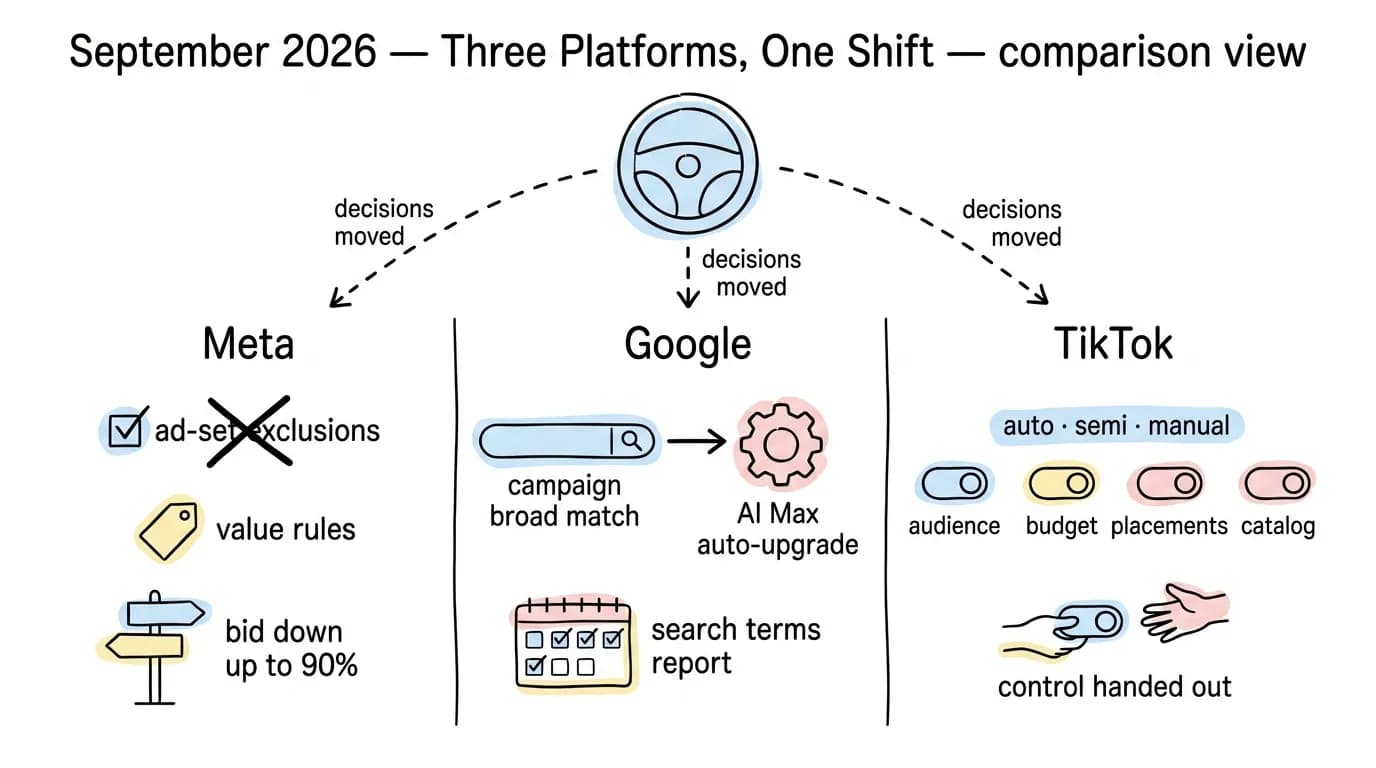
In September, Three Platforms Took Away Part of Your Steering Wheel
A few days ago, I went through everything the three big ad platforms did in September 2026. And I noticed a remarkably interesting coincidence.
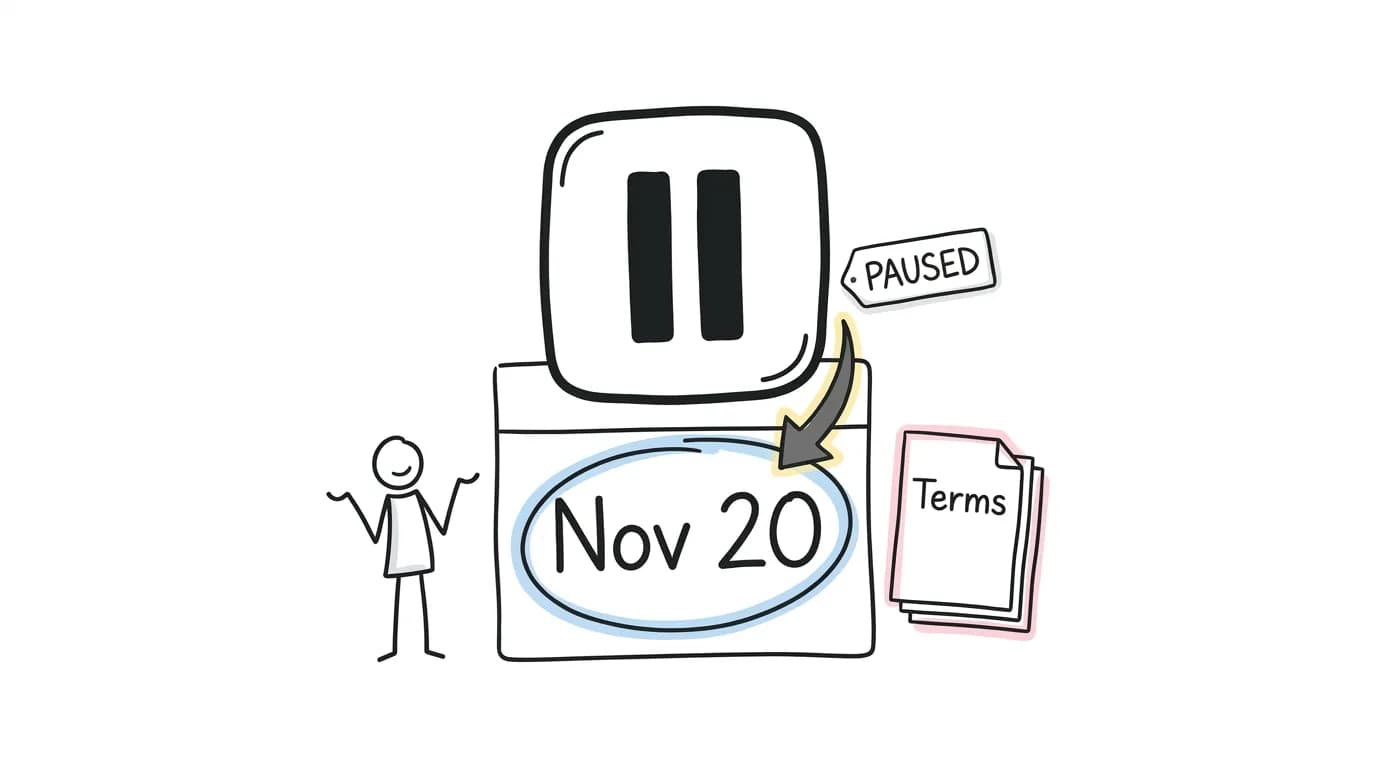
Meta's New Terms Hit the Pause Button on the Eve of the Effective Date
A while back, I was helping a friend of mine who runs a cross-border e-commerce business go through the compliance checklist for his ad account.
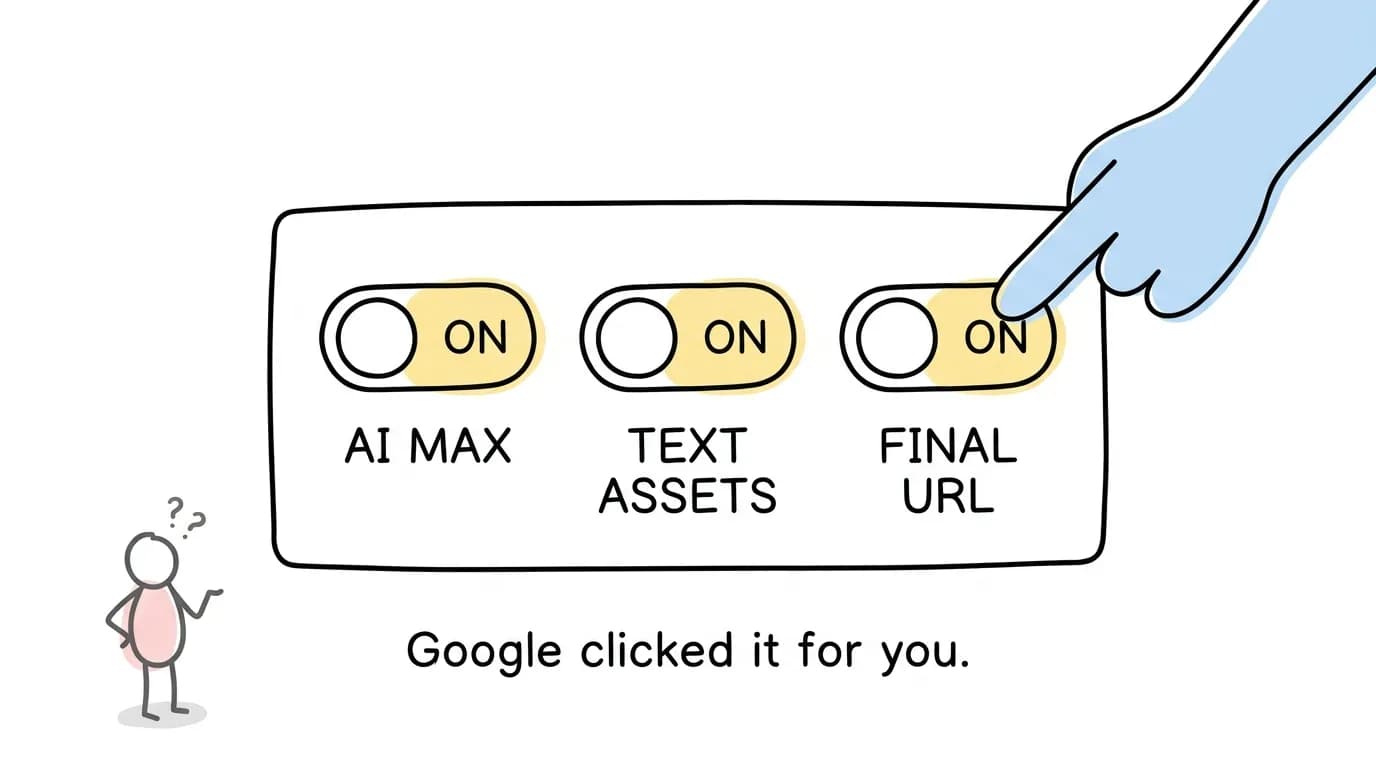
Google and Meta changed 17 ad rules this week. 6 of them need checking today.
A few days ago, I was helping a friend who runs a cross-border e-commerce business go through his ad accounts.