
When Must You Tell Users It's AI? The EU Has Already Written the Rules
An explainer on Article 50 of the EU AI Act (effective August 2, 2026): when chatbots must identify themselves, deepfake ads need disclosure, generative outputs carry machine-readable markings, and AI-written public-interest text has special rules, plus vendor-contract and internal-policy takeaways.
A few days ago, I had dinner with a friend who runs a cross-border marketing business.
His team leans on AI for everything. Social media copy — AI. Product images — AI. Cutting videos, generating voiceovers, personalizing ads for users in different countries — all AI. I asked him casually: does your company have any rules about when you have to tell users "this was made by AI"?
He froze. After a long pause, he said: never thought about it.
I told him he had some homework to do. Because on August 2, 2026, Article 50 of the EU's Artificial Intelligence Act (EU AI Act) formally took effect, and it governs exactly this question: when you use AI, when must you disclose it?
Using AI isn't the problem. Not knowing when you have to say so — that's the problem.
What Kind of Provision Is Article 50?
First, some context on what kind of law this is.
The EU AI Act is the world's first comprehensive law regulating artificial intelligence. Article 50 deals specifically with transparency obligations: when AI interacts with people, or generates content realistic enough to pass as real, the other side has to know.
You might say: it's a European law. What does it have to do with me?
A great deal. This law has extraterritorial effect: even if your company is incorporated in the United States, headquartered in Chicago, as long as the output of your AI systems is used in the EU market, you fall within its reach. The ad a consumer in Paris sees, the chatbot on your own website chatting with French users — all of it counts.
A Chicago retailer selling goods to the French; an Illinois software company running an AI customer-service agent for European users. None of these scenarios escape it.
Does Every Piece of Content Need an "AI-Generated" Label?
Don't panic. No.
This is the first misconception to clear up: Article 50 does not impose a blanket requirement that every AI-assisted email or every AI-retouched photo be declared as AI-created.
Why? Because what AI does inside a marketing department varies enormously.
At one end, employees use AI to casually fix grammar, adjust paragraphs, resize images, or strip noise from a video. These are standard editing moves, and the law explicitly carves out an exception: where AI performs only routine editing and doesn't substantively change the content or its meaning, no technical labeling obligation is triggered.
At the other end, a company fabricates a photorealistic spokesperson who doesn't exist, puts words in the mouth of a real person who never said them, or lets an AI customer-service agent pose as a human.
The law has something different to say about those.
So the question marketing teams should really be asking was never "did AI participate?" It's: what did AI actually create or change — and how are we presenting that result to users?
The First Threshold: The Bot Has to Identify Itself
Four categories. Let's take them one at a time.
Category one: customer-service automation.
More and more companies now use AI chatbots to handle users: answering product questions, recommending items, handling complaints, booking appointments, qualifying leads, guiding purchases. Some bots are obviously machines. But many are deliberately built to pass as human — in conversation, nearly indistinguishable.
Article 50's requirement: any AI system designed to interact directly with people must, in principle, let users know they are dealing with AI. Clearly, and before the first interaction. The only exemption is where it's already obvious to an ordinarily observant person.
What does that mean? If your bot doesn't look human or sound human — if users see through it at a glance — you can stay silent. But if you've deliberately built it so users can't tell, you must disclose.
Think about what this means for marketing and customer-experience teams: chatbot "design" is now a compliance question. And even if the bot came from a third-party vendor, the responsibility doesn't get outsourced with it.
The Second Threshold: Deepfake Ads Must Be Disclosed
Category two is far higher risk.
Generative tools can now produce eerily convincing people, voices, scenes, and events. No actors needed to manufacture a virtual spokesperson; no shoot needed to place your product in an environment that never existed.
Article 50 sets a clear requirement for this kind of content: wherever generated or manipulated image, audio, or video constitutes a deepfake, the content must be disclosed as artificially generated or manipulated.
This is no longer just about political disinformation. Picture this: a company uses AI to generate a video in which a well-known executive "personally" introduces the product — though he never recorded a word of it. An ad shows real-looking events, storefronts, destinations — none of which ever happened. All of this could cross the line.
The law does leave room for artistic, satirical, and fictional works: such content may disclose in a way that doesn't disrupt the experience of the work. The test comes down to one question: will the audience mistake the synthetic content for something that actually happened?
The Third Threshold: Watermarks Are for Machines to Read
Category three governs companies that provide generative AI systems: any system capable of generating synthetic audio, images, video, or text must, in principle, ensure its outputs carry machine-readable markings — so machines can detect that the content is AI-generated.
Note: this watermark is not a consumer-facing notice. It's for platforms, regulators, and other systems to run detection against.
Why should the marketing department care? Because most companies don't build their own models — they use third-party AI platforms. The marking itself you depend on your vendor to apply; but how the content is used, and whether consumers get a disclosure, is on you. The European Commission has issued dedicated guidance on Article 50 to help providers and deployers (the companies putting AI into use) sort out their respective roles.
So when you procure AI tools, you need clarity: what does the vendor actually mean by "our outputs carry compliant watermarks"? After the content is edited, downloaded, republished, or moved to another platform — does the watermark survive?
The Fourth Threshold: AI-Written Copy Is the Subtlest
Text is the subtlest of the four.
Article 50 does not require AI-assisted product descriptions, promo emails, or ad copy to carry labels. It covers only one special case: AI-generated or manipulated text published with the purpose of informing the public on matters of public interest — informally, something close to AI-written news. And even there, if the content has undergone human review and there is a clearly identified person or organization accountable for the editorial process, it's exempt.
So an AI-polished product blurb and an AI-ghostwritten public-interest news report get completely different treatment under the law.
But don't celebrate just yet. What Article 50 doesn't govern, other laws still do. Advertising law, consumer protection, intellectual property, privacy — all the traditional rules still apply. AI won't shield you from false advertising: fabricated product claims are just as illegal whether AI wrote them or a human did.
In other words, an ad may need no AI disclosure at all and still have a legal problem. These are two different yardsticks — measure with each separately.
Where Things Blow Up Most Easily: AI Spokespeople
Virtual influencers, synthetic presenters, AI brand personas — these deserve their own section.
An obviously cartoonish figure and a photorealistic "synthetic person" create completely different expectations in the audience's mind. When the latter shows up as a real customer, a real employee, a real expert — and the audience believes it — that's where the trouble starts.
Testimonials above all. When a synthetic character narrates his "first-hand experience" with a product, the audience reads it in a completely different way than an obviously fictional ad. At that point you're not just looking at AI disclosure obligations — you're stacking traditional advertising testimonial rules on top.
The critical moment is this: make the call before the content is published — not after, when someone asks "was the person in that ad real?"
You Can Outsource the Work, Not the Liability
There's another layer most people never think about.
Plenty of companies outsource creative work to agencies, social-media operators, freelancers. Generative AI is already woven into these vendors' daily workflows — and they won't necessarily tell you every time.
So here's the situation you can end up in: you approved an ad, but you have no idea whether the spokesperson was AI-generated, whether the audio is a cloned voice, how far the photos were retouched. Once the campaign lands in front of European consumers, who makes the disclosure, whether the technical markings survived — it's a tangle of unanswered questions.
So in contracts with marketing vendors, spell out AI usage: when generative AI was used on user-facing content, whether third-party intellectual property is involved, who owns the disclosure duty, and whether required technical markings could be stripped out by downstream edits.
Not every freelance agreement needs a lengthy AI clause — clauses should match the risk. But one thing is certain: you can outsource the creative work. You cannot outsource the legal liability.
Give the Team a Set of Rules They Can Actually Use
So what about internally?
A usable AI marketing policy shouldn't require employees to check with legal every time they open a writing assistant. What it should do is draw a line: on this side, routine editing — use freely; on that side, user-facing AI customer service, photorealistic synthetic persons, cloned voices, deepfake-style videos, AI testimonials, public-interest content — an extra layer of review, mandatory.
At minimum, employees should know: when disclosure might be needed, which campaigns go through legal, which tools are approved, and whether customer data can be fed into third-party systems.
And one more thing to be clear about: where does the content flow? A social campaign built in Chicago is instantly visible to users in Paris, Madrid, and Berlin. A chatbot developed for American customers, mounted on a global website, is just as available to European consumers.
Digital marketing has erased geographic boundaries. Regulation hasn't disappeared along with them.
At Bottom, This Is About Trust
One last, bigger point.
Transparency rules exist because of something deeper: generative AI is making "what is real" harder and harder to determine.
Which creates a business problem. If users discover the testimonial was synthetic, the spokesperson was fake, the product demo never happened — if they poured their hearts out to a chatbot believing a human was on the other end — what you lose isn't a fine. It's trust.
So don't start from "what does the law require me to disclose?" Ask one more question: what would users want to know?
Some campaigns, boldly labeled as AI-assisted, come out stronger for it. Sometimes proactive disclosure is what stops users from drawing exactly the conclusion you never wanted them to draw.
Here's how I left it with that friend: AI makes marketing faster, cheaper, more personal — those dividends aren't going away. What is going away is the default assumption that "we used AI and nobody needs to know."
The most sustainable way to use this technology is to make communication better — not to depend on users not seeing clearly.
And here's my wish for you: may you never have to pay a late tuition on your users' trust.
Continue reading
Related articles

When AI Does the Creative, Mistakes Come in Batches Too
A learn article on the risks of using generative AI for marketing creative across brand, legal, compliance, and operational layers, with case examples and seven practices for review, rights clearance, documentation, and vendor governance.
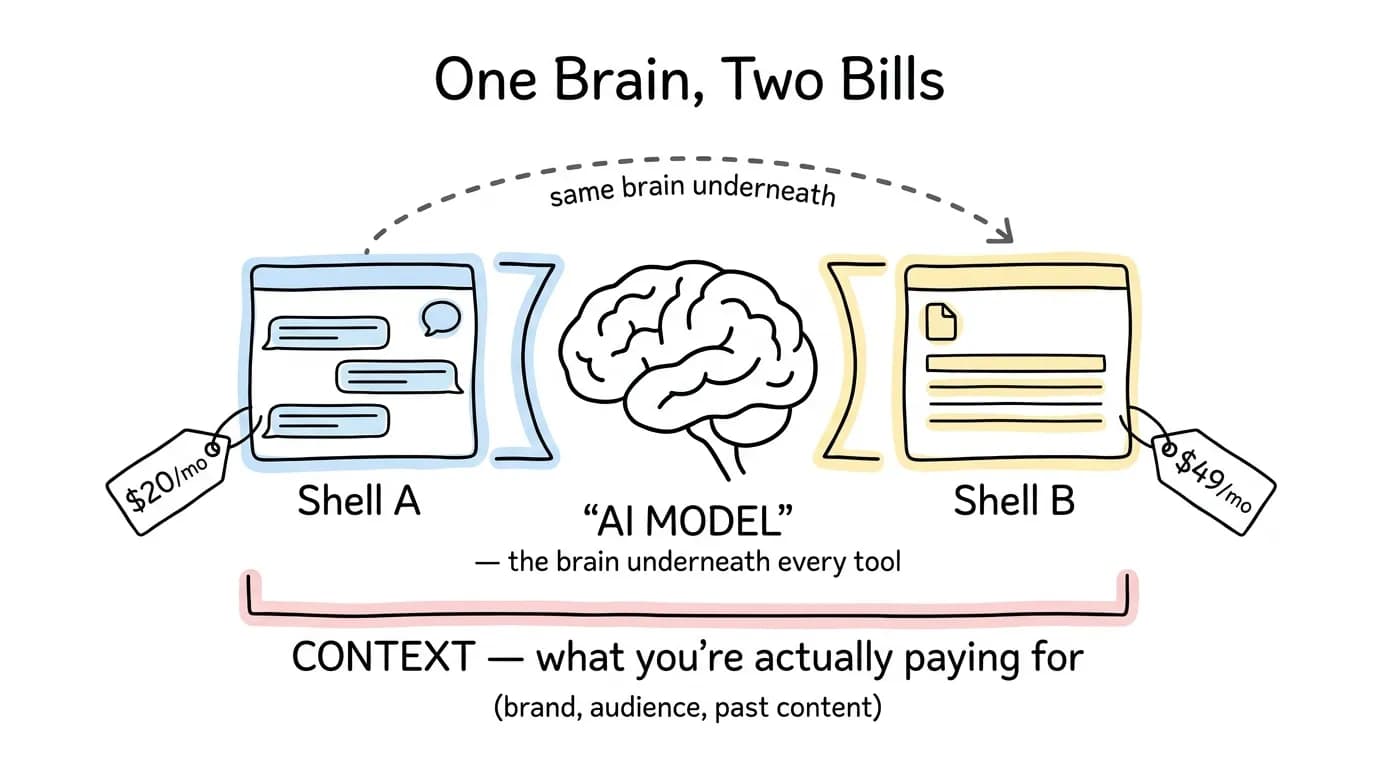
Which AI Should Your Startup Actually Use for Marketing?
A startup marketing guide explaining the difference between AI models and tools, sorting tools by job (writing, research, design, leads, email, video ads), and outlining a 30-day test plan for choosing them. It also covers generative engine optimization and budget trade-offs.
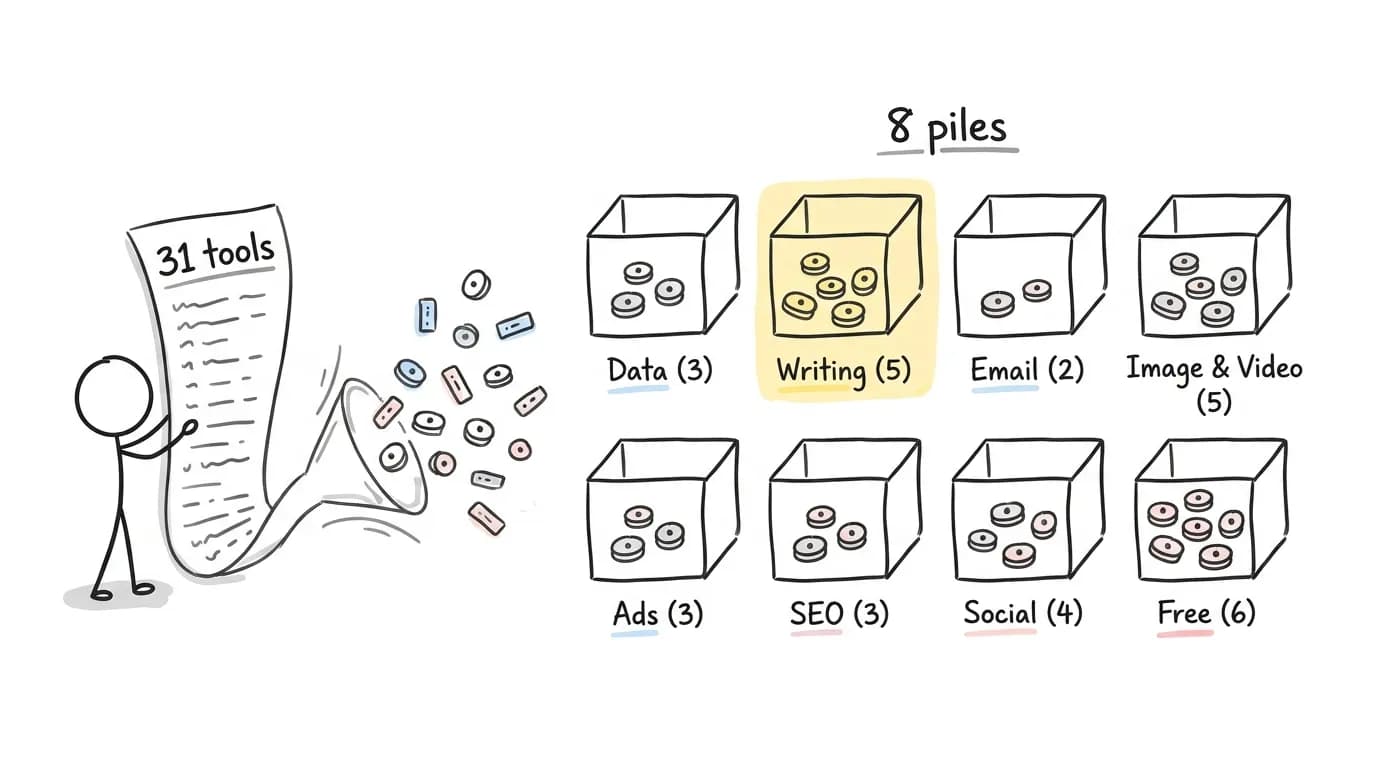
31 AI Marketing Tools, Reviewed One by One: How Exactly Should You Spend the Money?
A review of 31 AI marketing tools grouped into eight categories, covering data, content, email, video, ads, SEO, social, and free options, with guidance on choosing one strong tool for your most frequent task and testing free tiers first.