
AI Marketing Daily · 2026-11-08
This daily brief covers two AI marketing stories: 5WPR's updated guide on AI in influencer marketing, covering fake-follower due diligence and FTC compliance red lines, and an NDTV Profit interview with WPP Media and Madison World executives on agencies shifting billing from billable hours to business outcomes.
On November 8, 2026, two stories from the AI marketing world pointed at the same question: once AI has flattened the execution floor, where should the money — and the judgment — go? 5WPR's updated guide on AI in influencer marketing writes the buying and selling of fake followers into the compliance red line, and for the first time the FTC's rulebook gets translated into the operating language of a marketing team. The other story worth filing under this week's reference shelf is that NDTV Profit conversation, in which executives from WPP Media and Madison World said it out loud: the agency industry's billing logic is shifting from billable hours to business outcomes. One story puts a leash on the hand that spends; the other rewrites the rules for spending. Whether you're setting influencer budgets or renegotiating agency contracts, today's two stories hand you the opening to cut in.
🎯 Today's Top Story
5WPR's updated AI guide to influencer marketing: fake-follower due diligence becomes a compliance action, and FTC red lines go straight into contracts
What happened
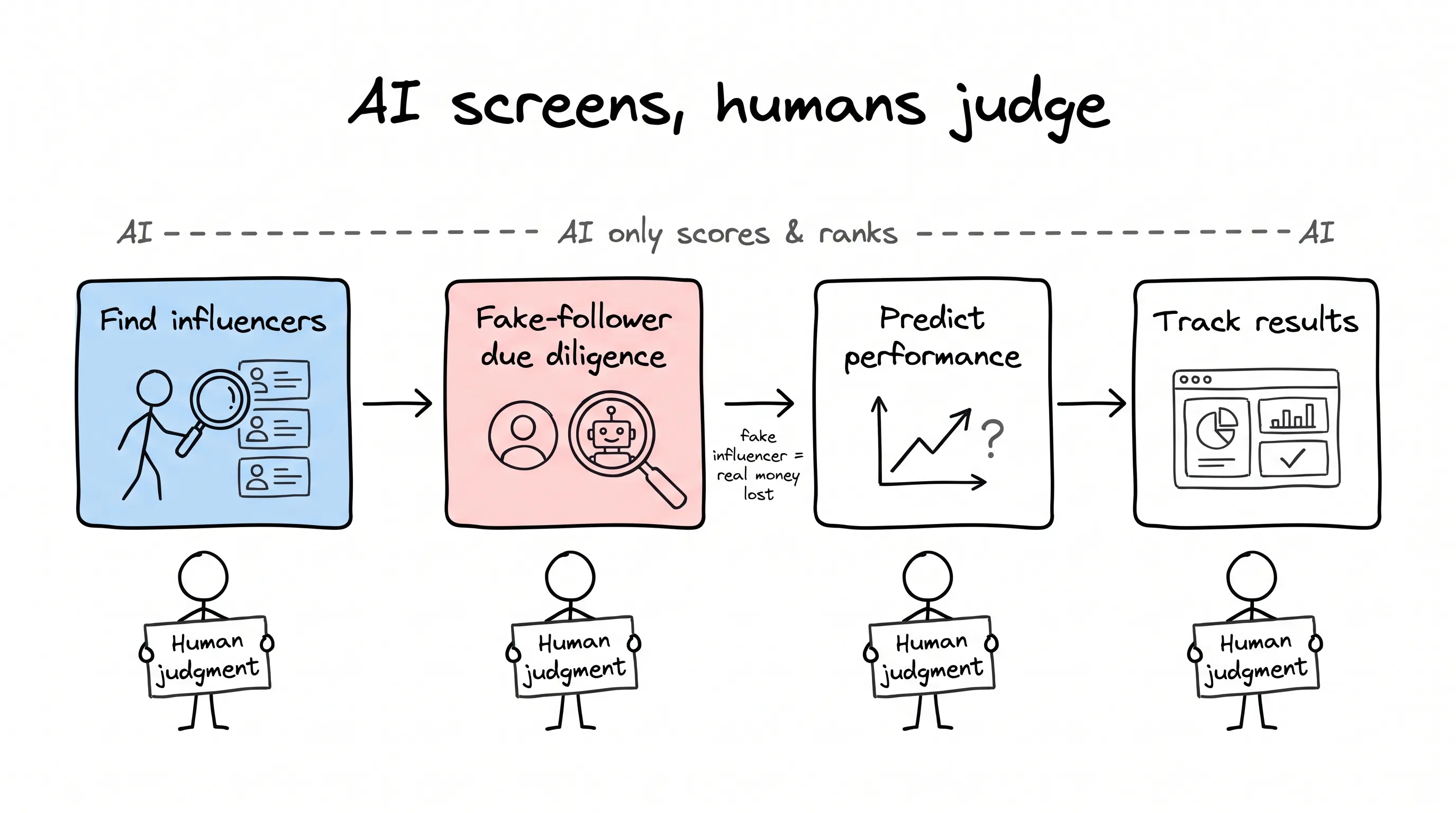
New York PR agency 5WPR has updated its hands-on guide to AI in influencer marketing, refreshed for timeliness on October 21; the named author, Robert Ford, is a partner at the firm and head of its corporate communications practice. The guide confines AI's role to four stages: finding influencers, due diligence against fake followers, predicting performance, and tracking results. All four stages share one bottom line — the tools only score and rank, while judgments like brand fit must be made by a human. The guide opens with a very practical suggestion: start with the fraud check, because dodging a single partnership with a fake influencer saves real, hard-cash budget.
This time, the regulatory section is written for the real world. The FTC's rule on fake reviews and testimonials was announced on August 14, 2024 and entered the Federal Register on August 22. It bans buying or selling fake followers and views when the buyer knows, or should know, they are fake — and it bans reviews from people who do not exist, with AI-generated fake reviews explicitly named. The term "fake follower" gets a clear definition too: accounts manufactured or purchased to inflate a creator's audience. They might be bots, or hijacked real accounts; either way, they represent no actual prospective customers. The guide puts it bluntly: a fraud check is now both a way to protect budget and a compliance action.
Why it matters
When the industry used to talk about AI in influencer marketing, the conversation always landed on efficiency. This guide swings the focus to accountability. Buying fake followers is no longer just wasted budget — crossing the FTC's line constitutes commercial deception, and the brand, as the supervising party, carries liability all the same. The guide lists three suspicious patterns worth a human check: follower growth that doesn't match content quality or posting cadence; an account long dormant that suddenly spikes in likes; comment sections with highly repetitive text. It also adds a caveat — after a viral hit, perfectly normal accounts show abnormal spikes too, so a score can only ever be an investigative lead, never a verdict. On disclosure, ownership of responsibility is spelled out as well: the same disclosure rules apply to AI-assisted influencer content, and watching influencer compliance is the brand's own job; the FTC's Q&A accompanying the endorsement guide makes clear that material connections must be clearly disclosed. The Q&A also draws the boundary of when buying followers breaks the law: only when the buyer knows — or has reason to know — that the data is faked, and then passes it off as influence in commercial expression. Falling into a trap by accident and doing it deliberately are two different orders of magnitude. The Q&A is complete enough to serve as internal team training material, saving you a consultant briefing.
What it means for marketers
Two lines get hit: media buying and influencer partnerships. The yardstick for vetting influencers shifts from follower counts to language analysis — AI reads what a creator has actually published and judges whether there is genuine expertise behind the account, which follower numbers cannot tell you. Prediction gets redefined: it is probability, and promises are not its job. The model eats historical data, so new categories and brand-new platform features can fall entirely outside its training data. The right use of prediction is to rank candidates and shape test plans, then compare micro-influencers (10,000 to 100,000 followers) against top-tier influencers on cost per outcome — not on reach. Micro-influencers have narrower audiences, and conversion often looks better.
Virtual influencers now have a category red line. AI personas like Lil Miquela, Imma, and Shudu have proven themselves with fashion and lifestyle brands, but in trust-sensitive categories — beauty, health, food, financial services — audiences are visibly warier of a synthetic face. The FTC rule carries one further implication: glowing reviews from people who don't exist are banned, so a fabricated persona can never, under any circumstances, be packaged as a real customer. The guide's safe play: use AI personas for testing and brainstorming, and hand public campaigns to real humans.
How to use it
The guide lays out a five-step rollout order. First, pilot AI due diligence on a subset of campaigns, with the manual process as your control group; next, switch on prediction and validate its hit rate against actual results; then let AI draft topic ideas, posting times, and copy first drafts, with the influencer's own voice staying in charge; then build a cross-platform dashboard to see attribution; leave automated optimization for last — decisions on budget and strategy must have human sign-off. Each of the four stages also has its own human checkpoint: at discovery, check whether the influencer's values and past work fit the brand; at due diligence, re-verify flagged accounts before signing; at prediction, confirm the model is estimating the brand's actual goals; at tracking, decide how to adjust mid-flight and whether any disclosure has been broken. On tooling, the guide name-checks influencer platforms such as CreatorIQ, Upfluence, Modash, and Meltwater Klear, and offers one selection criterion: can the tool connect to the brand's own attribution system? And don't reverse the selection order — first be clear about whether you're solving fake-follower prevention or prediction, then pick the tool. Never let the tool define the process backwards.
On the contract side, do at least two things: write disclosure and AI-usage rules into influencer contracts, and keep a human-review record for every AI recommendation — the way AI was used should leave a paper trail too. Platform rules on AI labeling are changing fast; verify each platform's current policy before anything goes live.
My take
The guide comes from an agency, and the prose is measured and corporate — but it writes down the full 2026 consensus on AI in influencer marketing: AI screens, humans judge. The genuinely valuable reminder is the compliance line: buying followers has moved from moral stain to legal risk. Teams whose due-diligence process runs smoothly save budget — and stay off the regulator's list. Its stance on virtual influencers is restrained too: it concedes fashion has made them work, and concedes that in trust-sensitive categories audiences aren't buying it. The tool list you can browse at leisure; the contract clauses and the review process can start moving this week, with a first version of the due-diligence workflow on the agenda within two weeks.
🔗 Further reading: Read the full article
🏷 Industry Data
WPP Media and Madison World executives in conversation: execution is commoditized, agency pay moves to outcome shares
NDTV Profit's interview show The Hook released a 23-minute conversation on October 11 with two guests: Vines Matthews, who leads WPP Media's South Asia team Fulcrum, and Vive Das, head of strategy and digital at Madison World. Host Alex Mathew pinned the discussion on a loosening industry consensus: media agencies used to be media buyers and campaign executors, and now they get called growth partners — at which layer did that change actually happen? Vines's description is concrete: the agency has already taken a seat on the client's board, and the conversation starts from the forces shaping growth — two steps earlier than the typical media-agency agenda. In other words, the pitch no longer starts from the media budget; it starts from where the business will grow, and media is merely downstream of that answer. The host's opening also supplied the backdrop — this episode asks how AI is reshaping the way brands connect with consumers — and the two guests brought that big question all the way down to the billing sheet.
The guests' first-layer answer was blunt: AI has flattened the execution floor. Vines has moved in and out of WPP for 16 years, and his before-and-after goes like this: the brief used to look like this — the task is here, the market is here, the audience is here, now deploy the media; today the conversation starts directly from growth. The foundation of the change is consumer behavior. In the broadcast era, the media mix led with TV, with print and outdoor filling in, and the brand did all the talking. After the digital explosion, consumers answer back at every stage — discovery, search-and-compare, e-commerce checkout — leaving signals at each one. Media plans follow the signals, and slowly become a real-time exercise. Vive calls this set of signals "dynamics": discovery, consideration, and decision each have their own signal format, and the way you buy media should change with them. A team still adjusting its buys on a monthly rhythm is navigating new roads with an old map — cadence itself is now part of your competitive edge.
The data scale shifted gears with it. Back then, the data behind one media plan could be processed by three or four people; now consumers leave signals at every stage, the data runs into billions, and the complexity has outgrown what the same team can handle by hand. One detail worth noting: planning teams were not cut from 100 people to 4 — it is the data volume that rose past what humans could absorb, and AI is there to swallow that layer of complexity. Execution itself has been commoditized; there is no premium left in it, and value has migrated upstream, to original thinking and plan design. In daily work, "upstream" means doing the business plan before the media plan — and the things that used to be back-office chores, like tool selection, data integrations, and metric definitions, now set a team's ceiling. Given the same budget, a year from now the gap between someone who knows how to buy data and someone who only knows how to buy impressions will be very hard to close. And quick commerce (~10-minute-delivery e-commerce) has compressed the decision window to 10 minutes, turning this from a trend into a necessity.
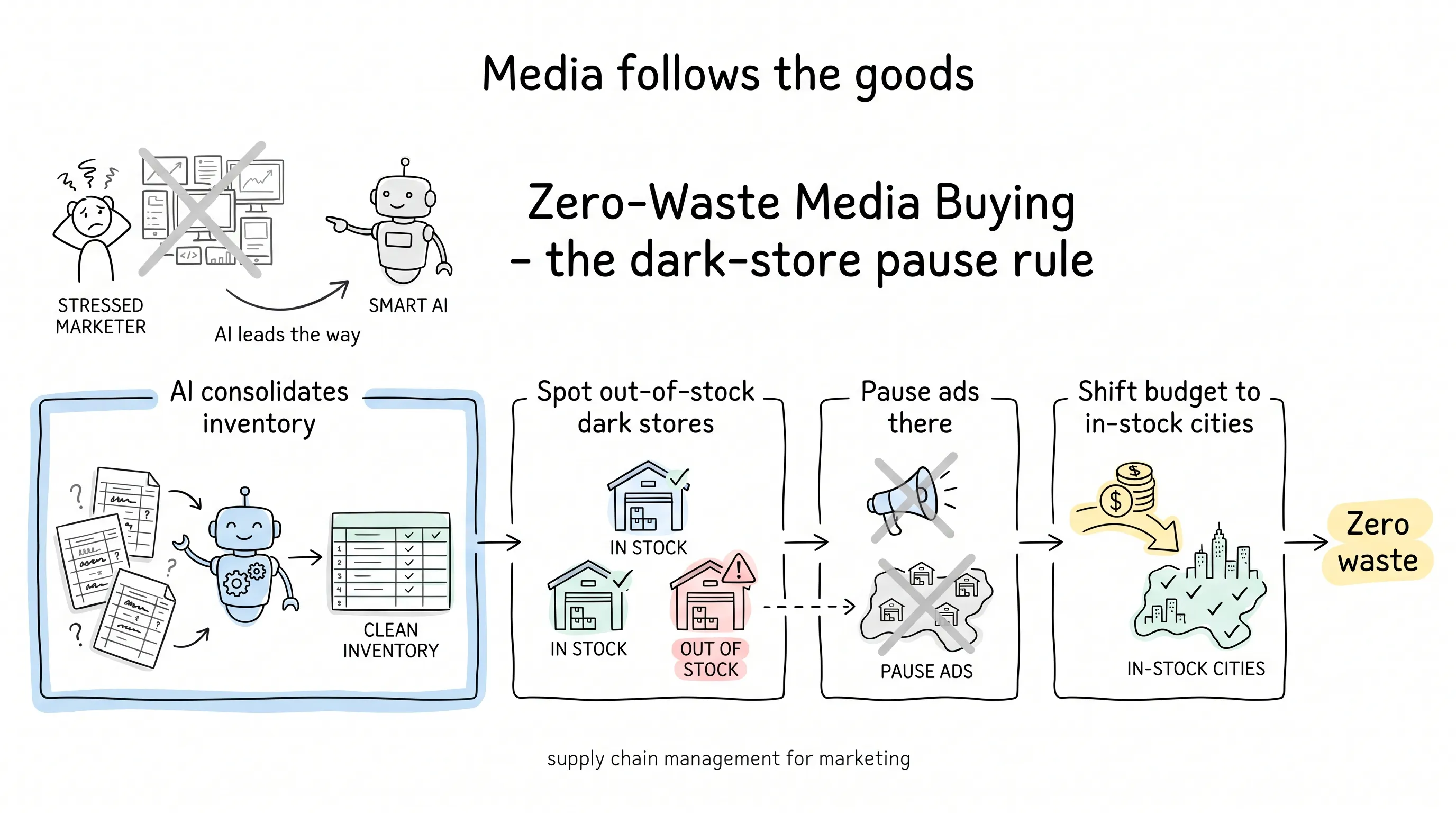
The most vivid case in the interview comes from FMCG. A bottle of shampoo or a bar of soap sits across three major quick-commerce platforms, covering 80 to 100 cities, with each platform dotted with large numbers of dark stores (hyperlocal fulfillment warehouses) organized by pin code, India's postal code. The customer expects delivery in 10 minutes, a stockout at any given dark store can happen at any moment, and no human can watch inventory across every zip code. Picture a room full of people staring at screens refreshing inventory spreadsheets — the image itself is absurd, and before AI the industry simply put up with it. Once AI consolidates inventory data in real time, it issues instructions directly: of 20 cities on sale, 30 dark stores are out of stock — pause ads in those areas and move the budget to cities with stock. The spend that gets saved doesn't vanish; it is redeployed to cities with inventory and keeps generating sales. That is what "zero waste" fully means. Vines said that this way there is no wasted media left, and the host followed up with a line: this is really supply chain management for marketing. That sentence deserves to be copied out on its own — it rewrites the worldview of a media system from an impressions business into an inventory business. Advertising is no longer paying for noise; it is routing demand to sellable stock.
The host asked a pointed question on behalf of brands: brands can pull this data themselves, so what role is left for the agency? The answer came in two layers. First, breadth of intelligence: any single brand's understanding of its own industry is one-dimensional, while an agency holds a cross-category, cross-market view running from hyperlocal to national — closer to a consulting firm that also knows how to execute. Second, execution excellence is still worth paying for. Anyone who says AI has taken over execution so you no longer need to execute is ignoring one fact: every platform you put money into has exactly one goal — maximizing its own profit — and whoever spends a brand's money has to know how to route that money around the algorithm's traps. That answer nails the agency's new value: data and tools impose no barrier; cross-industry insight and spending discipline are the barrier. The first comes from accumulation, the second from mechanisms — and a brand missing both will find that building in-house is actually more expensive. The methodology underpinning this intelligence got spelled out too: pull every commercially usable public dataset into one system, and grow judgment on questions like retail penetration, channel expansion, and market entry.
The differences between industries cut deeper still. For a jewelry brand rolling out nationally, the real competitive turbulence happens at the regional and local level — the same brand's playbook has to be recalculated from one Indian state to the next. The tire industry's rules are harder: no matter how much you advertise, the customer is handed over to the dealer the moment they walk into the store, so media must be front-loaded to before the store visit. Paint companies face a similar channel structure. What these industries share is a stretch of the decision chain that advertising does not control — and the job of advertising is to move people up to just before that stretch.
Vive Das taught the leitmotif of this playbook through two workshops. One day before this interview, he ran an internal training at a large industrial conglomerate; the next day he visited a multinational financial company planning to enter India. Both conversations, improbably, landed on the same question: how do you sync advertising with sales? Over decades of evolution, the gap between marketing and sales has only widened, and AI is now smoothing it flat — on the condition that the data spine and the martech stack can tell advertising what to sell and when, with both the demand side and the supply side plugged in. In home appliances the question gets finer: you're selling fans on social media and three SKUs go out of stock — how do you reallocate? Problems like that only have answers once the data foundation is built. Selling insurance or loans runs on yet another logic — you first have to work out whether these signals are even visible in the data. For the financial company preparing to enter India, the question carries extra weight: every unit of ad spend in a new market has to be accounted for inside customer acquisition cost (CAC), and if ads and sales are out of sync, the books simply don't balance. Two workshops, one day apart, same question — which tells you this is not some industry-local problem.
The change in compensation models was the most concrete part of the interview. The traditional agency billed on headcount intensity; now the client's opening line has changed: "I like your energy and your creativity, but I need all of it working toward some target — and for every rupee I spend on you, some part must map to a measurable result." The old metric stack of reach, impressions, and frequency exits with it. In the past you quoted on headcount — extra revisions cost extra, extra placements cost extra; in the future you quote on outcomes — a plan is worth whatever business it takes with it. Vines broke the new model apart: a base for the fundamentals, high returns on the high-risk portions, structured as a tiered slab model (layered fee bands). His first question to a client founder is: are you after a valuation window, or are you building an institution? The two answers map to two playbooks — they might land on the same number in three years, but the paths are completely different. Clients building an institution respect the value of knowledge work, so a base retainer plus outcome share is enough; clients running on pure valuation logic pay only on sales, which is real, on-the-table risk for the agency, hedged with the tiered structure — low-risk stages protect the base, high-risk stages chase the high return. Only when an agency ties its compensation to the client's growth does it have skin in the game — and the standing to tell platforms that how this money gets spent is decided by our strategy.
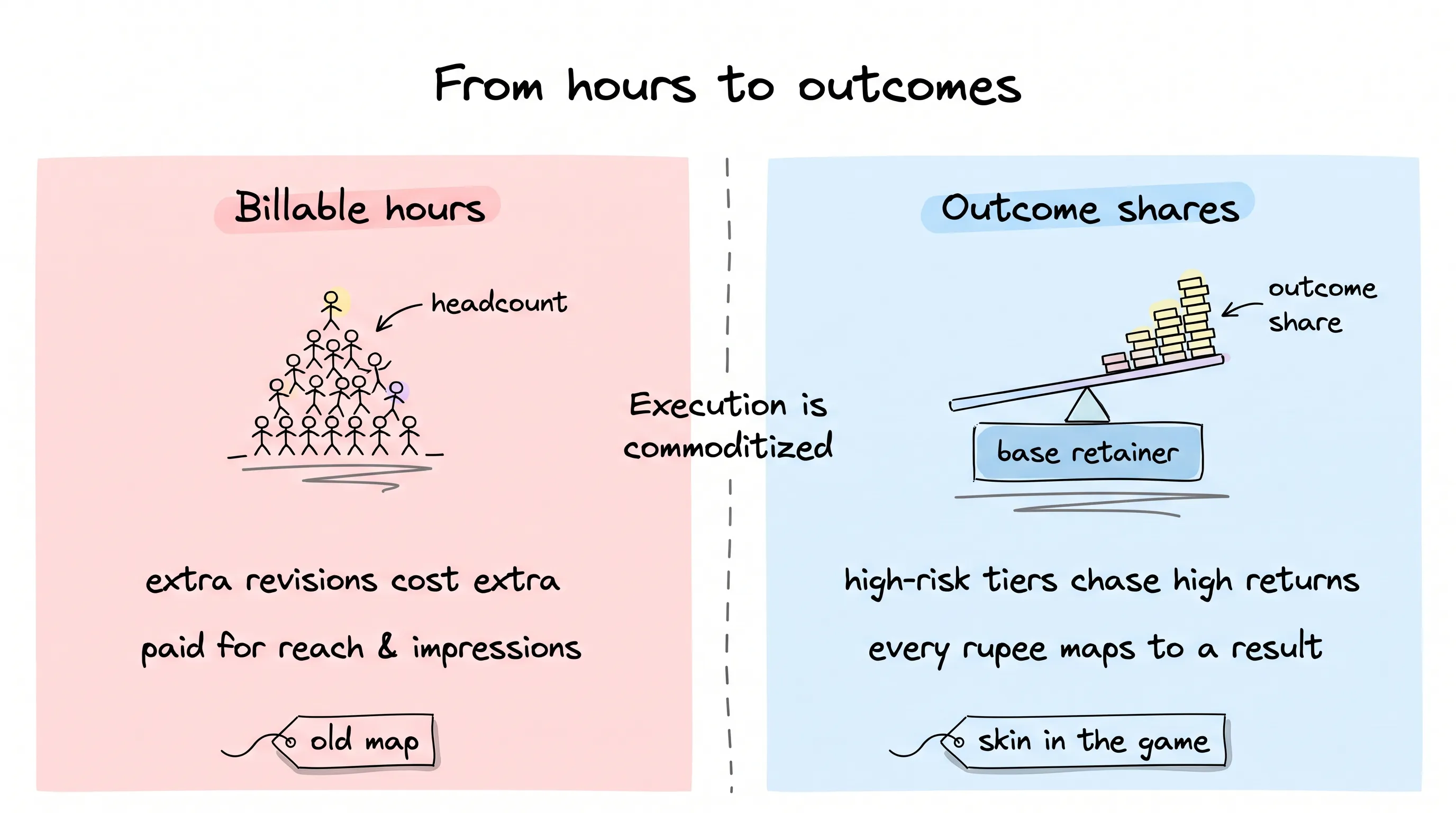
The interview also owns this model's double edge. Not every brand will make it; in crowded lanes, failure rates for new brands are nothing to brag about, and incumbents like Unilever stand on turnover speed accumulated over decades. Betting on outcomes means agencies must choose their clients and their categories — and it means the traditional agency business model, stacked on headcount, has to regrow from the root. The client-picking was discussed candidly: when Vines meets a founder, his first question — valuation or institution? — is really asking whether the other side is willing to pay for knowledge work in pursuit of long-term outcomes; only those clients are worth three years of accompaniment. For brands it holds up a mirror too: if you demand an outcome bet from your agency, you must hand over your own family silver — attribution, inventory, the product lineup — or there is nothing to bet on.
The WPP Media side added one precondition. Once the talk turns outcome-driven, the first thing to establish is media's share within the sales or brand-health metric. Many variables drive results; you need an attribution model to isolate media's independent contribution, align with the client that this is what media is driving, and then underwrite outcomes against that KPI. Once this is done, every line of media spend can find its corresponding row in the business ledger, and media reports and finance reports finally speak the same language. The implication for CMOs is direct: budget defense now has a language the other side understands. His judgment: attribution models are already quite robust, and what AI is doing is running these studies faster and cheaper — once scaled, even mid-size clients can reach them. Vive Das immediately set the boundary: the big clients who can fund attribution studies repeatedly and deploy MMM (media mix modeling) can indeed negotiate on precision; most Indian companies lack the intelligence to isolate media's contribution — especially the SMBs and MSMEs that exploded in recent years and are being added to pitch reports for the first time.
So the brand's demand collapses into one sentence: keep advertising as close to distribution and sales as possible, and create demand where supply can cover it. Translated: media follows the goods — where the goods go, ads go; where the goods haven't arrived, don't shout yet. That sentence can go straight onto line one of your media-buying SOP. The counterpart in the room is changing too: agencies used to talk to CMOs; now they often talk straight to the CEO and the board. CMO accountability is rising — with data and attribution in hand, you must be able to explain why you chose this move and dropped that one. Agencies used to report how many impressions were delivered; now they must answer how much business this flight generated. The question has changed shape, and the granularity of the answer must change with it. The other side of rising accountability is decision transparency: what used to be settled on experience must now have its reasons laid flat with data. The interview's verdict: heavier accountability has, on balance, raised the industry's game — the cost is that every decision demands deeper work.
The KOL segment came from a viral reel: a brand's global CEO appeared for free, sipping coffee and nibbling snacks, with a caption mocking influencers who quote $2,000 just to take a job — and the engagement on that post pushed anti-influencer sentiment onto the table. The host twisted the knife: that CEO was drawing a salary to drink coffee anyway. Behind the joke sits a serious question: are brands growing tired of influencers? Influencer marketing went viral overnight back in the day, and crowds rushed in; now brands and agencies have started asking what influencers actually drive within the marketing mix, and whether the tests have been run enough. The asking itself is progress — this question never used to get asked. As attribution catches up, the role of every touchpoint can be computed, and the influencer is only one of them. What brands are pushing back on is not influencers — it's spending whose contribution nobody can explain. The interview also sized India's influencer market: annual spend of ₹5,000–10,000 crore (a pool of roughly ₹50–100 billion a year), under 10% of total ad spend — hardly saturated; the problem is over-concentration on a few platforms, with maturation and cleanup still ahead. The direction of the cleanup follows naturally: once fake followers and junk engagement are scrubbed out, the budget that remains has earned the right to talk performance — which links straight back to the due-diligence step in the FTC story above. From the marketer's view the market looks fragmented; from the consumer's view it isn't — algorithms shape perception too, and how often you scroll past influencer content has already been tuned by recommendation systems against your age and interests. Dairy brand Country Delight is the pure influencer-first, creative-first launch case, and its value as a case is that it launched without paid media — content plus influencers, two legs, carried it from zero to one. For new brands on tight budgets, it is a template worth copying.
The interview's sense of proportion came from Vive Das's closing. AI has improved prediction, but it cannot understand nuance — culture, festive atmosphere, household decision-making. Buying a refrigerator is a family decision; buying insurance is a considered purchase; the structure of the buying unit and its psychology live outside the data. However clever the targeting system, it cannot simulate a family around the dinner table debating which fridge to buy — the last step of such decisions happens where data can't see. Systems and data make complexity manageable, but what actually makes a campaign work is human judgment and creativity layered on top. That close is the footnote to the whole interview: neither guest spent a minute talking down the agency industry — they simply re-priced which parts of it are valuable. The valuable parts got more expensive; the worthless parts went to zero. That signal holds for both sides of the table.
Stepping outside the Indian context, three things travel. The dark-store logic holds for any channel with an inventory boundary — physical stores, regional warehouses, cross-border supply all fit the same pause-ads rule — and for domestic teams, instant-retail platforms have inventory data APIs too; map the rule over and it works. Slab billing turns agency procurement from a pitch logic into a wager logic, and what brands must prepare in advance is the attribution standard — without it, you can't even set the negotiation table. SMBs lacking intelligence is, flipped around, an opportunity: whoever turns attribution into a standardized product catches the spillover demand. For teams outside India, the growth-partner framework is spreading too — European and American agencies are also pinning fee structures to business metrics — and preparing attribution under this framework earlier means less losing leverage at the table. Different markets; no need to change the methodology.
💬 How marketers use it: two things can move this week. On the media side, wire inventory or supply data into the pause rule — out of stock, stop — and the wasted budget you save drops straight into your pocket. On the contract side, when renegotiating billing with your agency, start with a small-percentage outcome tier, and require the agency to hand over its attribution standard for media's contribution — negotiating a revenue share without attribution is negotiating on nerve alone.
🔗 Further reading: Read the full article
💡 Today's Takeaway
Read together, today's two stories are two faces of the same hole card. The 5WPR guide stands on the compliance side: the FTC has written fake-follower trading and AI fake reviews into explicit no-go territory, and from now on the numbers inflated inside the influencer ecosystem carry a legal cost. The Hook conversation stands on the business side: the agency industry has moved compensation from billable hours to business outcomes, and media has moved from buying reach to the seam between inventory and distribution. Both point at the same shift: once AI flattened the execution floor, two new scarce resources took the place of execution itself: authenticity that can survive regulatory and attribution scrutiny, and a pricing system brave enough to bet on results.
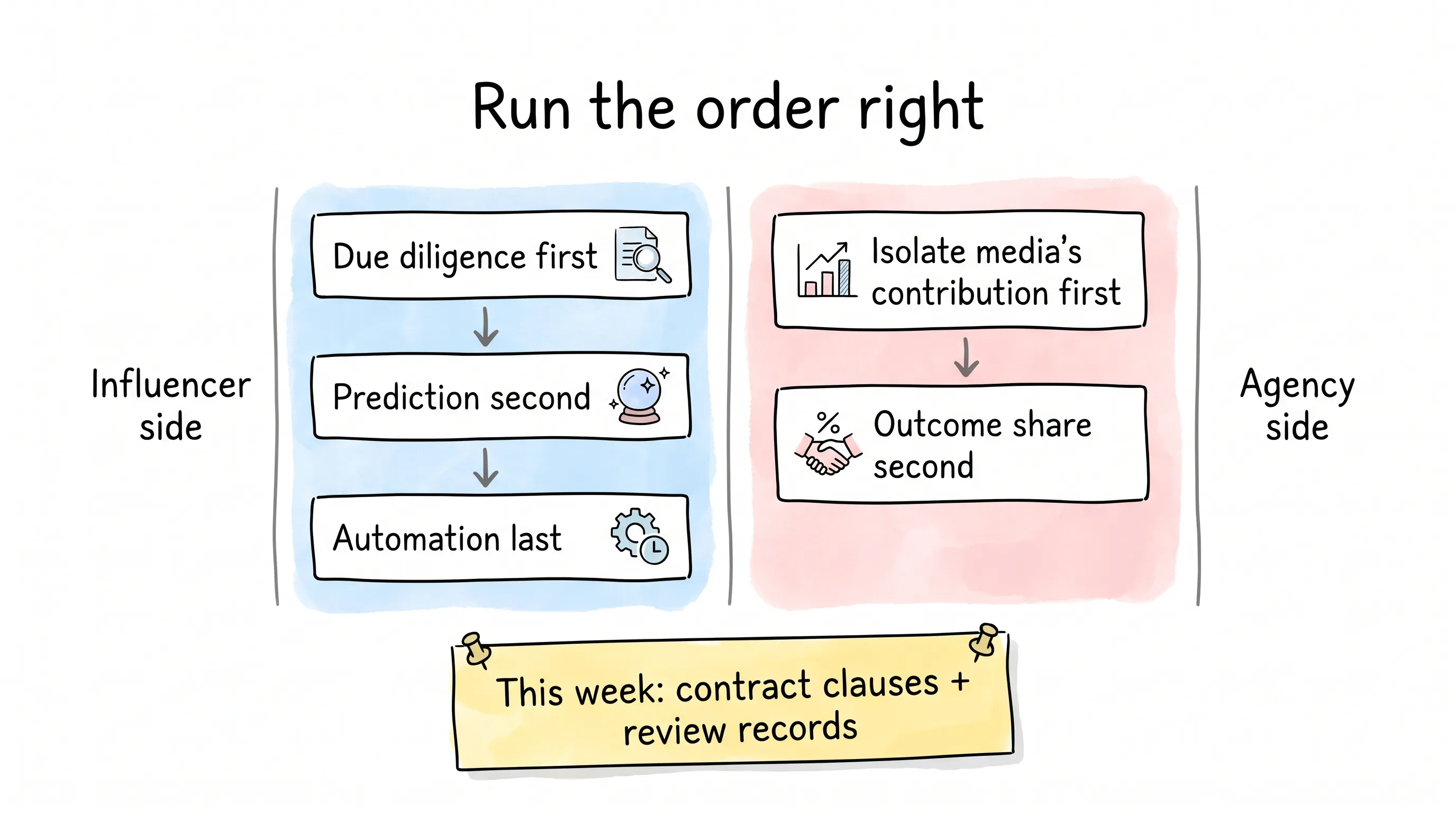
The two stories carry very different adoption costs. The first costs almost nothing — contract clauses, review records, platform-labeling checks; it is all process. The second moves the data foundation — inventory integrations, attribution modeling, tiered billing — each a quarter-scale engineering project. The reminders for marketers are mirror images too: on the influencer side the order is due diligence first, prediction second, automation last; on the agency side the order is isolate media's contribution first, outcome shares second. Run the order backwards and you step in the potholes on both sides. If this week allows only one move, put the contract clauses and review records in place first — lowest cost, fastest effect — and greenlight the attribution foundation in parallel, talking revenue share at quarter's end. One more note: the platform-labeling rules from the top story and the agency contract clauses from this one belong in the same checklist, walked through together before the next campaign goes live.
Both stories deserve a slot in the team's next-quarter planning discussion — the first clamps down on risk exposure, the second reorders budget logic. The answer to how next year's influencer budget should be handed out is also hidden inside these two stories: give it to real people, to influencers who survive due diligence, and to agencies brave enough to price on results. Read both together before you set the plan — clearer than reading either alone. And once you've read this report, you'll walk into tomorrow's topic-selection meeting with something to say.
Continue reading
Related articles
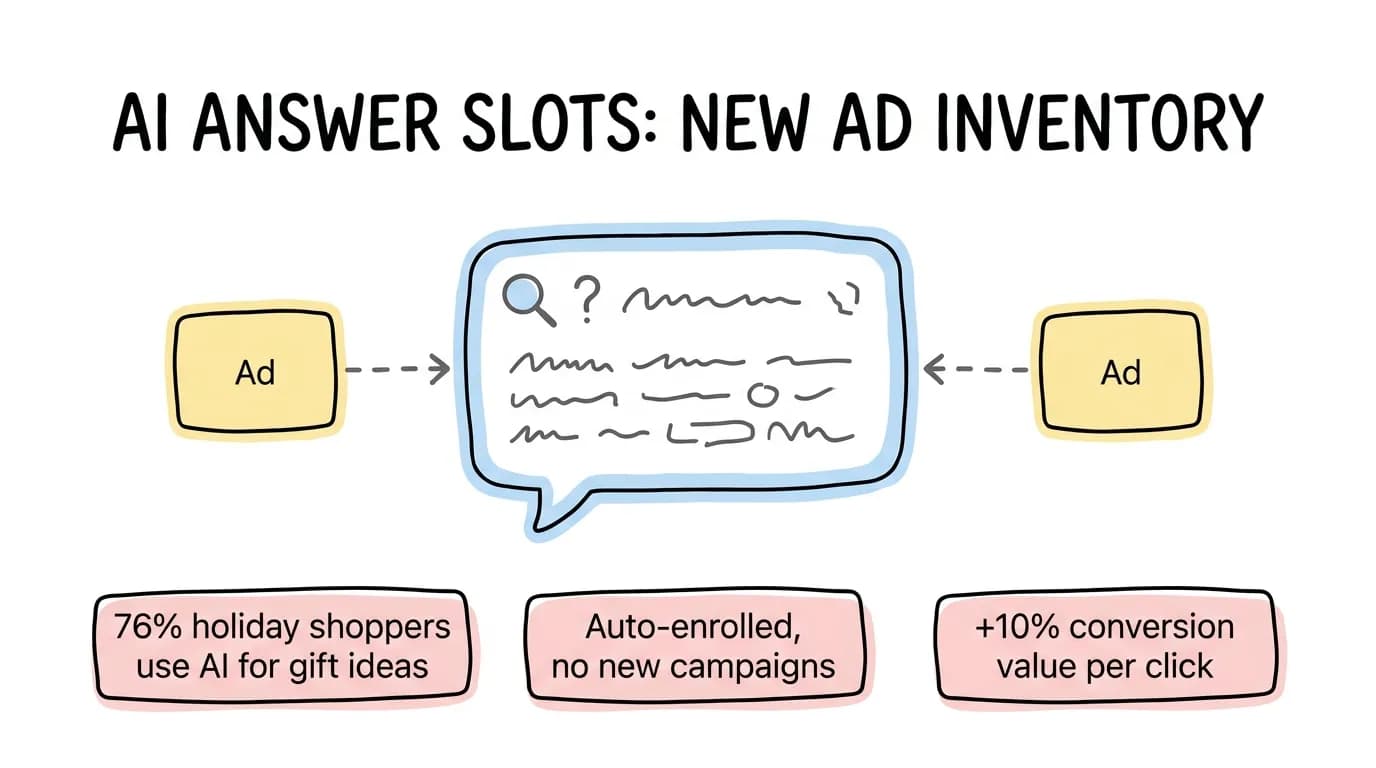
AI Marketing Daily · 2026-11-22
AI Marketing Daily for 2026-11-22 rounds up 20 items led by Microsoft opening Bing AI Overviews to ads and Google expanding AI Mode ads to ten countries, plus GEO guides, ad automation delegation guidance, AI Overviews CTR data, and a legal-risk checklist for AI-generated creative.
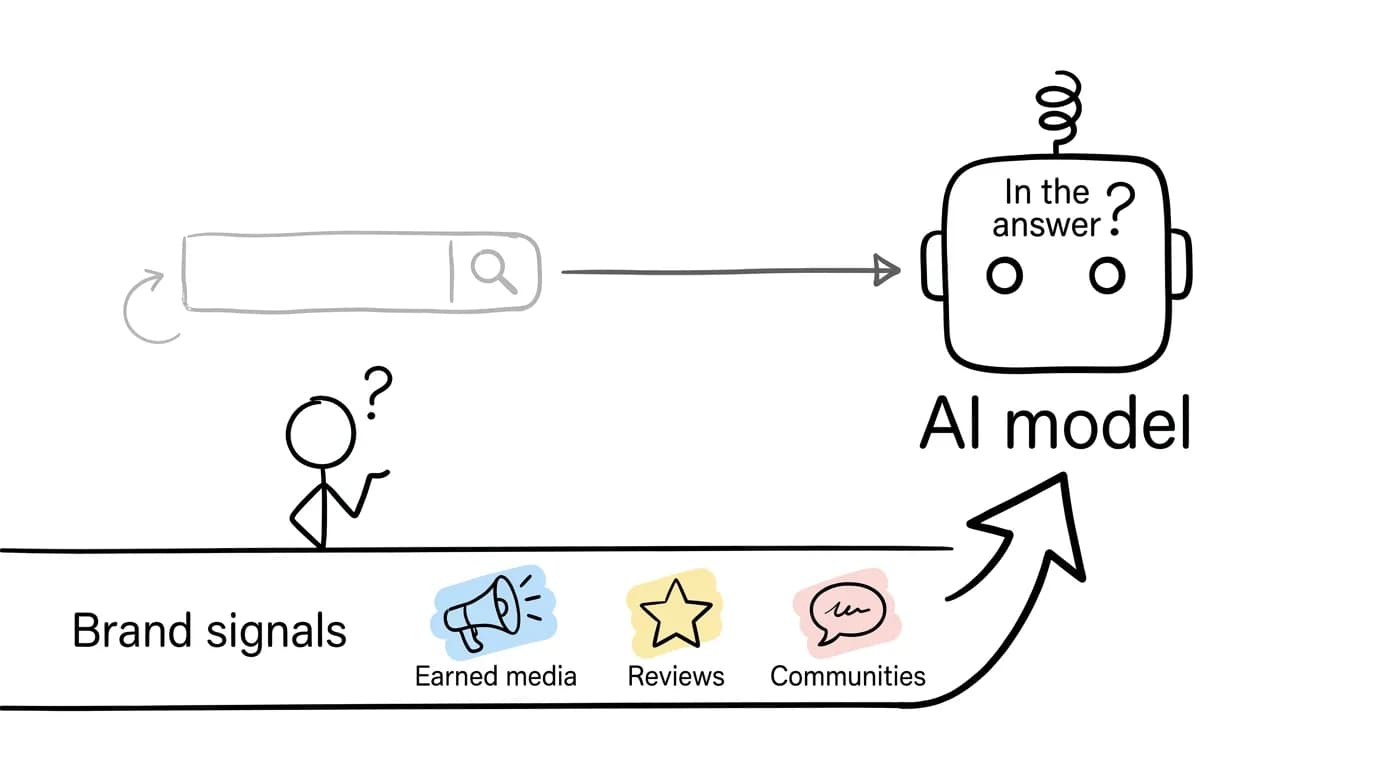
AI Marketing Daily · 2026-11-21
A November 21, 2026 AI-marketing daily covering AI search visibility, GEO methods, Google AI Mode ads expanding to ten countries, Meta's pre-Black Friday changes, agentic shopping, and industry adoption and ROI data.
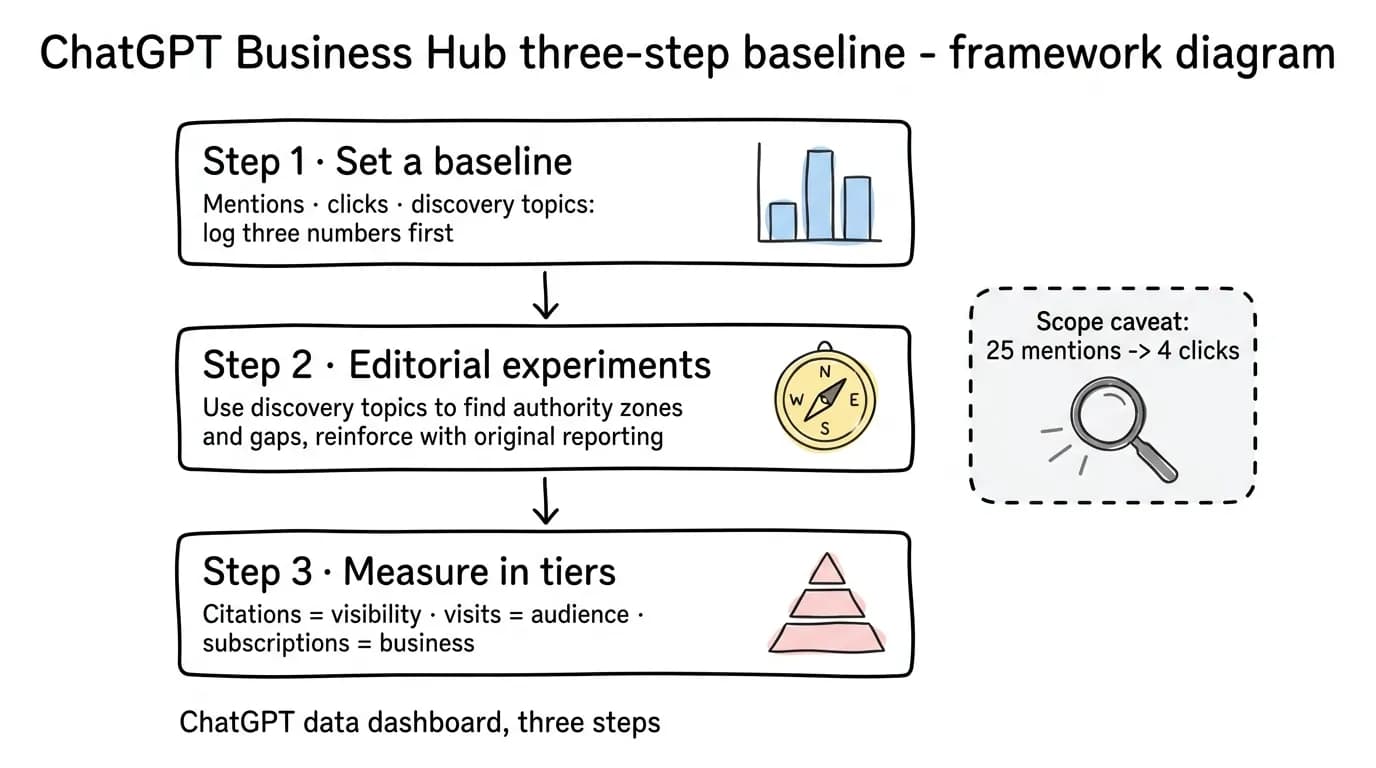
AI Marketing Daily · 2026-11-20
AI Marketing Daily for 2026-11-20 rounds up 19 items centered on measurement: OpenAI's ChatGPT Business Hub dashboard, EU rules for agent-mediated purchasing, Meta pausing four AI terms, and B2B data on shortlists and the dark funnel, each with action advice.