
Ad Money Is Starting to Be Billed by Results
An industry commentary on how AI is reshaping media agencies: execution work like ad buying and reporting is being commoditized, agency compensation is shifting toward results-based models, and value moves to strategy, attribution, and tying media plans to business plans.
A couple of days ago, a post scrolled across my feed.
The global CEO of a coffee brand appeared on camera himself, took a sip of his own coffee, bit into one of his own croissants. The caption went something like: influencers charge $2,000 to drink our coffee. Me? Free.
The comments section cracked up, calling the guy a cheapskate.
I had my laugh — and then a much bigger thought hit me: the advertising business is being dug up and turned over by AI, root and branch. The work of the hands is losing its price. The work of the brain is worth more than ever.
Where to begin? With the least visible player in all of advertising — the one outsiders never see.
First, What a Media Agency Actually Does
What is a media agency?
Put simply: the people who help brands spend money.
Think about it — over these past decades, how have brands been talking to you? The TV spot at halftime of the World Cup. The billboard you pass on your commute every single day. And now, the precisely targeted feed ad that lands in front of you as you scroll social media. One medium has replaced another, wave after wave — but one thing never has: someone has to decide, on your behalf, where the money goes.
That is what a media agency does. How much goes to which channel, how to buy it, how to execute — they take care of all of it. In plain terms: buyer plus executor.
But that role is changing fast. How fast? A few days ago I watched a conversation with two leaders from Madison World and WPP Media South Asia. I came away with a single feeling: this isn't the same industry anymore.
From the Back of the Meeting Room to the Boardroom Table
The head of Team Fulcrum at WPP Media South Asia joined the industry 16 years ago, left at one point, and came back. He says that 16 years ago, a brief read like this: here's the job, here's the market, here's the audience — now give me a media strategy.
That was it. You were the executor, standing at the back of the meeting room.
And now? Madison World's head of strategy and digital business says that when they meet clients, they sit at the boardroom table. Where does the conversation start? With "What forces are shaping your growth?" Media comes up only once growth has been fully talked through. That's two full steps earlier than a typical media briefing.
Why would clients give them a seat at the boardroom table?
Because the conversation now is about growth, not placements. And behind that lies a complete change in the scale of data.
Run the numbers. Sixteen years ago, a media planner could handle the data of the day with a team of three or four. Doing the same job today would take a hundred people. And now? The people are still the same people — it's the data that has grown to a scale of billions. Across platforms and ecosystems, consumers leave a signal at every step — discovering a product, searching and comparing, all the way down to placing the order on an e-commerce site. At this level of complexity, no pair of human eyes can keep up.
That's exactly what AI is for. It has taken over the data no human could ever keep up with.
Execution Has Lost Its Price
This has been the most dramatic change of the past year or two.
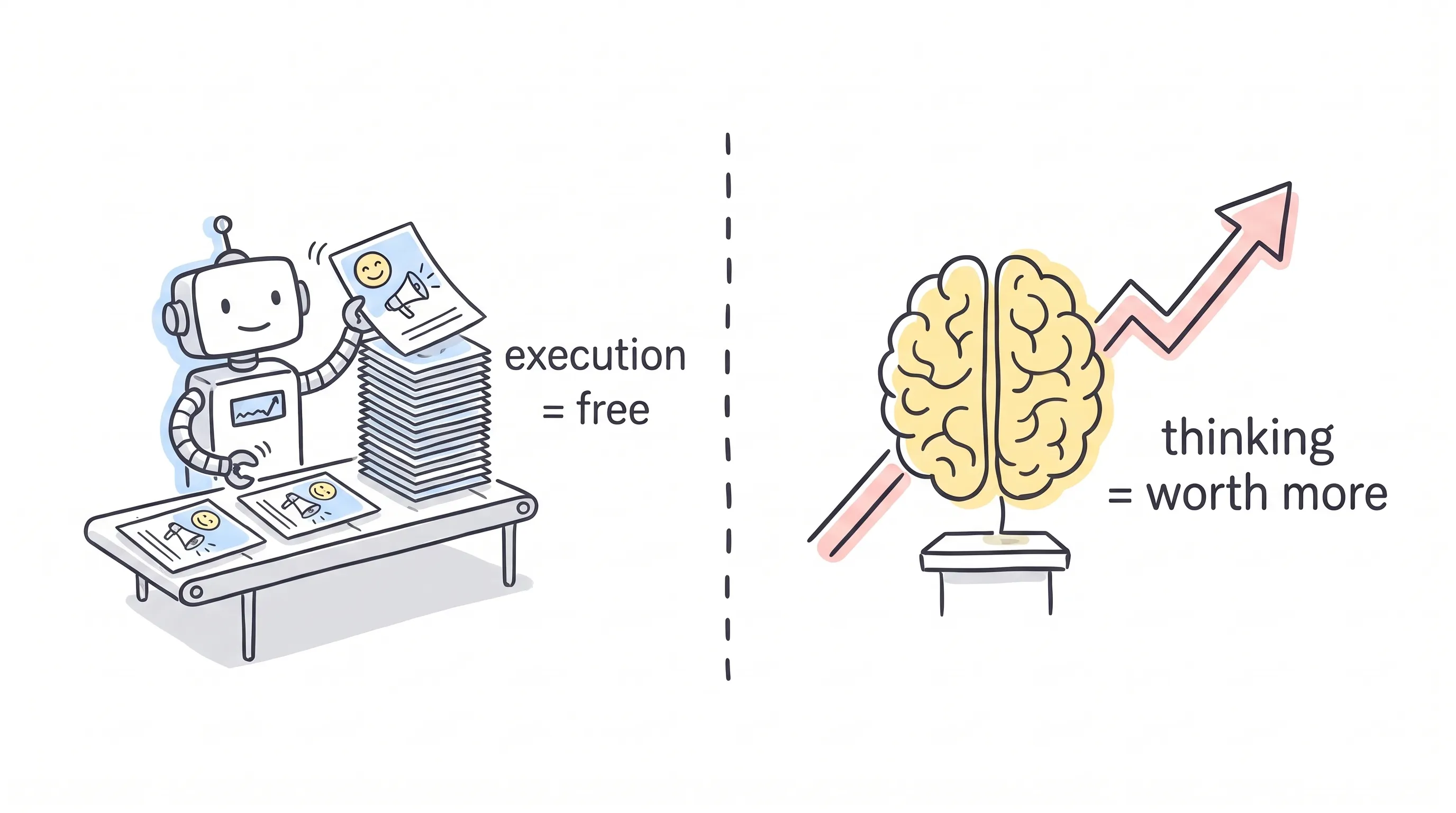
AI has lifted the entire floor of execution. Ad buying, optimization, churning out reports at scale — the bread-and-butter services agencies used to bill for now sell for next to nothing. The executive put it bluntly: there's no value left in execution. It has been commoditized.
Where's the value? In original thinking, in solution design, in the ability to connect ideas across domains.
Execution is free. Thinking costs more. That's the pricing logic of this business now.
An Example That Made Me Sit Up
Concepts alone don't land, so let me give you something concrete.
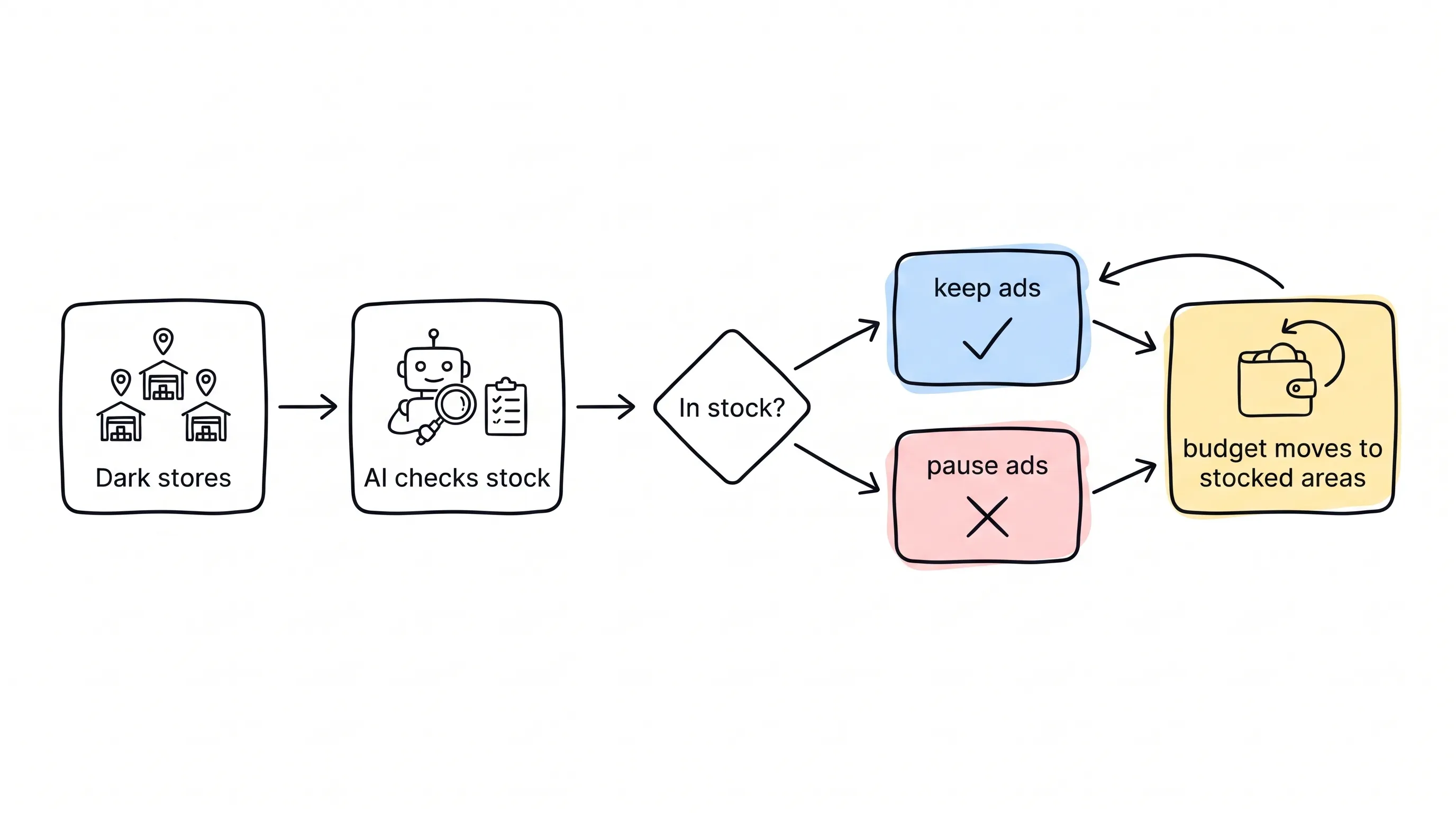
Say you sell shampoo and soap. Your products sit on the top three quick-commerce platforms, covering 80 to 100 cities. Consumers tap a few times and the goods arrive at your door in 10 minutes. To make that 10 minutes possible, these platforms run a dense web of forward warehouses by PIN code — the so-called dark stores (dark store: a small hyperlocal warehouse built for rapid delivery).
Now the problem: at one dark store, your product just went out of stock.
In the old days, the ads kept running. After all, you're targeting a city — who's going to check the shelves of a warehouse?
Now, AI pools the inventory data from every dark store in real time and tells you: you're live in 20 cities, and 30 of your dark stores are out of stock. In those areas, pause the ads until the stock is replenished.
And move the paused budget to the areas where stock is plentiful.
Not a single rupee of ad money goes to waste.
When they heard this, someone blurted out: This isn't advertising. This is supply chain management for marketing.
That's brilliant. I've remembered that line ever since.
What AI Cannot Compute
That said, everything has a flip side.
AI can sharpen predictions and process data at scale. But there's one thing it can't help you with: grasping nuance. Culture, festivals, family — these it cannot compute.
Take an example. When you sell a refrigerator, is it one person buying? No — a whole family discusses and decides together. Selling health insurance? The head of the household may be the one paying, but it's a deeply considered purchase. For products like these, the setting, the family structure, the timing — all of it is at play. Data and systems can talk to each other, but the final layer laid on top takes human creativity and judgment.
And what AI can't compute differs from industry to industry.
Take jewelry. A mature national brand enters the regional market of one state, all the disruption happens locally, and the playbook changes immediately. Tires are even blunter: no matter how good the advertising is, once the customer walks into the dealership, the game is over — the dealer takes over everything. Paint is much the same.
And there's a more universal headache: advertising and sales out of step with each other.
The executive said he sat in two completely different meetings over two straight days — one with a large industrial conglomerate, one with a multinational financial firm preparing to enter India. Both asked the very same question: how do we get advertising and sales to mesh? The appliance seller put it more practically: I'm pushing fans on social media, and three models go out of stock at once — how am I supposed to keep advertising? For decades, the crack between advertising and sales has only widened. AI is now stitching it closed — but only if the data foundation and the marketing technology stack are built first.
Platforms Make Money Off You. Agencies Make Growth for You.
Go one level deeper, and there's an accounting that most people never notice.
The executive offered two plain sentences that, I think, every ad spender should copy down.
First: Every platform you put money into has exactly one goal — maximizing its own profit.
Second: Agency compensation is now starting to be tied to client growth.
Put those two side by side, and the strategy flips. In the past, you obeyed the algorithm — wherever it told you to spend, you spent. Now it's the reverse: first design a strategy that drives your growth — volume or profit, decide clearly — and then it's you telling the platforms how your money should be spent.
The initiative has moved back from the platforms into the hands of brands and agencies.
What Does Paying for Results Mean?
So what's in it for the agencies themselves?
Clients' attitude now: I like your energy, I admire your creativity — but every rupee I spend has to map to a result. The traditional metrics of reach, impressions, frequency no longer cut it.
This shakes the agency business model to its core. This was once a labor-intensive industry, built by piling on people; the future leans ever harder on results.
Here's a particularly interesting detail. The executive says that when he meets founders, before any talk of partnership he asks one question first: Are you doing this to cash out, or to build an institution?
Both kinds may land on the same number three years from now. But the strategies are completely different.
Those building an institution accept that this work involves a great deal of knowledge, are willing to pay a base fee for thinking, and tie the larger remaining share to how the business actually performs. Those chasing valuation only pay on sales — so the agency has to hedge. How? Layering. Keep a base salary on the low-risk portion, chase high returns on the high-risk portion: a tiered compensation structure.
Sounds lovely. But the other executive threw in the crucial catch.
To truly be paid by results, you must first make clear how much credit media actually deserves in any given sale. Did that conversion come from the advertising, or from the channel, the pricing, the brand's word of mouth? It takes data and an analytics system to isolate media's contribution, and you must tell the client up front: I'm accountable only for the part I move. Otherwise the books can't be settled.
How accurate is this model? Quite accurate now — attribution studies and marketing mix models are strong, and AI keeps raising both precision and scale. But there's a reality: the ones who can run attribution studies with real rigor and depth are the big companies. Small and micro businesses on the Indian market are exploding in number, and for the first time industry reports are tracking them as a separate segment — precisely because they don't have this kind of intelligence.
So for most businesses, the answer isn't attribution — it's a clumsier but sturdier binding: tie the media plan directly to the business plan. Build demand only where supply exists; place ads only where demand can be caught.
The CMO's Job Isn't Getting Easier Either
By the way, in this round of change, the one hurting most may be the CMO.
With all the information and data in hand, accountability naturally rises. But the upside is real too: for every campaign, why it launched and why it came down can be explained. It used to be gut calls; now it's results.
And one more thing shows the shift even better: when many brands talk marketing, the person across the table is no longer the CMO — it's the CEO, it's the board.
Is Influencer Marketing Dead?
Back to the coffee-drinking CEO from the start.
Everyone just found it funny. But the Madison World executive laid bare the trend beneath it: brands are now asking which slice of their business influencer marketing actually contributes to. Every touchpoint has to be accountable, and influencers are just one touchpoint among many.
So is influencer marketing saturated?
The answer: it isn't saturated — it's over-concentrated on a handful of platforms.
Run the numbers again. Industry-wide, spending on influencer marketing runs between 5,000 and 10,000 crore rupees a year — that is, ₹50 billion to ₹100 billion (1 crore = 10 million). Sounds like a lot, right? Set against the entire ad market, it's still under 10%.
The money is nowhere near spent out — it's just crowded into too few places.
And the business isn't without its success stories. Country Delight, a dairy brand, built itself from zero entirely on an influencer-first, content-first strategy.
So his verdict: this market has room to mature, and room to be cleaned up. What it needs is someone to put the structure in place.
The Brain Is Worth More Than Ever
I've since worked out what that coffee-drinking CEO was really up to.
Everyone laughed at his stinginess. But what he was actually doing was calculating "who speaks for me" down to the last decimal. He didn't want to pay $2,000 a cup of coffee not because he's poor, but because he accounts for where every cent goes.
And that is exactly the lesson the entire advertising industry is now being forced to learn.
AI has turned execution into a dirt-cheap commodity, and turned data into something like tap water — always on, nearly free. What it took away was the agencies' hands. What it left behind was their brains.
The hands aren't worth much anymore.
The brain is worth more than ever.
And here's wishing you: may you always earn your living with your brain.
Continue reading
Related articles

It's 2026: Stop "Buying" AI Tools for Your Marketing Team — Start "Hiring" AI Agents
This learn article explains how AI agents differ from standalone AI tools in marketing, outlines three agent categories — build-your-own platforms, CRM-native agents, and vertical tools — and covers use cases across SEO, social media, advertising, and reporting, plus criteria for choosing one.

Did the Money You Spent on AI Marketing Ever Come Back?
A guide to measuring AI marketing ROI across three layers: ad reports, sales pipeline, and the financial ledger. Covers metrics such as ROAS and CPA, eight dashboard metrics, industry benchmarks, and common measurement mistakes.

How to Pick a Creative Automation Platform: First, Figure Out What These Eleven Actually Do
A learn article sorts eleven creative automation platforms — including Bannerflow, Celtra, Smartly.io, and Storyteq — into four functional groups and proposes five evaluation questions covering publishing reach, automation depth, ease of adoption, team fit, and verifiable evidence.