
Zappi Just Posted a 243% Scorecard. Let Me Walk You Through the Numbers
A walkthrough of a 2025 Forrester Total Economic Impact study commissioned by Zappi, which reports a 243% three-year ROI, $7.5 million NPV, and six-month payback for consumer goods brands, attributed to improved ad ROAS, faster product launches, lower research spend, and insights-team time savings.
Let me start with a scenario you may have lived through yourself.
You're the marketing lead at a consumer goods company, holding a budget worth hundreds of millions, about to launch a wave of advertising. Before you spend a dollar, there's a knot in your stomach: will consumers actually respond to this ad?
The traditional playbook says hire a research firm. Scheduling interviews, recruiting sample audiences — one full cycle, and two weeks are gone. Two weeks later you're handed a thick report, while your competitor may already be airing their second ad.
Waiting, in itself, has a price tag.
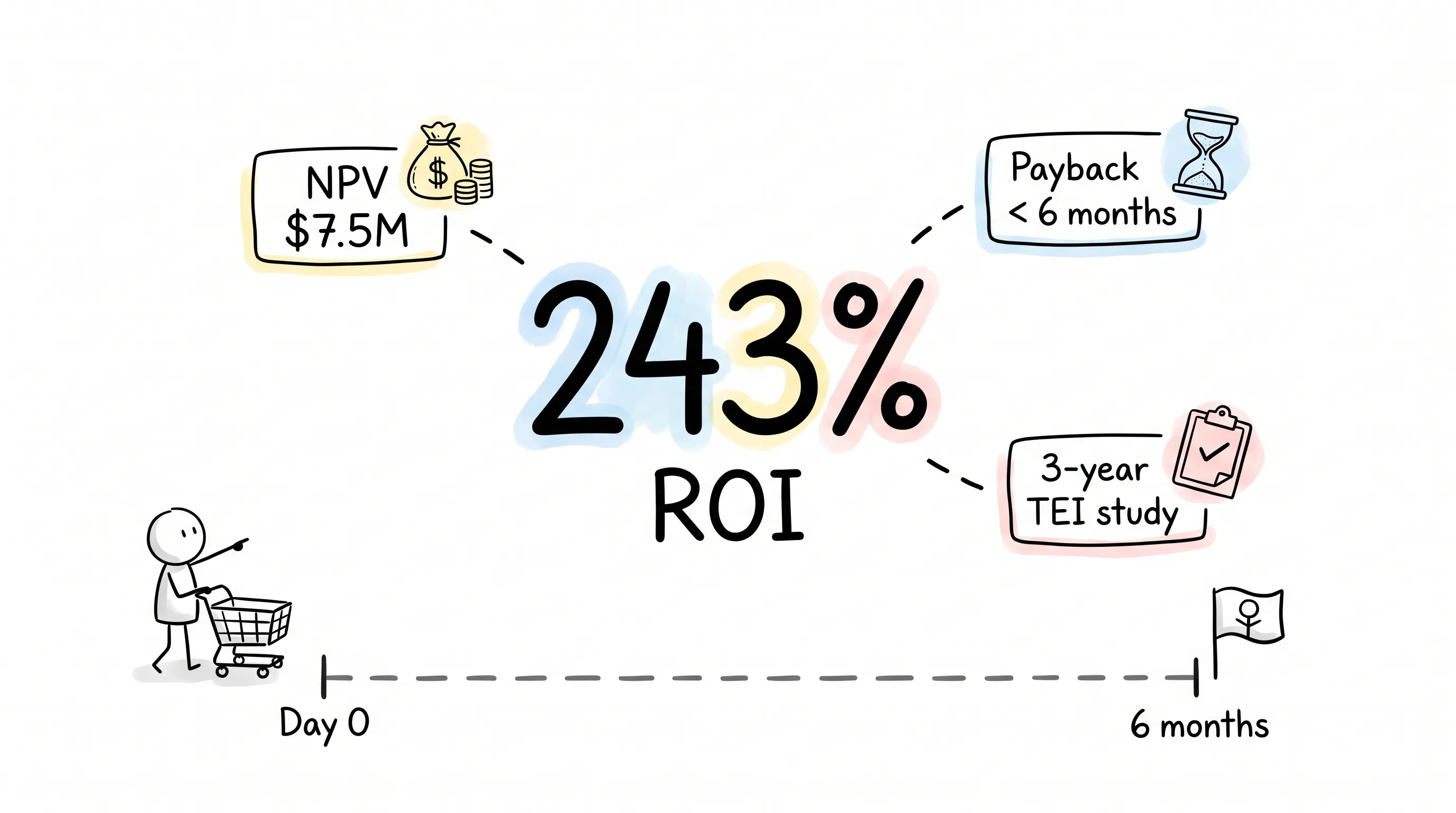
In 2025, Forrester Consulting released an independent study commissioned by Zappi (Total Economic Impact, or TEI) that put hard numbers on this: consumer goods brands using Zappi, the consumer insights platform, to test their work saw a 243% return on investment over three years, a net present value (NPV) of $7.5 million, and payback within six months.
243%. You read that right.
How Was This Math Done?
First, a word on Forrester's methodology. Rather than tracking a single company, they built a model of a "composite company": 7,000 employees, $5 billion in annual revenue, 15 insights professionals. Then they fed in real data from multinational consumer goods brands averaging nearly $9 billion in annual revenue, and looked at exactly what changed once Zappi entered the picture.
Four things changed.
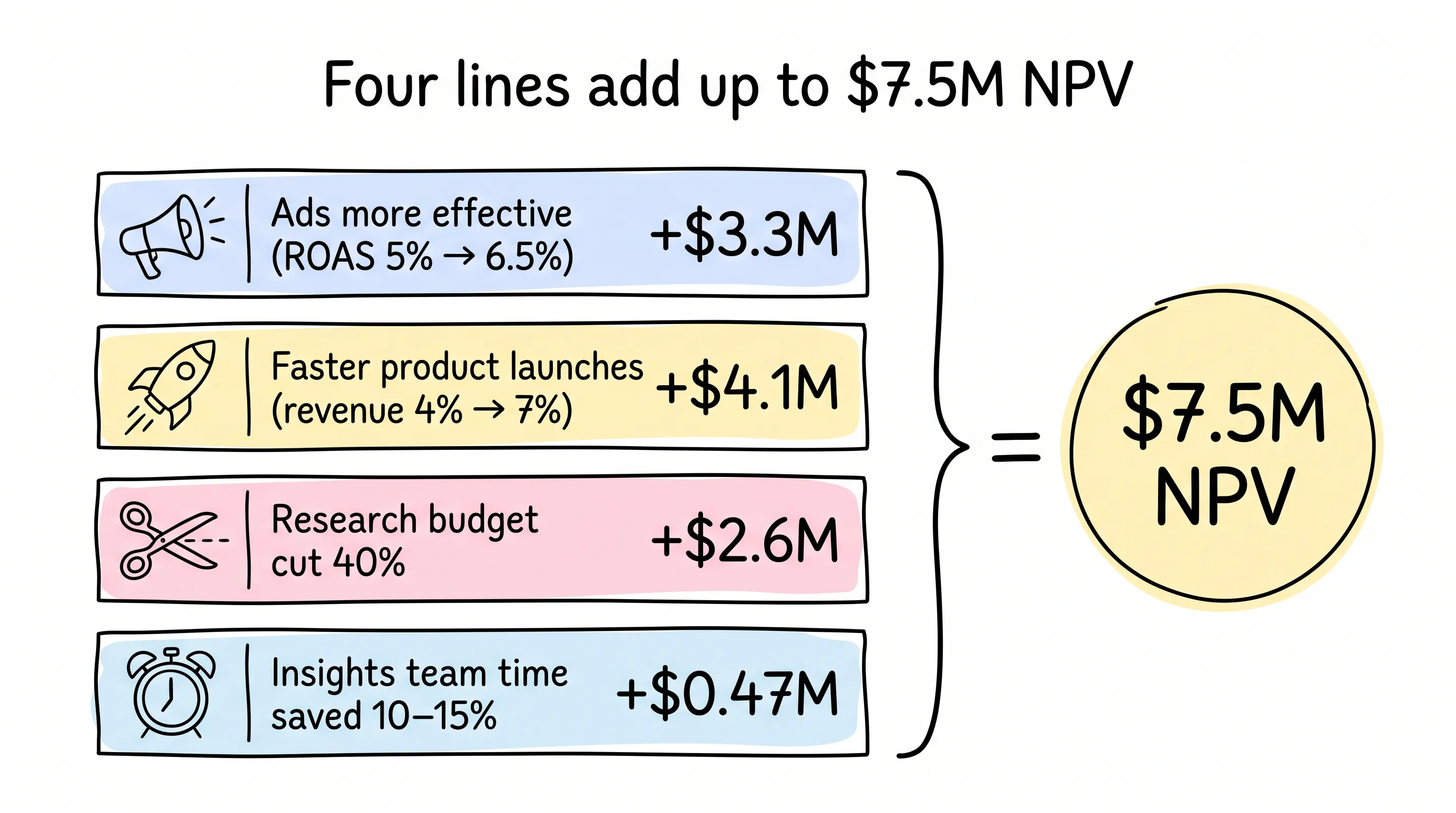
First, ads got more effective. By testing and iterating creative over and over with Zappi, advertising ROAS (return on ad spend) improved from 5% to 6.5%, worth $3.3 million.
Second, new products launched with more confidence. Faster product testing accelerated time-to-market; new-product revenue rose 4% to 7%, adding $4.1 million in profit.
Third, research budgets shrank. Spending on traditional research was cut by 40%, freeing up $2.6 million to be reinvested in more testing.
Fourth, people were freed up. Insights teams no longer hauled questionnaires around or chased vendors, saving 10% to 15% of their time — equivalent to $472,000 in labor costs.
Add the four lines together, subtract the platform cost, and you get $7.5 million in net present value.
Impressive. This accounting is clearer than many companies' annual reports.
The Most Brutal Line Item Is Actually Time
One interviewee in the study — a brand insights director at a food and beverage company — said traditional research takes about two weeks for the "execution window" alone; across every study they've run with Zappi, they've saved 30 weeks of dead time.
30 weeks. More than half a year.
Think about it: get your new product to market three months early, and within that window, you're the one who defines the category. Arrive three months late, and you can only trail behind others, executing answers somebody else already validated.
Another interviewee, a vice president at a B2C fintech company, put it even more bluntly: we spend hundreds of millions on marketing every year, and what Zappi guarantees is getting our known best-performing creative into the market, so that every dollar spent works as hard as possible.
Put simply, the first saves time cost; the second saves the cost of mistakes. Both are money.
Why This One, of All Things?
One phrase kept surfacing in the study: connected insights — connecting the dots.
What does connecting the dots mean?
Traditional research is a series of isolated projects. Finish, archive, forget — then the next project starts from zero. What Zappi does is consolidate every piece of consumer feedback into a single, comparable knowledge base — each round of testing paves the way for the next.
What does that resemble? Compound interest.
Any single test delivers only marginal gains. But across more than 350 brands and years of accumulation, the data grows its own judgment. Layer AI on top of that data asset, and answers on how to fix an ad or tune a new product arrive faster every time.
Another Forrester study points in the same direction: consumer-centric companies grow revenue 41% faster than their peers, and profit 49% faster.
Fast has never been a feeling — it's a gap you can calculate.
The study also notes that even a giant like PepsiCo has already used it to lift creative effectiveness by 30%.
Zappi CEO Aaron Kechley said something that stayed with me: consumer insights work is moving on from its old role as "slow, passive, and a cost center"; teams that truly understand consumers no longer just use data to validate their ideas — they use data to shape their ideas.
Validation is confirming after the fact. Shaping is placing the bet before it.
And you can only bet boldly if you're holding real consumer voices in your hands.
Back to Where We Started
Your budget will get spent either way. The only difference: do you decide on a whim and then spend money to buy reassurance, or spend money first to bring the consumer's voice in — and then commit?
Slow research is the expensive research.
And here's my wish for you: may consumers stand on your side of every bet you place.
Continue reading
Related articles

What Is AI Marketing Automation? It Starts With a 40-Point Gap
A learn article explaining what AI marketing automation is: how learning-based systems differ from rule-based automation, how AI decisioning optimizes message, channel, and timing choices, what data it depends on, and where it applies across the customer lifecycle.

It's 2026: Stop "Buying" AI Tools for Your Marketing Team — Start "Hiring" AI Agents
This learn article explains how AI agents differ from standalone AI tools in marketing, outlines three agent categories — build-your-own platforms, CRM-native agents, and vertical tools — and covers use cases across SEO, social media, advertising, and reporting, plus criteria for choosing one.

What Is an AI Marketing Agent? From "Using AI" to "Delegating to AI"
A learn article explaining what an AI marketing agent is, how it differs from rule-based automation, and which repetitive tasks such as lead qualification, reporting, and campaign monitoring can be delegated while humans keep key decisions.