
Your Website Just Got a Visitor Who Never Buys Anything
An explainer on GEO (Generative Engine Optimization): why AI crawler visits that never convert can still matter, how GEO differs from SEO, and five steps to make content easier for AI answers to cite, plus five starting actions for beginners.
A few days ago, a friend of mine who runs an e-commerce business showed me the server logs of their official website.
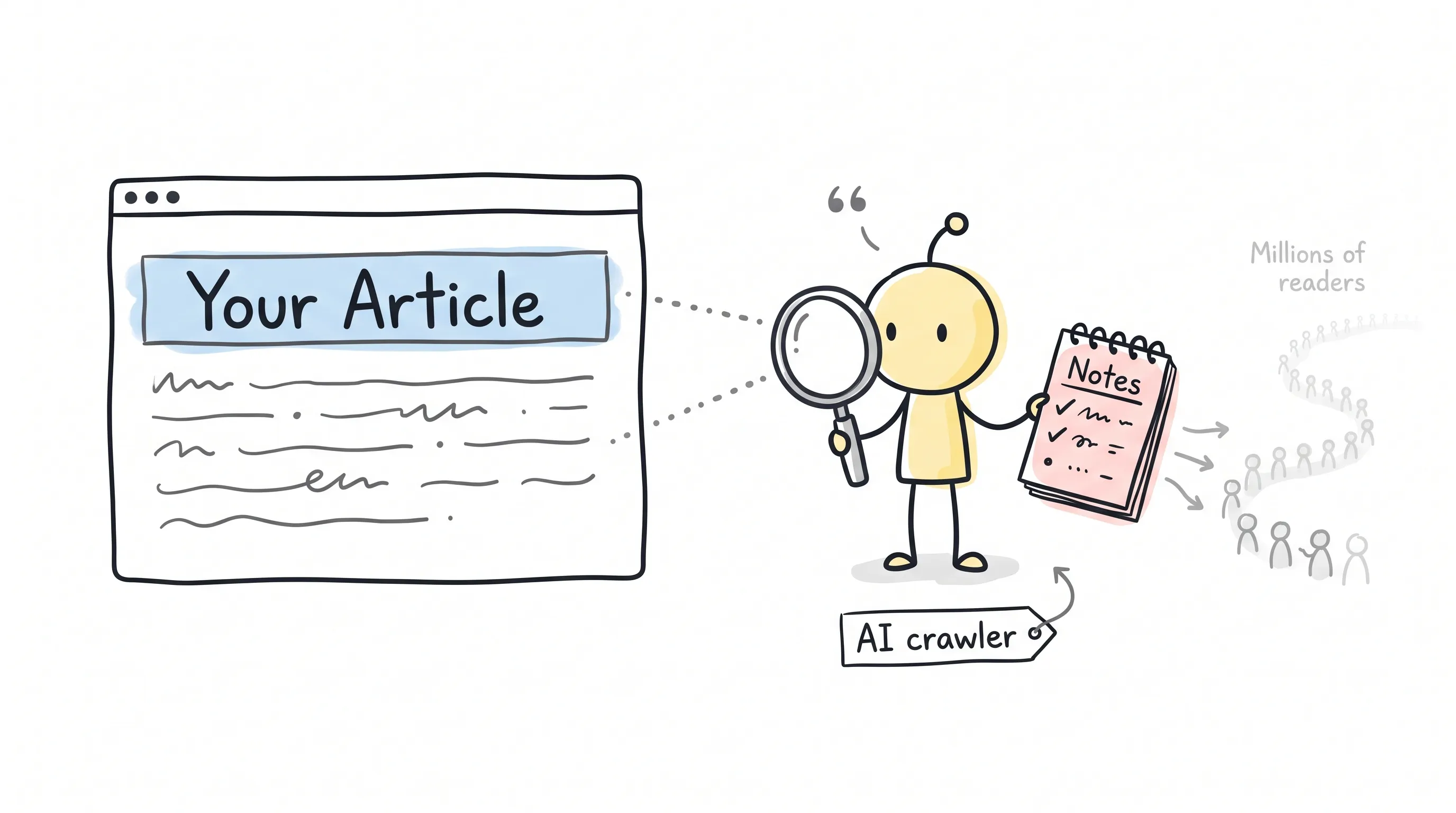
There was one visitor that struck them as odd. Every time they published a new article, it would show up within minutes, crawling from top to bottom, not missing a single page. But it never clicked an ad. Never left contact info. Never bought anything. Conversion rate: always 0.
My friend asked me whether they should block it.
I said, whatever you do, don't block it. This might be the most important reader your website has.
It's most likely an AI crawler. People around the world ask ChatGPT, Gemini, and Perplexity so many questions every day — and how much of a mention you get in those AI answers depends largely on what this reader takes away from your website.
It never buys. But it takes notes for millions.
What Is GEO?
This thing has a name: GEO, Generative Engine Optimization.
What's a generative engine? It's the kind of AI — ChatGPT, Gemini, Perplexity — that doesn't hand you a page of links but gives you a direct answer.
What's Generative Engine Optimization? Let me put it this way.
In the old days of SEO, you were hauling your book onto the most visible shelf in the library, betting that a reader browsing past would happen to pick yours up.
Now, with GEO, you're getting the library's AI librarian to open your book and read a passage aloud — citing you as the source — whenever someone walks up and asks a question.
The reader never browses the shelves at all. They just stand at the front desk and ask.
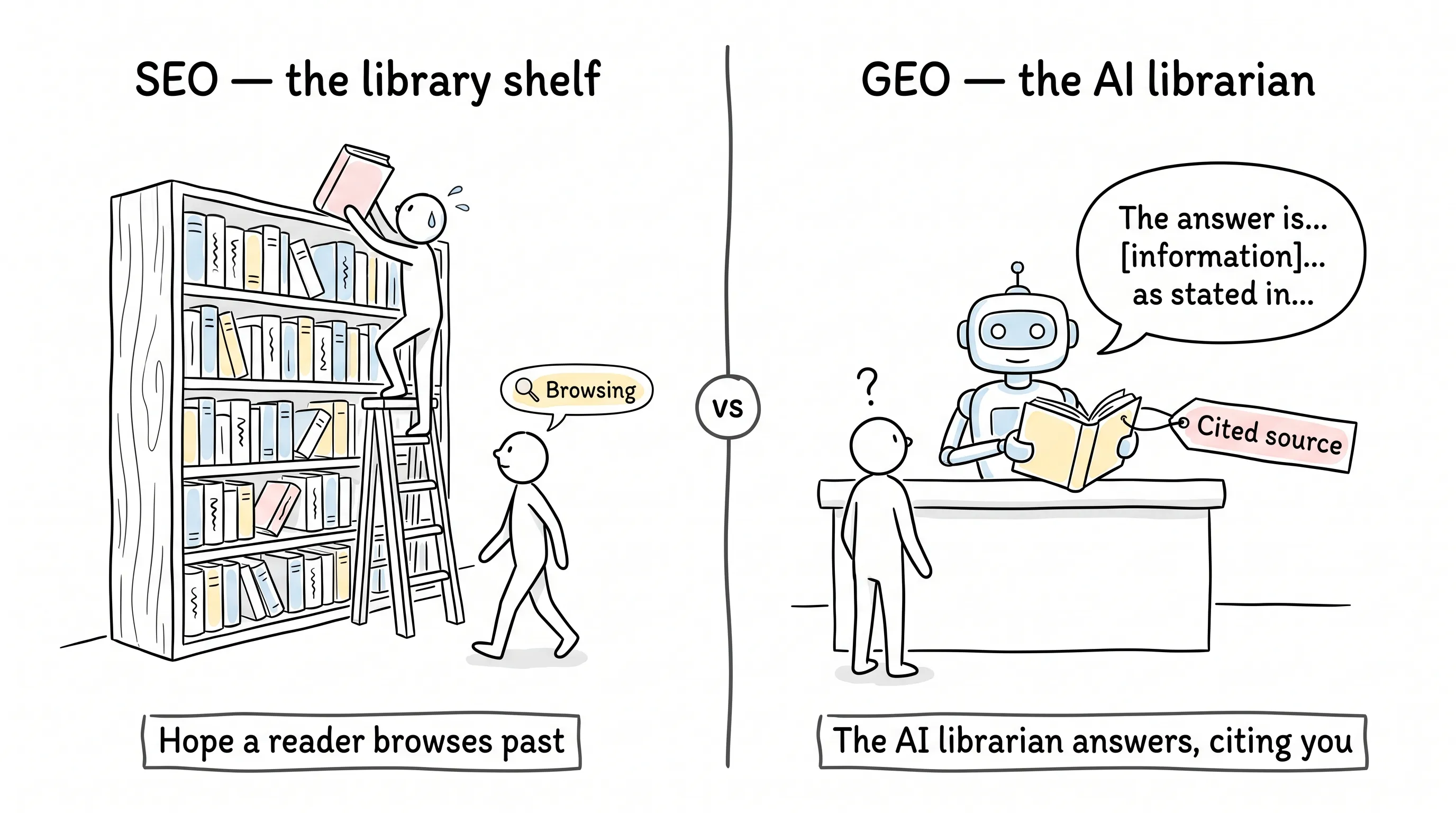
The underlying logic of the two is completely different. SEO is a contest of keywords, backlinks, and page authority. What does GEO compete on? Content quality, depth of context, and whether you actually answered the question the user was really asking.
One exam tests "matching." The other tests "worth quoting."
This Reader Has a Very Particular Temperament
If you want to win it over, you first have to understand its temperament. As I've summed it up, it has three traits.
First, it comes on someone else's behalf. Users are past the point of flipping through ten blue links; when they have a question, they just ask the AI. And where does the AI go for answers? To the websites it has read. Take a guess — is your site on its reading list?
Second, it only copies what's easy to copy. If your content is a structural mess, if the answer is buried in the eighth paragraph, if the whole piece just talks to itself — it can't make sense of it, and it won't quote it. Only writing that is clear, direct, and ready to drop straight into an answer earns an excerpt.
Third, it has to answer for its own answers. When the AI reads your content out loud to someone, it's staking its own credibility on you. So it favors content that comes with evidence built in: data with sources, claims with citations, writing with depth. It wouldn't dare serve its users a pile of empty talk.
So you see, the essence of GEO is turning your content into a source worth being cited by AI.
Search engines decide whether people can find you. AI decides whether people ask about you.
How Do You Actually Do It? Five Steps
Enough theory — here's what you can put into practice. I've broken GEO down into five steps; check your own content against each one.
Step one: make your content thicker. What AI loves most is content that walks a question from start to finish — not just giving the answer, but anticipating the follow-up and covering "what about in another scenario" along the way. A 300-word article padded out to hit keywords is practically invisible to it.
Step two: format it the way people talk. Answer the way users ask. Build a FAQ section, laid out in question-and-answer format, putting the raw, real-life questions — "How do I choose?", "How much does it cost?", "Is it legit?" — one by one on the page. If you've already chopped the quotable passages into clean paragraphs for the AI, it copies them with ease.
Step three: get the AI to issue you an ID card. This is the step most often overlooked. What is entity optimization? It's making absolutely sure the AI knows precisely: who you are, what you sell, and who you're connected with. Mark your brand name, product names, and service scope clearly with structured data, and keep the wording consistent everywhere across the web. If you keep changing your name, the AI will think you're three different companies.
Step four: build up proof of trust. Cite outside references, bring in real experts to speak, pair things with videos, diagrams, podcasts. When a source has been cross-checked by multiple parties, the AI's trust in you goes up a notch. These aren't decoration — they're a chain of evidence.
Step five: refresh regularly. AI models keep updating, and their taste in what they learn keeps shifting. Content left untouched slowly loses the trust it accumulated. Treat this as ongoing maintenance, not a one-off renovation.
Will GEO Replace SEO?
People ask me this all the time.
My judgment: no. It's a layer on top, not a replacement.
SEO secures your position in traditional search; GEO secures your position in AI answers. More and more people are asking AI questions, but the search engine pie is still huge. Two exam papers land on your desk at the same time — you have to answer both. Whoever answers only one hands in a blank sheet in the other exam room.
So don't rush to move your whole budget over. Keep doing your SEO, and use your spare capacity to add GEO.
Tonight, Start With Five Things
No need for a dramatic overhaul. At the starting stage, five things are enough:
- Go through your existing content from the top, and ask yourself from the AI's perspective: can it understand this article? Would it dare quote it?
- Pick a few of your core articles and rework them into Q&A structures, putting the questions users would actually ask straight into the subheadings.
- Add structured data to your key pages, marking entity information — brand, products, services — clearly.
- Check that your brand is described consistently across the web: official site, social accounts, encyclopedia entries, storefronts — all aligned.
- Regularly ask ChatGPT or Perplexity a question related to your business, and see whether the answer mentions you — and in what tone.
The fifth one matters most. If you don't even know whether your presence in AI answers is zero or negative, what is there to optimize?
Finally, Back to That Visitor
The next time you spot that visitor in your server logs — the one that never clicks an ad and never buys — don't block it.
It's here to copy homework. And the homework it copies will be passed around by millions tomorrow.
Even better: may you soon be the name that shows up in AI's answers.
Continue reading
Related articles

What Is AI Marketing Automation? It Starts With a 40-Point Gap
A learn article explaining what AI marketing automation is: how learning-based systems differ from rule-based automation, how AI decisioning optimizes message, channel, and timing choices, what data it depends on, and where it applies across the customer lifecycle.

It's 2026: Stop "Buying" AI Tools for Your Marketing Team — Start "Hiring" AI Agents
This learn article explains how AI agents differ from standalone AI tools in marketing, outlines three agent categories — build-your-own platforms, CRM-native agents, and vertical tools — and covers use cases across SEO, social media, advertising, and reporting, plus criteria for choosing one.

What Is an AI Marketing Agent? From "Using AI" to "Delegating to AI"
A learn article explaining what an AI marketing agent is, how it differs from rule-based automation, and which repetitive tasks such as lead qualification, reporting, and campaign monitoring can be delegated while humans keep key decisions.