
Your Customers Are Asking AI Now. Will It Dare to Cite Your Content?
A learn article introducing GEO (Generative Engine Optimization): how AI assistants choose which sources to cite, how that differs from search-engine ranking logic, and what the shift means for SEO, ads, email, and video workflows.
A few days ago, I had dinner with a friend who works in marketing. He sat down and sighed: his website traffic was holding steady, but the inquiries kept drying up.
I asked him one question: how many times were you cited by ChatGPT this month?
He froze. What does "cited by ChatGPT" even mean?
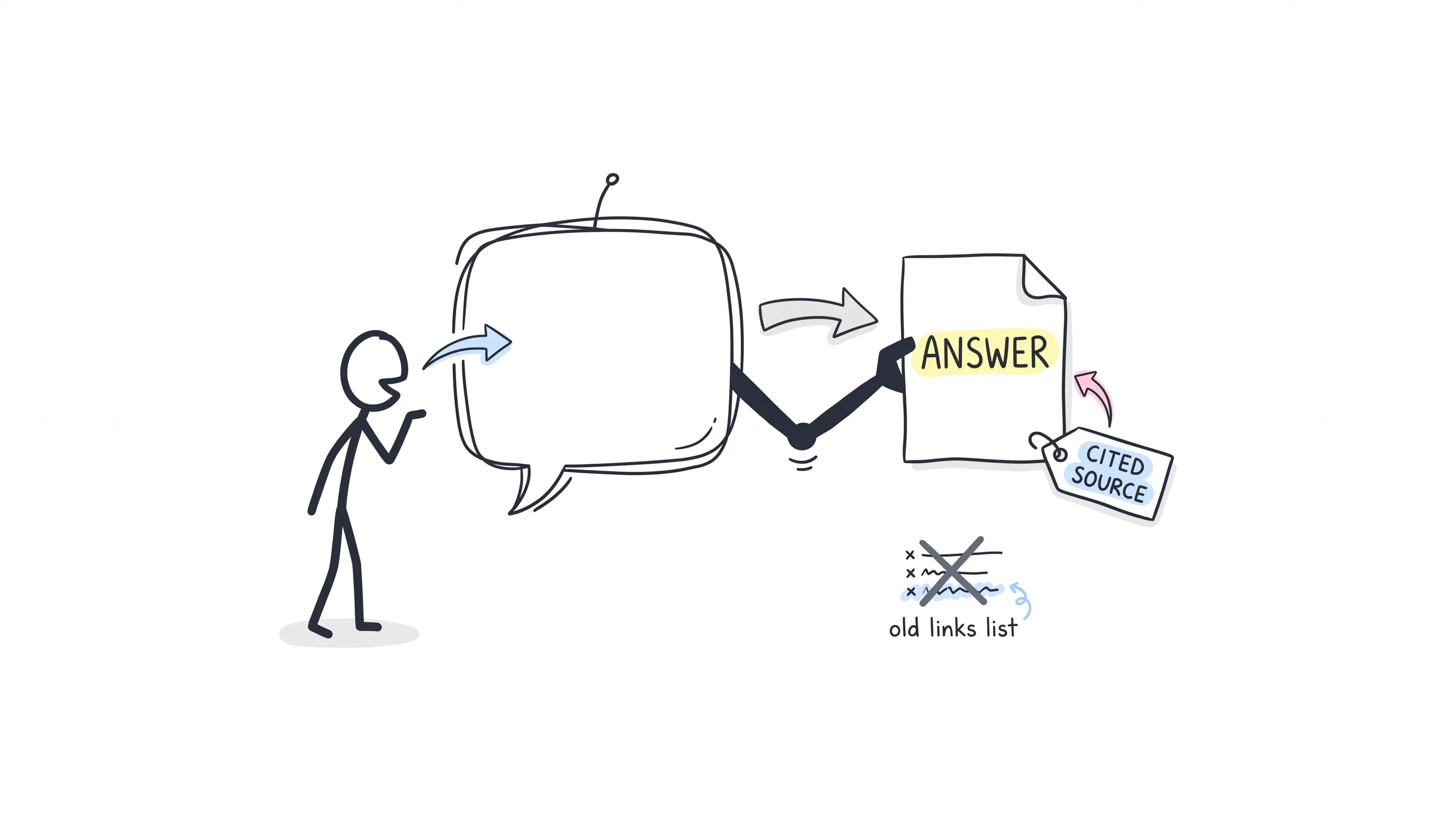
Here's what I told him: your customers have changed. Used to be, when they wanted to learn something, they'd go to a search engine, type in keywords, and sift through that page of blue links. Now they just ask AI. And AI doesn't hand them links — it hands them answers.
Whether you show up in that answer? That's the new "ranking."
The search-engine war is over. The AI war has just begun.
What Is GEO?
GEO stands for Generative Engine Optimization.
Put simply, it means making your content something AI can find, understand, and actually wants to cite in its answers.
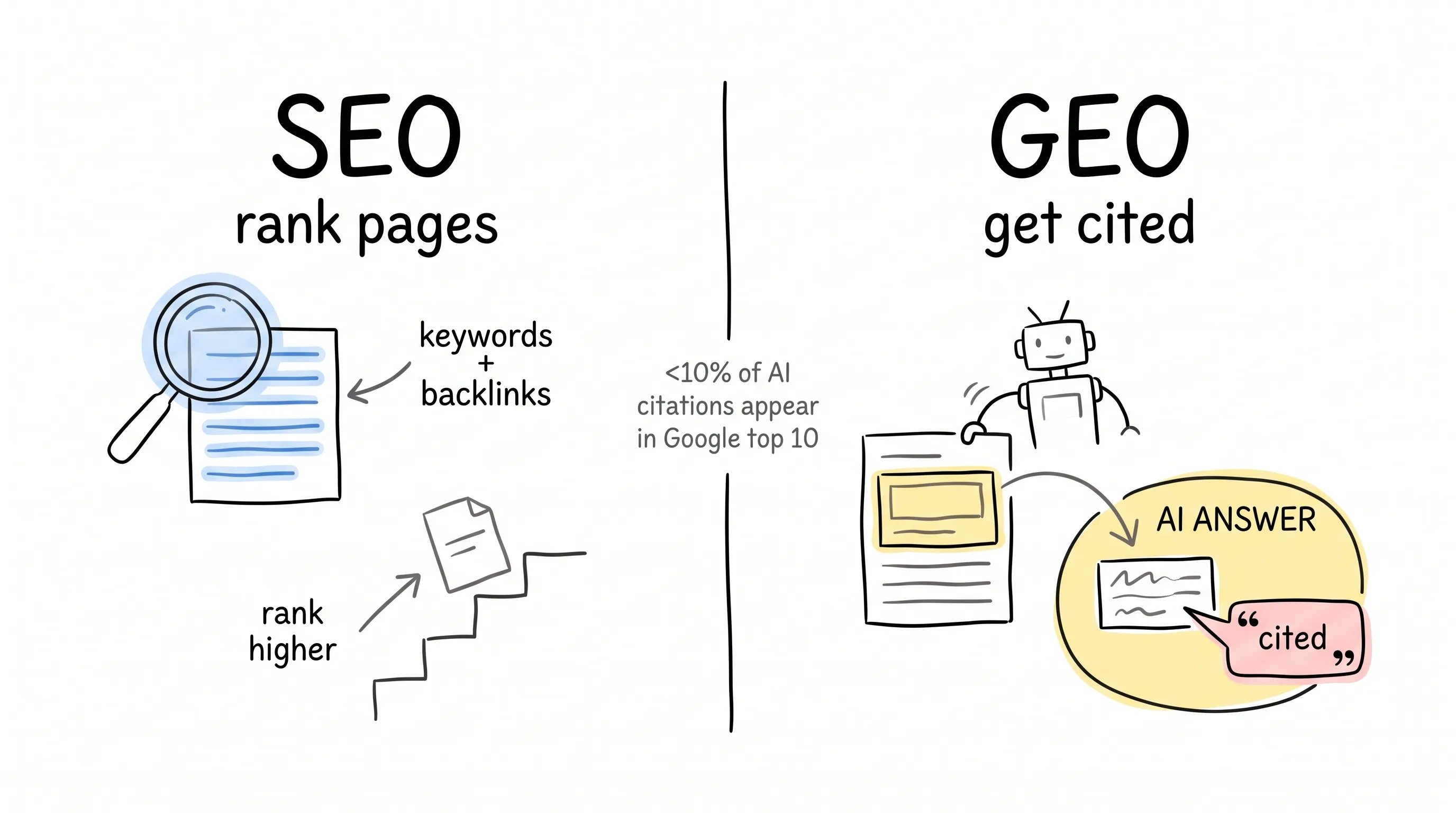
Back in the SEO days, you were competing for rankings. Keyword placement, backlinks, page authority — all so that when users searched, you'd rank high enough for them to click you.
With GEO, you're competing for citations. When a user asks AI a question, AI assembles an answer on the spot. Whether you're among that answer's sources has nothing to do with where you rank in a search engine.
One statistic stuck with me: of all the sources cited by mainstream AI tools like ChatGPT, Gemini, and Copilot, fewer than 10% also appear in Google's top 10 organic results.
Fewer than one in ten.
In other words, the skills you've spent a decade honing in search barely count here. This is a new exam — and the syllabus has changed.
AI Picks Sources and Search Engines Rank Pages — Two Different Logics
So you might ask: what kind of content does AI actually like?
Search engines like "matching." Keywords line up, authority is high enough, you move up.
AI likes content that's easy to quote from. It needs to lift a passage straight out of your content and drop it into an answer. So it favors content like this: clearly structured, with subheadings that say exactly what they mean; facts and numbers up front; claims that come with sources and can be verified; and — this last one matters — third parties saying nice things about you.
That last one is particularly interesting. More than 95% of what AI cites is unpaid third-party content, and 27% of its cited sources come from news coverage.
To translate: when you praise yourself, AI doesn't quite believe it. When others write about you, AI believes it.
Which means a solid piece of media coverage today may be worth more than ten backlinks. That's a shift many veteran marketers still haven't made.
This Isn't Early Days
Some people think AI search is still a long way off.
It isn't. GEO has already grown into an industry: agencies dedicated to it, conferences about it, budgets for it. The tools have sprung up too — Evertune, AthenaHQ, and Otterly AI all play in this space.
One forecast puts it this way: by the end of this year, traditional search engines will have lost 25% of their search volume.
A quarter of all traffic is moving house.
Where to? Into a chat box.
Channel by Channel, the Math Has to Be Redone
Google Ads. AI Overviews have landed on the search results page, and ads can now appear right alongside AI answers. If your content is easier for AI to understand and cite, your brand is more likely to get name-checked — and your cost per click can actually come down.
Meta Ads. Before a user ever sees your ad on Facebook or Instagram, they may have already encountered you in an AI answer. Seen once in an answer, seen again in the feed — half the trust-building is already done, and conversions follow.
Email. In the zero-click era, people search, get their answer, and leave; websites struggle to hold anyone. Email has become one of the few channels that still reaches a person directly. Let AI make them aware of you; let email make them remember you.
Video. AI is also adding images and video to its answers. Videos with complete subtitles, transcripts, and structured descriptions are far more likely to get picked up.
See? The playbook for every one of these channels has to be recalculated in light of this shift.
Don't Throw SEO Away
One last thing, so nobody overcorrects.
GEO isn't here to replace SEO. Search engines still exist, the traffic is still there, and the optimization work still needs doing. GEO adds a layer on top of the content capabilities you already have: making it easy for AI to understand you and want to cite you.
Concretely, it comes down to a handful of things: clearer structure, more specific facts, more solid sourcing — and getting credible third parties to talk about you more.
You should have been doing all of this anyway. Now there's just one more non-negotiable reason to.
Back to That Dinner
After dinner that night, the first thing my friend did was open ChatGPT and ask the question his customers ask most often.
The answer didn't mention him.
He told me that moment hit harder than any traffic report ever had.
I'd like you to try it tonight. Ask AI the one question you most wish your customers would ask about you — and see whether the answer includes you.
If it does, congratulations. If it doesn't, at least now you know exactly where to start catching up.
Continue reading
Related articles

What Is AI Marketing Automation? It Starts With a 40-Point Gap
A learn article explaining what AI marketing automation is: how learning-based systems differ from rule-based automation, how AI decisioning optimizes message, channel, and timing choices, what data it depends on, and where it applies across the customer lifecycle.

It's 2026: Stop "Buying" AI Tools for Your Marketing Team — Start "Hiring" AI Agents
This learn article explains how AI agents differ from standalone AI tools in marketing, outlines three agent categories — build-your-own platforms, CRM-native agents, and vertical tools — and covers use cases across SEO, social media, advertising, and reporting, plus criteria for choosing one.

What Is an AI Marketing Agent? From "Using AI" to "Delegating to AI"
A learn article explaining what an AI marketing agent is, how it differs from rule-based automation, and which repetitive tasks such as lead qualification, reporting, and campaign monitoring can be delegated while humans keep key decisions.