
You Ranked #1 on Google, but AI Doesn't Know You Exist: Time to Change Your Brand's Scorecard
This learn article explains why ranking #1 on Google no longer guarantees visibility in AI-generated answers, and covers metrics such as citation rate and share of voice, per-platform and per-segment breakdowns, and steps for building a repeatable AI search benchmark.
A while back, an old friend in enterprise software invited me out for tea.
He'd just gotten his quarterly report, and he was glowing: for his core keyword, he ranked #1 on Google organically, with steady traffic to match.
I asked him one question: open ChatGPT, ask it "what tools are worth a look in your category," and see what it says.
He pulled out his phone and tried it right there.
Five prompts. Not one mention of his company. Not a single citation.
He just sat there, stunned. I said, congratulations — you aced the Google exam, but on the AI exam, you handed in a blank sheet.
These two report cards are graded on two different exams.
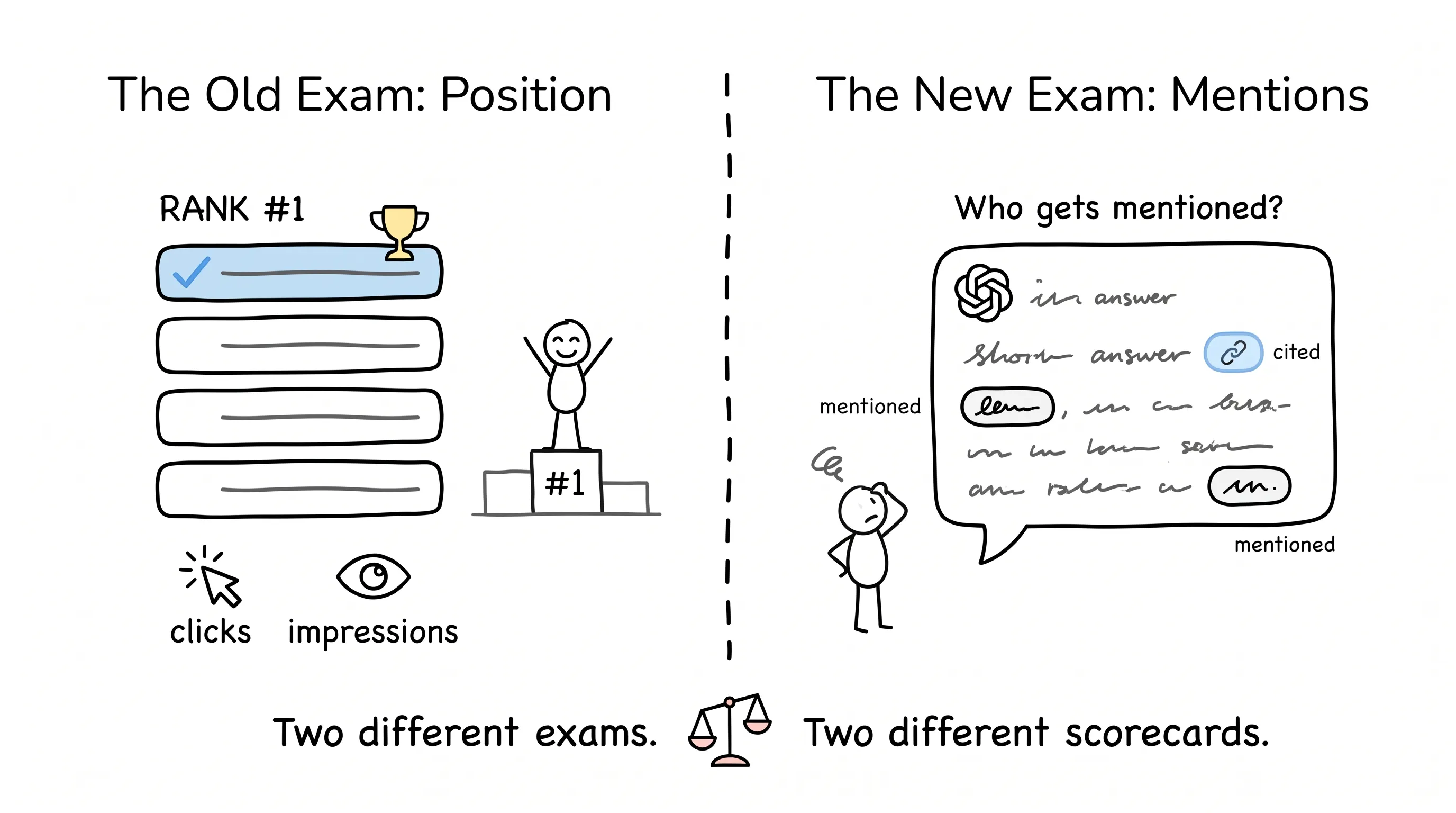
That's what this article sets out to break down, piece by piece: how the AI search exam actually gets scored.
Why Is the #1 Ranking No Longer Enough?
First, let's be clear about the underlying shift.
Traditional search competes on "position." Where your page ranks in the results, and whether users click it. The clicks and impressions in Google Search Console measure exactly this.
AI search competes on "who gets mentioned." A user asks a question, and the AI generates an answer on the spot. Is your brand in that answer? Are you flagged as a cited source? That's a different layer of visibility.
A position score can't answer a mention-score question.
And there's data to prove it.
In December 2025, Ahrefs found that when Google AI Overviews appear, the page ranking #1 sees its average click-through rate drop by 58%.
Think about what that means.
It means you claw your way to the number one spot, and users don't click at all.
Here's an even more painful number. BrightEdge analyzed the sources cited in AI Overviews: only about 17% of cited pages also rank in the top 10 organic results. In other words, for every six sources the AI cites, five aren't on page one at all.
The AI cites beyond page one just fine.
And this isn't marketers patting themselves on the back. HubSpot's 2026 State of AEO report had two numbers that made me pause the first time I saw them: 44% of marketers surveyed said they had already placed business purchases based on brands they discovered in AI answers; and in a separate survey of more than 200 B2B decision-makers, 42% said AI recommendations make a brand seem "more credible — if AI recommends it, it must have been vetted." Only 11% said it made a brand less credible.
The place where buyers discover you and evaluate you has moved upstream of the website click.
So stop treating your ranking as the only scorecard. But to keep score, you need metrics. Which ones?
Four Metrics Are Enough
First, two terms that people constantly mix up.
What's a mention? The AI says your brand name in an answer, but gives no link. That's a mention.
What's a citation? The AI doesn't just name you — it flags you as a source and links to you. That's a citation.
A citation is worth more than a mention. It comes with an attribution, a formal endorsement.
Now, the metrics. Four of them.
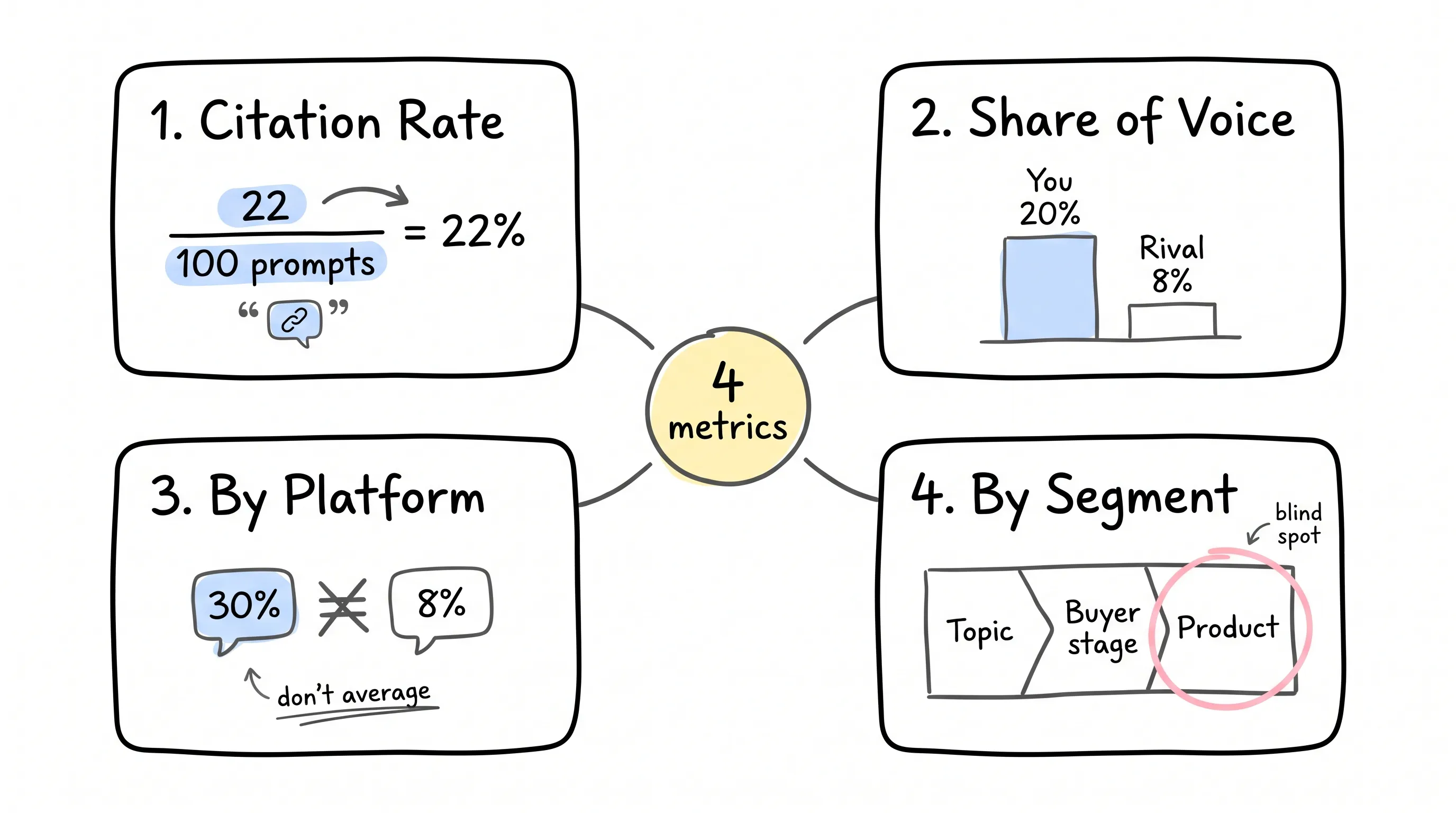
The first: citation rate.
The formula is simple: the number of prompts where you were cited, divided by the total number of prompts you monitor, times 100.
Say you track 100 questions, and 22 of the answers cite your domain. Your citation rate is 22%. It's your baseline — it shows whether your "attributable visibility" is rising or falling. A single percentage in isolation means nothing; you need a second ruler alongside it.
The second: share of voice.
Formula: the number of times your brand is mentioned, divided by the total mentions across "you plus your competitors," times 100.
You're at 20%, your closest competitor at 8% — that means you dominate share of voice in this set of questions. But note: this only says you're leading on this batch of questions, against these particular rivals. Switch question sets, and the conclusion could flip.
The third: break it down by platform.
This is the step people most often skip out of laziness.
The same question can get completely different answers and citations from ChatGPT, Gemini, and Perplexity. You might be a regular in Perplexity and a total stranger in ChatGPT.
So calculate citation rate and share of voice one platform at a time. A 30% citation rate on Perplexity and an 8% one on ChatGPT are two independent scores, not ingredients to be averaged. Average them, and the problem disappears from view.
The fourth: break it down by segment.
Slice your question set into groups: by topic, by buyer stage, by product line. Compute citation rate and share of voice for each group separately.
Why slice? Because healthy totals are often an illusion. Your overall citation rate looks great, but the moment you cut to "head-to-head product comparisons" — the bottom-of-funnel questions — you never show up once. Holes like that are invisible until you slice.
By the way, tools can now do all of this automatically. HubSpot's AEO (Answer Engine Optimization) product automatically tracks prompts, brand visibility, competitor share of voice, citation analysis, and sentiment, covering ChatGPT, Gemini, and Perplexity, and it lives inside Marketing Hub Pro and Enterprise. Bought separately, it runs $50 a month, or $45 a month billed annually. You save $60 a year — not much money, but it saves you the effort of manually asking AI every single day.
Metrics in hand. Next question: when you take these numbers and compare against your industry, how do you do it without fooling yourself?
Comparing Against Industry: Align the Rulers First
The prerequisite for comparison is measuring on the same scale.
Your citation rate can only be compared — against itself, or against a fixed set of competitors — within the same question set, the same competitor set, the same platform, and the same collection window.
What about industry-level benchmarks? You can use them, but put them in the right place.
HubSpot runs a free public dashboard called AI Search Sensor, currently in public beta. It tracks industry-level trends across three platforms: estimated visibility, citation share, AI-driven traffic, citation patterns, plus a 0–100 "answer engine volatility index," updated daily, telling you whether AI search citation behavior is calm, mild, or wildly volatile right now.
Note my word choice there: industry-level.
It measures the industry at large, not your own brand. Treat it as a weather forecast, not your personal check-up report. If the tide is rising but you're sinking, the problem is probably you. If the tide is falling and you're sinking with it, it might just be the wave.
These two kinds of data are two different animals. To see your own brand's actual performance, HubSpot's AEO tool has layers for brand visibility score, share of voice, competitor and citation analysis, and sentiment analysis (−100 to +100). And if you want a free taste first, they also offer AI Search Grader, a one-shot snapshot score across ChatGPT, Perplexity, and Gemini.
Snapshots are fine for getting started. For long-term tracking, you're back on the old road: a fixed question set, a fixed competitor set, a fixed rerun cadence.
How Do You Build Your Own Benchmark?
Rule number one: define the exam first.
Step one: write the questions.
List the questions your target customers would genuinely ask. Note: questions buyers actually ask, not the keywords you wish you ranked for.
A workable question set covers at least four types:
- Category questions: "What's the best XX software?" "What tools help with XX?"
- Comparison questions: "A or B — which is better?" "What are alternatives to A?"
- Pain-point questions: no brands named, "How do I solve XX?"
- Brand questions: ones mentioning you, and ones mentioning each competitor.
If you're testing manually, keep the question set small enough that you can rerun it weekly, and treat early results as directional. For something more rigorous, Discovered Labs' AEO benchmarking guide recommends listing 50 to 200 high-intent questions; for statistically defensible conclusions, you may need several hundred question variants, across multiple platforms, tested repeatedly.
Step two: pick your competitors.
Don't build the competitor list off the top of your head. Run your question set once first, see who keeps showing up in the answers, and pull in those direct competitors — plus the ones buyers genuinely compare you against.
Step three: set the cadence, lock the versions.
Run the benchmark weekly and watch the trend. Review the question set and competitor list quarterly; if a major product release, a category upheaval, or a competitor shake-up hits, review early. Otherwise, don't touch it.
When you really must change something, bump the version number and write down exactly what changed. Label Studio's guide on benchmarking evolution puts it bluntly: only standardized question sets make results comparable across rounds.
Change something once without a record, and every trend line you've built breaks.
Step four: keep the records.
Question logs, competitor lists, results from every round — write them all down. Starting manually is fine; once you've run enough rounds, added platforms, and grown the question set, it's time to consider automation. The whole point of tools is to free you from "manually asking AI twenty times a week."
The Numbers Are In. Now What?
The value of a benchmark isn't in the numbers themselves — it's in how they change what you do next.
Get your segmented results and look at the weakest segment first. Then go through, one by one: in the prompts where you weren't cited, who did the AI cite instead? Which domains, which pages, what kind of content?
Don't assume from thin air that "the AI just loves some format." Let the actual citations speak.
After you've looked, sort the gaps into three types:
- Coverage gaps: no content anywhere that directly answers this question. You're out of stock — restock first.
- Citation gaps: the content exists, but someone else gets cited. Find out who's taking the citation — third-party reviews, competitor docs, or industry rankings.
- Platform gaps: on a given engine, you're simply invisible for the same question set. Tune specifically for that one.
Which of the three to fix first? Rank by business value and repeatability — don't plug every hole you see.
Reporting: Decisions Only
When you report all this upward, the most common mistake is dumping the entire question log in your boss's lap.
Your boss doesn't want the log; they want the basis for a decision. One page is enough: current citation rate and share of voice, where you stand relative to competitors; whether the trend is up, down, or flat; the biggest gaps and what you're doing about them; the state of the broader environment. If the data allows, add AI-driven traffic, conversions, and pipeline contribution.
The few hundred daily question logs stay with the marketing and SEO team.
And while you're at it, clarify ownership: question set, competitor set, citation analysis, content actions — marketing and SEO own those. When you need to connect AI traffic to CRM, pipeline, and revenue data, bring RevOps (revenue operations) in, and let them align the definitions.
A Closing Word
Back to that friend over tea.
He really did go build a benchmark: forty-some questions, five competitors, run weekly. Three months later, his name started appearing in the comparison questions.
One thing he said stuck with me: the old way of putting it was "we seem to show up now and then." Now it's "in which week, on which platform, on which type of question, we show up."
That's what benchmarking is for. Turning gut feel into markings on a scale.
AI search and traditional SEO are two scorecards answering two different questions. Neither needs to replace the other — but you need to read both.
Here's to getting your second report card soon, too.
Continue reading
Related articles

It's 2026: Stop "Buying" AI Tools for Your Marketing Team — Start "Hiring" AI Agents
This learn article explains how AI agents differ from standalone AI tools in marketing, outlines three agent categories — build-your-own platforms, CRM-native agents, and vertical tools — and covers use cases across SEO, social media, advertising, and reporting, plus criteria for choosing one.

What Is GEO? How Your Brand Gets "Mentioned" in the Age of AI Search
An explainer on GEO (Generative Engine Optimization) for e-commerce and DTC brands: how it differs from SEO and AEO, why AI answers shape brand visibility, and eight practices covering question-focused content, consistent brand messaging, structured pages, external evidence, comparisons, and AI mention tracking.

AI Is Already Making Decisions for Your Customers. Are You on the List?
A learn article explains GEO (Generative Engine Optimization): why AI-generated answers now shape which brands customers see, and how SEO fundamentals, entity clarity, citable evidence, and monthly measurement affect visibility in AI answers.