
95% of Companies Use AI. Only 6% See Real Results. What's the Gap? Kolsquare's New Report Nails the Answer
A recap of a Kolsquare webinar on AI in influencer marketing, covering adoption gaps, AI-labeled content engagement, AI influencer limits, and generative engine visibility. It also outlines four practical moves for 2027 planning.
A few days ago, I curled up at home and watched a Kolsquare webinar titled "Beyond the Hype: AI for Influencer Marketing 2027."
Translated literally: setting the hype aside, and talking about what AI can actually do for influencer marketing.
Right at the opening, the host threw out a set of numbers that made my stomach drop.
A recent Bain survey of executives found that 95% of companies are already using AI tools. But only 6% said AI has delivered substantive results for them.
95% using it. 6% seeing it work.
Where did the other 89 points go?
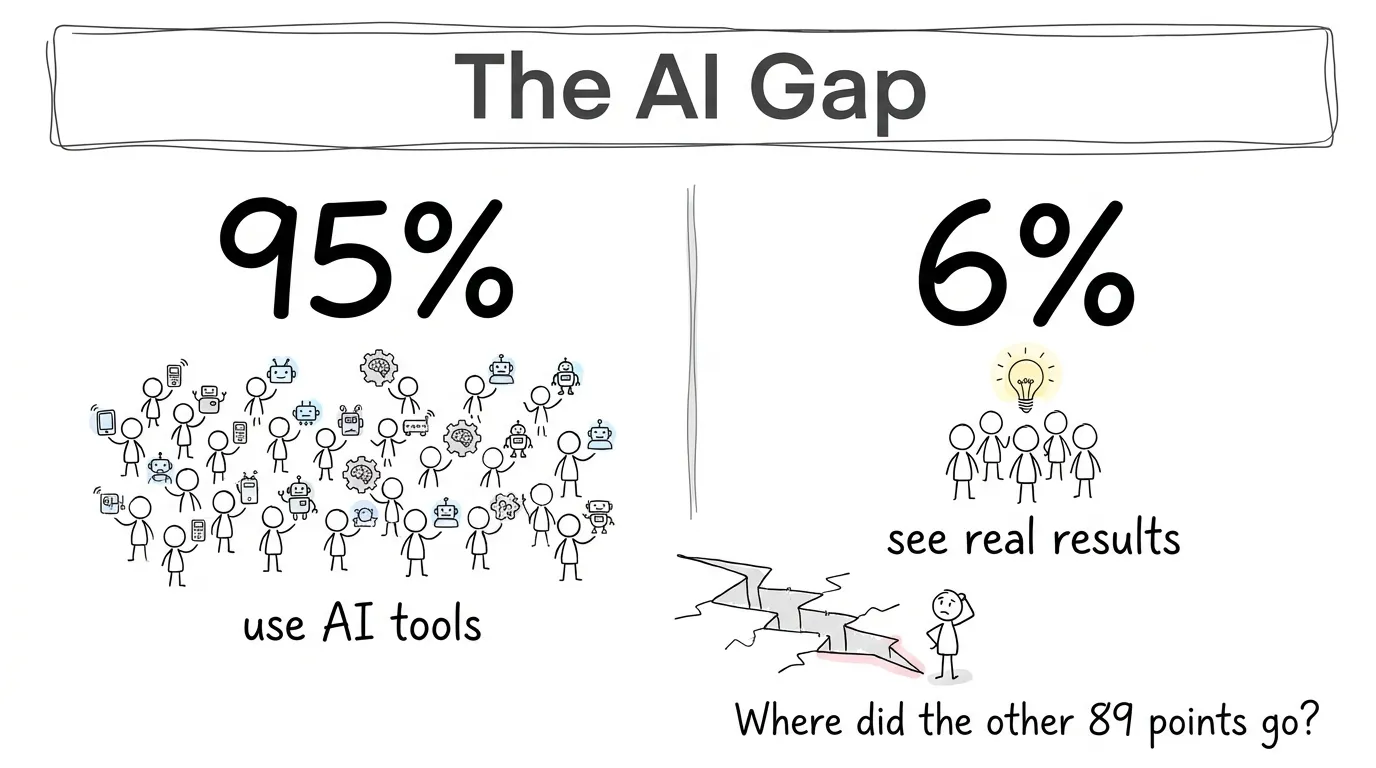
Think about it. If 95% of people are using a tool, and that tool has been hyped for two years, and yet only 6% say it actually works, the problem almost certainly isn't the tool.
So where is the problem?
Kolsquare's head of field marketing, who spends her days running events and talking to brands, said something that stings: that gap is exactly the work that should have been done before AI ever showed up.
What does that mean?
At an event she attended in London last month, a room full of brands kept asking the same question: the data looks fine, but what is any of it actually doing for revenue?
When you dig in, it turns out most brands haven't even built the basics. Influencer data is scattered, platform data sits in silos, they can't run even a basic audit — and yet they're rushing to bolt AI automation on top.
It's like installing an elevator before the foundation is poured.
The elevator is a great elevator. The building will collapse.
So for AI to actually deliver, the precondition is wiring influencer marketing into the whole marketing mix — tied together with PR, paid media, and advertising — and letting AI connect the dots, find patterns, and surface insights. And that requires a solid foundation. Many companies aren't there yet.
Which Jobs Has AI Taken Over?
First, a basic fact: whether to use AI is no longer the question.
Kolsquare's own survey data shows 84% of influencer marketing practitioners and 72% of influencers are already using AI or automation tools.
The real question is: how?
According to the report, the current focus is clear — hand the high-volume, repetitive work to AI: influencer outreach, rate negotiation, those collaboration contracts that run dozens of pages, data extraction, report generation, and fake-follower detection.
Influencer discovery is in the mix too, but less than you'd think. And the report makes a point of flagging it: discovery is not matching. AI can dig up 1,000 influencers for you — that doesn't mean it knows which one actually fits your brand.
Once you've handed off the heavy lifting, what do you do with the time you get back?
There's a case study in the report that made me sit up. An agency used to spend 90% of its time pulling data and only 10% analyzing it. Now it's flipped: 30% pulling data, 70% actually thinking about what the numbers mean and how to optimize the next round.
And the time you save? Go grab a coffee with your influencer and talk through whether they're truly right for your brand.
See — AI didn't take away the marketer's job. It took away the part of the job marketers hate most.
Will Teams Shrink?
This is the question everyone is quietly asking: if AI does the data and the reports, can we cut headcount?
When AI first exploded two years ago, some people genuinely thought that: great, cut headcount, let AI do the work.
Forrester poured cold water on that. Their warning: chief marketing officers who cut 25% of marketing roles to chase AI dividends will next face either shrinking output or cut programs.
Here's the math: AI didn't cancel the job. It rewrote the job.
The people who used to chase numbers now have to read the patterns behind them; the people who used to just execute now have to make judgment calls. The influencer marketing manager role is shifting from "data mover" to "strategy analyst plus relationship builder."
Does the Audience Care About AI-Made Content?
This next part was, to me, the most interesting data of the entire webinar.
Three quick findings first: half of people cannot reliably tell AI-generated content apart in their feeds; two-thirds don't much mind whether an ad is AI-made, as long as it's useful; but forced to choose, people still prefer ads "made by humans."
— There you go. Humans, being gloriously contradictory.
So should influencers use AI for content? Absolutely. Editing, B-roll, captions that make videos legible to search engines and AI assistants — behind-the-scenes work that AI handles is entirely fair game.
The real issue is transparency.
Kolsquare pulled this data for the first time: putting the same influencer's AI-labeled posts and non-AI-labeled posts side by side.
The result: on TikTok, AI-labeled organic content saw an engagement rate 21% lower than the same influencer's other posts. On Instagram, the difference was negligible.
How to explain it? The host had a theory that strikes me as plausible: after the pandemic, a lot of people went to TikTok looking for genuine human connection; Instagram was always about the polished aesthetic. So the label "this was made by AI" lands much harder on TikTok.
And here's a counterintuitive data point the report verified repeatedly: posts labeled as paid partnerships consistently outperform unlabeled ones on engagement.
You read that right. Honest labeling actually lifts engagement.
So the conclusion is clear: audiences don't hate AI. Audiences hate being kept in the dark. The moment they feel you're not being straight with them, they swipe away. That 21% gap on TikTok is the price tag on the "honesty tax."
Why Not Just Use AI Influencers?
An audience member asked: AI influencers are cheap, obedient, and can livestream-sell around the clock — so why not go all-in on AI influencers?
Let me merge the two speakers' answers.
If all you need is a "script-reading machine" — here's the product, here's the price, here's the link, here's where to buy, on infinite loop at 3 a.m. — then a virtual human does the job fine. I understand the temptation.
But the line is drawn at the moment genuine recommendation is required.
You can generate a thousand posts overnight. You cannot generate a thousand people who genuinely believe in you.
Trust does not scale the way content does.
What is influence, really? At its core, it's a recommendation from someone you know. They trust you, so they trust what you recommend. An AI influencer can "look human," but it has never used that face cream, never pulled that all-nighter, never lived that experience.
By the way, Kolsquare's CEO published an AI manifesto, putting the company's position on this in writing — in this industry, having a stance is itself a competitive edge.
The live poll was telling, too: in 2027, would you collaborate with an AI influencer? The overwhelming majority picked "absolutely not," only around 26% were willing to experiment, and 3–4% had already started.
Oh, and one hidden cost: virtual humans aren't free. Someone has to feed and maintain them, plus compute and environmental bills. Cheap doesn't necessarily mean good value.
The experts' verdict: virtual humans will have their place, but they'll stay niche for a long time.
Your Second Reader Is AI
This section was, to me, the single most worth-noting part of the webinar.
In the past, who was influencer content made for? People.
Now, there's a second readership.
Search is shifting from SEO to GEO (Generative Engine Optimization). The questions people used to ask Google every day are increasingly going to AI assistants instead: GPT, Claude, Perplexity...
What does that have to do with influencer marketing? A great deal.
Research has found that the content most likely to surface in AI answers is "earned media" — expert content, authentic reviews, influencer content. The kind you pay for barely registers.
And when consumers use AI, it's mainly not to "discover" products but to compare options: Is this cream more expensive than that one? Does it contain this ingredient? The reviews, explainers, and ingredient comparisons inside influencer content are precisely the answers AI is looking for.
So where does AI find that content? YouTube, by a landslide.
Between August and December 2025, YouTube's share of social citations in AI answers jumped from roughly 19% to 39%. Over the same period, Instagram sat at just 1.7% and TikTok at just 0.5%.
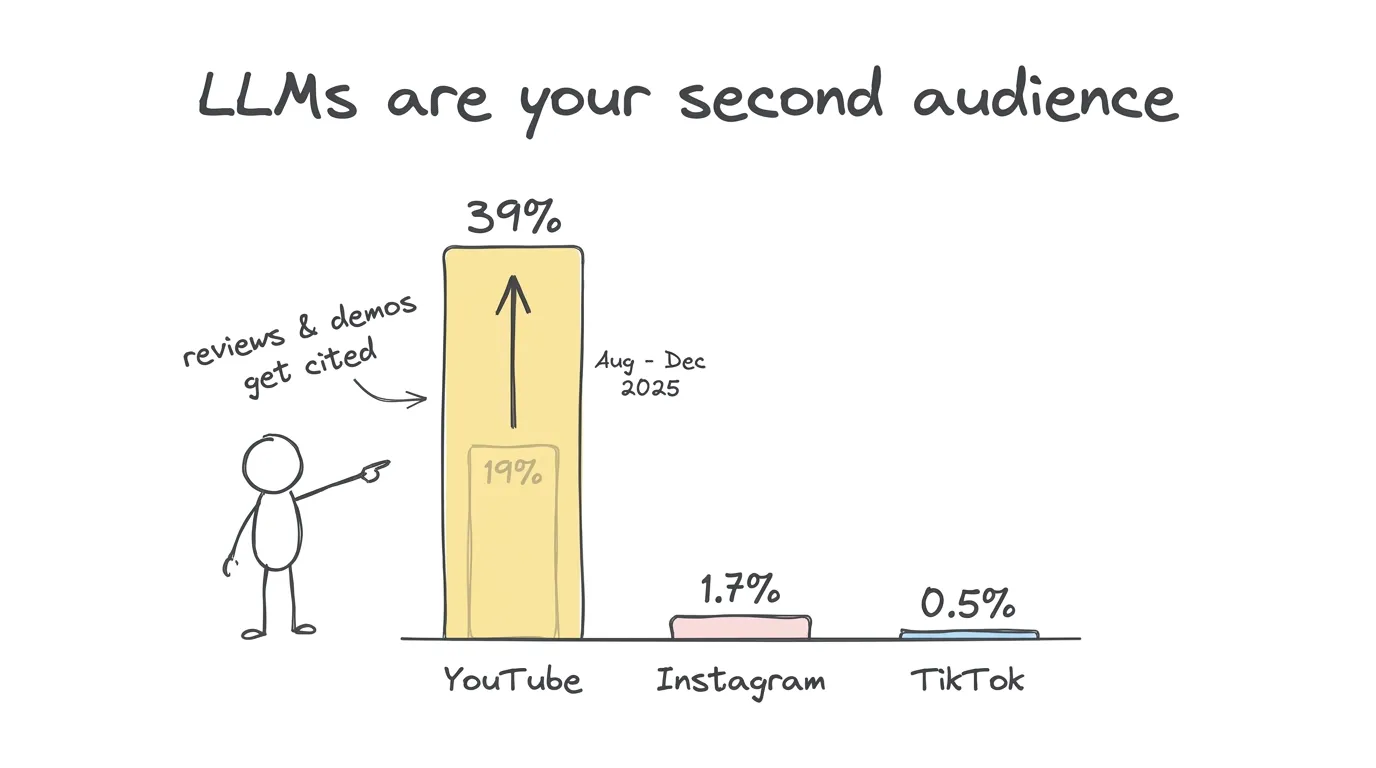
Notice the painful detail: the two platforms carrying the most influencer marketing programs right now — Instagram and TikTok — are exactly the two at the bottom of AI citations.
Why? Because what AI loves to cite is the very specific kind of YouTube video: reviews, demos. Long-form content has a long shelf life — it used to collect the SEO dividend, and now it's collecting the GEO dividend.
Hence the report's framing: LLMs are your "second audience."
The moment I heard that, an analogy came to mind: GEO today is like SEO 20 years ago — open wilderness. Whoever gives the clearest answer first gets cited first.
Yet in the live poll, half the audience had no idea what their brand even looks like inside AI answers, and another quarter weren't tracking it at all.
This wilderness is still unclaimed territory.
Is AI Biased? Yes. And You Can Use That Bias
An audience member asked: does AI favor certain brands?
It does. AI's answers are assembled from everything ever written across the web. Whoever gets written about the most shows up the most. And rephrase the question or switch tools, and the answer may change — so any single AI response has limited reference value.
But flip it around, and this bias works for you: as long as someone is writing seriously about your product — including your influencers — AI will fish you out of the pile.
Influencer content is no longer just for social feeds anymore. It's also deciding whether your name can be called out in AI answers.
Of course, never forget: AI makes mistakes — often. Every answer AI gives you should pass through your own brain first.
Playing 2027: The Game Plan
Finally, let me compress the webinar's practical advice into four moves.
First, what to hand to AI right away: the heavy reporting. Consolidating platform data and stitching together reports — hand that grunt work to AI and free up your time to think. But a caveat — before you delegate, get clear on what you want AI to answer: why did this piece of content work? Why is this influencer outperforming? Don't let AI hand you a pile of numbers; make it answer your questions.
Second, what stays human forever: strategic judgment and relationships. AI can pull the data and spot the patterns, but "where does this campaign go next" and "is this influencer relationship worth doubling down on" — those are human calls. Trust takes time to grow, and audiences can tell the difference between what's real and what's going through the motions.
Third, can you use AI content in paid media? Yes — in the right places. A/B testing, ad variants, filling the gaps between big campaigns: AI fits well. But anything that depends on lived experience — reviews, word of mouth, recommendations — real human influencers still win. Take the budget AI saves you and put it behind the influencer who actually moves the needle. One heads-up: AI transparency regulation is tightening — it has already landed in Europe, New York has legislated, and every major platform is labeling AI content.
Fourth, the foundation. How do you hook AI up to your influencer data? The current approach is MCP — connecting influencer data from a platform like Kolsquare to Claude so you can directly ask "what was Sunday's engagement rate?" APIs work too, but they require development capability. One expert put it bluntly: spend six months first getting your data, foundations, and understanding fully cleaned up — then talk AI. Six months sounds like a luxury at today's pace. But the direction is right: get clear on what you want AI to do, why, and what you're willing to invest — then start.
So what does 2027 look like?
I strongly agree with the two speakers' predictions: the influencer marketing manager role will become more interesting — diving deep into data for real analysis on one side, cultivating genuine relationships with influencers on the other. And the brands that win in the end will be the ones that have already jumped from "one-off collaborations" to "long-term co-creation."
By next year, everyone will have AI.
But not everyone will have influencer relationships that stand the test of time.
That is the true dividing line between the 6% and the 95%.
Here's to being part of that 6% — and to owning the one thing AI will never be able to generate: the human heart.
Continue reading
Related articles

What Is GEO? How Your Brand Gets "Mentioned" in the Age of AI Search
An explainer on GEO (Generative Engine Optimization) for e-commerce and DTC brands: how it differs from SEO and AEO, why AI answers shape brand visibility, and eight practices covering question-focused content, consistent brand messaging, structured pages, external evidence, comparisons, and AI mention tracking.

AI Is Already Making Decisions for Your Customers. Are You on the List?
A learn article explains GEO (Generative Engine Optimization): why AI-generated answers now shape which brands customers see, and how SEO fundamentals, entity clarity, citable evidence, and monthly measurement affect visibility in AI answers.

Google Is Stuffing Ads Into AI Search: These Recent Stories Are Really One Story
A news roundup linking recent AI marketing stories—Google adding ads to AI Mode, Amazon's Ads Agent, ChatGPT image updates, a UK startup tracking brand mentions in AI answers, and an AI ransomware warning—arguing that control over ad data and visibility is shifting toward platforms.