
Why Do Ads Push Exactly What You Just Thought of Buying?
An explainer on personalized content: how browsing data, AI, and automation tailor ads, emails, and site experiences, with criteria for evaluating personalization platforms.
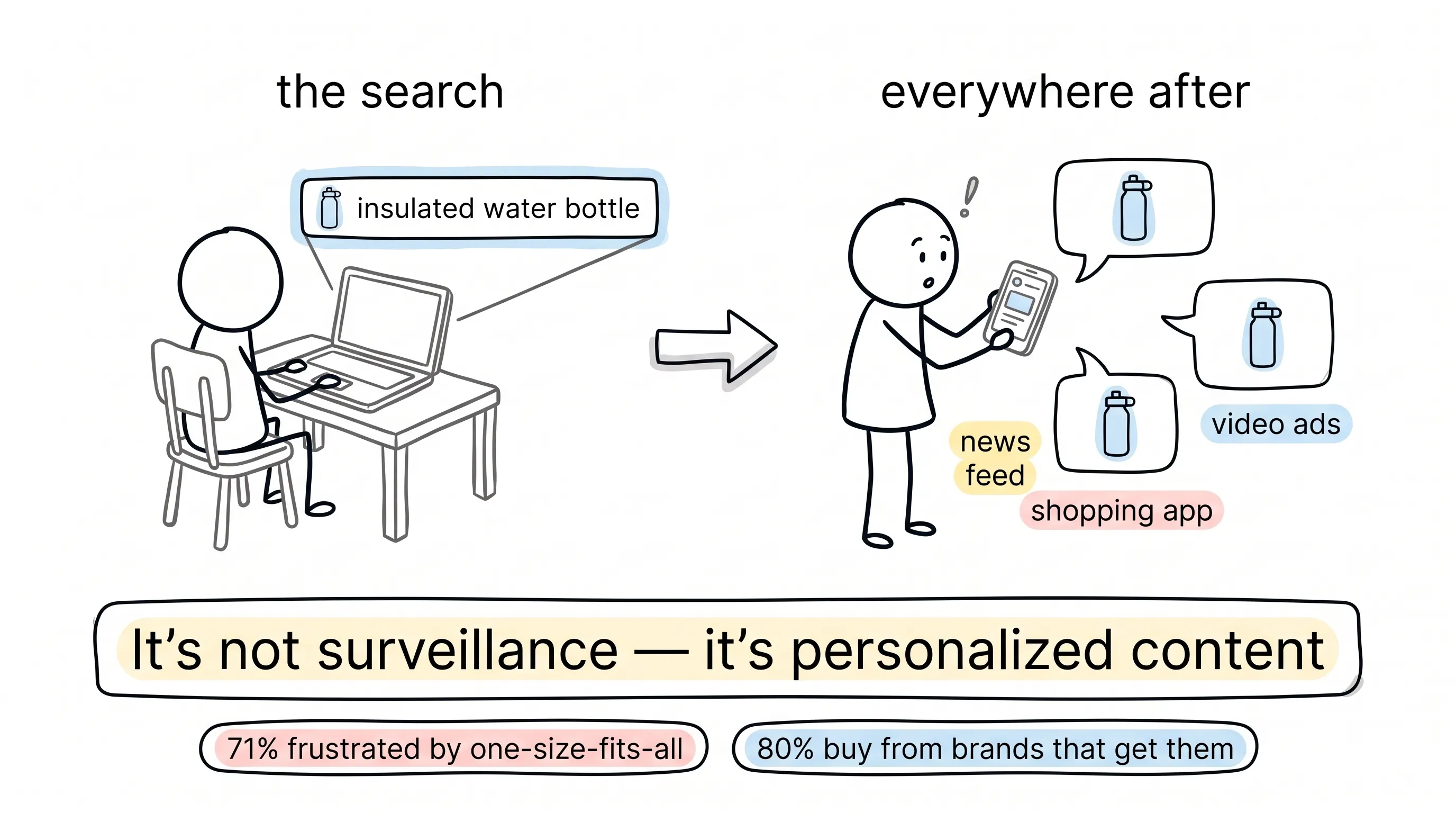
The other day, I searched online for an insulated water bottle.
When I was done, I closed the page and went on scrolling the news. And guess what happened?
Insulated water bottles. Everywhere. In my news feed, in my shopping apps, even in the ads that play before videos.
My first reaction: am I being watched?
After some head-scratching, I figured it out. This isn't surveillance — it's a business. And this business has a name: personalized content. It isn't new, either. Even Aprimo, a veteran vendor that started out in digital asset management, has turned it into a core product line.
Years ago, research firms overseas ran consumer surveys: 71% of people get frustrated when a shopping experience feels like it was made for anyone and everyone; 80% would rather buy from brands that "get" them.
Do the math. Out of every 100 people, 71 are annoyed with you, and 80 are waiting to be won over. The gap between an ordinary brand and a great one may come down to exactly this one question.
So what is personalized content, exactly?
Put simply: one website, opened by a thousand people, looks a thousand different ways. One shopper sees a fishing rod; the next sees lipstick. Emails, landing pages, product recommendations, ads — all of it varies from person to person.
Because it remembers, it's relevant. Because it's relevant, the sale happens.
The Tailor Shop Mastered This Craft Long Ago
Have you ever stepped into one of those old tailor shops?
The old master tailor never measures twice. Mr. Zhang's waist, Mrs. Wang's shoulders — it's all in his head. The moment you walk in, he knows your suit from last time is ready for pickup, and he'll ask, almost in passing: your son's starting school soon, isn't he? Want his uniform altered while we're at it?
That is personalization.
The only catch: this craft used to live in a person. The shopkeeper's memory was the little store's entire database. But a memory that lives in one head can't scale. There's only one shopkeeper, and a brain tops out at two hundred regulars.
Personalization today is, at its core, moving that shopkeeper's memory into a system.
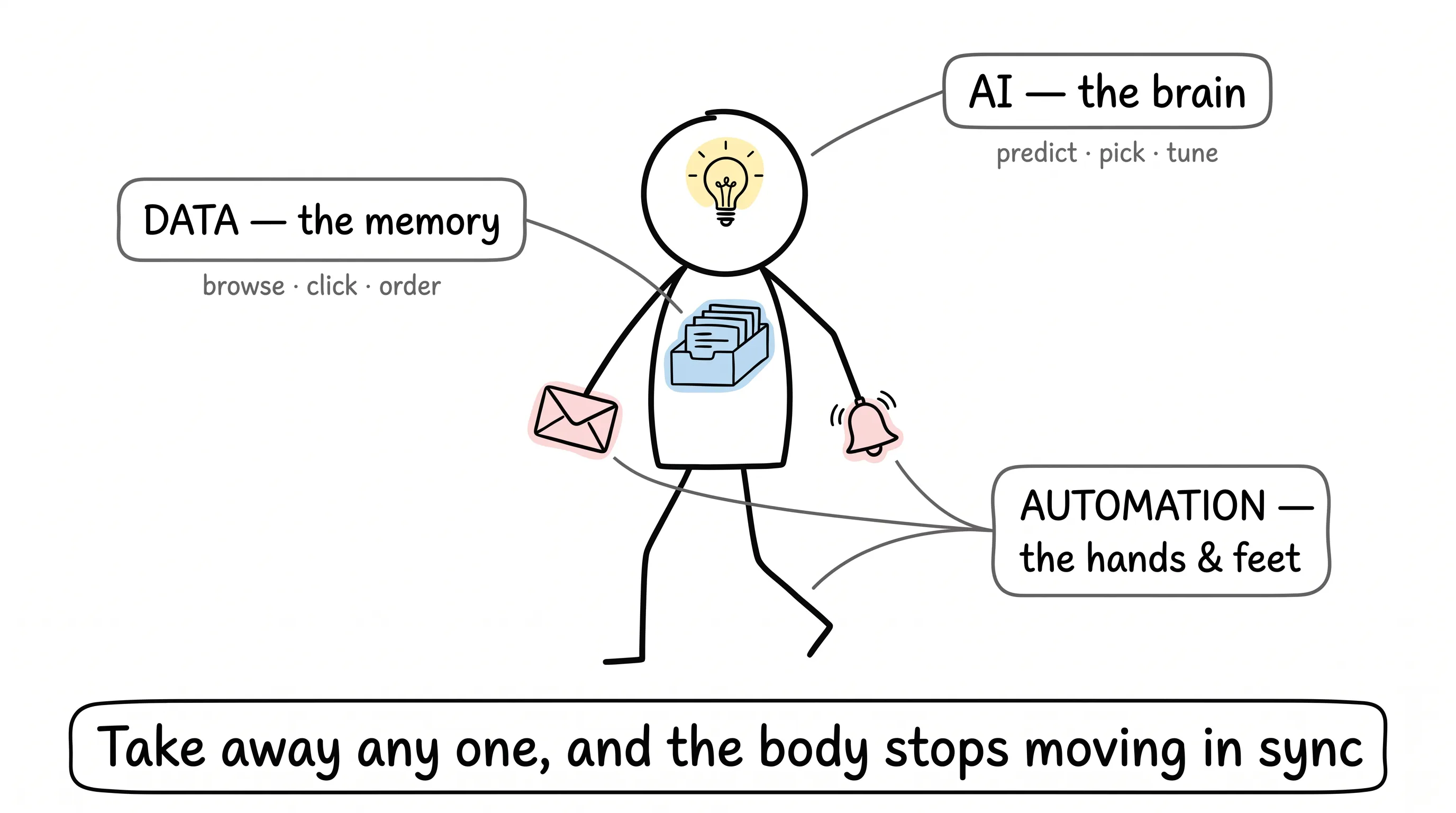
And the raw material? Data. Every browse, every click, every order is another entry in that memory.
All this data mainly does three things:
First, segment people. Group them by interest, by browsing habits — stop greeting everyone with the same poster.
Second, spot the high-intent shoppers. Some are just wandering; others have a cart about to overflow. Those two shoppers should be seeing completely different things.
Third, nail the timing. The same message, delivered the moment a customer first feels the urge versus three days after he closed the page, produces night-and-day results.
Data is the memory of doing business online. No memory, and personalization is off the table.
Knowing One Customer Isn't Enough
Fine — now you have memory. But the next question arrives immediately:
How many places does the customer show up in?
Website, email, app, text messages, push notifications. In every one of those places, he's the same person.
Think of a friend: the person you talk to on the phone is the same one you chat with on WeChat, and the same one again in person. He doesn't change faces when he changes channels.
Brands are no different. Customers don't remember what you said on which channel. They form one overall impression: this brand gets me.
So: the homepage stocks itself with products he probably wants, based on what he's browsed. Email stops being the same "big sale" blast to your whole list; instead it recommends the styles he actually cares about, based on what he last looked at. A push notification taps him gently on the shoulder at the very moment he might just need it.
And there's one especially classic move: abandoned-cart recovery.
The customer fills a cart, then walks away. The next day, the system automatically sends an email: those pieces you were looking at? Still here — we're holding them for you.
How many hesitant shoppers does that one move pull back? Ask anyone who's run an e-commerce operation and they'll tell you: it's among the most reliably profitable moves in all of marketing automation.
Once AI Walked In, the Craft Took Off
Everything above can be partly done with manually configured rules. Once AI enters, things change.
How? I sum up AI's job in three words: predict, pick, tune.
Predict. Before you've even searched, it has already guessed what you want. It used to be: you search for something, it pushes it. Now it reads your behavior and surfaces the needs you've never said out loud.
Pick. Which image, which copy, which product this person should see — the system assembles it all automatically. No more marketers hand-picking images one at a time and matching products one by one.
Tune. Two versions of a landing page — whichever performs better, the system watches the data and swaps it in on its own. No waiting for the weekly review, then queuing up a change request.
But the most brilliant part, to me, is that AI can fish out micro-segments.
What's a micro-segment?
It's the kind of tiny cluster that manual segmentation can never surface. Take the people who habitually order coffee machines late at night: within that group there's a subset that also loves buying ambient lighting. When marketers sketch out user personas, this cluster almost never shows up in the picture. AI can pull it out of the data.
And once you've caught them? Show them dedicated recommendations. Conversion rates are often frighteningly high.
Can't Remember Them All? Let Automation Handle It
By now you might say: one or two customers, I can serve them by hand.
True. But what about a million customers?
That's where automation earns its keep.
Let me give you a playbook that has actually been run. A global retail brand wanted its website, emails, and push notifications to be personal for everyone. What it did boils down to one thing: feed customers' browsing habits into the system, and the system automatically assembles a different homepage for each person, sends different promo emails, and pushes different product notices.
The result? Average order value went up, repeat purchase rate went up — and the ops team didn't have to double its overtime to make it happen.
Data is the memory, AI is the brain, automation is the hands and feet. Take away any one of them, and the body stops moving in sync.
Shopping for a Tool? Run It Past These Four Tests
You might be wondering: so which tool should I get?
Plenty of personalization platforms are on the market, and quality varies wildly. Don't just listen to the sales pitch — vet them against four questions:
-
Are AI and automation one integrated whole, or two pieces bolted together? Can it make recommendations, swap copy, and fine-tune campaigns automatically, with no one babysitting?
-
Omnichannel delivery. Does the same customer get a seamless experience across website, email, and app?
-
Does the data connect? Can it hook into Google Analytics, your CRM, and your content management system? If it can't, your memory is stranded on an island.
-
Scale. If your business doubles, can the system keep up? Would it slot into your existing workflows without a fight?
Established vendors generally cover these four. Take Aprimo: it started out in digital asset management (DAM) — in plain terms, helping big companies keep their images, videos, and other "content valuables" properly organized. Once the valuables are in order, who each piece of content should reach and where it should appear falls naturally into place. So when it comes to personalization, Aprimo gets there with less effort than most.
Before you buy, make them run a full demo against your real-world scenario. Don't settle for a slide deck.
Finally, Back to That Water Bottle
Next time you search for an insulated water bottle and immediately get served water bottles, don't be so quick to assume you're being watched.
It may be some brand that has only just learned the old shopkeeper's craft.
In an age of product abundance, customers can buy anything. What's truly scarce is the feeling that someone remembers you. Whoever can scale that memory into every touchpoint gets a different business out of the same traffic.
Here's to you becoming the brand that gets remembered.
Continue reading
Related articles
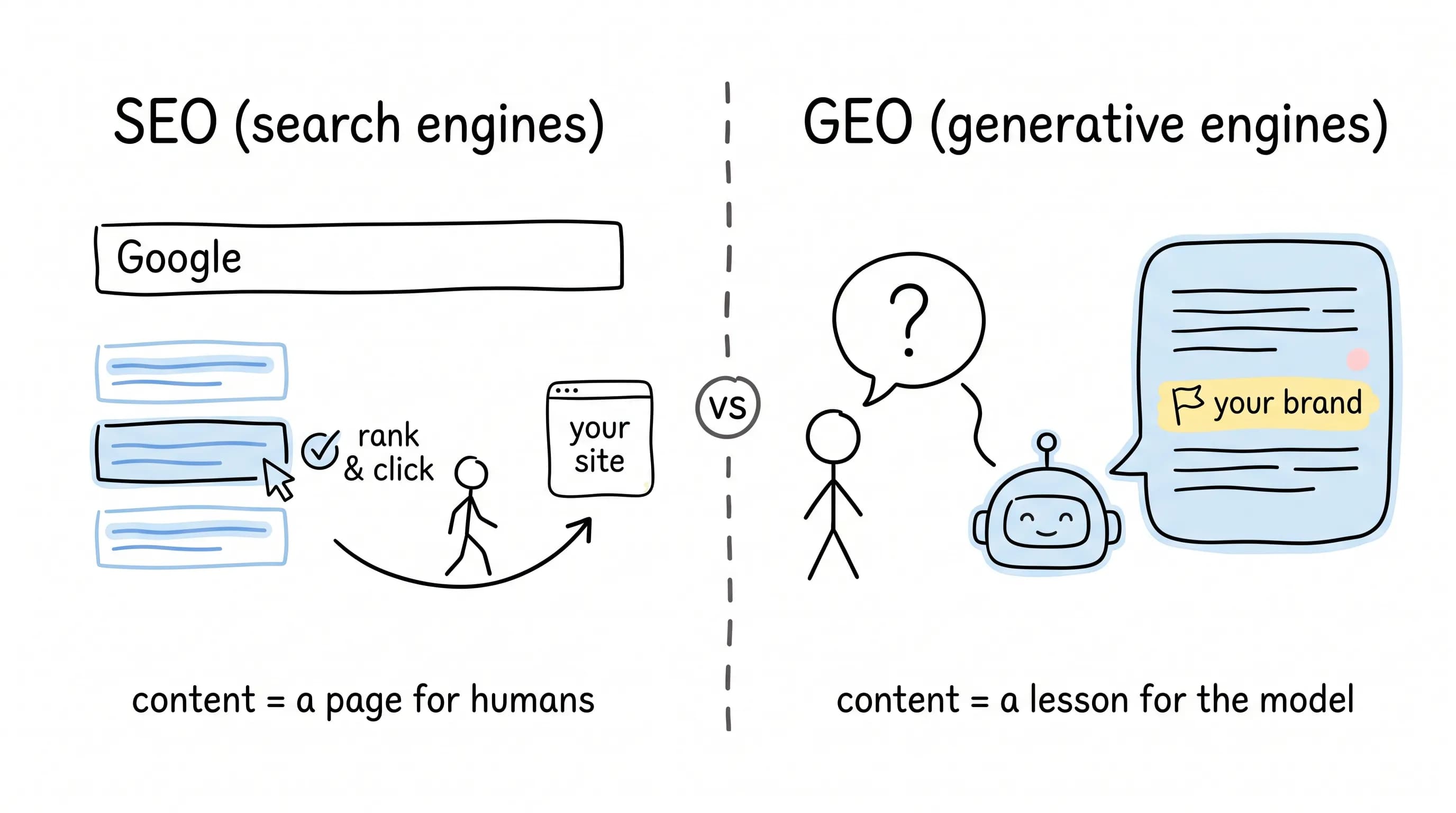
Does AI Know Your Brand? A Look at GEO, the New Craft
An explainer on GEO (Generative Engine Optimization): how AI engines like ChatGPT, Perplexity, and Gemini differ, how GEO goals and metrics diverge from SEO, and which SEO skills still carry over.
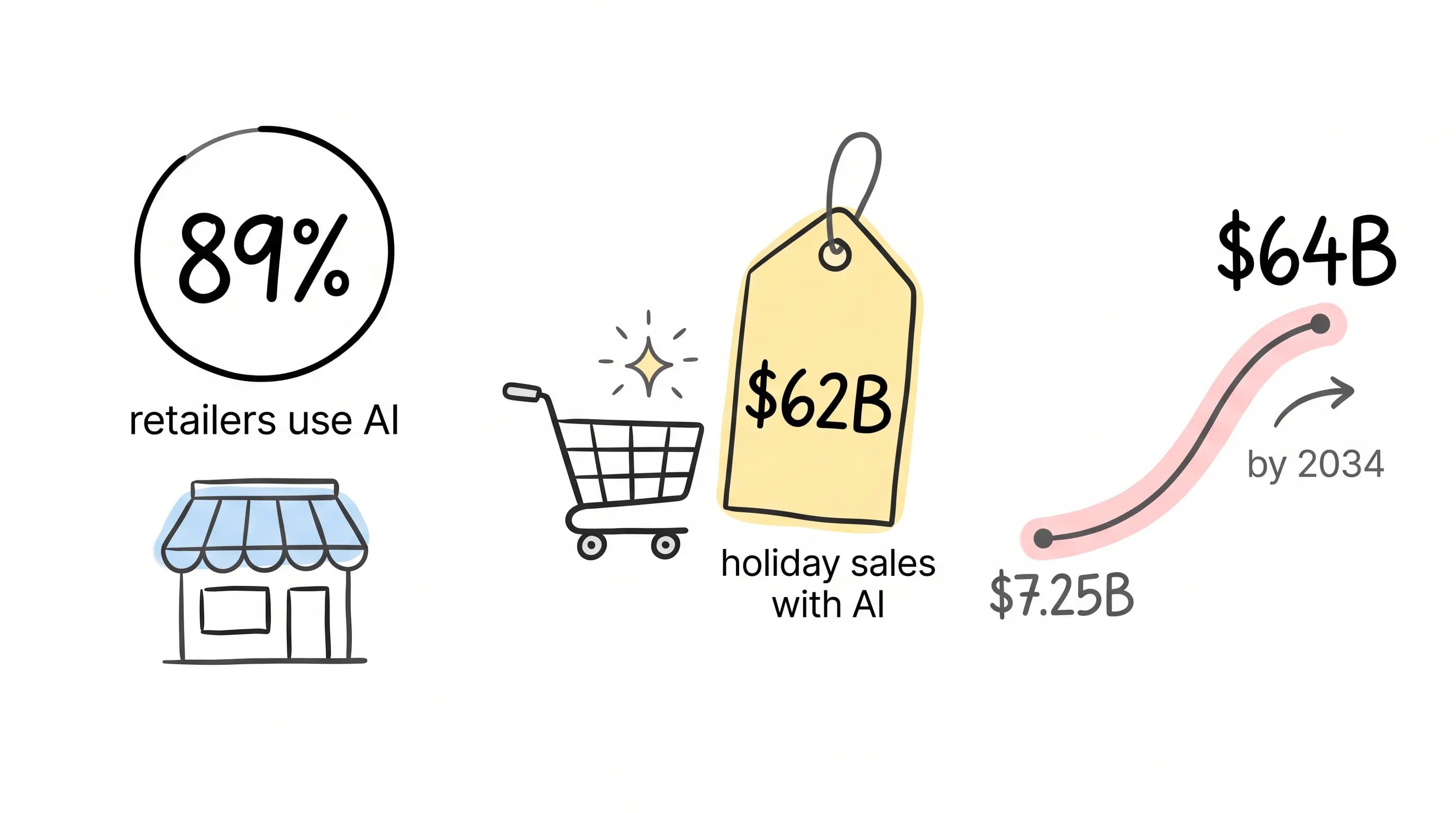
89% of Retailers Are Already Using AI. The Playbook for E-Commerce Has Changed
A learn article on AI in e-commerce: adoption context, use cases from recommendations, search, dynamic pricing, customer service, inventory, and fraud control, plus B2B applications, generative AI content, tool examples, pitfalls, and a six-step adoption path.
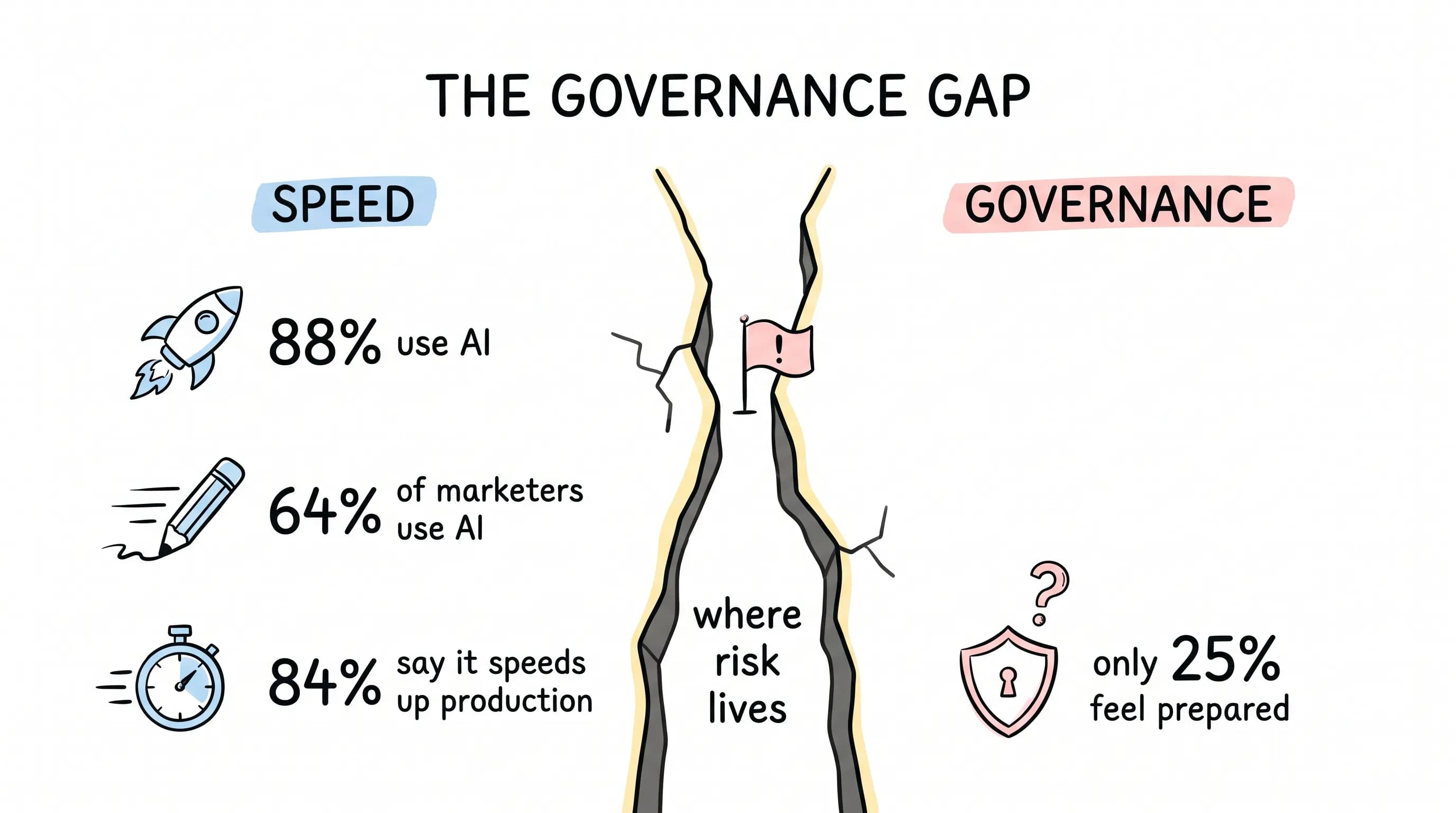
AI Makes Content at Lightning Speed — But Can You Answer "Who Approved This?"
This article looks at the gap between AI content speed and governance readiness in marketing teams, and outlines nine control points — prompt validation, brand guardrails, permissions, approval workflows, human review, versioning, IP checks, audit trails, and asset reuse — for brand-safe AI content.