
How a Company With No Content Team Grew Its Website From Zero to 4,000 Monthly Visitors in a Year: A Breakdown of Postbeam's 10 Content Channels
An article breaking down the ten content channels Postbeam used to grow its website without a content team, covering LinkedIn, blog and SEO, newsletters, YouTube, webinars, podcasts, original data, community, creators, and customer content, plus AI-assisted workflows and visibility in AI answers.
I recently took a deep dive into how Postbeam approaches content.
This company has no content team. Yet their website went from zero to 4,000 monthly visitors within a year. Their previous company, Hoppier, landed more than 1,200 customers with a single newsletter, one podcast, and some SEO.
No team — so how did they do it?
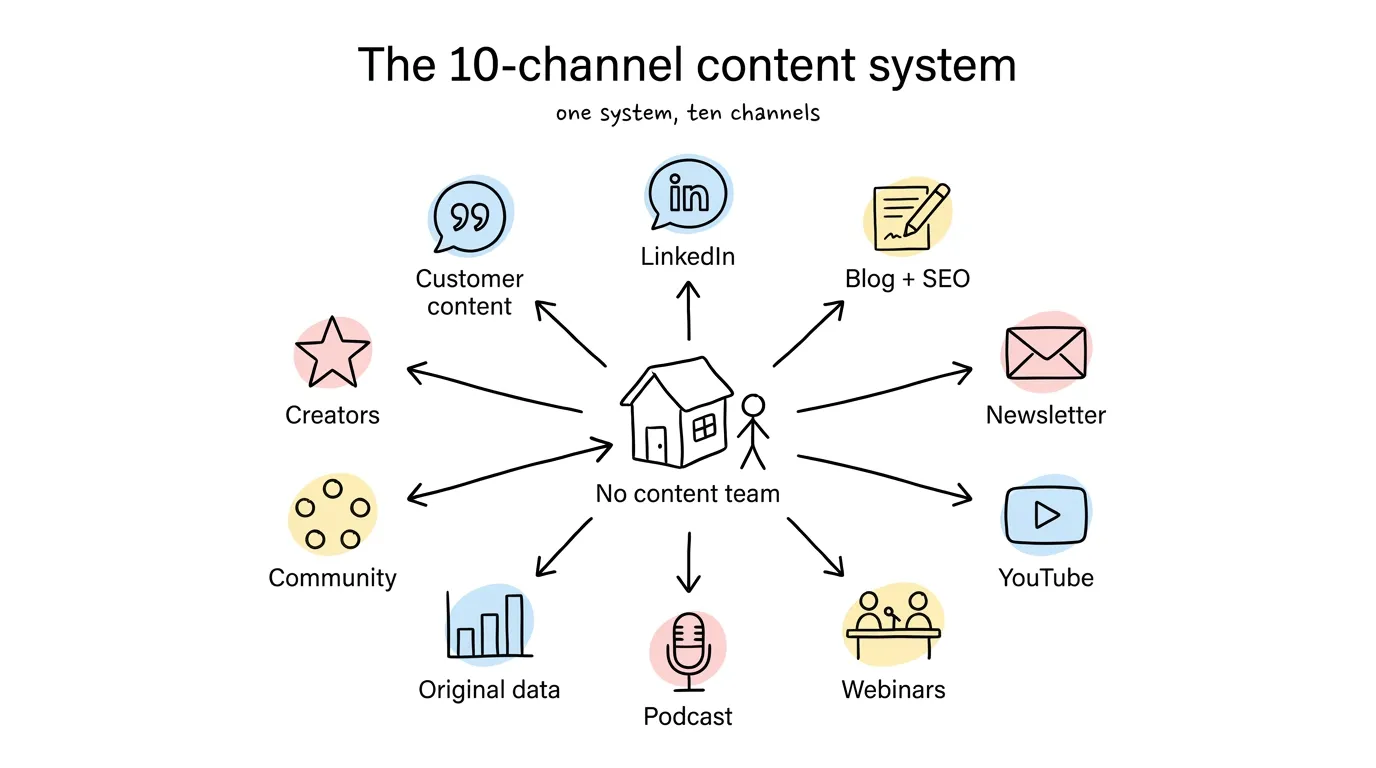
With a system. I'll walk you through all 10 channels in the order they built them. But first, let's answer one question:
What is B2B content marketing?
It's building trust with content before a buyer ever meets your sales team. In 2026, three things about this have changed: buyers trust people far more than they trust logos; much of the research that used to start on Google now happens inside AI assistants like ChatGPT and Claude; and the companies that win — think Lovable, beehiiv, Cursor — run their entire team like a media company.
Keep those three ideas in mind. Let's get started.
01. LinkedIn: A goldmine 99% of companies never take seriously
On LinkedIn, fewer than 1% of members post in any given month.
Think about what that means. Attention is everywhere, but almost nobody is doing the work. That gap is the entire opportunity.
And the algorithm hands free reach to people, not company pages. Postbeam runs three accounts in parallel: 318,000 impressions, 162,000 member reach, and 2,220 new followers. One founder account, posting daily, pulled in 853,000 impressions over the year — up 202% year over year. A single post crossed 100,000 impressions and brought in more than 20 customers.
This is reach you own. Ads are rented; this is yours.
The lowest-effort LinkedIn play: get the whole company posting. Lovable takes it even further — the moment an employee posts, the entire company floods the comments within two hours. beehiiv used exactly this playbook to reach $2 million in monthly revenue.
So what about the colleagues who say they "don't have time"? The answer is to give them context, not pep talks. Turn meeting recordings into transcripts, have AI draft posts in each salesperson's voice using what they actually told clients that week, and let marketing do just three things: review, schedule, publish. Ten minutes of orchestration becomes a month of team content.
It comes down to one line: AI with informational substance is a weapon; AI without it is garbage.
02. Blog and SEO: What died wasn't SEO — it was lazy SEO
Start with two numbers. A golf content site drew 86,000 of its 94,000 users from organic search. Paid traffic? Three. Hoppier's blog brought in 173,000 users and 790,000 views over the year.
Articles compound. Ads stop the moment you stop paying.
But the game changed in 2026. An article written by summarizing the top 10 search results gets penalized by Google, skipped by readers, and ignored by large language models — there's no reason to cite it.
So what's the fix? Better inputs.
Go get material nobody else has: competitor pricing screenshots, historical snapshots, Ahrefs data, real sales call recordings. Have two people talk through the topic in depth — with opinions, with disagreement — then hand the transcript, screenshots, and data to Claude, which is connected to the site's GitHub repo and assembles the piece, builds internal links, and sources images. You just polish it and hit publish.
If there's nothing to paraphrase, there's something to cite.
One more move: free tools. Every industry has "free XX generator" style searches, and the competition is thin. Build one genuinely useful free tool and you earn backlinks while giving people a taste of the paid product — hand out the candy first, then sell the whole store. Postbeam quietly runs 14 free LinkedIn tools compounding in the background.
Finally, AEO. More and more B2B research now ends in the answer box of ChatGPT, Claude, or Perplexity. So the question shifts from "where do we rank" to "are we being cited."
Semrush data from January 2026: among the domains LLMs cite most, Reddit ranked first at 11.29%, LinkedIn second at 11.03%, followed by Wikipedia at 9.53% and YouTube at 8.77%.
Three plays. First, minimize the "cost of answering" for large language models — put pricing screenshots for eight competitors, honest comparisons, and original numbers on one page, and what else would it cite? Second, show up where LLMs already trust: find the top-ranking relevant threads on Reddit and comment with your identity disclosed — "I'm the founder of Postbeam." Occasional brand mentions are fine; astroturfing at scale invites trouble. Third, do the unglamorous work of earning backlinks — get into those listicles already ranking. Google reads them, and so do the models.
One project drew 43,000 sessions from Reddit — more than from Google.
03. Newsletter: The only audience that truly belongs to you
What does an audience you truly own mean? One nobody can take away, that you never bid on, and that never raises its prices.
Hoppier's newsletter, Hot in Events, grew to 8,000 subscribers. The system was almost embarrassingly simple: set up Google Alerts for industry keywords, pull the hottest stories from Twitter, Reddit, and TikTok each week, pick the 5 that readers would forward to a colleague, add one line of your own take to each, and send on time.
Two hours a week, and it rolls into a compounding asset.
On tools: use beehiiv for a media-style newsletter, and Customer.io for product lifecycle email. And don't forget the rented piece: LinkedIn newsletters, where the platform actively pushes the subscribe prompt to your network. Treat it as a distribution lever, not a replacement for your owned list.
04. YouTube: Record once, eat five times
Postbeam's YouTube series features its two founders in conversation, breaking down how companies like Lovable and ElevenLabs grew.
One recording session becomes five assets: a YouTube video, a long-form article (the transcript feeds the blog system described earlier), a set of LinkedIn clips, and a batch of Shorts. Two people sustained this only because of that "record once, publish everywhere" loop.
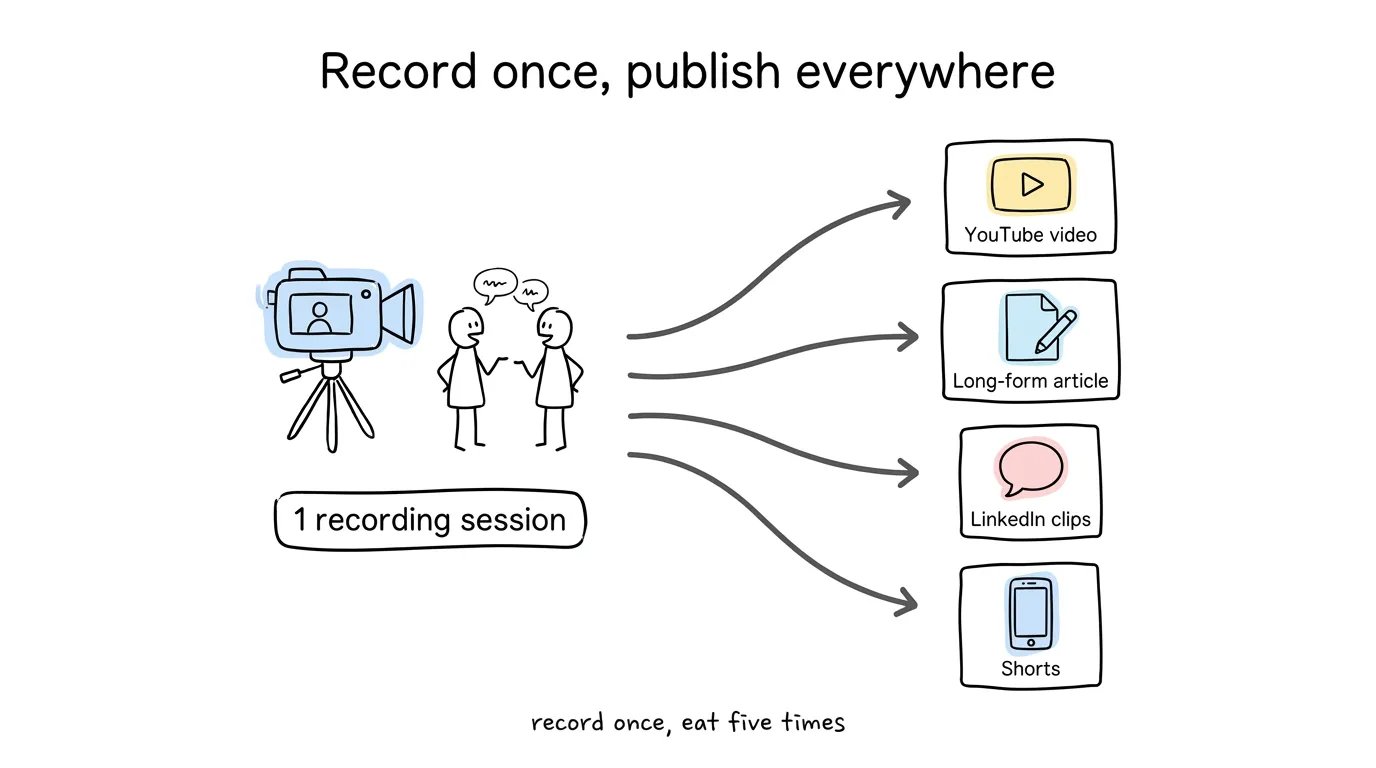
Don't underestimate Shorts. The same footage cut vertical pulled 45,000 views in 3 months, almost entirely from people who would never click a 15-minute long video.
The craft worth stealing comes from TBPN: a livestream averages 7,000 viewers, yet each clip averages 257,000 views, and the show was reportedly sold to OpenAI for $200 million. Their formula: every guest segment stands alone as a 5-10 minute closed loop, making each one clip-ready; cut straight to the point in the first 3 seconds; burn subtitles into the frame with speaker labels; keep each clip between 30 and 90 seconds; publish 8-15 clips per episode spread across the day; and always show the guest's handle at the end — when the guest shares it, that's your second distribution channel.
05. Webinars: Sounds dated, sign-ups keep climbing
Postbeam's webinars went from 20 attendees, to 50, to 50-100.
The recipe is copyable: once a month, 30 minutes total — a 15-minute panel conversation, 15 minutes of audience Q&A. Always a conversation, never a slide deck, with 2-3 guests whose audiences overlap with yours.
The clever part is distribution: a Luma page plus a LinkedIn event, with every guest added as a co-host and asked to blast the invite to their network. Record a 2-minute Loom showing them how; each guest spends 3 minutes, and registrations triple.
Guests are the distribution.
A 30-minute livestream becomes a YouTube video, a blog recap, a week's worth of clips — and it sits on the on-demand page forever, converting for months.
06. Podcasts: Be a guest cheaply, be a host expensively
The cheap path: list every podcast in your industry and pitch with a specific angle — never "I'd love to share my journey" — and treat every appearance as source material to be sliced. If that sounds like too much hassle, hand it to an agency like Fame that runs podcast booking end to end, from pitching to editing and distribution.
The expensive path: host your own. This is the sharpest strategy for landing mid-market and enterprise customers, because guests become customers. Invite a VP at a target account onto your show, and you've created your warmest touchpoint yet: 45 minutes where they talk about their own problems while sitting across from the person who can solve them.
Hoppier did exactly that back in the day, inviting HR and culture leaders — their most precisely targeted buyers.
Whichever side of the microphone you sit on, the key move is the same: after recording, send the guest the full video and the cut clips together, and explicitly ask them to share. Their network is the reach you actually want.
07. Original data: You're already holding what nobody else has
The highest-authority content you can publish is your own proprietary data. Journalists cite it, competitors link to it, and LLMs love it — unique numbers are the sources they trust most when answering.
Hoppier turned anonymized platform data into a report: 662 webinar programs, 12,907 attendees, $525,000 in gift cards, and an average attendance lift of 30%.
Nobody else can publish that report. That's its value.
The recipe: slice off a piece of product data, anonymize it, find the 3-4 numbers that are genuinely surprising, and pair them with clean charts. One dataset feeds a full year: the report, a launch post, hooks for journalists, and that "according to our data" line in every channel.
08. Community: Start small, then go big
Two paths. First, participate: show up in the Slack, Discord, and Reddit communities where your buyers gather and answer questions — don't pitch. Then, own: Postbeam runs a VIP Slack, small and curated, where users share their setups, refer each other, and feed back product ideas.
Remember one line: 30 people answering each other's questions beat 3,000 lurkers.
How high can the ceiling go? Instantly's "Cold Email Masters" Facebook group started as a byproduct of their AppSumo onboarding and grew past 60,000 members. Community is a moat — switching tools means leaving the room where your peers hang out.
09. Creators: Stop renting attention from the ad auction
Pay the people your audience already follows. Platforms like Passionfroot make it feel like booking ad space: browse creators, check rates, sign, ship.
Three lessons: choosing on audience overlap alone, or on follower count alone, usually loses money; give them source material and let them write in their own voice — their followers can smell your marketing department through the screen; and run the math — skipping the auction and the algorithm usually beats paid social.
10. Customer content: Let your customers say the most persuasive thing
The one sentence you most want to tell customers — let a customer say it for you.
Record short video testimonials from customers, put them on your site, then run the same footage as ads — it consistently outperforms anything your own team produces. Reviews on G2 and Capterra are content too, read by both buyers and AI.
Make sharing easy: send customers the clips, quote cards, and links together, the same way you equip a podcast guest.
So where do you start?
Not all ten at once.
The best advice is to pick the one or two with the highest potential, go deep first, then expand. For most B2B companies, the answer in 2026 is clear: start with LinkedIn — that's where the buyers are, the reach is still free, and your whole team can amplify it. Then add one compounding channel: if customers search, do SEO plus a free tool; if you sell to mid-market and enterprise, do webinars and podcasts; if your industry runs on news, do a newsletter.
Then, let the channels feed each other. One recording becomes a video, an article, ten clips, a newsletter issue, and next week's posts. One dataset becomes a report, a livestream topic, and a hundred citations.
Finally, measure the program, not the individual piece. When revenue is climbing and customer lifetime value keeps beating acquisition cost, the mix is working — keep feeding it.
Ads are rented traffic; content is a planted asset.
Here's to planting the field that will one day pay you back.
Continue reading
Related articles

When AI Does the Creative, Mistakes Come in Batches Too
A learn article on the risks of using generative AI for marketing creative across brand, legal, compliance, and operational layers, with case examples and seven practices for review, rights clearance, documentation, and vendor governance.
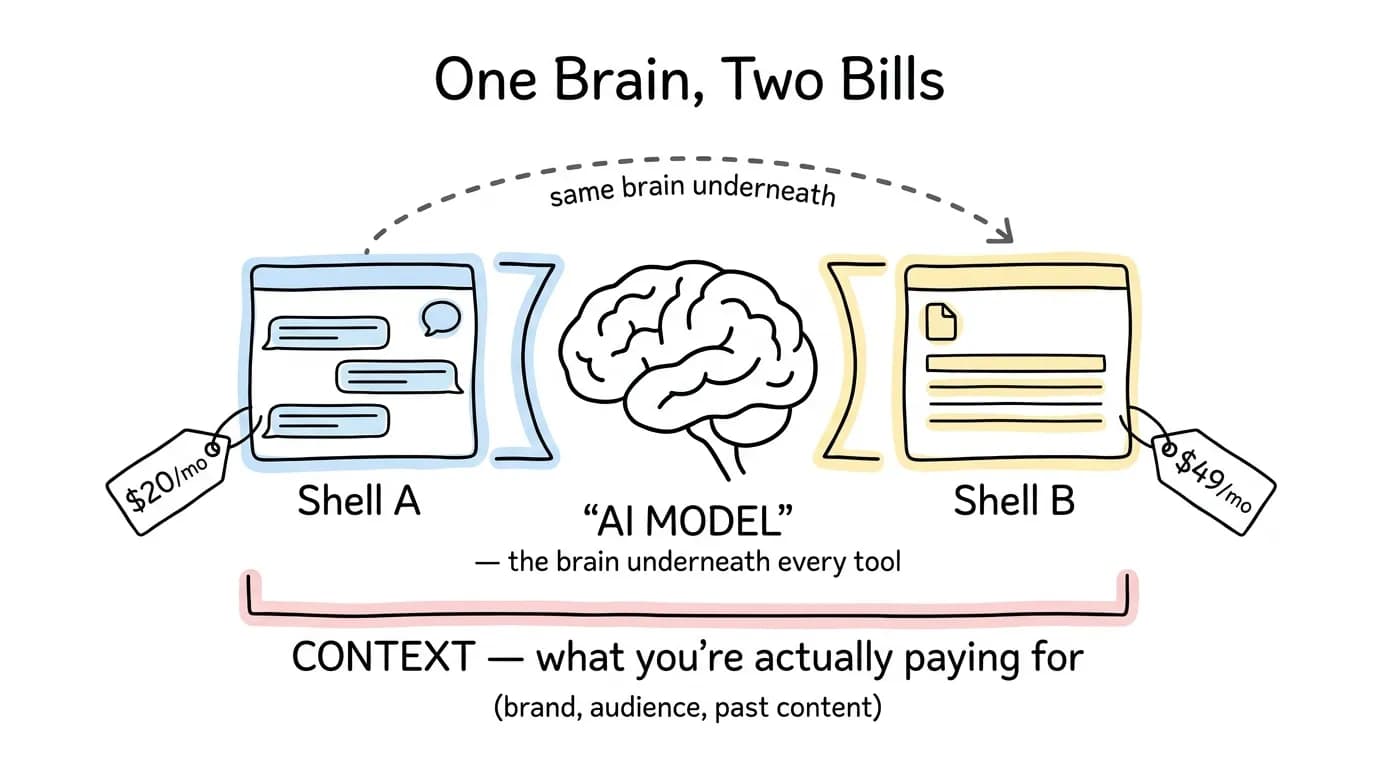
Which AI Should Your Startup Actually Use for Marketing?
A startup marketing guide explaining the difference between AI models and tools, sorting tools by job (writing, research, design, leads, email, video ads), and outlining a 30-day test plan for choosing them. It also covers generative engine optimization and budget trade-offs.
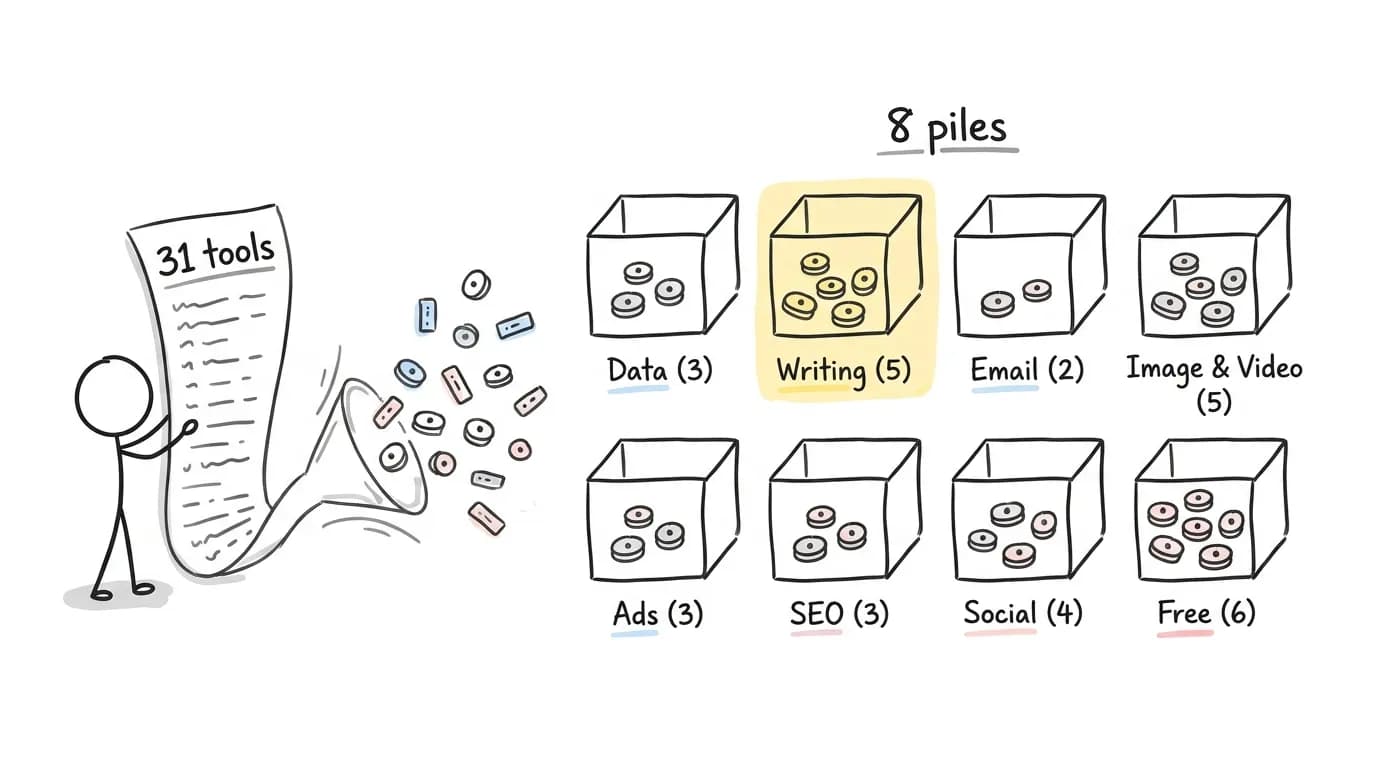
31 AI Marketing Tools, Reviewed One by One: How Exactly Should You Spend the Money?
A review of 31 AI marketing tools grouped into eight categories, covering data, content, email, video, ads, SEO, social, and free options, with guidance on choosing one strong tool for your most frequent task and testing free tiers first.