
When Enterprise Buyers Ask AI for Creative Automation Platforms, Who Gets Recommended? 14 Models, 84 Answers, and a Few Surprises
A study write-up: one creative automation platform question asked six ways across 14 AI models produced 84 answers. It reports AI recommendations diverge from Google rankings, shift with buyer persona, and often cite vendor blogs, arguing brands should write content for AI visibility.
The other day, a friend of mine who sells to large enterprises vented to me about something.
His company needed to procure a creative automation platform. What's a creative automation platform? It's a tool that helps marketing teams mass-produce ad creative. A company with thousands of employees needs tens of thousands of images and hundreds of videos a year. Following his old habit, he searched Google for "the best creative automation platforms," scrolled through the results for a while, and came away more confused than ever.
Then he tried a new trick: he asked AI directly.
After asking, he was even more confused. Because what AI recommended was completely different from what Google turned up.
What's going on here? I recently came across a study that explains this remarkably well.
How the Study Worked
Someone took the same question, phrased it in different ways, and asked 14 AI models.
The question was roughly this: "What's the best creative automation platform for an enterprise B2B company?"
But they didn't stop there. They asked it several different ways: rephrased it and asked again. Added budget constraints and asked again. "We're a 5,000-person company that needs SSO, SOC 2, and procurement review — what should we look at?" Asked again. They even flipped it: "Which platforms should be avoided?"
6 phrasings, 14 models, 84 answers in total.
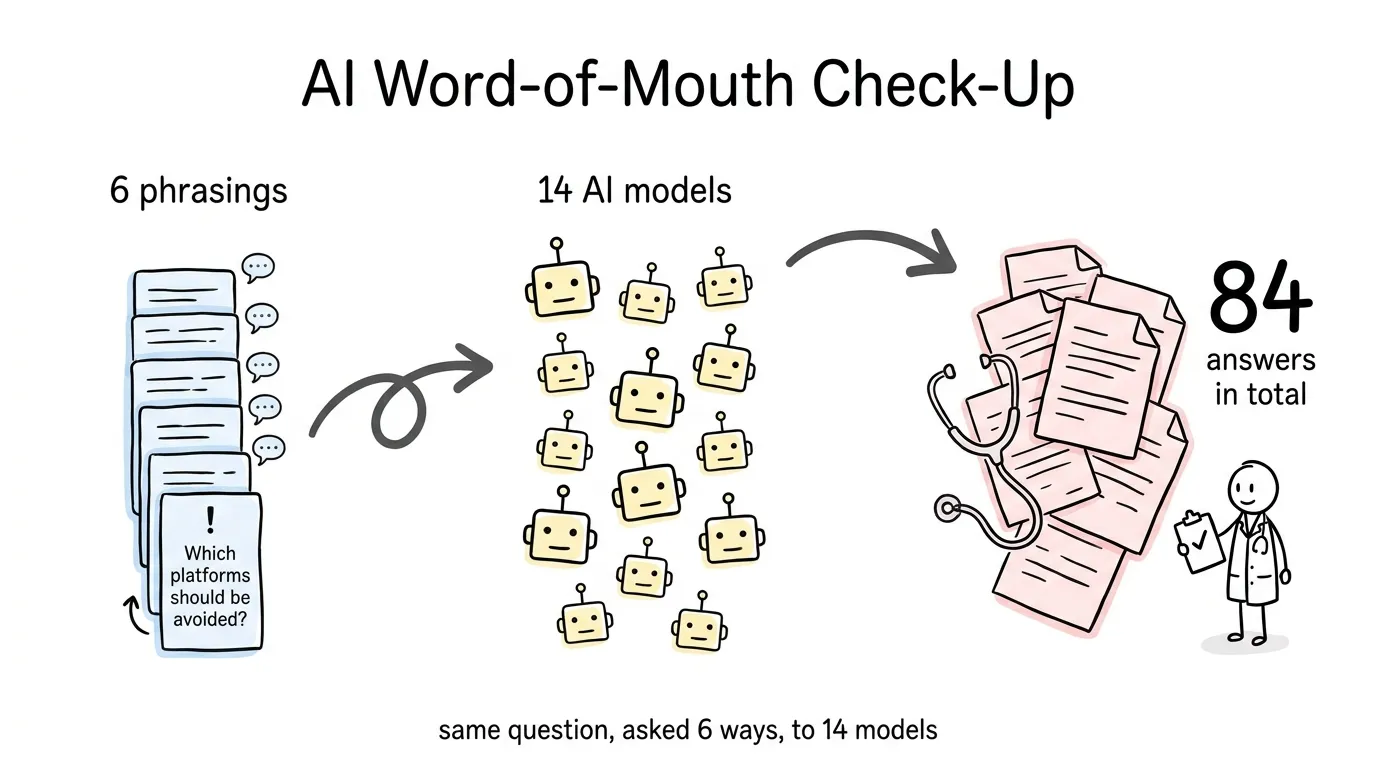
Think of it as a health check on "AI word-of-mouth." You don't have to guess who AI will recommend — you can just look at who it actually recommended.
The First Surprise: The One with Massive Search Volume? Nobody Recommended It
Start with the large-enterprise segment.
Celtra, a 50% first-recommendation rate, way out in front.
Second place went to Bannerflow at 15%. Adobe GenStudio, Storyteq, Marq Team, Abyssale, and Viewst each took 4%. Further down, Canva got 2%.
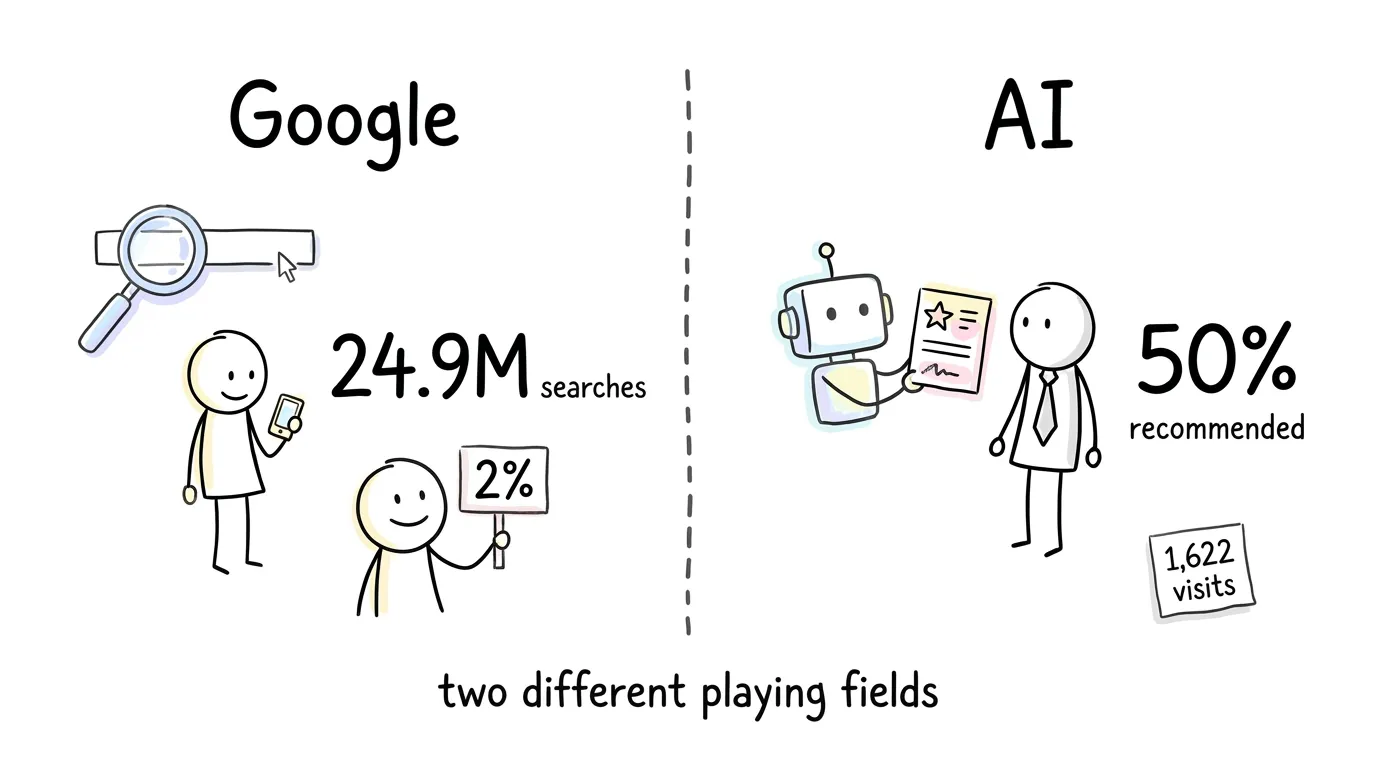
Think about that. What kind of player is Canva? 24.9 million monthly searches, over 80 million website visits a month. Practically everyone who designs anything uses it.
Yet among enterprise buyers, it got 2%.
And Celtra? 1,300 monthly searches and 1,622 monthly website visits. Yes, I counted the digits carefully — 1,622.
One twenty-thousandth of Canva's search volume, but 25 times its recommendation rate.
Why? Because what enterprise buyers want is different from what everyone else wants. Regular users want easy, cheap, and template-rich. Enterprises want permissions, compliance, and brand governance — thousands of users collaborating without things falling apart.
By the way, 8 of the 14 models kept the same first choice even when the question was rephrased. AI's answers are more stable than you'd think.
Google search volume measures the masses. AI recommendation rate measures buyers. These are two completely different playing fields.
The Second Surprise: Change the Buyer Persona, and the Answer Changes
Even more interesting: ask the same question from a different buyer persona, and AI gives a completely different answer.
Small businesses asked? Canva led at 32%. Mid-sized companies? Bannerflow led at 21%. Large enterprises? Celtra led at 50%.
You see, AI doesn't have one "standard answer." It carries several answer sets in its head, and it pulls out whichever one matches who you are.
And that actually mirrors the real world. Small companies want speed and savings, so of course they use Canva. Big companies want governance and compliance, so they need tools like Celtra that grew up serving enterprises.
But flip it around, and here's the unsettling part: AI is doing "filtering" for you, and you may not know what logic it's filtering by.
The Third Surprise: Which Changes Are Real, and Which Are Noise
Data goes up and down. But how do you know which movement is real?
This study came up with a clever method: ask the exact same question twice, and see how far the AI drifts on its own. The result: 11 percentage points.
That's the "noise floor." Movement under 11 points might just be random jitter. Above 11 points is a real signal.
Measured against that yardstick, three big things happened between October and November:
Celtra rose from 38% to 50%, up 12 points — a real gain. Bannerflow rose from 4% to 15%, up 11 points — a real gain. Smartly fell from 13% to 0%, down 13 points — a real drop.
Goodness, Smartly. 13% of recommendations a month ago; this month, zero.
And Canva falling from 8% to 2%? Looks alarming, but it didn't clear the floor — hold your conclusion for now.
When you read data, first find the noise, then find the signal. People without a yardstick only ever see what they want to see.
The Fourth Surprise: What AI Cites Isn't What Ranks on Google
Here's the question I find most worth chewing on.
When AI makes recommendations, what is it actually looking at?
The researchers tallied the citation sources across all 84 answers: 978 links, from 242 websites.
The single most-cited source was Bannerflow's own corporate blog — an article on "the best creative automation platforms in 2026," cited in 44 answers.
Notice that? A vendor's own blog.
Meanwhile, a Google search for "best creative automation platform" returned 15 sites across the top ten results — and only 4 of them overlapped with AI's citation sources.
In other words, ranking first on Google doesn't mean AI recommends you. AI doesn't look at rankings; it looks at who keeps getting mentioned and cited, over and over, in the material it learned from.
What does that resemble? It used to be that if you ran a restaurant, you fought to crack the top ten on a review site. Now a new kind of customer has arrived — one who ignores the reviews and asks the ten knowledgeable friends instead. Whichever articles those friends have read, that's who gets recommended.
Many vendors have already caught on. Bannerflow, Viewst, Abyssale, Celtra — the most-cited sources are almost all vendors' own websites and blogs. This is a new content war: write not for SEO rankings, but for AI's sense of familiarity.
The Fifth Surprise: AI Will Also Tell You Who to Avoid
The study had one particularly clever design: asking in reverse.
"Which platforms should large enterprises avoid?"
Canva's negative-label rate: 52%. 14 of its 27 labels were negative, and 11 of the 14 models called it out. One model said it outright: the tools to avoid are consumer-grade ones like Canva and Adobe Express.
Adobe Express fared worse still: 5 labels, all 5 negative — 100%. One model's verdict: fine for low-stakes content, but it can't support enterprise workflows with governance requirements.
Still, every coin has two sides. Even the front-runner Celtra carried a 14% negative-label rate. One model cautioned: platforms like Celtra and Smartly are complex, expensive to implement, and heavy to operate — not every large enterprise can shoulder that.
You see, even the leader's biggest selling point — serious enterprise-grade capability — is also its biggest turn-off. The heavier the features, the heavier the burden.
There's no perfect tool, only a matched persona. Choosing a platform is, at its core, choosing how much complexity you're willing to pay for control.
Finally, Back to My Friend
Later, I asked him what he ended up choosing.
He said that after quizzing the AI, he ran a round of validation with his team, and ultimately settled on the very names the AI kept mentioning.
He said something that stuck with me: "Doing homework before a purchase used to mean digging through materials. Now doing homework means asking AI first — it's like a consultant who has read every review, every official site, and every comparison article, free of charge, answering in seconds."
He's right. AI is becoming the new front door for procurement.
The first wave of companies to grasp this are already writing content furiously — not written for Google, but written for AI. The second wave is still figuring out how to squeeze "best creative automation platform" into Google's top ten.
My advice: go ask AI today, "What are the best products in our industry?" — and see whose names come up.
If yours isn't one of them, don't panic. First figure out whose writing it's been reading.
Google rankings decide your traffic. AI citations decide your recommendations. Traffic fades; recommendations stay.
Here's to becoming, sooner rather than later, the name AI finds familiar.
Continue reading
Related articles

What Is GEO? How Your Brand Gets "Mentioned" in the Age of AI Search
An explainer on GEO (Generative Engine Optimization) for e-commerce and DTC brands: how it differs from SEO and AEO, why AI answers shape brand visibility, and eight practices covering question-focused content, consistent brand messaging, structured pages, external evidence, comparisons, and AI mention tracking.

AI Is Already Making Decisions for Your Customers. Are You on the List?
A learn article explains GEO (Generative Engine Optimization): why AI-generated answers now shape which brands customers see, and how SEO fundamentals, entity clarity, citable evidence, and monthly measurement affect visibility in AI answers.

Google Is Stuffing Ads Into AI Search: These Recent Stories Are Really One Story
A news roundup linking recent AI marketing stories—Google adding ads to AI Mode, Amazon's Ads Agent, ChatGPT image updates, a UK startup tracking brand mentions in AI answers, and an AI ransomware warning—arguing that control over ad data and visibility is shifting toward platforms.