
When Bots Outnumber People, What's a Marketer to Do?
An industry overview on how bot traffic, AI ad platforms, and AI answers are reshaping digital marketing. Covers Google's AI ad tools, ChatGPT's ad system, Meta's AI automation, and the split between SEO rankings and AI citations, with advice on product feeds, channel mix, and measurement.
A few days ago, I had dinner with a friend who runs a cross-border e-commerce business. The dishes had barely hit the table before he started sighing: website traffic was slipping, ads were getting more and more expensive, and his SEO colleague was in meetings all day, coming out of each one more confused than before.
After listening, I said one sentence to him, and he sat there stunned for a good while.
I said: Stop using human thinking to study an internet where bots now hold half the territory.
I wasn't trying to scare him. Put a few sets of data from the first half of this year next to a few big events, and you'll see that the foundation of the marketing business is being quietly swapped out from under it.
Start With a Number
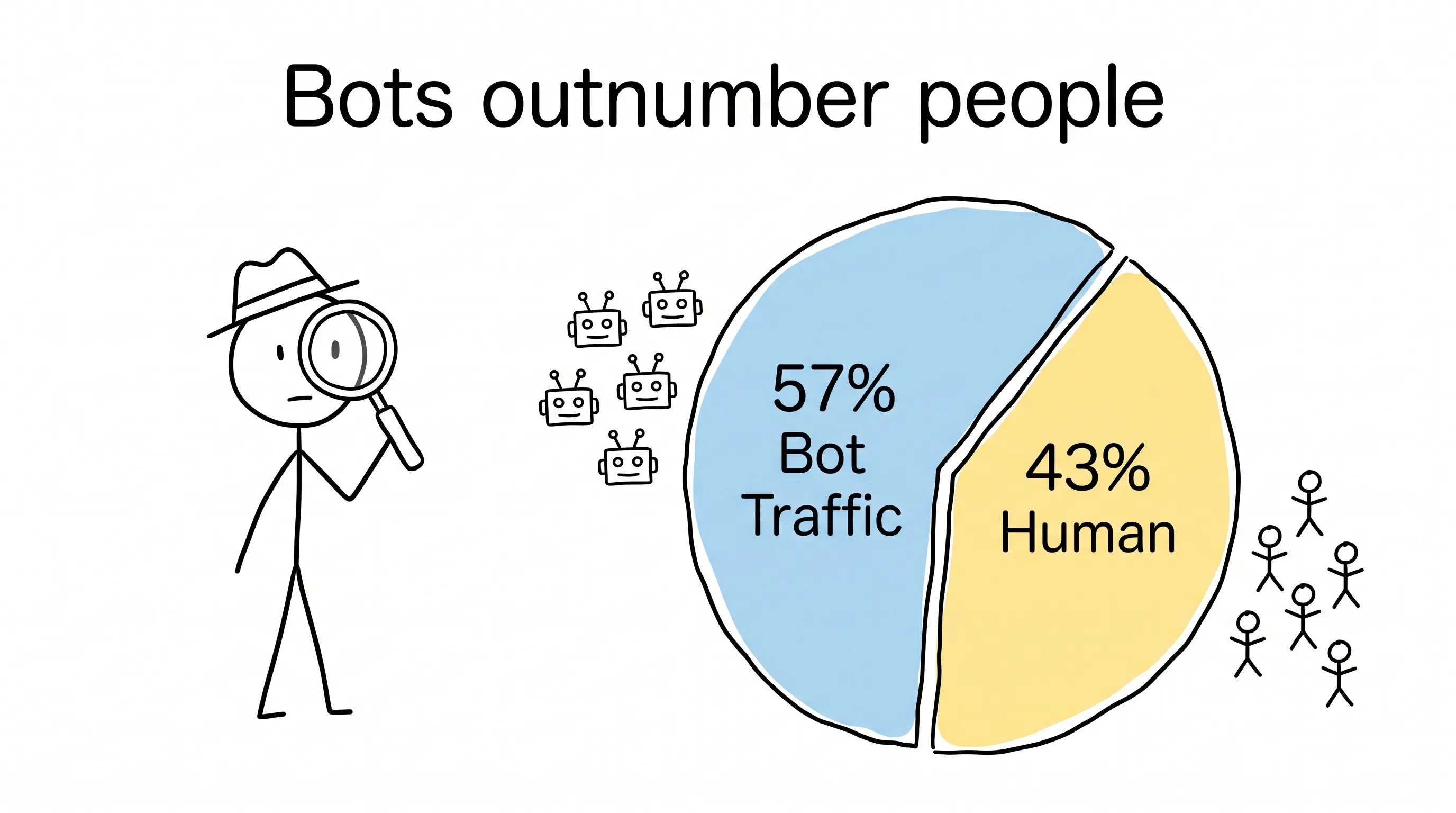
57%.
According to the cloud provider Cloudflare, this past June, roughly 57 out of every 100 requests sent to web pages across the internet came from machines. Crawlers, AI scrapers, and the agents running errands for real people—all count.
In other words, of all that lively-looking "traffic" online, more than half was never clicked by a human at all.
Scary, right? What does that actually mean?
It means you may not even be able to count who your "users" are anymore. Visitor counts in your reports are inflated, a crowd of fake spectators is mixed into your A/B tests, conversion rates get diluted. Behind every curve you look at, you first have to ask: how much of this is human?
That's why quite a few teams have already started changing their playbook: move measurement to the server side, add strict machine filtering, shift to looking at real identity and closed deals rather than traffic.
Put bluntly, from now on, a "visit" no longer naturally equals a "person."
The Foundation of Advertising Has Been Swapped Out for AI
Now look at advertising. The message from this year's Google Marketing Live conference was clear: AI is no longer a feature button inside an ad product—it is the product itself.
An example. Google launched an assistant called Ask Advisor, powered by Gemini underneath. What can it do? Stitch Google Ads, Analytics, Merchant Center—systems that used to each govern their own corner—into a single chat box. Before, you had to hop back and forth between several dashboards to check data; now you just ask out loud.
Take search ads, too. The keyword-style targeting that was once the main act is being handed over to an AI-driven approach. The migration was originally planned to finish in September; having listened to advertisers, Google relaxed the deadline to February 2027. Giving a buffer period is itself a statement: the road back is gone.
Rolling out alongside it was a whole suite of AI tools: shopping ads that can dynamically display product details, promotional components with expanded benefits, business agents that help local service providers pick up leads, conversational discovery ads designed for AI search, and a creative factory that can batch-generate images, copy, and video from a single brief.
Then there's shopping. Google built a Universal Cart—products you spot while searching, in Gmail, on YouTube, even while chatting with Gemini can all be tossed into the same cart, with checkout at the end via Google Pay or on the merchant's site. Nike, Walmart, Sephora, plus a large batch of Shopify merchants, have all gotten on board. Underneath, propping it up, is an open-source Universal Commerce Protocol, built specifically to let AI agents find products for you, compare prices, manage the cart, and complete the order.
What does it look like when the entrance to shopping changes? This.
ChatGPT Is Open for Business Too
Even more worth chewing on is OpenAI.
In June of this year, ChatGPT's advertising system opened wide to all US merchants—no minimum spend, no invite code to wait for. All you do is plug in your product catalog, and when the thought of buying bubbles up in a conversation, the relevant products get handed to the user as sponsored items. Bidding comes in two flavors, CPC and CPM, and the toolkit—conversion tracking, campaign optimization—is all there.
The interesting part is the approach: it doesn't hand advertisers user profiles. Traditional platforms sell "I know who this person is"; ChatGPT sells "I know what this sentence wants to buy." Matching happens by conversational intent, not by audience segments.
Should you try it? My view is direct: the sooner the better. If you're already running Shopping or Performance Max, the product feed apparatus can be reused directly, so migration cost isn't high. And the early-bird dividend on a new platform always belongs to the first batch in. Once everyone has crowded in and the bidding has been pushed up, the good days are over.
The Throne May Be Changing Hands
One more piece of news: unremarkable at first hearing, frightening on second thought.
If forecasts for the full year from multiple advertising-industry agencies come true, Meta's global ad revenue could surpass Google's for the first time this year. Since modern digital advertising took shape as a business, Google has never given up the head seat.
How does Meta pull it off? Reels keeps earning more and more, Advantage+ keeps expanding, and AI automatically allocates budgets and adjusts creative for advertisers. True Classic, a menswear brand, simply handed most of its Meta budget over to AI to spend—humans only set the goals and supply the creative.
Of course, this playbook has a precondition: the data volume has to be sufficient. Big advertisers get wings from it; small brands and B2B businesses still have to watch things themselves. But there's nothing to argue about on direction: for future campaigns, you supply goals and budget; AI supplies execution.
The River of Search Has Changed Course Too
For friends who do SEO, the hardest news to swallow is this: rankings and AI citations have gone their separate ways.
Before, monopolizing the first page of search results equaled monopolizing the citation slots in AI answers. After May's Google core algorithm update this year, the situation changed. June's data shows that when AI generates answers, it has begun drawing heavily from deep search results, forum discussions, industry experts, and highly structured content, no longer deferring to rank.
What kind of content is easy for AI to cite? Q&A-style pieces written clearly, deep topical coverage, key passages that are easy to excerpt, consistency with trusted sources, visible professional craft. Old signals like backlinks still work, but on the matter of AI citations their weight has lightened.
To make matters worse, a study from earlier this year showed that AI-generated overviews measurably depress the click-through rate of ordinary results.
And what does Google itself say? This year it published official AI search guidance, its attitude astonishingly calm: don't put faith in those "generative engine optimization" services that tout themselves to the sky. The elements that can get your content cited by AI are about the same as the old principles—findable, expert, accurate, and people-friendly.
Put plainly: quality content is still king; there are just a few new examiners sitting beside the throne now.
Reddit, for instance. AI especially loves citing the firsthand experience and real discussions there. With citations up, brands have to show up in person and participate in the community. But fair warning: being cited does not equal being clicked. Plenty of people finish reading AI's summary and turn right around and leave.
Money You Can't Trace Is the Hardest to Earn
That dinner-table line about "ads working less and less"—the root of the illness is probably here: attribution is broken.
Consumers nowadays ask ChatGPT, Gemini, Claude, Perplexity before buying. After asking, they may search the brand name directly a few days later and place the order. In the eyes of a traditional analytics system, that sale was brought in by "direct traffic." That AI conversation left no trace.
The credit ledger in between is blank.
What to do? The methods being tried—watching AI citations, analyzing search trends on brand terms, running user surveys, lining up the timeline of direct traffic against content publishing—are all variations on a theme. Honestly, not one of them counts as a perfect answer. But the direction is the same: traditional attribution models cannot hold the consumer journey of the AI era.
Apple, and a Few Small Things
At June's WWDC, Apple released a new version of Siri powered by Apple Intelligence: chattier, embedded more deeply into all kinds of apps, with on-device and cloud working together. On sheer momentum, Apple still trails Google and OpenAI by a step, but it is genuinely catching up, and it isn't moving slowly.
A few other items, quickly: Microsoft Ads opened up ad placement for cryptocurrency trading platforms; Google Analytics and Business Profile data are now joined, so local businesses can see conversions more clearly; on the social side, Meta is still testing AI creator labels on Instagram, with creators most worried about whether reach will take a hit; and the executive changes at The Trade Desk have ad-tech circles debating the competitive landscape again.
So Which Four Things Should We Watch
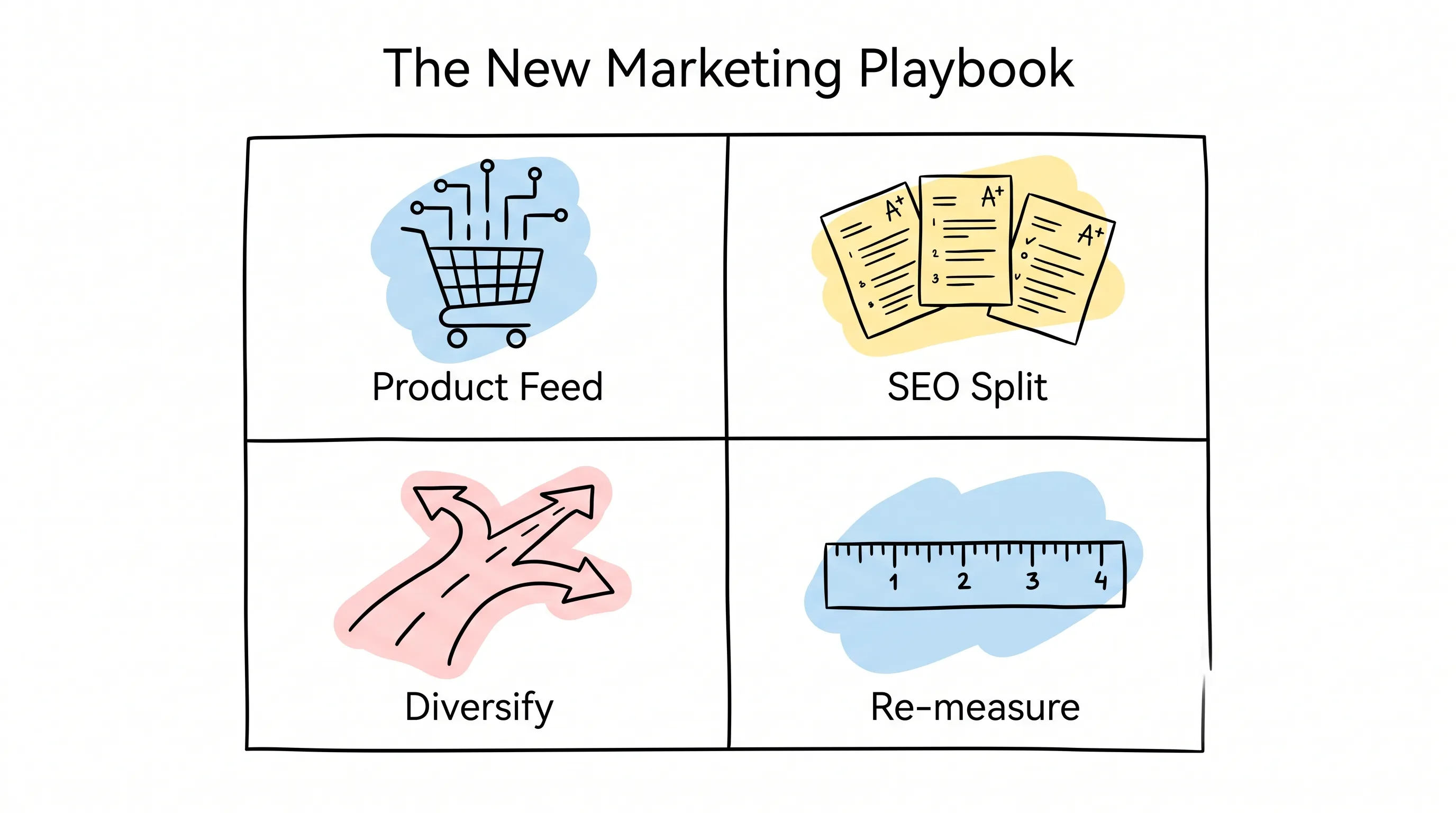
Blend the first half of this year's events together, and the battle plan for what's next comes down to four lines.
First, treat your product feed as an asset to cultivate. Whether it's Google or ChatGPT, AI can only recommend products when the structured information feeding it is clean and accurate. Inventory, price, description, reviews—one error anywhere, distortion everywhere.
Second, split SEO into three exam papers. Keyword rankings, AI citations, and AI agents' trust used to be one thing; now they are three things. One exam paper can't test three subjects.
Third, don't put your eggs in one basket. Meta, Google, and ChatGPT each have their own strengths; overcommitting to any one platform means playing by someone else's rules.
Fourth, rebuild the measuring stick. Bot traffic, AI's influence, closed-loop sales inside platforms—the old systems can't measure any of them.
Back to That Dinner
When dinner ended that day, I told my friend: your traffic didn't fall—the continent beneath your feet drifted.
Search engines are becoming answer engines, advertising is becoming autopilot, shopping is growing into the conversation, and bots are busier than people. You can't see continental drift because it moves only a tiny bit each day. By the time you see it, the coastline has already changed shape.
The good news is the direction is clear: structured data, diversified channels, measurement that keeps up with the era, and the kind of content both humans and AI can read.
Here's wishing your next visit comes from a real human being.
Continue reading
Related articles

It's 2026: Stop "Buying" AI Tools for Your Marketing Team — Start "Hiring" AI Agents
This learn article explains how AI agents differ from standalone AI tools in marketing, outlines three agent categories — build-your-own platforms, CRM-native agents, and vertical tools — and covers use cases across SEO, social media, advertising, and reporting, plus criteria for choosing one.

What Is GEO? How Your Brand Gets "Mentioned" in the Age of AI Search
An explainer on GEO (Generative Engine Optimization) for e-commerce and DTC brands: how it differs from SEO and AEO, why AI answers shape brand visibility, and eight practices covering question-focused content, consistent brand messaging, structured pages, external evidence, comparisons, and AI mention tracking.

AI Is Already Making Decisions for Your Customers. Are You on the List?
A learn article explains GEO (Generative Engine Optimization): why AI-generated answers now shape which brands customers see, and how SEO fundamentals, entity clarity, citable evidence, and monthly measurement affect visibility in AI answers.