
What Does "Chatting with Your Data" Even Mean? Mapp Turned It Into a Product
A look at Mapp AI Chat, an October 2024 addition to the Mapp AI Assistant suite built on ChatGPT-4o, which lets marketers query their data conversationally and get role-based answers in seconds rather than waiting days for analyst reports, with a caution that asking good questions still matters.
A few days ago, I had dinner with a friend who runs an e-commerce business. He vented to me: his company's back-end data was piling up like stars in the sky. But the number of people who could actually read anything useful out of it? You could count them on one hand.
Want to ask a question? Fine. File a request, wait for scheduling, and let the data analyst get through the work already on their plate. A week later, the answer arrives.
But in that one week, the market had already changed.
He said: what I'm missing isn't data. What I'm missing is an analyst who's on call and speaks plain language.
When I heard this, something immediately came to mind. In October 2024, the global marketing-technology company Mapp launched a tool called Mapp AI Chat. It's part of the Mapp AI Assistant suite, and under the hood is ChatGPT-4o.
What this thing does can be summed up in one sentence: it lets you chat with your data.
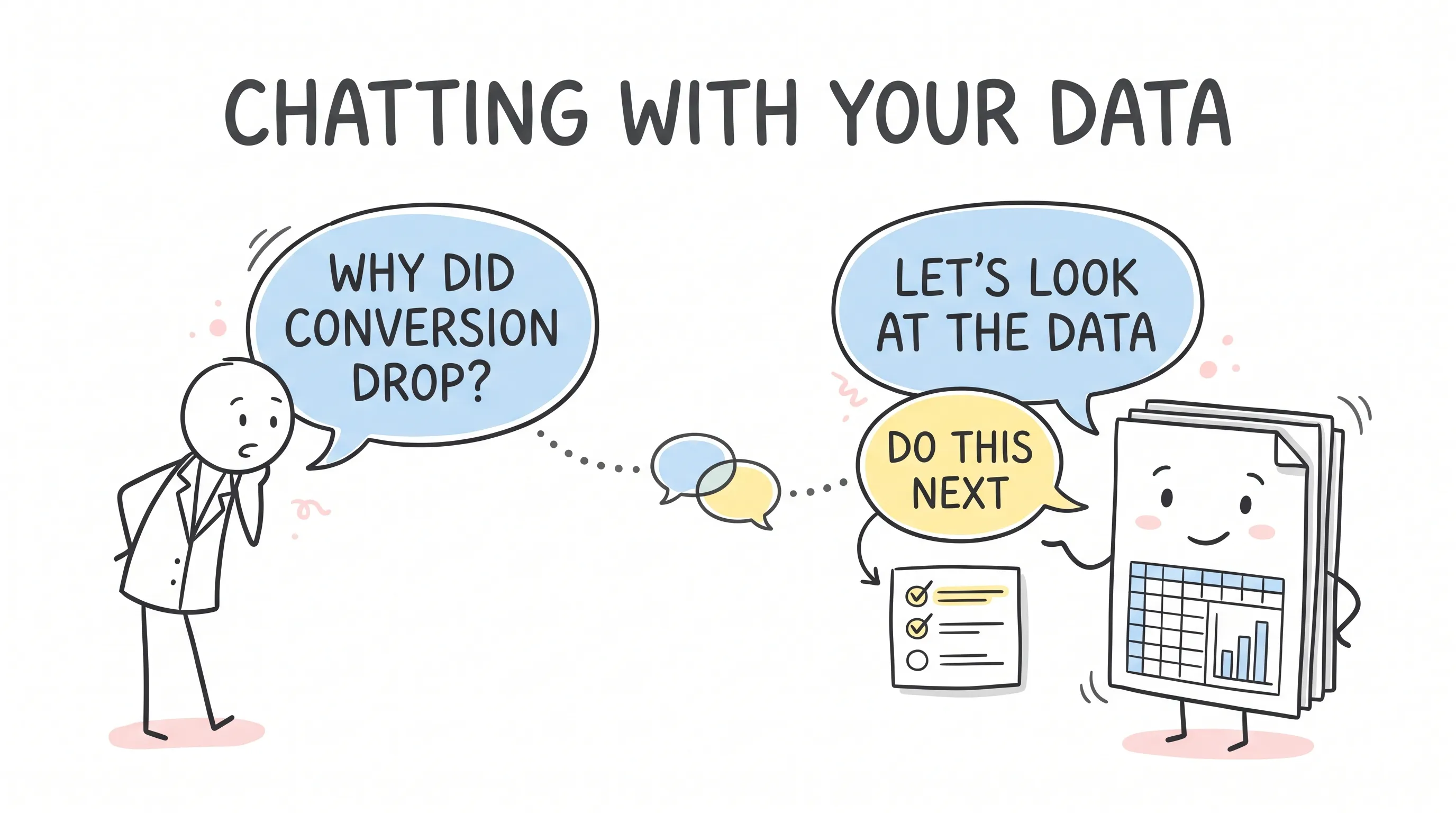
What Does "Chatting with Your Data" Mean?
Put simply, it turns a pile of complicated spreadsheets into a conversation.
You ask, it answers. You can have it explain a string of numbers you can't make sense of, ask "why did this conversion rate drop," request an executive summary, or get recommendations on what to do next, handed straight to you. In real time.
And it has no intention of turning you into a data scientist. Its plan is to translate your data into plain language for you.
It's like going to the doctor. A doctor explains the same medication to you and to a nurse in two completely different versions. It's not that the doctor is holding out on you — it's that the two of you need different information.
That's exactly the playbook Mapp AI Chat follows.
If you're a data scientist, it will go deep with you on variable correlations. If you're an e-commerce manager, it breaks down user engagement and shows you how to sharpen your next campaign. If you're a marketer, it just speaks plainly: this campaign — what worked, what to adjust.
The same data, asked by different people, yields different answers. It will even, based on your role, turn around and recommend what you should ask next.
That's the part I find most brilliant. The tool isn't just answering questions — it's teaching you to pose a better next question.
Running the Numbers
A marketer's most expensive cost has never been the software subscription. It's the waiting.
How long did an ad-hoc query take in the past? File a request, wait in line, go back and forth on details, wait for results. Two or three days on the short end, a week on the long end. And if a metric suddenly went haywire in the meantime, all you could do is watch — and wait for your slot in the queue.
And now? One sentence. A few seconds.
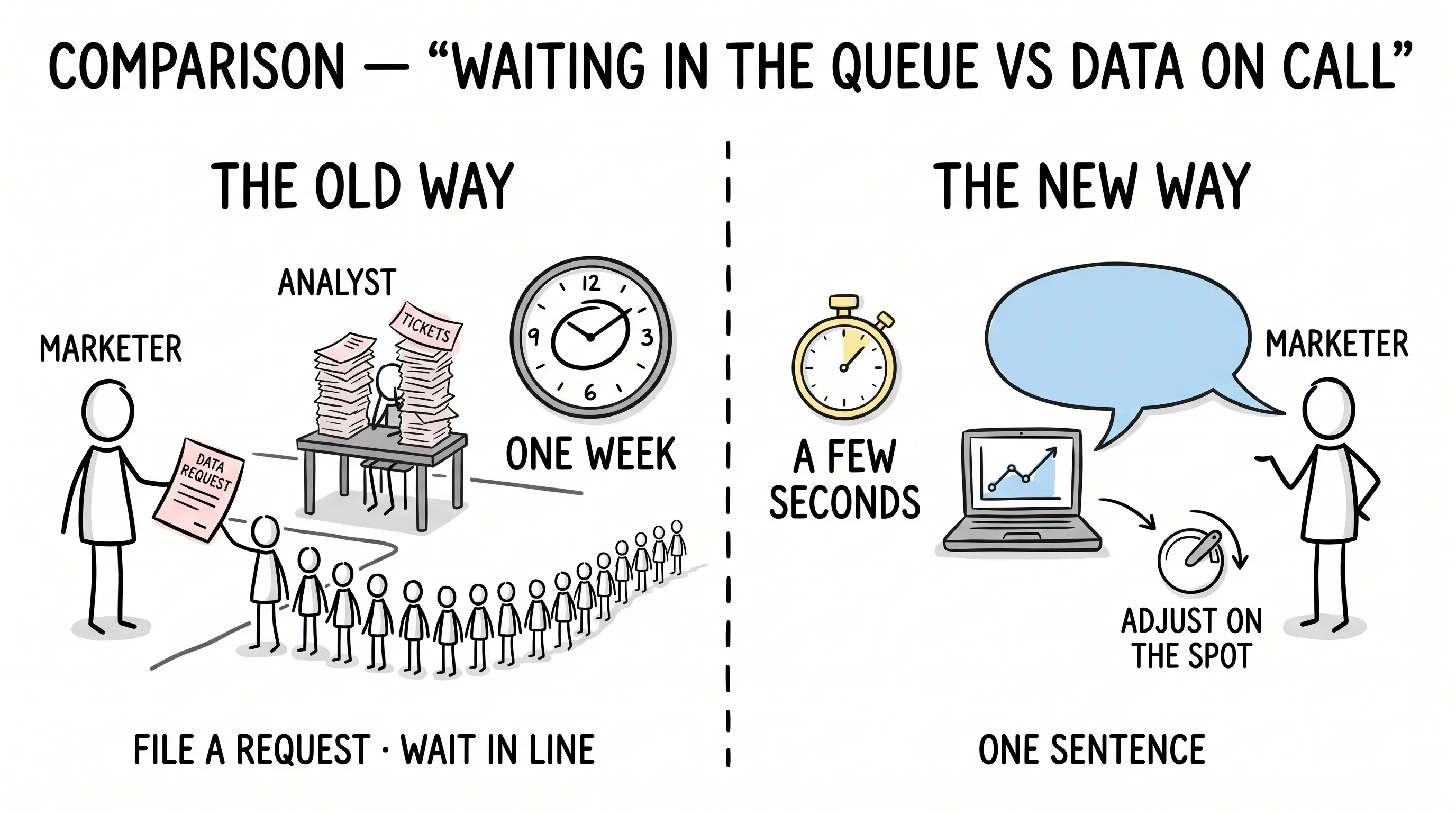
Metric moved? Ask directly. Campaign drifting off course? Look at the data on the spot, adjust on the spot. The most congested stretch of the decision pipeline has been dismantled.
Data isn't scarce — reports are everywhere. What's scarce is the step between data and decision.
Eric Lubow, Chief Technology & Product Officer at Mapp, said when the launch was announced that making data analysis more intuitive and easier to pick up has long been a priority for Mapp. By combining large language models (LLMs) with its own technology, marketers and data analysts can genuinely converse with complex data, pull out actionable insights, and make better decisions. It's one example of how Mapp is making AI-powered marketing more accessible.
In that passage, the two words I care about most are: actionable insights.
Because too many so-called data insights are beautiful, polished — and then what? There's no "then." You read them, the meeting ends, and next week it's back to business as usual.
An actionable insight means that when you're done reading, you know what to do next. Shift the budget, swap the creative, cut a channel, or slice the audience one level finer. That's what's actually valuable.
One Caution
That said, I should offer a word of caution too.
The tool lowered the barrier — but it didn't grow judgment for you.
Once data is on call, what actually sets people apart is the quality of their questions. Someone who asks well can dig out the real problem in a few rounds. Someone who doesn't, holding the strongest tool in the world, will still only produce answers like "what were last month's sales" — the kind sitting in row one of a report.
Tools democratized the answers. But the questions were always yours.
So my advice is simple: the next time you're stuck staring at data you don't understand, don't rush to file a request with the analysts. Spend ten minutes getting clear on what you actually want to know — and which decision that answer would change.
Once you've thought it through, then speak up.
Here's to staying one step ahead of the report, always, in the open ocean of data.
Continue reading
Related articles
What Is AI Marketing Automation? It Starts With a 40-Point Gap
A learn article explaining what AI marketing automation is: how learning-based systems differ from rule-based automation, how AI decisioning optimizes message, channel, and timing choices, what data it depends on, and where it applies across the customer lifecycle.

It's 2026: Stop "Buying" AI Tools for Your Marketing Team — Start "Hiring" AI Agents
This learn article explains how AI agents differ from standalone AI tools in marketing, outlines three agent categories — build-your-own platforms, CRM-native agents, and vertical tools — and covers use cases across SEO, social media, advertising, and reporting, plus criteria for choosing one.

What Is an AI Marketing Agent? From "Using AI" to "Delegating to AI"
A learn article explaining what an AI marketing agent is, how it differs from rule-based automation, and which repetitive tasks such as lead qualification, reporting, and campaign monitoring can be delegated while humans keep key decisions.