
Time to Start Writing Your Content for AI
A learn article introducing GEO (Generative Engine Optimization): how AI-generated answers differ from traditional SEO rankings, how AI engines retrieve and cite content, and ten data-backed tactics for improving brand visibility and citations in AI answers.
A few days ago, a friend of mine who runs an e-commerce business invited me out for tea. He told me about something strange.
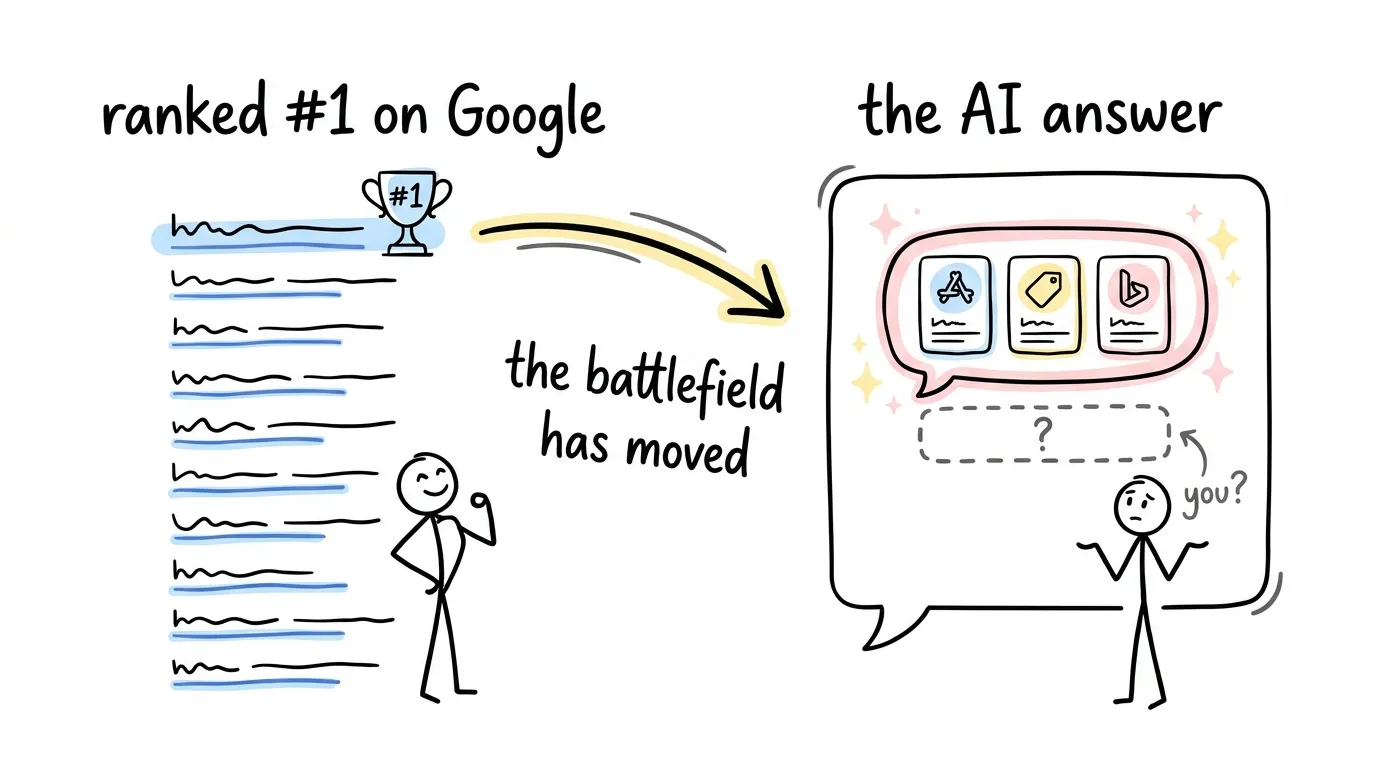
His website has been sitting firmly at number one on Google. But now, before buying anything, his son doesn't search Google at all — he just asks ChatGPT. So my friend took the single question his customers ask most often and fed it to an AI, word for word.
The AI recommended three brands.
He wasn't one of them.
The traffic is still there. The customers are gone. He asked me: have I been fighting this battle in the wrong place?
I said, exactly. The battlefield has moved. And today, I want to talk with you about that new battlefield: GEO.
What Is GEO?
GEO stands for Generative Engine Optimization.
Put simply, it's the set of methods that gets your content seen, trusted, cited, and recommended by AI search engines.
Think about it. In the past, you wrote an article for Google's ranking algorithm, aiming to land at number one among ten blue links. And now? ChatGPT, Google's AI Mode and AI Overviews, Perplexity, Gemini, Claude… these engines don't rank links for you. They write the answer directly. The answer is just a few paragraphs, with a few brand names in it.
Search engines decide where you rank. Generative engines decide whether you're in the room at all.
That's the problem GEO exists to solve.
Where did the term come from? You might be surprised: it first appeared as the title of a research paper in 2023. A researcher named Aggarwal and his colleagues built a test set called GEO-bench — ten thousand real queries — and tried nine different ways of rewriting content to see which one got cited more often in AI answers. In 2024, the research was formally published at the KDD conference.
An academic term, and in two years, it became something no one who makes content can afford to ignore.
Why Now?
You might say: AI search still sounds like a side quest, doesn't it?
Let me give you a few numbers.
In May 2026, Google's AI Mode passed one billion monthly active users. ChatGPT got there even earlier — 800 million weekly active users back in October 2025. Asking AI questions has gone from novelty to habit.
So how much traffic does AI actually send to websites? SE Ranking counted: in early 2026, AI referral traffic accounted for roughly 0.32% of total website traffic.
0.32%. Sounds tiny, right?
But that number has grown about 16-fold since 2024. And it badly understates AI's real impact. Why? Because when AI erases you from the answer, it doesn't even leave you the chance of being clicked.
Seer Interactive measured this: with the same Google exposure, brands that had been cited in AI Overviews earned 120% more organic clicks per impression than brands that hadn't.
If you're absent from the AI answer, ranking number one on Google is worthless.
So what's the relationship between GEO, SEO, and AEO?
Don't get tangled up. SEO optimizes rankings. AEO optimizes the "single answer" — the featured snippet or the one-sentence reply a voice assistant gives you. GEO optimizes being cited and recommended inside AI-generated answers. The units of measurement are completely different: SEO looks at pages, AEO looks at answers, GEO looks at paragraphs and brands.
Google itself puts it bluntly: want to perform well in my AI features? That's still just SEO — no special markup required. The real lesson you need to catch up on lives at the other engines.
One Paper, Nine Methods, Ten Thousand Experiments
The most valuable thing about GEO is that it was born carrying experimental data. This isn't received wisdom — it's measured.
Nine methods, one by one, with the results. All numbers are relative to a baseline of "doing nothing."
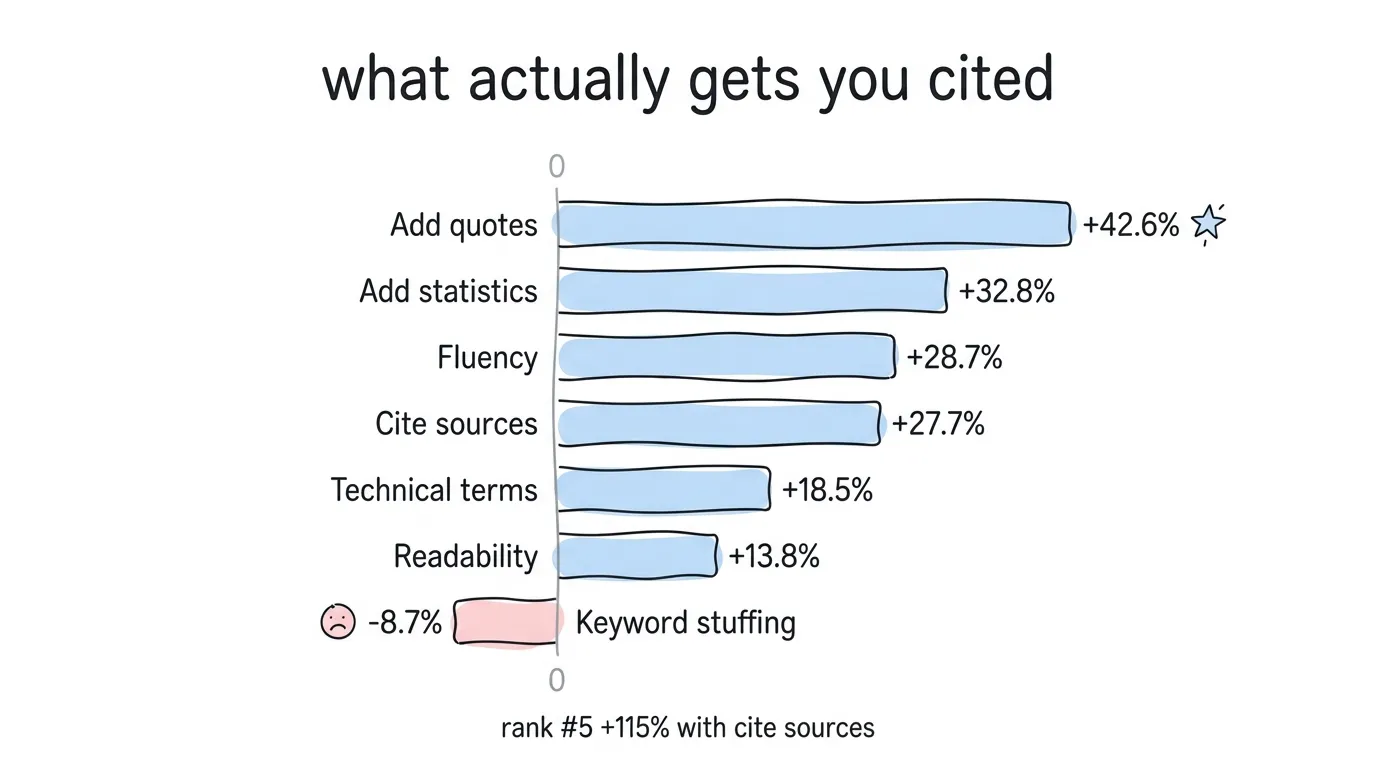
Add quotes — put in the actual words real people have said — and visibility rises 42.6%, the best result in the entire study. Add statistics: up 32.8%. Make the writing more fluent: up 28.7%. Cite sources and attribute claims: up 27.7%. Use technical terms but explain them clearly: up 18.5. Make the text easier to read: up 13.8%.
And then, the only negative number in the whole study.
Keyword stuffing: -8.7%.
The trick that never failed in the old SEO era doesn't just stop working with generative engines — it actually costs you points.
The underlying logic here, if you think about it, is actually quite simple: when AI writes an answer, it is essentially "selecting the words worth repeating." A quote with a source attached, a concrete number — that's exactly the kind of material it loves to copy into its homework. Stuffed keywords, on the other hand, only dilute the credibility density of every paragraph.
There's one more finding, and to me it's the most stunning of all.
In this study, the page ranked fifth — using the "cite sources" tactic alone — saw its visibility jump 115%. The page ranked first, using the very same tactic, actually dropped 30%.
What does that mean?
AI doesn't cite whoever is strongest. It cites whoever's words can be lifted and used as-is. The comeback opportunity for small sites is real.
Of course, the study used 2023-era models, so treat the specific numbers as a directional signal. But the direction has been validated again and again: in 2026, new research found that simply restructuring content to make it easier for AI to extract lifted the citation rate by an average of 17.3% across six generative engines.
How Does AI "Remember" You?
To really get GEO, you first have to understand how those AI engines answer questions.
Two paths.
The first path is memory. During training, the model read the whole web, and however your brand was written about is how it remembers you. What the internet says about you before the training cutoff date determines how it answers. There's no cramming for this one — your only option is consistently leaving authentic, coherent brand information across platforms, all the time.
The second path is live retrieval. The AI receives your question, first runs several rounds of searches — the industry calls it fan-out, where the question spreads out — pulls back the relevant paragraphs from web pages, and assembles them into an answer with citations attached. Google's AI Overviews and AI Mode, and Perplexity, take this path for most questions. ChatGPT and Gemini play it by ear — some questions get a live search, others get answered from memory.
Commercial questions and time-sensitive questions almost always trigger live retrieval.
So the retrieval stage is where the main battle of GEO is fought.
Surfer analyzed roughly five million web pages that got cited by AI, and a few of its findings deserve a spot in your notebook.
One: pages that cover an entire topic cluster are 161% more likely to be cited. AI breaks a question into several sub-queries. Having just one page rank isn't enough — the whole string of questions needs to lead back to you.
Two: domain authority has almost zero correlation with AI citations. Yes, you read that right. The authority an old domain has accumulated basically doesn't count here.
Three: 38% of AI Overview citations come from the first 100 words of a page.
Read those three together, and the conclusion is frighteningly clear: AI doesn't care how established you are. It only cares whether this paragraph is the best answer to this question, right now.
Ten Plays
Alright — the theory is done. Here come the plays. Ten of them, each one backed by data.
Play one: answer real scenarios, not just keywords. People no longer type "best laptop" into an AI. They say "a laptop under $600 that works for a graphic design student." Peec AI looked at more than twenty million of ChatGPT's internal searches, and over four months the average query length doubled, from 6 words to 12. Write out your customer's role, budget, constraints, and goals, put them into your content in plain language, and catch those specific versions of the questions.
Play two: give the answer first, then the explanation. On every page, in every section, the first one or two sentences should say the answer outright. AI extracts paragraphs, and a paragraph that gets straight to the point is its favorite material to carry off. If your answer is buried behind 800 words of setup, AI simply skips you.
Play three: bring evidence. This is the most brutally validated tactic of all. Key claims get numbers. Important opinions get expert quotes. Factual statements get attribution. And go one step further: publish data only you have — your own product data, surveys, benchmarks. AI needs a reason to cite you instead of the person who said the exact same thing. Write every fact as a single sentence that can be lifted out whole.
Play four: write like a human. Fluency optimization gained 28.7%, readability gained 13.8%. Short sentences, plain words, smooth transitions. Where you do need jargon, use it — that's worth 18.5% — but explain it in your own words.
Play five: cover the entire topic cluster. Behind a single ChatGPT question run about 2 searches; Google's AI Mode runs 5 to 11. Your content needs to reach all those sub-questions. But whatever you do, don't build one page per sub-query. Google calls mass page creation "scaled content abuse" — that's walking straight into the line of fire.
Play six: format for extraction. Give every section one job: a plain-language heading, one paragraph that answers directly, a little supporting detail. Options go in lists, processes go in steps, comparisons go in tables. Keep related information together, so a single paragraph can independently answer one small question.
Play seven: build your brand off-site. How AI describes you depends on what the whole web says about you, not just what your own website says. Yext counted it: 86% of AI citations come from sources the brand manages itself. Store listings, encyclopedia entries, official materials — make sure those are accurate first. For recommendation-type answers, you need to earn mentions on the blogs, reviews, and listicles that AI loves to cite. Surfer's data says mentions in blogs have the strongest correlation with how strongly AI recommends you.
Play eight: don't write text only. Surfer analyzed 36 million AI answers, and the most-cited domain of all was YouTube, at 23%. For how-to questions, a video with a clear title and description may be easier to cite than an article. Sincere discussions on Reddit and in communities — AI reads those too.
Play nine: stay fresh, stay crawlable. Ahrefs found that content cited by AI assistants is on average 25.7% fresher than Google's organic results. Update your key pages — and when you do, change the data, not just the date. On the technical side, don't block search-type crawlers like OAI-SearchBot or PerplexityBot. As for llms.txt? Google has said it outright: its search features don't use it. Don't waste your time there.
Play ten: measure, test, iterate. Test using the answers from real AI interfaces, not the API. Surfer found that API results overlap with what users actually see by only 15.5% to 31.6%. Watch these metrics: the share of target questions where your brand gets mentioned, how often you get cited, your share of voice against competitors, and whether AI gets your facts right. Then change one variable at a time — add data, restructure, rewrite the opening — and compare citation rates.
Finally, Back to My Friend
After our chat, my friend went back and did three things: he rewrote the first 100 words of his product pages into direct answers; he added his own test data to every core article; and he audited his brand information across the entire web.
Last month he sent me a message: he asked that same old question one more time.
This time, the AI's answer included him.
I don't have any profound summary. The traffic logic of this era really comes down to one sentence:
SEO decides whether AI can find you. GEO decides whether AI dares to cite you.
Have both, and you're truly in the room.
Here's to being remembered by AI — sooner rather than later.
Continue reading
Related articles

It's 2026: Stop "Buying" AI Tools for Your Marketing Team — Start "Hiring" AI Agents
This learn article explains how AI agents differ from standalone AI tools in marketing, outlines three agent categories — build-your-own platforms, CRM-native agents, and vertical tools — and covers use cases across SEO, social media, advertising, and reporting, plus criteria for choosing one.

What Is GEO? How Your Brand Gets "Mentioned" in the Age of AI Search
An explainer on GEO (Generative Engine Optimization) for e-commerce and DTC brands: how it differs from SEO and AEO, why AI answers shape brand visibility, and eight practices covering question-focused content, consistent brand messaging, structured pages, external evidence, comparisons, and AI mention tracking.

AI Is Already Making Decisions for Your Customers. Are You on the List?
A learn article explains GEO (Generative Engine Optimization): why AI-generated answers now shape which brands customers see, and how SEO fundamentals, entity clarity, citable evidence, and monthly measurement affect visibility in AI answers.