
Thinking About Replacing Salesforce? Answer One Question First
A learn article on choosing a Salesforce alternative: buyers weigh evaluation and contracting, integration and deployment, service and support, and product capability, with review-based notes on HubSpot, Microsoft, Oracle, SAP, Adobe, Zoho, and other candidates.
A while back, an old friend who runs a B2B business invited me out for coffee. He had barely sat down before he sighed: his company had been on Salesforce for years, and lately people inside were quietly mulling a switch. He wanted me to recommend a few candidates.
I didn't answer directly. I asked him a question back: what are you trying to solve by switching?
He paused for a beat.
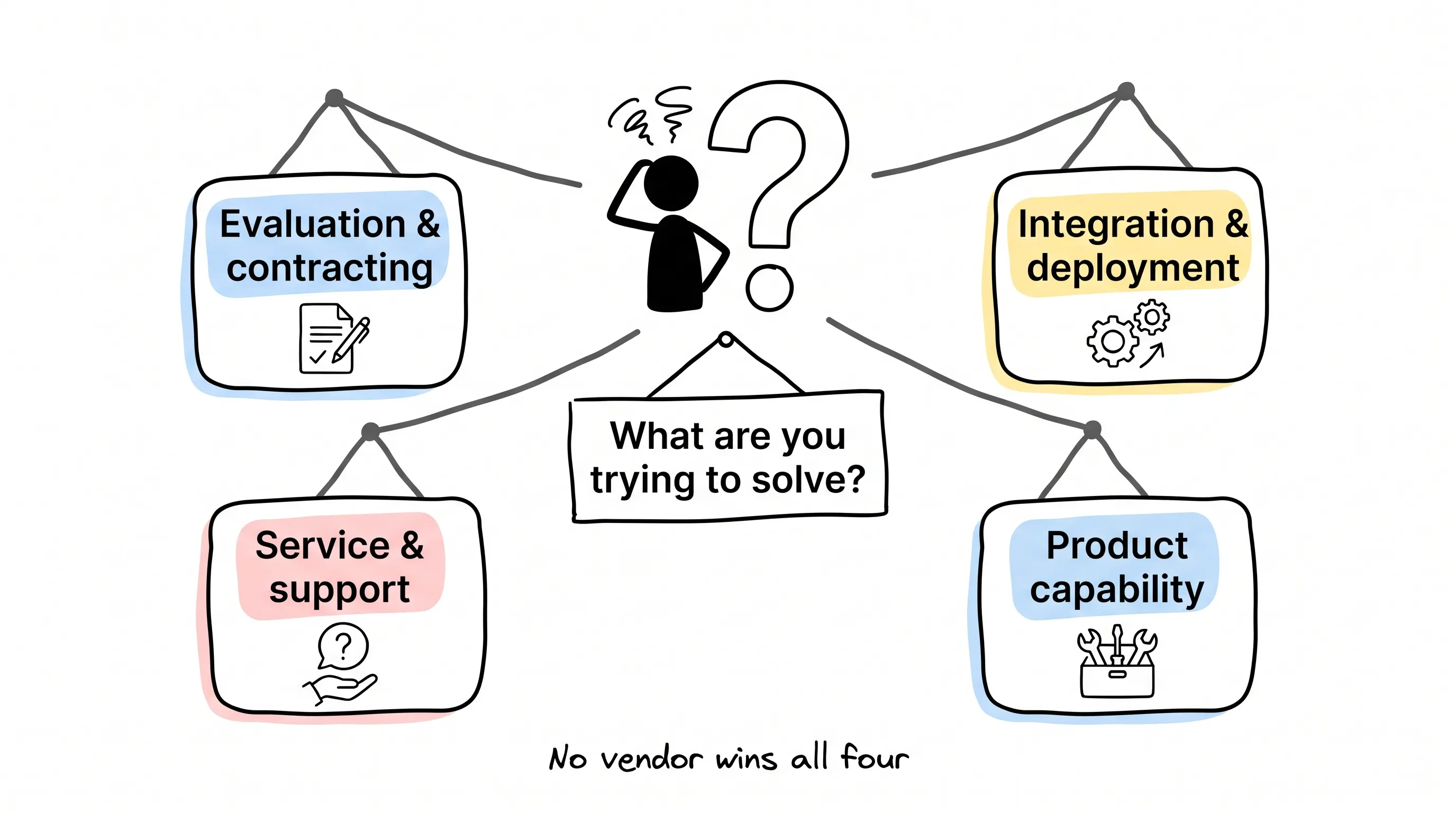
That question matters. Because if you go read the reviews left by people who have actually bought and used these systems, you'll notice something fascinating: buyers seriously considering Salesforce alternatives never compare on a single score.
When real buyers make their choice, they mainly wrestle with four things: the experience of evaluation and contracting, the difficulty of integration and deployment, the quality of service and support, and the product's own capabilities.
Rarely does one vendor excel at all four at once.
So Who's on the Shortlist?
Over the past 12 months, the vendors Salesforce users have seriously considered are roughly these: HubSpot, Microsoft, Oracle, SAP, Adobe, Act-On, Zoho, plus a few smaller players.
Let's take them one by one.
First, HubSpot.
4.4, from 2,218 ratings.
What does 2,218 ratings mean? It means that, whether you like it or not, that many people paid real money, used it, and then scored it. That number is solid. One user says they run their paid and organic marketing emails and campaigns through HubSpot's Marketing Hub, and handle social media publishing there too. It offers SEO optimization suggestions, lets you build CTAs and forms right inside, and keeps inbound and outbound leads in one place. That same user ran the numbers: this workflow saved them over 70 hours of manual work — tasks that used to take several people working separately now don't, and costs came down with it.
See what users praise? Less hassle, fewer people, less money.
Now, Microsoft.
One company uses Dynamics 365 Customer Insights to pull data from their CRM, e-commerce, ERP, and customer service platform into one place. Its CDP (customer data platform) capabilities are very strong at building unified customer profiles, and it connects natively with Microsoft's own Azure, Power BI, Teams, and Dynamics 365 Sales — something no one else can offer. AI-powered segmentation plus real-time journey orchestration took their personalized marketing up a notch.
But the early data mapping? Painful.
Thankfully, in their own words: the result was worth the ordeal.
What about Oracle?
The thing Oracle Eloqua users bring up most: the learning curve is steep. But it can carry complex multi-step marketing automation, advanced segmentation, and customer journeys; its scalability, data control, and workflow flexibility are all intact — a fit for enterprise marketing teams.
Now here's the interesting part. When buyers score these two side by side, Salesforce actually comes out higher on several counts: better service and support, easier integration and deployment, and a smoother evaluation and contracting experience.
A little surprising, isn't it?
Oracle's strength is carrying complexity; Salesforce's strength is peace of mind. Neither one steamrolls the other across the board.
On the SAP side, the score is the highest of the bunch: 4.5.
But don't get excited yet.
82 ratings.
Same four and a half stars — but behind HubSpot's score stand 2,218 raters; behind SAP's, 82. Here's an analogy: one is a restaurant rated four and a half stars by two thousand-plus diners; the other is a restaurant rated four and a half stars by about eighty. The latter might be a genuine hidden gem, or it might just not have met the crowd that doesn't like it yet. Different sample sizes, different weight behind the score.
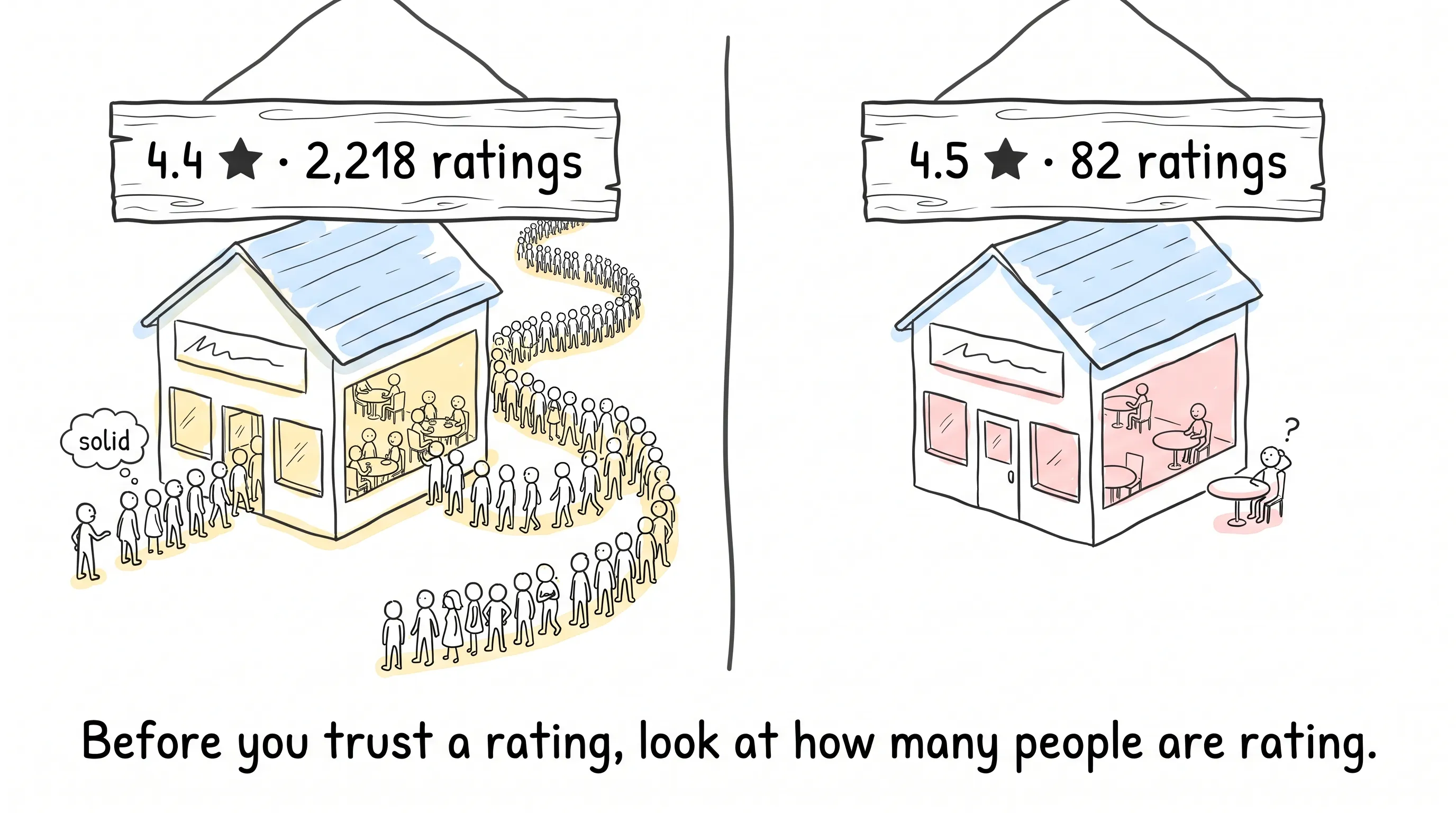
Before you trust a rating, look at how many people are rating.
Users' verdict on it is clear, though: it is solid at running cross-channel, data-driven campaigns, with strong segmentation, suited to more precise B2B journeys.
Then there's Adobe. Of all of them, I find this one's reviews the most worth reading closely.
One user went live on Adobe Marketo six years ago. At the time they didn't even have a marketing automation platform — all they had was an email system. Marketo's step-by-step interface, where smart list conditions and automation actions run along one clear single flow, was especially friendly to an organization just stepping through the automation door.
You might find that too basic. But for people just starting out, basic is the biggest value.
Six years later, this company now leans on Marketo heavily. They didn't spin up several instances; they folded their global marketing database into one instance, connected to their CRM; every lead coming in from the web flows from a Marketo form into Microsoft Dynamics.
One more detail stuck with me: permissions aren't one-size-fits-all. View, create, edit, update, delete, approve — each level can be authorized separately. The bigger the enterprise, the more that granularity is worth.
Even a major version migration — the kind of surgery that rattles an organization — Adobe handled steadily.
So you see, what Marketo users praise is that it grows up alongside you.
The Rest, in Brief
Zoho: 4.3, from 875 ratings. Users say it's easy to manage and scalable, bringing sales, marketing, and back-end support under one roof. But whether it fits has a precondition: you have to value a highly customizable ecosystem more than out-of-the-box smoothness.
Act-On: 4.2, from 100 ratings. Users find it works great for email marketing paired with a CRM.
Sugar Market scores only 3.3. Users say it is direct enough for standard campaigns, core automation, and lead tracking, but the interface and workflows aren't as smooth as newer platforms, and advanced customization takes a lot more effort. A low score doesn't mean it's unusable. It only means that in some places, it didn't keep up.
Two smaller ones: CRMNEXT, from BUSINESSNEXT, does solid work on a panoramic, unified view of customer data and on sales pipelines — 4.2; Acoustic Connect has intuitive dashboards that let non-technical operators run campaigns and multichannel personalized outreach — 3.7. The people who like them really like them.
So, How Do You Actually Choose?
By the second half of that coffee, my friend asked me: so tell me, how should I pick?
My answer was still the line from the start: first get clear on what you want to solve.
Just starting out and wanting one platform to manage inbound and outbound leads? HubSpot's hassle-saving, headcount-saving approach will hit the spot. Data scattered across CRM, e-commerce, and ERP, and you want to pull customer profiles into a single unified view? Go look at Microsoft's CDP. Enterprise-scale, with campaign logic so complex nobody dares touch it casually? Veterans like Oracle Eloqua and Adobe Marketo that can carry complexity deserve a serious evaluation. Budget-sensitive but willing to tinker with customization yourself? Zoho deserves a spot on the shortlist. As for SAP — the score is beautiful; just check how many people rated it before you judge.
Oh, and the most easily overlooked point: what others call an "alternative" is not necessarily stronger than Salesforce in every respect. At least on service and support, integration and deployment, and evaluation and contracting, buyers' scores stand on Salesforce's side.
There is no best product, only the one that best fits the problem you have right now.
When the coffee was done that day, he didn't ask me to recommend any single vendor. He said he'd go back, hold a meeting first, and list out the problems to solve one by one.
That's exactly right.
Here's wishing him a smooth selection. And wishing you the same: may you never press the confirm button on a system switch before you've thought it through.
Continue reading
Related articles

It's 2026: Stop "Buying" AI Tools for Your Marketing Team — Start "Hiring" AI Agents
This learn article explains how AI agents differ from standalone AI tools in marketing, outlines three agent categories — build-your-own platforms, CRM-native agents, and vertical tools — and covers use cases across SEO, social media, advertising, and reporting, plus criteria for choosing one.

What Is GEO? How Your Brand Gets "Mentioned" in the Age of AI Search
An explainer on GEO (Generative Engine Optimization) for e-commerce and DTC brands: how it differs from SEO and AEO, why AI answers shape brand visibility, and eight practices covering question-focused content, consistent brand messaging, structured pages, external evidence, comparisons, and AI mention tracking.

AI Is Already Making Decisions for Your Customers. Are You on the List?
A learn article explains GEO (Generative Engine Optimization): why AI-generated answers now shape which brands customers see, and how SEO fundamentals, entity clarity, citable evidence, and monthly measurement affect visibility in AI answers.