
The Next Battle in Cross-Border E-Commerce Isn't in the Shopping Cart. It's at the Customs Desk.
A learn article arguing the next AI battleground in cross-border e-commerce is customs clearance: it covers HS code misclassification risks and describes how AEB applies AI to code classification and document extraction, so people review results instead of manual entry.
A few days ago, a friend of mine who runs a cross-border trade business came to vent.
One shipment, bound for Europe, had been stuck at customs for half a month. The reason was remarkably simple: the HS code (Harmonized System code) had been classified into the wrong category.
The goods sat in the yard while storage fees burned away day after day. The freight forwarder, the customs broker, the client — the phone never stopped ringing from all three.
I asked him: why does this work still have to be done by hand, one field at a time?
The AI in the Shopping Cart — You've Seen It Already
First, the obvious stuff.
The most famous battleground where AI is transforming cross-border e-commerce is the selling side.
Shopify has published a set of figures: with AI-powered product recommendations, a merchant's revenue can grow as much as threefold, conversion rates can more than double, and average order value can climb by up to 50%.
Behind those numbers, the whole market is swelling. In 2025, the global cross-border e-commerce market pushed past $551 billion. In DHL's 2025 e-commerce trends report, AI ranked among the most eagerly anticipated innovation directions worldwide; at that same year's Balkan e-commerce summit, the experts were talking about exactly the same things: hyper-personalization, predictive analytics, conversational shopping, automated delivery.
Even earlier, at the end of 2024, practitioners in the cross-border space had already distilled AI's reshaping of China–Europe trade into five themes: anti-fraud, personalization, compliance, translation, and more. Looking back now, they've come true one by one.
So on the selling side, AI holds no surprises anymore.
But the Real Hard Nut Lies Where You Can't See It
What about logistics and customs clearance?
That's exactly where my friend got stuck.
What is an HS code, anyway?
An HS code is an ID number for every kind of goods on earth. When you ship a consignment, customs reads that number first — only then do they know how much duty to collect, whether to inspect, whether to release.
The trouble is, assigning that number is remarkably easy to get wrong.
Take the same lamp: with a dimming function or without, the code may differ. Get the code wrong by one digit and the duty rate is off by one bracket; get the rate wrong by one bracket, and at best you pay the duty you owed — at worst, the whole shipment is seized.
A customs-compliance team faces hundreds, sometimes thousands, of documents a day, hunting for the one right code among tens of thousands. That isn't work. That's firefighting.
Two Answers from AEB
There's a company that specializes in customs software, called AEB. They've applied AI to two very concrete problems.
The first: HS code classification.
An AI model reads the product description, historical declaration records, and the classification taxonomy together, then automatically suggests a code. Humans go from "flipping through books to find the number" to "reviewing and confirming." Error rates fall; clearance speeds up.
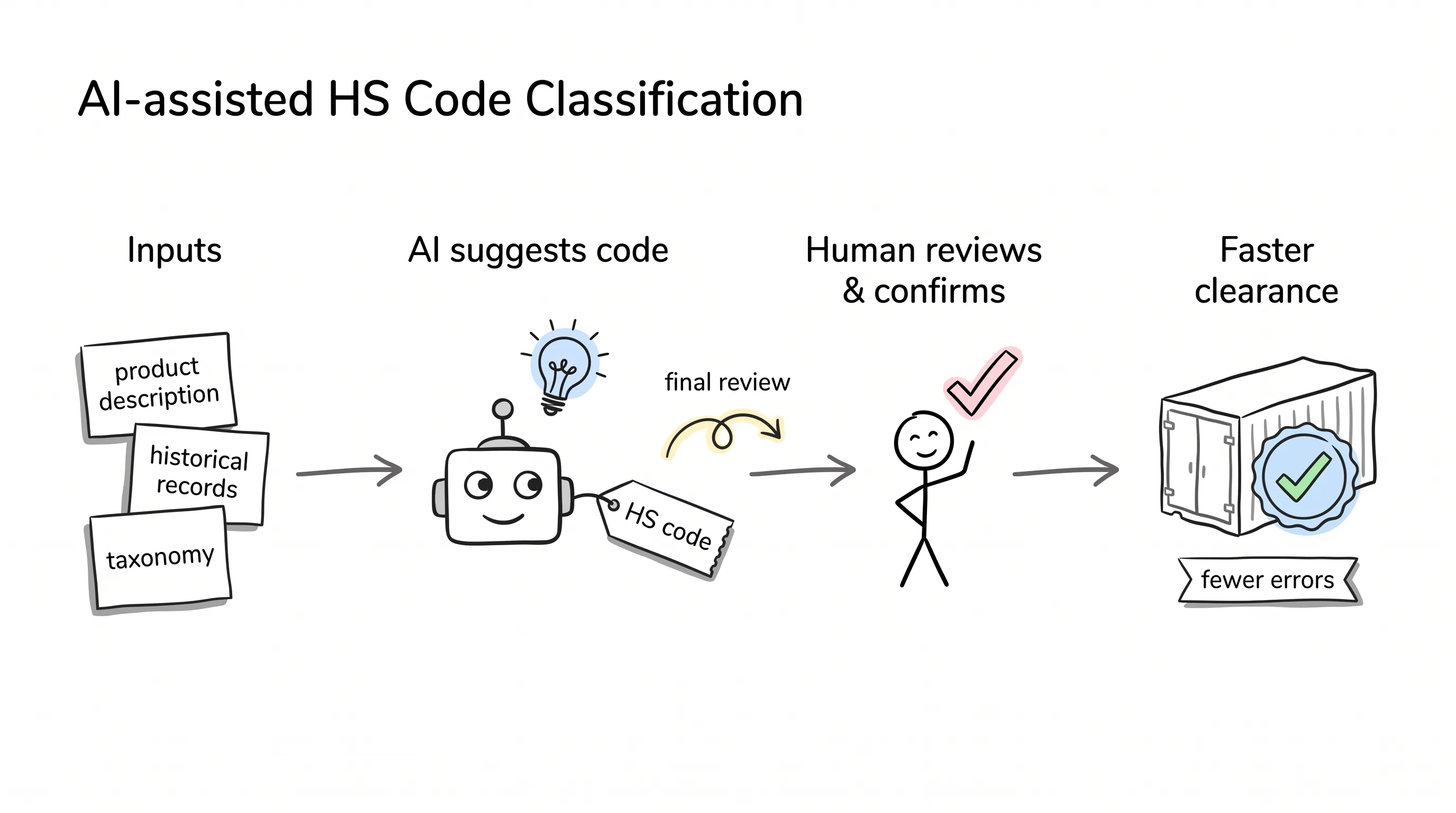
The second: document extraction.
What's the most painful part of customs declaration? The paperwork. Invoices, bills of lading, packing lists — all PDFs, all unstructured. It used to be typed in field by field, by hand. Now AI pulls the information straight out of the documents, turns it into structured declaration data, and fills it in automatically.
Think about it: a single bill of lading has dozens of fields. How long does a skilled operator take to enter one? For AI, it's a matter of seconds — and it never tires, never loses focus, never skips a line.
There's an observation circulating in the industry: the fastest-growing use of generative AI in logistics is precisely customs declaration and cross-border flows. Why? Because that's where the repetitive labor is heaviest, and the cost of a single mistake is highest.
The Quiet Revolution
So I often say this is a quiet revolution.
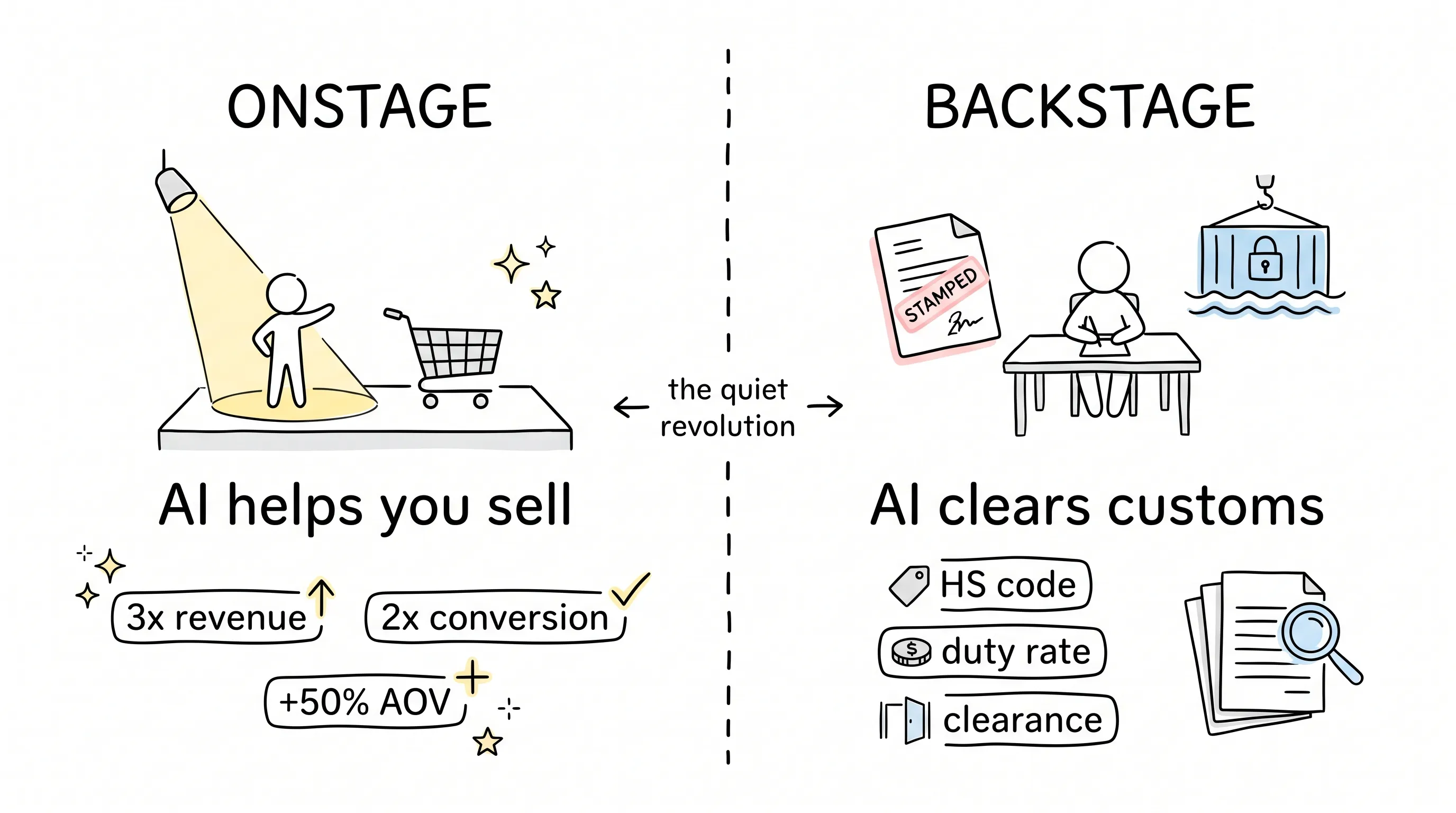
Onstage, AI is helping you sell. Backstage, AI is getting your goods through customs.
AI has turned customs compliance from manual firefighting into intelligent orchestration.
That modest onstage growth? Without the system underneath holding it up, it never touches the ground. However precise the recommendations, if the goods can't clear customs, it all adds up to zero.
One more thing: this isn't about replacing customs professionals. Only when people are freed from tens of thousands of codes can they do what genuinely requires judgment: when the rules change, how to adjust strategy; when the tax system shifts, how to re-route.
Machines handle the repetition. People handle the judgment. That's the right way for AI to enter the cross-border trade business.
Back to That Shipment
Later I told my friend: your shipment, if it happened today, most likely wouldn't sit at customs for half a month.
Send in the product description, and the code suggestion comes back in seconds. Upload the bill of lading, and the declaration data generates itself. What he should be doing is giving it one final review before confirming.
He went quiet for a moment, then said: two years too early.
Yes.
Here's to your next shipment — green lights all the way.
Continue reading
Related articles

What Is an AI Marketing Agent? From "Using AI" to "Delegating to AI"
A learn article explaining what an AI marketing agent is, how it differs from rule-based automation, and which repetitive tasks such as lead qualification, reporting, and campaign monitoring can be delegated while humans keep key decisions.

Marketing Automation Is Shifting from "You Do It" to "You Say It"
This article explains how marketing automation is shifting from rule-based platforms that merely execute toward AI agents that plan, create, publish, and review campaigns, covering delegable tasks, underlying technologies, tool categories, adoption steps, and risks such as privacy and automating without strategy.

When AI Does the Creative, Mistakes Come in Batches Too
A learn article on the risks of using generative AI for marketing creative across brand, legal, compliance, and operational layers, with case examples and seven practices for review, rights clearance, documentation, and vendor governance.