
The Lead Came In, But Nobody Called for 48 Hours: The Three Layers of AI Tools Defining B2B Lead Generation in 2026
A bilingual guide to AI lead generation for B2B in 2026, covering predictive and intent-based scoring, data enrichment, and routing tools across three layers. It also discusses compliance checks for black-box scoring and share-of-model visibility in AI answers.
Let me start with a scenario.
A prospective customer fills out the form on your website at 1 a.m. He's serious — he lists his company name, budget, and requirements in detail.
Then what?
Then that lead sits in your system for 48 hours before a human finally routes it to a salesperson.
Forty-eight hours. Two days. Meanwhile, that night, the buyer researched five or six of your competitors. By the time your rep finally calls on day three and opens with, "Hi, do you happen to have a purchasing need?"
He already bought from someone else.
That's the most painful truth about B2B lead generation today: It's not that you don't have leads. It's that once a lead comes in, you're too slow to act on it.
So what do you do? I've recently gone through the current crop of AI lead-generation tools, and I want to share my take.
First, Get Clear: What Is AI Lead Generation?
At its core, AI lead generation uses machine learning to do four things for you: find customers, score them, enrich the data, and route the work.
Note that all four of these used to be human jobs. Rules, gut feel, and sales managers making judgment calls like "this one looks like a winnable deal."
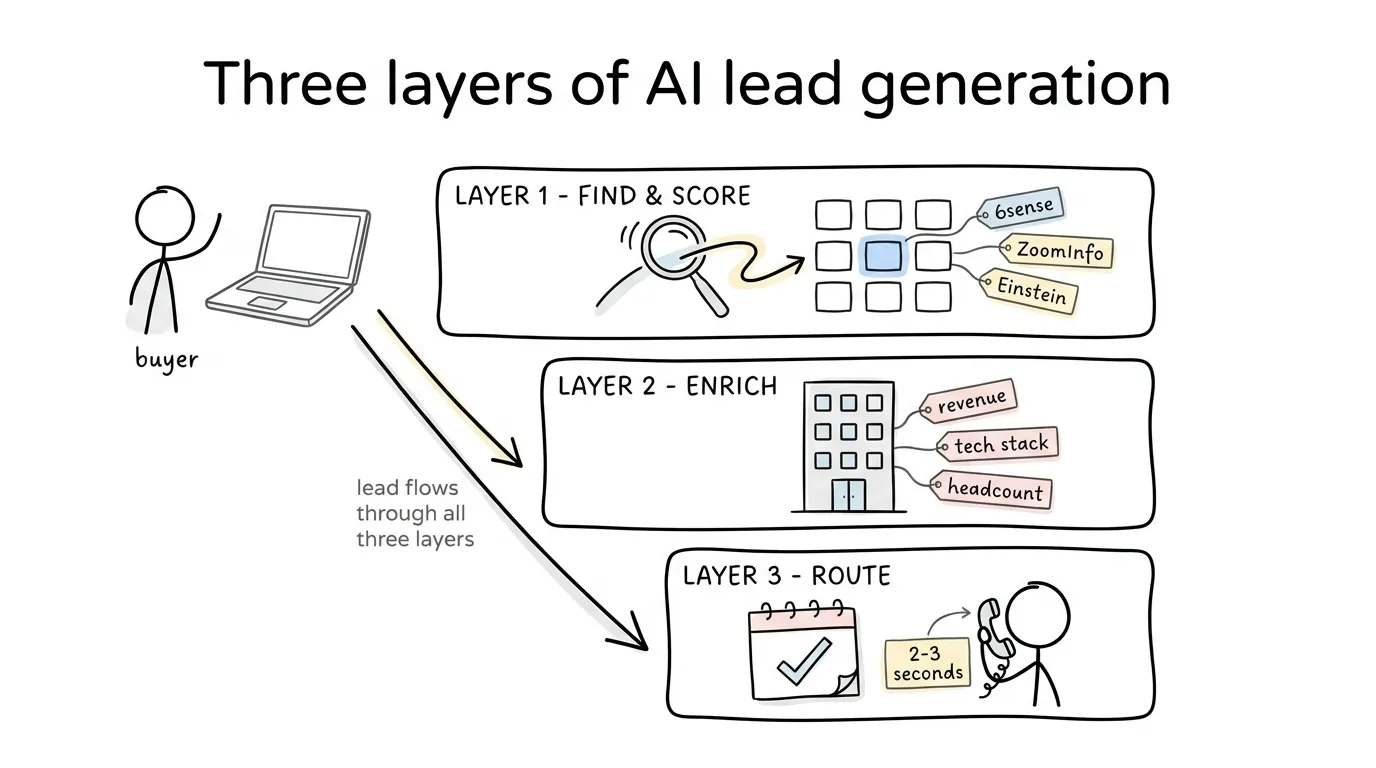
Now, think in three layers.
Layer one: finding and scoring customers — digging the best accounts out of the market and ranking them by priority.
Layer two: data enrichment — filling in a company's revenue, tech stack, and headcount to make scoring more accurate.
Layer three: routing — the moment a lead arrives, booking a meeting and handing it to sales within seconds.
The three layers interlock. No single tool covers all three, no matter what the pitch says. Don't believe it.
Why is all of this suddenly so hot? Forrester's research found that 88% of B2B companies are already using — or planning to use — AI agents. Why? Because the way buyers purchase has changed, and manual scoring simply can't keep up with how fast they research.
Two Kinds of Scoring — Don't Mix Them Up
Whenever AI scoring comes up, people tend to conflate two very different things. Let me draw a clear analogy.
Predictive lead scoring ranks the people already on your list. It trains a model on all your historical closed-won and closed-lost data and calculates each contact's "probability of buying." For example, HubSpot's "Likelihood to Close" gives a score of 22, which means a 22% chance of closing within 90 days. Plain enough, right?
But there's a catch. HubSpot itself admits this is black-box machine learning. You get the score, but how it was calculated stays invisible.
Intent-based account scoring is a different animal. Instead of watching the people on your list, it monitors the entire market. Platforms like 6sense capture billions of buyer signals from across the web — including which reviews prospects read on G2 and TrustRadius — and then tell you: these companies are actively researching your category right now, and they haven't even filled out a form yet.
One ranks the leads you already know about; the other scans the whole field and surfaces buyers who haven't raised their hands.
In B2B, the purchase decision is usually made by a buying committee, not a single person. So you need both.
The Three Layers, Tool by Tool
Layer one: finding and scoring customers.
6sense is the flagship of intent-based scoring. It replaces the traditional MQL with 6QA — its own definition of a "qualified account." The vendor's own numbers: opportunities sourced from 6QA carry 99% higher average deal sizes and close 27% faster. Honestly, though, its biggest historical weakness has been exactly that black box — the good news is that 6sense has placed explainable scoring at the center of its 2026 product roadmap and is moving toward transparency.
ZoomInfo Copilot wraps an AI layer around ZoomInfo's B2B data, pushing ranked accounts, buying signals, and even AI-drafted emails directly to salespeople. Its beta results were striking: it predicted nearly half of users' existing pipelines, roughly doubled the opportunities they created, and saved each rep about 10 hours of research per week. It now also ships with a privacy dashboard and cookieless tracking, which makes it friendly to compliance-sensitive teams.
Salesforce Einstein wins on being "native." Scores live directly inside your CRM and are computed on your own historical data. Low friction — for longtime Salesforce users, it's the obvious choice. It now refreshes scores on a regular cadence and breaks out the impact of each contributing factor — a direct answer to the industry-wide pressure for explainability.
Layer two: data enrichment.
HubSpot's Breeze pairs CRM-native scoring with credit-based data enrichment, feeding company revenue, tech stack, and headcount into the model. It also offers a sandbox where operations teams can test LLM-based filtering logic before anything goes live. A thoughtful touch.
Apollo.io bundles data and email sequences into a single offering at $49 per user per month, plus a "Shadow SDR" agent that automatically generates email variations. As for its claimed meeting-lift numbers, I'd verify the sample sizes and third-party validation first — the price is genuinely great, but run the math yourself.
Layer three: routing. This is the layer where deals quietly go to die.
Consider these numbers: Cal.com goes from form submission to booked meeting in 2 to 3 seconds, is open source, and can be self-hosted in the EU. RevenueHero takes 10 to 15 seconds and costs $30 to $40 per user per month. Chili Piper takes 15 to 30 seconds, runs $30 to $80, and has built-in PECR and GDPR guidance.
Think about it: 2 to 3 seconds, versus that 48-hour opening story. How many orders of magnitude apart?
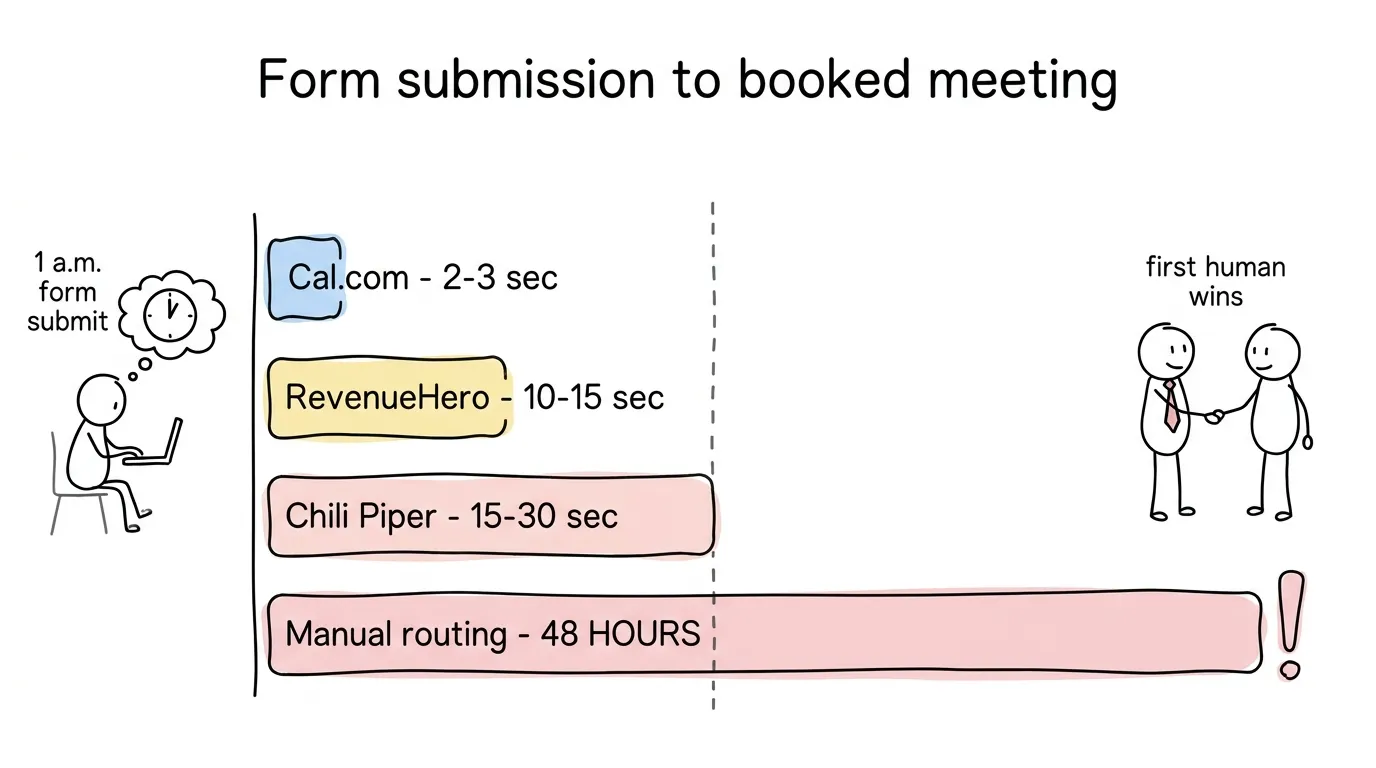
The deciding factors in this layer aren't the feature checklist — everyone's features look about the same. It's integration maturity and speed. Whoever gets a live human in front of the buyer first, wins.
How to Choose: One Hard Standard
On August 2, 2026, the EU AI Act's full set of obligations took effect. That changed a fundamental assumption: For regulated teams, black-box scoring tools have gone from "not ideal" to "not legally usable."
So when you're evaluating vendors, run through four checks — and don't skip a single one:
First, explainability. Can every factor behind a score be broken out? Salesforce Einstein, ZoomInfo, and Apollo have already done this; 6sense has committed to follow in 2026.
Second, data lineage. Can you trace which node performed the inference and prove that logs are retained with zero retention? Buyers genuinely ask "where does the inference run?" these days.
Third, regulatory coverage. Is it GDPR-aligned? If you're doing voice and SMS outreach, what about TCPA and HIPAA guardrails?
Fourth, compliance documentation. Demand evidence, not promises. Whoever publicly published audit-grade materials ahead of the August deadline is the one you can trust.
One sentence: Blacklisting black-box tools isn't posturing — it's compliance.
The Unsexy (and Smartest) Way to Build Your Stack
For a mid-market B2B company, I have exactly one piece of stack-building advice: Go one layer at a time. Run a small pilot, let the ROI speak, then scale.
For the scoring layer, if you want CRM-native simplicity, go with HubSpot or Salesforce Einstein; if you want to surface accounts that haven't raised their hands yet, go with 6sense. For enrichment, if budget is tight, Apollo; if you're already in the HubSpot ecosystem, Breeze. For routing, if you want maximum speed and EU hosting, Cal.com; if you want fuller routing features, Chili Piper or RevenueHero.
There's a McKinsey finding I love: most salespeople spend less than half their time actually selling. Which means every hour you automate back is real money.
But two disciplines matter more than which tools you pick.
First, pair tools with training. Teams that invest in training beyond the tools see clearly stronger returns. Buying a great knife without learning knife skills is a waste of money.
Second, keep humans in the loop. Governance with human oversight dramatically reduces serious incidents. You can choose not to look at AI's scores, but when something goes wrong and you can't explain it to the outside world, don't say nobody warned you. And the research keeps saying it too: even as automation expands, more than 70% of skills remain relevant — tools take over the process, not the judgment.
A Quick Word on a New Term: Share-of-Model
Finally, something that's quietly replacing SEO.
Your buyers no longer research on Google — they go straight to ChatGPT, Perplexity, or Gemini. So what's the new metric of visibility? Share-of-Model — how often your brand gets cited in AI answers.
How do you get AI to cite you? Five things:
Open with the answer in the first sentence or two — AI engines grab the first factual statement. Put a 50-word TL;DR under the headline. Publish quotable facts — price ranges, speed benchmarks, ROI tables — under permissive licenses. Write subheadings in the exact words buyers use when asking AI. Update monthly and timestamp in ISO 8601 — large models weight freshness heavily.
In the past, analyst reports sat behind paywalls and updated once a year. Now, public, frequently updated, fact-dense guides are exactly what AI engines seize on as the "de facto standard." That window is still open.
The Bottom Line
Back to that person filling out your form at 1 a.m.
He had actually made up his mind long before — before your salesperson called, before he asked AI "who's the best in this space?" Your job isn't to wait for him to raise his hand. It's to use the three layers of tooling to spot him before he raises his hand, and to catch him within three seconds after he does.
B2B lead generation in 2026 isn't about who has the most leads. It's about who responds fastest, who runs the fewest black boxes, and who dares to put a human in front of a human first.
Stop letting good leads spend the night in your system.
Here's to every form submission being caught in under 3 seconds.
Continue reading
Related articles

It's 2026: Stop "Buying" AI Tools for Your Marketing Team — Start "Hiring" AI Agents
This learn article explains how AI agents differ from standalone AI tools in marketing, outlines three agent categories — build-your-own platforms, CRM-native agents, and vertical tools — and covers use cases across SEO, social media, advertising, and reporting, plus criteria for choosing one.

What Is GEO? How Your Brand Gets "Mentioned" in the Age of AI Search
An explainer on GEO (Generative Engine Optimization) for e-commerce and DTC brands: how it differs from SEO and AEO, why AI answers shape brand visibility, and eight practices covering question-focused content, consistent brand messaging, structured pages, external evidence, comparisons, and AI mention tracking.

AI Is Already Making Decisions for Your Customers. Are You on the List?
A learn article explains GEO (Generative Engine Optimization): why AI-generated answers now shape which brands customers see, and how SEO fundamentals, entity clarity, citable evidence, and monthly measurement affect visibility in AI answers.