
The Conveyor Belt Keeps Speeding Up
A commentary on the annual CMI and MarketingProfs B2B marketing survey, framed by the I Love Lucy candy-factory scene, examining how AI accelerates content production while quality control, audience trust, and burnout concerns persist. It discusses shifting budget toward owned media, events, and human expertise, and建议s
A few days ago, I rewatched the candy factory episode of I Love Lucy.
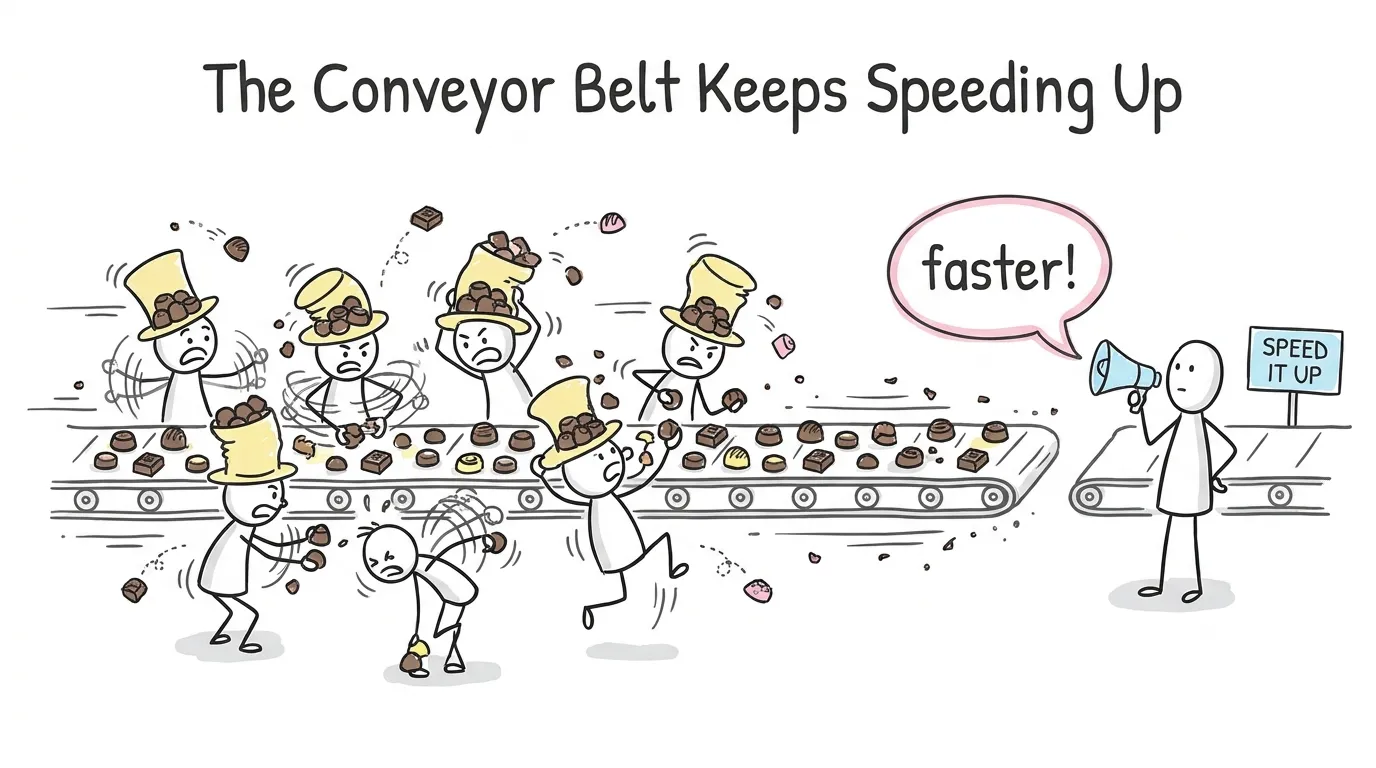
Lucy and Ethel take jobs on a chocolate-wrapping line. Chocolates come down the conveyor belt, and if they don't wrap them properly, the candies roll off the table and the girls get fired. It's manageable at first. Then the supervisor shouts from the back: speed it up.
So the two of them start stuffing chocolates into their mouths, into their hats, into their clothes. When the supervisor turns around, the table is spotless — not a single chocolate left behind. She nods, satisfied, and calls back to the kitchen: a little faster.
God. I laugh every time I watch it. But this time, I couldn't laugh.
Because I'd just finished reading an annual survey of the B2B marketing industry. The one CMI and MarketingProfs have run for 17 straight years — 1,132 responses collected between June and August 2026, 861 of them from B2B marketers. When I finished, only one image was in my head: a huge crowd of marketers, standing in front of a conveyor belt that keeps speeding up, stuffing chocolates into their hats.
And the people shouting "faster" can't see any of it.
The Machine, It Turns Out, Got Built
Let's start with the good news. The AI machine did get built — and it's spinning fast.
88% of B2B marketing teams are using AI for content. 60% of them expanded their use of it over the past year. And it gets wilder with AI agents — the kind of systems that can plan and execute multi-step marketing workflows on their own. Last year, 28% of marketers were still "experimenting" with them. This year, that number more than doubled, to 59%.
And it's not careless use. Content management, customer insights, SEO, reporting — agents have already threaded themselves into every pipe of the daily workflow.
Great. So what has this machine, running at full tilt, actually done for content?
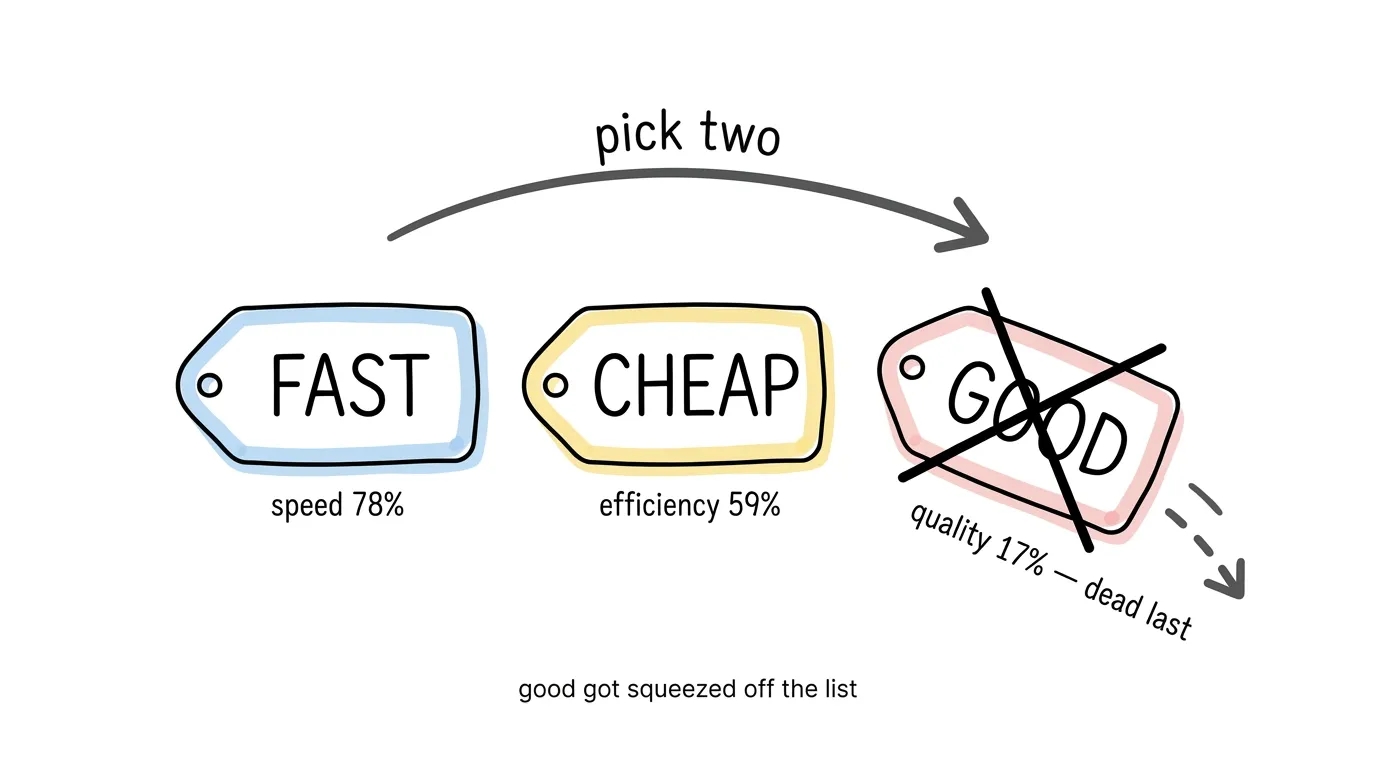
The survey asked marketers to pick the three biggest contributions AI has made. The answers are remarkably consistent: speed, 78%. Efficiency, 59%. Output volume, 44%.
What about quality?
17%. Dead last.
Even more interesting is another set of numbers: what are the biggest challenges of using AI for content? The top three: ensuring accuracy, 54%; maintaining quality control, 54%; keeping the brand voice and authenticity, 52%.
Notice what's happening. Marketers admit, on one hand, that AI delivers fast, cheap, and more. On the other hand, they struggle with whether it's accurate, whether it's good, whether it's real.
Fast, good, cheap — pick two. That old saying hasn't changed a single word in the AI era. It's just that "good" got squeezed off the list.
So, What Does "Good" Mean?
Which raises the question. Everyone says "quality" matters most — so what does good actually mean?
Let me copy the survey's answers to "what actually worked" for you. The marketers who gave their own marketing performance over the past 12 months a high score — who did they credit?
First: the relevance and quality of content, 47%. Second: their team's skills and capabilities, 43%. Sales alignment and channel selection only come after that.
What about AI-powered marketing applications?
14%. Below the middle of the pack.
Now look at trust. How do you make your audience believe you? The top three answers: consistently providing useful, actionable information, 64%; demonstrating industry expertise, 59%; telling real customer stories, 50%.
Hold that list up against the machine, and you'll spot something deeply awkward:
Not a single item on that list gets better by being faster. Not one.
And the thing the machine is best at is precisely speed.
The Price of Fast
You might think: if speed can't buy quality, surely someone would hit the brakes?
No. 65% of B2B marketers say the pressure to "produce content faster" increased over the past year. 28% of them say it increased significantly.
And what did all that pressure buy? The survey asked. The answer: 35% experienced burnout or creative depletion; 32% are doing less original thinking; 29% produced more mediocre content.
That "efficiency gain" everyone wanted most? 28%. Fourth place.
In other words, they stomped on the gas with everything they had, and the first three things they bought back were: exhausted, dulled, and flat.
Why Can't Leadership See It?
The most fascinating part of this survey is that the researchers sliced the data three ways by seniority: directors and above, managers with teams, and front-line practitioners.
Most of the time, these three groups answer in near unison. But on the question of speed, the crack appears.
Feeling pressure to speed up: front line, 72%. Managers, 69%. Leadership, only 59%.
Burned out by that pressure: front line, 48%. Managers, 41%. Leadership, 27%.
Believing the pressure delivered efficiency gains: leadership, 38%, perfectly content. Managers? 20%. Front line? 22%.
Put those three sets of numbers side by side and you see a brutal structure: the illusion of efficiency floats upward, while operational friction rolls downhill. The only person in the organization with a hand on the emergency-stop button is, as it happens, the person sitting in the most stable seat.
I don't think leaders are blind. They're just standing at the other end of the conveyor belt. From that end, every chocolate looks beautifully wrapped. From this end, people know exactly which ones were pulled out of someone's trouser pocket.
No one ever sits in a meeting and decides to trade quality for speed. The dashboard says throughput went up, and that's true. It's just that the original viewpoints never written, the phone call never made to the expert, the customer story synthesized rather than interviewed — those show up on a dashboard much, much later.
By the time they show up, it's too late.
Where the Money Is Going
So what are marketers doing about it? The survey reveals one clear move: pulling back.
Pulling back to the ground they control. 40% of marketers increased investment in their own channels over the past year — website, blog, email list, that kind of thing. Asked where they plan to double down in 2027, owned media came in first at 42%, up 10 percentage points from the year before; events and experiences came second at 35%. And AI marketing tools? 30%, down 15 percentage points — the steepest drop of anything on the list.
Why these two directions? Website traffic is a footnote: over the past year, 31% of marketers saw traffic rise, 31% saw it fall — almost an even split. But among those whose traffic dropped, 79% blamed AI search.
God. Seventy-nine percent.
The open web isn't dead, but nobody dares bet the business on a channel that swaps its algorithm every 12 months. Search sends you strangers. The people sitting in your newsletter, your community, your in-person events — those are people you actually know.
The surge in experience budgets makes the point even more sharply. In 2026, 82% of teams budgeted for content-enabled experiences and experiential marketing; the share putting more than a third of their budget there nearly doubled, from 17% in 2025 to 31%. And the number-one return they got in exchange? Building brand trust, 43%.
Have you noticed? The flow of money lines up, seam for seam, with that earlier list of "what builds trust." Marketers don't say it out loud, but their bodies are honest: the volume part goes to the machine, and the trust part — the money goes back to where humans meet humans.
A Question I Keep Coming Back To
Finally, the part of the survey that made me stop for a long time.
75% of B2B marketers worry that AI is making audiences trust online content less. My first reaction: good — they should worry.
But. 52% of organizations have no policy at all on whether to disclose AI use. Only 8% disclose AI's involvement in every piece of content.
Why no policy? Two answers tied for first, at 41% each: "AI involvement is too small to be worth disclosing," and "It's unclear what level of involvement would require disclosure."
Sit with that for a moment: an entire industry worries that audiences won't trust AI content, while believing its own AI content doesn't count — and can't say what would count.
That sounds like denial. But I don't think it is. The ancient Greeks debated this exact question: how many grains of sand make a heap? Take one away — still a heap? Take another? Down to the last grain, split it in half — when does it stop being a heap again?
Today, AI is already in every step: topic selection, outlines, first drafts, editing, distribution. It's like electricity. The lights in the building run on electricity, and so does the elevator — nobody posts a sign in the lobby reading "this building discloses its electricity use."
So the question "how much AI is in this content?" has only one honest answer: everywhere, and nowhere you can count. The question itself has stopped working. And this survey happened to snap a photo of the disclosure system collapsing, right at the midpoint.
So what does the audience actually care about?
The audience answered that long ago. It's the same list from before: useful information, visible expertise, real customer stories, genuine experts, original research run by hand.
Not one item cares about the process. Every single one cares about the provenance. A real human understands this. A real customer has lived it. The data is something you counted yourself.
Good content written with AI is good content. Bad content written without AI is just organically bad.
So stop asking "where is the AI in this piece?" — that question has no answer. Ask instead:
"Where is the human in this piece?"
That one, every piece can answer.
What You Can Do
A survey that doesn't turn into action is just a well-sourced complaint. I've tried to break the advice down by where you stand.
If you're the executive in charge of content: go stand at the other end of the conveyor belt for a while. The efficiency you see is real, and the burnout you don't see is real too — your team reports burnout at nearly twice your rate. Then take a look at what's on your scoreboard. If it's all output and turnaround time, you've already told everyone what matters.
If you're the one building the 2027 budget: owned media, events, and communities are all just containers. Go ask for the budget for the "raw material": the experts willing to spend an hour in a deep conversation with a writer, the customers willing to put their real names on their experiences, the research you run yourself. That's what the containers are supposed to hold. That's also the thing an answer engine literally cannot produce without you.
If you're the one actually doing the work: you already know all of this. You are the 48%. You've received the AI-written white paper forwarded down from above, with a note saying "you polish this." And you're holding a lever no one else has: whether each piece of content contains a human is something you put in — or left out. If you can hold that line, hold it.
That is the entire core of the job right now.
Back to the Candy Factory
The ending of that I Love Lucy episode has no winners. Lucy and Ethel get fired. Their husbands, left running the household, set the kitchen on fire. All four go back to the trades they're actually good at, and the husbands walk in carrying a peace offering: a five-pound box of chocolates.
Lucy and Ethel exchange a glance and gag.
Think about it. Hours earlier, they were deftly wrapping that very thing on the assembly line. The same object, in a different context, is a gift; after a full day of stuffing it away, it's a nightmare.
That's exactly the picture this survey paints. The machine hasn't made anyone hate content — but it has made the people producing content start to gag. 35% are burned out. 26% have lost their connection to the work itself.
The machine can wrap chocolates all day long: drafting, rewriting, distributing, optimizing — faster than any of us. What it can't do is know something. To have been there. To have counted it by hand. Everything else is process. And no one has ever trusted anyone because of a process.
Once the conveyor belt hits top speed, what remains is still the oldest thing there is: a person who genuinely knows something, and cares enough to tell it well.
AI hasn't changed that standard.
It has simply removed every excuse for falling short of it.
Here's to always standing at the right end of the conveyor belt.
Continue reading
Related articles

It's 2026: Stop "Buying" AI Tools for Your Marketing Team — Start "Hiring" AI Agents
This learn article explains how AI agents differ from standalone AI tools in marketing, outlines three agent categories — build-your-own platforms, CRM-native agents, and vertical tools — and covers use cases across SEO, social media, advertising, and reporting, plus criteria for choosing one.

What Is GEO? How Your Brand Gets "Mentioned" in the Age of AI Search
An explainer on GEO (Generative Engine Optimization) for e-commerce and DTC brands: how it differs from SEO and AEO, why AI answers shape brand visibility, and eight practices covering question-focused content, consistent brand messaging, structured pages, external evidence, comparisons, and AI mention tracking.

AI Is Already Making Decisions for Your Customers. Are You on the List?
A learn article explains GEO (Generative Engine Optimization): why AI-generated answers now shape which brands customers see, and how SEO fundamentals, entity clarity, citable evidence, and monthly measurement affect visibility in AI answers.