
The Budget You Invest in Influencers May Be Locked in Someone Else's Fish Pond
An essay on why influencer budgets can feel trapped inside social platforms — opaque data, shifting algorithms, and rising rates — and how brands can test creatives on social first, then scale validated content across the Open Web for reuse and more transparent data.
A while back, I had dinner with an old friend who runs a consumer brand.
Over the past two years he had invested quite a bit in influencers on short-video platforms. He'd spent plenty of money, but at the dinner table, his brow never relaxed.
I asked him what was wrong.
He rattled off three things in one breath: the data in the platform's backend says whatever the platform says it does — there's no way to audit it yourself; whenever the algorithm gets a revamp, the traffic to your content drops off a cliff without so much as a heads-up; and influencer rates climb year after year, so the more you invest, the more it feels like a bottomless pit.
I told him: your three headaches are actually one headache.
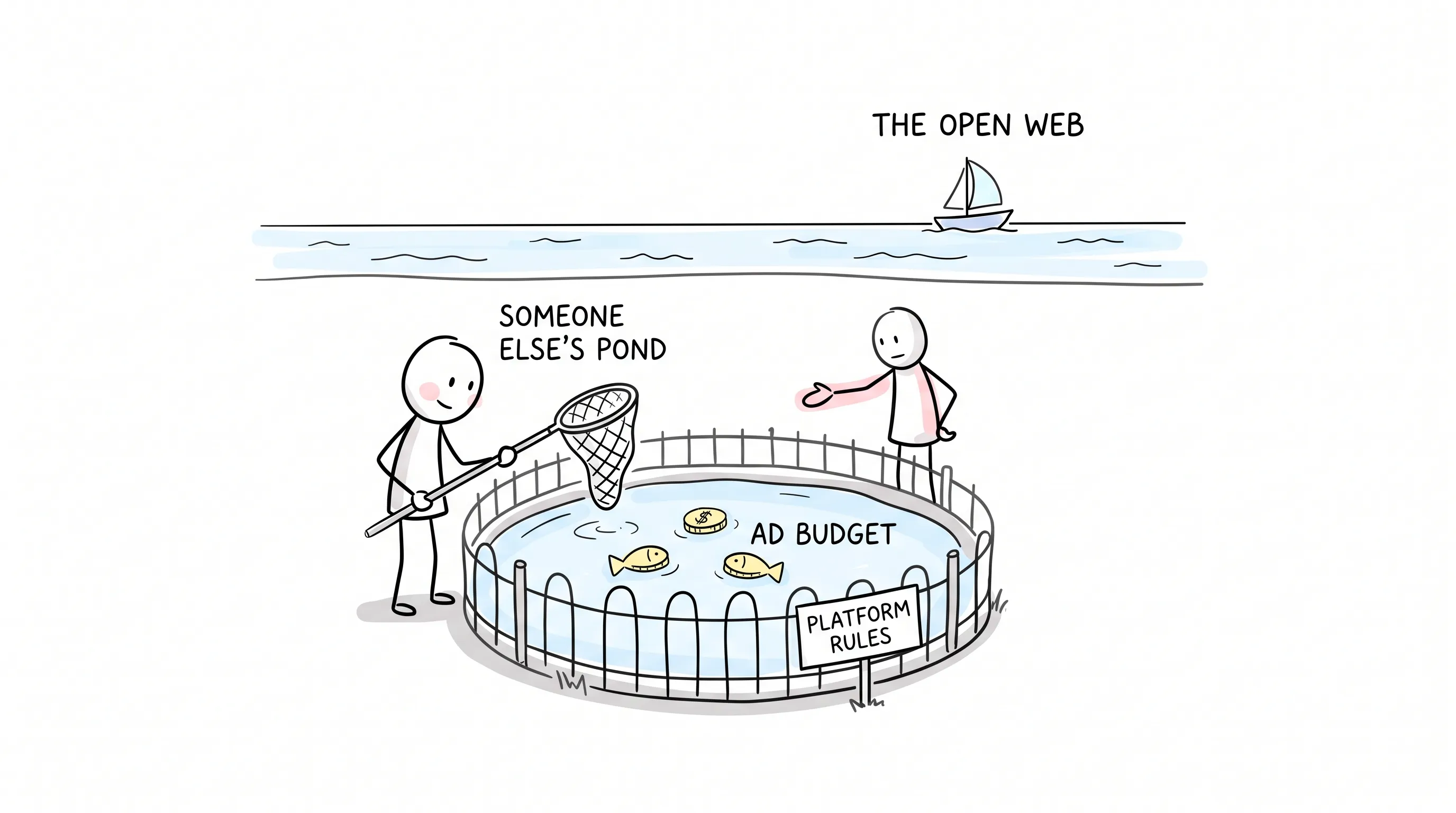
You've staked the entire business on someone else's turf.
Later I read a whitepaper that laid out the whole story behind this. Today, let me break it all down for you, piece by piece.
This Market Has Grown Too Big to Ignore
In 2023, a creative-AI company called Nova published a whitepaper on digital advertising. Nova is an interesting outfit: it partners with ad agencies, publishers, and technology platforms to help them automate ad delivery with AI. The market discussed in that whitepaper is exactly where my friend's money goes: influencer marketing.
What is influencer marketing?
Simply put, it's when brands team up with influencers — the bloggers, video creators, and livestream hosts you scroll past every day — and leverage their content and their clout with fans to push products and brands.
The playbook started out extremely niche: it was all about reaching young people. Because young people don't watch TV and don't read newspapers, but they live on social media.
And all that soaking produced a massive market. The forecast Nova cited in the whitepaper was that influencer marketing would grow into a $21 billion arena. Brands line up to strike deals with influencers, just to reach every kind of audience imaginable.
Why is it growing so fast?
I believe it comes down, at the root, to one word: trust.
The younger generation comes with built-in immunity to traditional advertising. However beautifully you shoot your ad, there's only one line in their heads: this is a script somebody paid for.
But influencers are different. Influencers eat with you, unbox gadgets with you, and vent with you, every single day. Watch someone for three years and they start to feel like an old acquaintance. When they recommend something, you're naturally a little more inclined to believe it.
A survey at the time found that 49% of consumers are influenced by creators in their purchase decisions.
That's nearly half of everyone.
Add to that the explosion of platforms like Instagram, TikTok, and YouTube over these years, which put huge active fan bases in influencers' hands; and the rise of short video, which turned "watching, learning, and getting sold in a single scroll" into the mainstream. With demand and soil both in place, this industry had no choice but to grow.
The whitepaper also cites a research finding: as much as 70% of an ad's effectiveness depends on the creative itself.
That's good news for brands. Because creative work is an asset that can be reused.
But let's set the good news aside for a moment. The other side of the coin is the real reason my friend's brow stayed furrowed.
Creator Content Is Great, but the Platforms Have Welded the Gate Shut
Influencer marketing grows on social media. And social media is the private property of the platforms.
That's where the trouble lies.
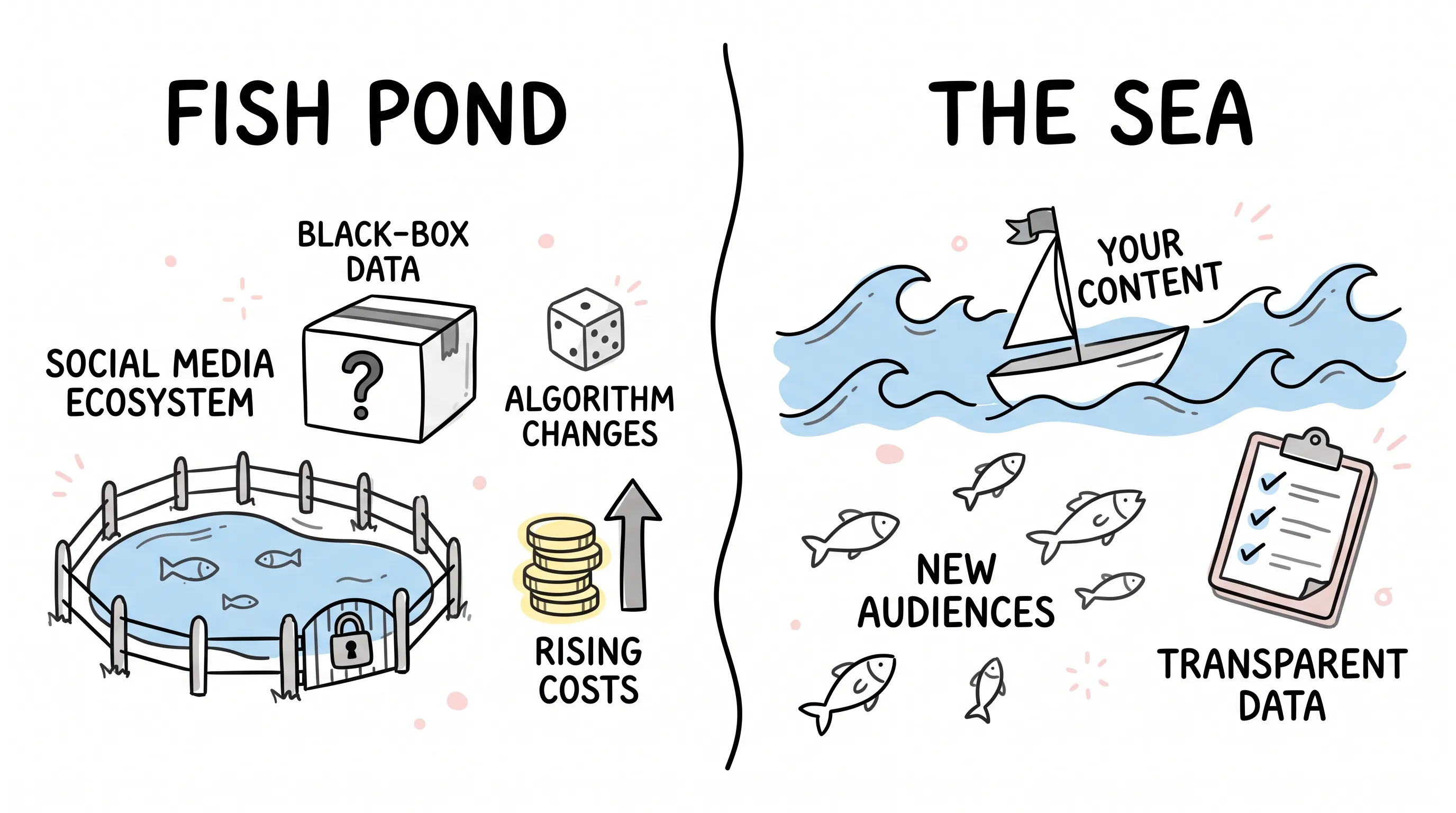
The data is a black box. Platforms restrict third-party tools from connecting in, and restrict third-party tracking too. Once you've spent money inside the platform, how it performed is essentially whatever the platform says — independent auditing is nearly impossible.
The algorithm changes on a whim. The content ecosystem you worked so hard to cultivate can be zeroed out by a single platform revamp. The rules are opaque, and you don't even know where to ask.
And costs keep rising. Brands pile in, fighting over influencers and traffic, and prices naturally climb.
At bottom, you're doing business in someone else's living room. When the guests multiply, the landlord raises the rent; when you want to measure the windows, the landlord says no.
So what do you do? The approach laid out in the whitepaper strikes me as well worth pondering.
Move Good Content Out of Social Media
Nova's suggestion is that creator content shouldn't be locked inside social media. The Open Web — the news portals, all manner of websites, and apps you open every day — is a far bigger stage.
How, concretely? I'd break it into two moves.
First move: test first, then scale.
Treat social platforms as your test field. Is a creative any good? Don't rush to roll it out across every channel — test it on social media at small cost first. Whatever runs well and posts good numbers, take to other channels and scale up. Your cost of trial and error drops, just like that.
Second move: make good content earn money more than once.
Creator content made for social media, with a little adaptation, can be deployed across channels on the Open Web. As noted earlier, the creative accounts for 70% of an ad's effectiveness. An asset that expensive, used once and thrown away — that's extravagant. Running it through one more channel costs almost nothing at the margin, yet the returns are real and tangible.
Moving your content out has extra benefits too: you'll reach new audiences, get data that is both finer-grained and far more transparent, and sidestep the ever-climbing cost of platform traffic.
To put it plainly: social platforms are a fish pond; the Open Web is the sea. Raising fish in a pond works fast, but the pond belongs to someone else, and so do the rules. Learn to release your fish into the sea, and only then do you get true scale.
Back to That Dinner
At the end of the meal, I told my friend: your influencer strategy doesn't need to be torn up — it just needs an upgrade.
Keep investing in influencers, absolutely. But don't let the good content that investment produces rot inside any single platform's algorithm. Take the validated creatives, move them onto the Open Web, run them through more channels, earn from them more than once, and bank more data you can actually see.
Creator content is an asset. And assets should flow.
He nodded, and said he'd sit down with his media-buying team for a review the following week.
I don't know how that review turned out. But this line of thinking deserves serious consideration from every brand now pouring money into influencers.
Continue reading
Related articles

What Is AI Marketing Automation? It Starts With a 40-Point Gap
A learn article explaining what AI marketing automation is: how learning-based systems differ from rule-based automation, how AI decisioning optimizes message, channel, and timing choices, what data it depends on, and where it applies across the customer lifecycle.

It's 2026: Stop "Buying" AI Tools for Your Marketing Team — Start "Hiring" AI Agents
This learn article explains how AI agents differ from standalone AI tools in marketing, outlines three agent categories — build-your-own platforms, CRM-native agents, and vertical tools — and covers use cases across SEO, social media, advertising, and reporting, plus criteria for choosing one.

What Is an AI Marketing Agent? From "Using AI" to "Delegating to AI"
A learn article explaining what an AI marketing agent is, how it differs from rule-based automation, and which repetitive tasks such as lead qualification, reporting, and campaign monitoring can be delegated while humans keep key decisions.