
The Brand Safety Exam Just Got a New Paper in the AI Era
A learn article on brand safety in the AI era: why keyword blocklists can't keep up with machine-generated content, how AI slop and deepfakes affect ads placed next to it, and how measurement standards, content labeling, and AI-based verification are responding.
A few days ago, I was scrolling through articles on a fairly well-known news site.
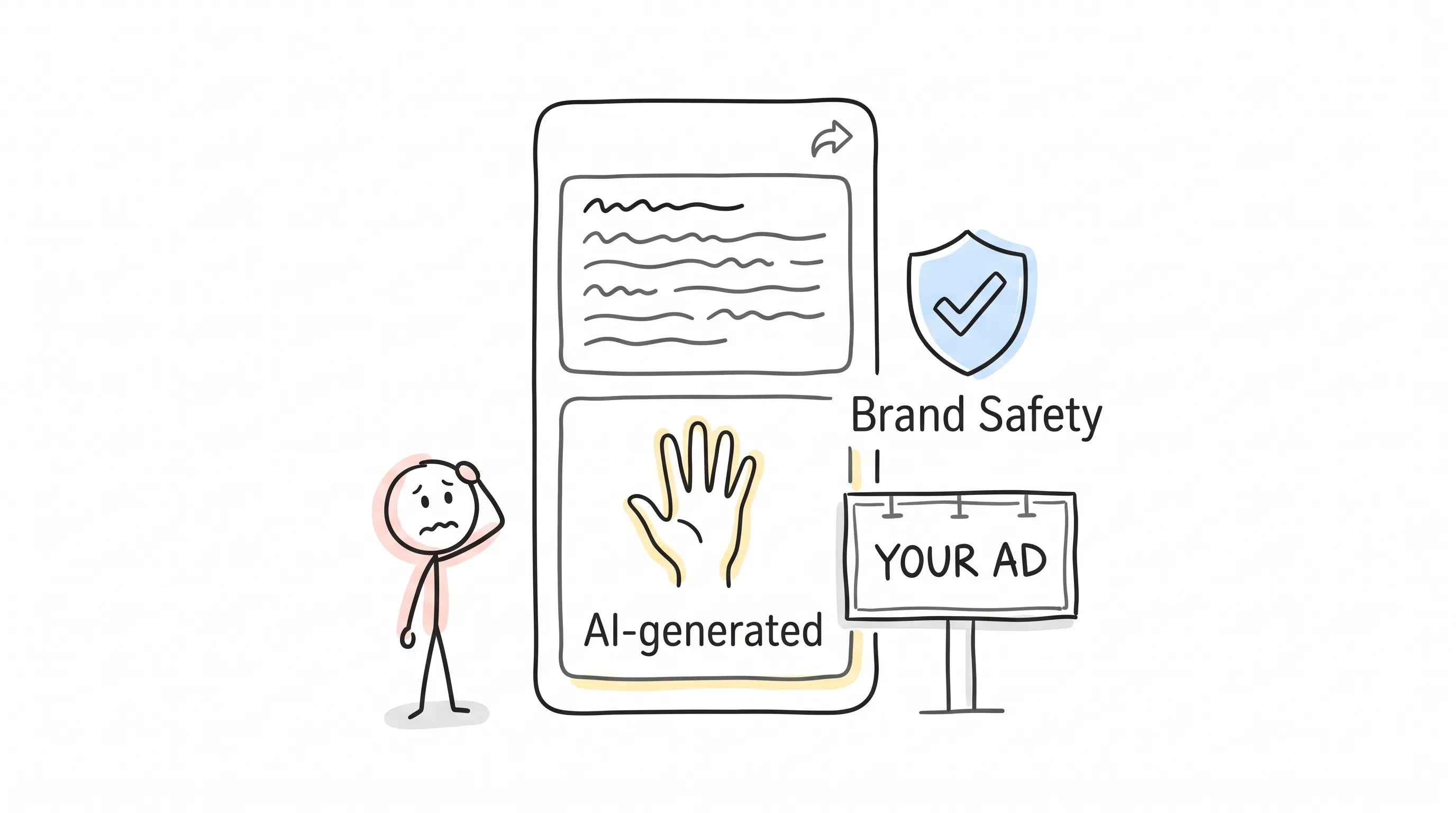
The content was decent. But then I glanced at the image beside it — the person in it had six fingers. A textbook AI-generated image, crude enough to spot at a glance.
And just below, right beside the image, sat an ad from a major brand.
My first reaction: how would that brand's ad-buying manager feel, seeing their ad placed next to six fingers?
That's what today's piece is about. It even has a proper name: brand safety.
What is brand safety?
Brand safety boils down to one sentence: Don't let your ad appear next to content that would make your mother frown.
Violence, pornography, fake news, scams… if your ads spend every day plastered next to this stuff, consumers won't blame the platform — they'll blame you.
The ad industry has been arguing about — and acting on — this principle for well over a decade.
The old approach: a keyword blocklist
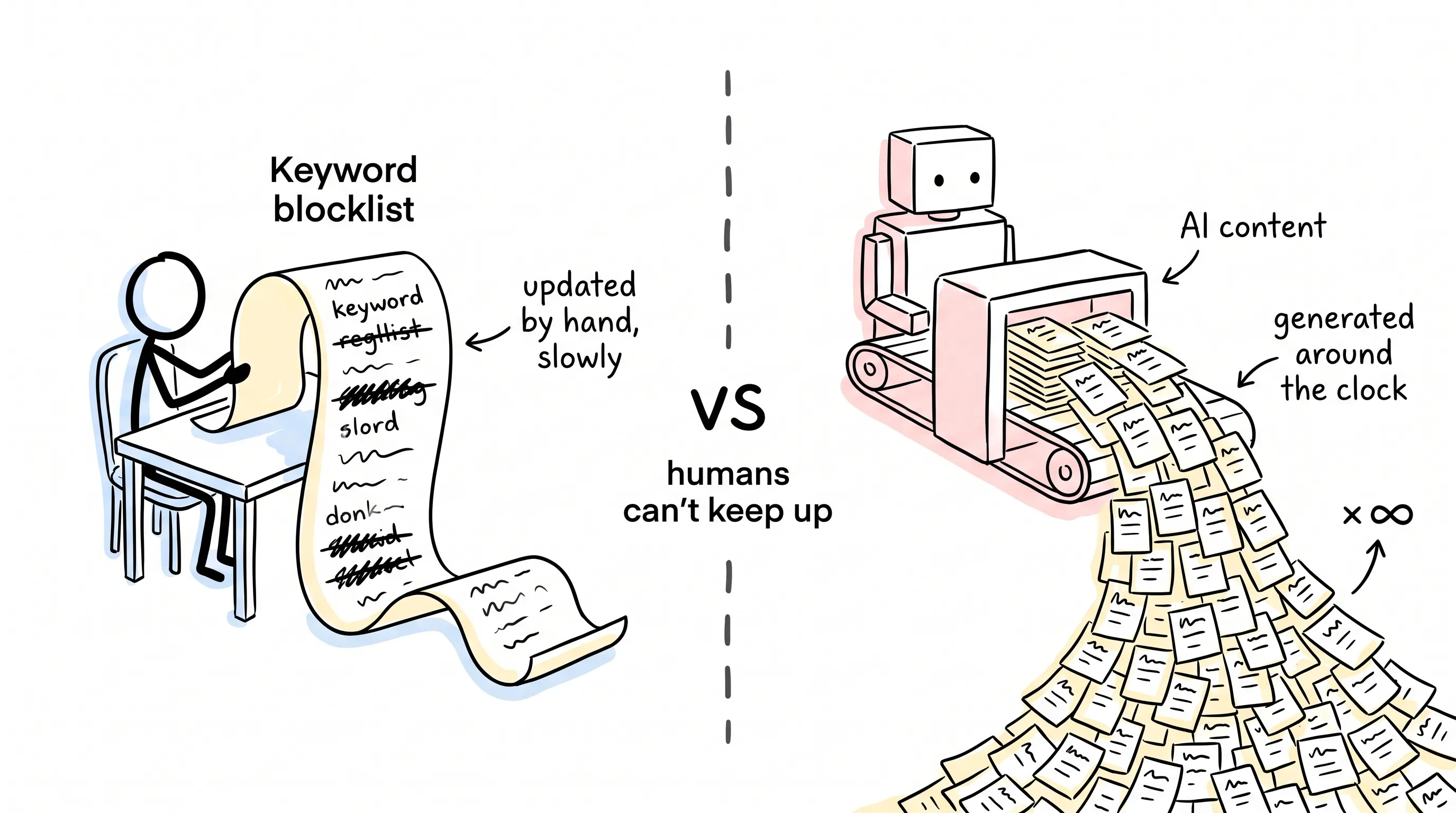
The old solution was blunt brute-force: draw up a list of sensitive keywords, and keep ads away from any page whose content touched them.
Sounds pretty effective, right?
But think about it: who maintains that list? Humans. And who generates the content? It used to be humans; now it's AI. What machines generate in a single day now outstrips what was generated in an entire year before.
Trying to block what machines churn out around the clock with a list maintained by hand — how do you win that fight?
Quite a few people in the industry lament that advertisers' brand safety headaches today are almost no different from a few years ago. The list keeps getting longer, and the collateral damage keeps growing. A serious report on breast cancer prevention was vetoed outright by the blocklist because its headline contained the words "breast cancer."
That's the deadlock of the blocklist era: Machines are chasing a human-made list, and humans can't keep up with machines.
The good news: the antidote is AI too
In recent years, an industry consensus has been getting clearer: content has become too fast and too fragmented for manual review to cover — AI has to do AI's job.
Understanding the visuals in a video, the audio in a podcast, the context of an article — this is exactly what AI is best at. Brand safety judgment has upgraded from "watching keywords" to "understanding content."
Makes sense! Many people cheered.
But everything has a flip side.
AI itself became the new problem
Have you heard of a term called AI slop?
Slop means pigswill. AI slop is machine-churned garbage content: cookie-cutter images, articles copying one another, and videos convincing enough to pass as real.
There's a company specializing in ad verification, called DoubleVerify. They studied how this slop affects brands, and the conclusion sends a chill down your spine: As long as an ad sits next to this content, consumers' perception of the brand deteriorates — even the click data gets contaminated.
What does that mean?
Every dollar of ad budget you spend may buy a pile of clicks that look lively but mean nothing. The platform reports look beautiful, and brand equity is leaking.
There's something even more unsettling. Meredith Whittaker, president of Signal (the encrypted-messaging company), offered an analogy on the SXSW stage that stuck with me. Having people attach AI agents to themselves, she said, amounts to "putting your brain in a jar."
AI books your tickets, answers your emails, and has even figured out what birthday gift to pick for your dad. Convenient? Extremely. But your attention, your decisions, and your privacy get packed into the jar along with everything else, handed over for someone else to keep.
The brand safety question has thus quietly expanded from "keep ads away from bad content" into a whole exam paper: content authenticity, deepfakes, privacy, platform accountability.
Who proctors the exam?
The exam just got a new paper, so the proctoring rules have to change too.
The Media Rating Council (MRC), the body that has long set the rules for ad measurement, is drawing up a full set of measurement standards for AI, focusing on four things: governance, bias, explainability, and accountability.
Meta has started labeling AI-generated content on its platform. There's no hiding it anymore — at the very least, let users know a machine drew it.
Then there's a company called Zefr doing something fascinating: using AI to fight AI. Inside platforms' walled gardens, machine-generated content is judged by machines. At scale, what wins is real engineering muscle, not polished keynote demos. At an industry conference in 2026, they offered a judgment I strongly agree with: brand safety has become an AI arms race.
"Arms race" is exactly the right phrase. Counterfeit bills and counterfeit detectors have always upgraded together.
The hardest layer is people
Lately, though, I keep thinking about a deeper question.
Frameworks for AI governance are already everywhere — for markets, for enterprises, all kinds.
But they share a common blind spot: at that specific moment when one person has to judge "this answer the AI gave me — do I actually trust it?", the frameworks are no help at all.
Institutions can govern organizations; they can't govern the worker at 2 a.m., rushing a deadline, who copy-pastes the AI's answer straight in.
Marketing is no different. A survey covering 14 countries and more than 1,950 marketing leaders found that today's CMOs nearly all hold a second job: overseeing AI's reshaping of marketing strategy. The technology sprints ahead while people are still learning where the brake pedal is.
This is precisely why industry organizations like the Brand Safety Institute exist: certifying brand safety officers, bringing advertisers and platforms to one round table, distilling scattered experience into methodology. Machines manage content, standards manage machines — but the final layer still takes people managing people.
Finally, let's do the math
Someone has estimated that building this AI infrastructure will take some $6 trillion. Others caution that "saving a few people's wages" alone can't support that number — entirely new sources of growth must be found.
Where will the money come from? A large chunk: advertisers' pockets.
And why would advertisers open their pockets for you? Only one precondition: on your platform, my brand is safe. The content is real, the placements are clean, the data is reliable.
The grand $6 trillion narrative lands, on every single ad, as one question: should your sign hang next to that six-fingered image?
So stop treating brand safety as the checkbox at the end of the campaign workflow. In the AI era, it isn't a cost — it's the foundation.
And when the foundation is shaky, the taller you build, the louder the collapse.
Continue reading
Related articles

What Is AI Marketing Automation? It Starts With a 40-Point Gap
A learn article explaining what AI marketing automation is: how learning-based systems differ from rule-based automation, how AI decisioning optimizes message, channel, and timing choices, what data it depends on, and where it applies across the customer lifecycle.

It's 2026: Stop "Buying" AI Tools for Your Marketing Team — Start "Hiring" AI Agents
This learn article explains how AI agents differ from standalone AI tools in marketing, outlines three agent categories — build-your-own platforms, CRM-native agents, and vertical tools — and covers use cases across SEO, social media, advertising, and reporting, plus criteria for choosing one.

What Is an AI Marketing Agent? From "Using AI" to "Delegating to AI"
A learn article explaining what an AI marketing agent is, how it differs from rule-based automation, and which repetitive tasks such as lead qualification, reporting, and campaign monitoring can be delegated while humans keep key decisions.