
The Battle for Search Has Moved to New Ground
This learn article argues search visibility now spans AI assistants and social platforms alongside Google, framing GEO (Generative Engine Optimization) as an evolution of SEO. It covers audience research, content formats, entity clarity, trust signals, measurement, and a sample budget framework.
A few days ago, an old friend who runs an e-commerce business invited me out for coffee.
Before we'd even sat down, he asked: "Be honest — should I still be putting money into SEO? Everyone just asks ChatGPT when they have a question now. Who's digging through page five of Google anymore?"
My answer: you're asking the wrong question.
The issue isn't whether to invest in search. It's that your understanding of what "search" is has gone stale.
For twenty years, the entire industry has obsessed over one thing: what users search for. Keywords, rankings, backlinks.
The question that actually matters now is: where users are searching.
What Is GEO?
GEO — Generative Engine Optimization.
It's not another buzzword or shiny new trend. It's a new pair of glasses. Put them on, and you see search, content, and how people find you in a completely different light.
One team has been tracking how search behavior has shifted over the past nine months, and three numbers tell the story:
Google is still king — 417 billion searches a month.
But ChatGPT alone now processes 72 billion messages a month.
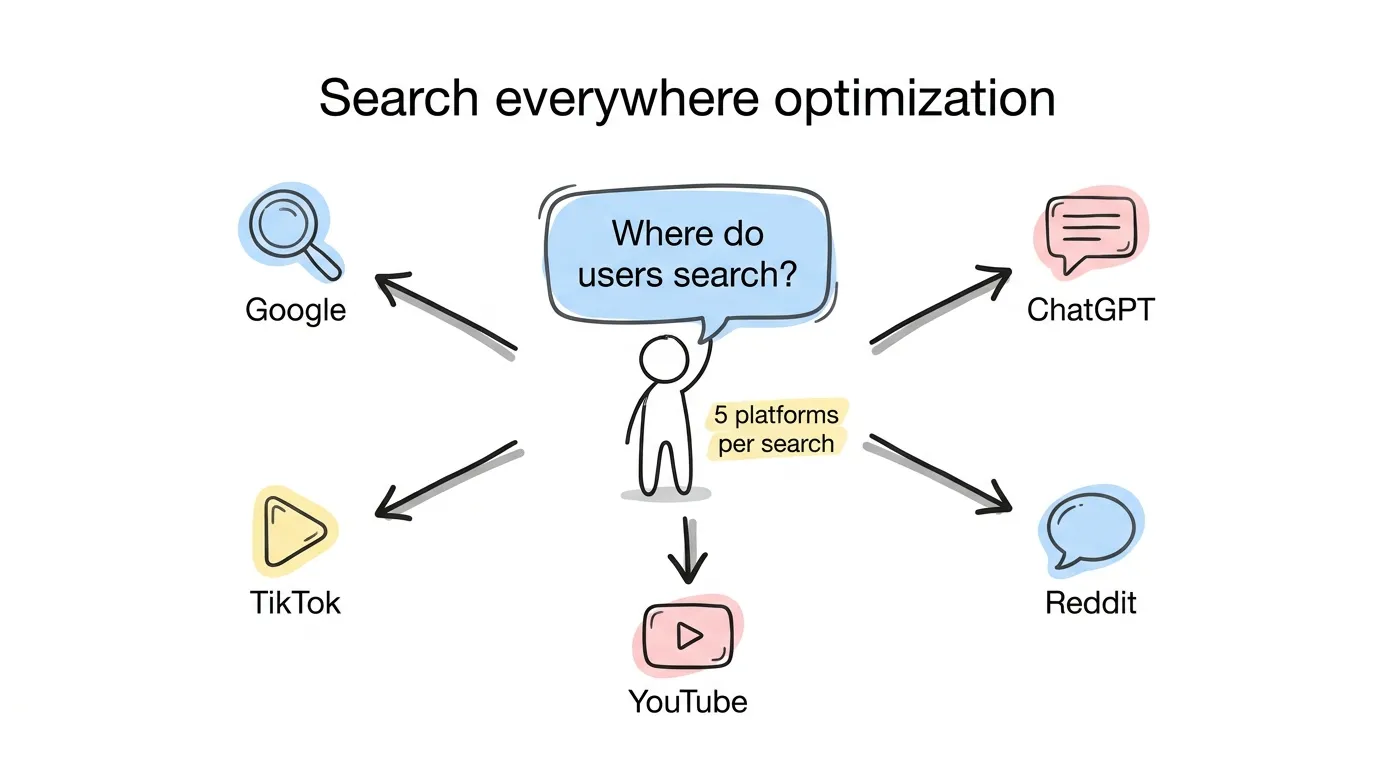
And users under 44 need an average of 5 platforms to complete a single "search."
From TikTok to ChatGPT, from Reddit to all kinds of review sites, the gateways of discovery are scattering. Your strategy has to follow the people.
The good news: this battle is still in its earliest stages. You have a real chance to lead — provided you're willing to change.
Why does multi-platform presence matter so much? Psychology answered this long ago — it's called the mere exposure effect: the more people see something, the more familiar it becomes; the more familiar, the more trusted. Before a user ever reaches your website, you've already earned a third of their trust.
But only if your brand shows up in those places first.
Where Do You Start? With People.
Start with audience research. Surveys, social listening, focus groups, data analysis — throw everything at answering three questions: Where does your audience search? What are they trying to do? What do they actually want in that moment?
Then map those answers against four underlying motivations:
- Fact-finding: they want objective, rational answers.
- Asking the crowd: they want validation and endorsement from their peers.
- Taste-hunting: they want inspiration that fits their identity.
- Shortcut-taking: they trust, so they just copy the familiar answer.
If your budget planning doesn't start here, you're renovating in the dark. Money goes out the door, and you have no idea whether it hit the wall.
Stop Fixating on Rankings — Fight for the "Real Estate"
For the past two years, the SEO world's attention has been completely swallowed by AI Overviews. But the bigger picture got ignored.
The search results page stopped being ten blue links a long time ago. Images, site links, video carousels, reviews, forum answers, shopping links, AI responses — all of them are competing for eyeballs.
Stop asking "what's my ranking?" Start asking "when users are looking for reassurance, am I there?"
Here's a content format framework — four types, matched to four states of mind:
- Opinion: op-eds, newsletters, blogs, published on X, Medium, Threads. The user is exploring ideas — go build thought leadership and ignite conversations in your industry.
- Discovery: short videos, UGC, reels, published on TikTok, Instagram, YouTube Shorts. The user is looking for emotion and identity — earn their affection with authentic visual storytelling.
- Substance: guides, FAQs, white papers, covering Google, Bing, and specialist AI tools. The user needs facts and confidence before deciding — trade expertise and transparency for trust.
- Tutorial: how-tos, demos, webinars, published on YouTube, LinkedIn Live. The user is about to get hands-on — clear the obstacles for them.
Your GEO budget should be spread across these four types. Not just for rankings — show up where the user is right now, in the posture they're in right now.
Make the Machines "Understand" You
LLMs read brands differently from search engines.
They can't figure you out just by crawling and following links. They need structured clarity: who you are, what you do, and why you're credible.
Run your company as an "entity": brand, people, products, expertise, processes — lay each one out plainly.
Most companies already have these assets — author bios, about pages, product documentation, award listings. The problem is, they're scattered everywhere and buried deep.
There's a simple behavioral principle here: both people and machines only trust logic that's visible.
Your internal recommendation engine? Your customer service process? Your buying guide? If that logic lives only in code and internal tools, neither users nor LLMs can trust something they can't see.
What's the fix? Put your decision logic on display:
- Write "How we choose" content;
- Add explainer videos and structured markup;
- Organize internal links the way the business thinks, not the way the site's nav is structured.
Let users and machines walk the same path you took to make the decision.
Trust Is the Hard Currency of 2026
Stop chasing algorithms. We're in the trust business — GEO just makes that harder to hide.
In 2026, E-E-A-T isn't going anywhere; it's the strategic foundation. Your budget must include: ongoing digital PR (consistent mentions in high-authority sources), data storytelling (reports and white papers built to be cited), review management (reputation, sentiment, responsiveness), awards and certifications, and behavioral insights.
How do you split the PR budget? One reference recipe: 45% ongoing reviews and seasonal hooks, 30% evergreen assets built up slowly, 20% integrated with on-site content and schema, 5% for experiments.
Before every campaign, ask one question:
Would a user type this phrase into Google or ask an AI assistant? And if they do, is our piece the answer they'd choose to trust?
If yes — that's what GEO-ready content actually means.
Who Says It Matters
What to say and where to say it — figured out. One last piece of the puzzle: who says it.
Behavioral science has the messenger effect: when judging whether information is true, people look first at who's saying it. That's the opportunity. Four voices, each with its own job:
- The brand's voice: your point of view, what you want to be remembered for.
- The users' voice: UGC — how everyone talks about you.
- The credible voice: KOLs, adding human warmth and endorsement to your story.
- The amplified voice: media, pushing your reach and authority outward.
Plan this layer early — otherwise the budget won't stretch when the time comes.
The Reporting Has to Be Rebuilt Too
The old saying holds: you can't manage what you can't measure. But GEO's exposure can't be fully seen through traditional SEO tools.
Your budget may need to add: tracking inclusion in AI Overviews and AI assistant answers, monitoring brand mentions and citations, measuring entity performance with structured data, analyzing sentiment and trust signals, and building first-party behavioral data.
Why is first-party data so valuable? Because LLMs index brands based on what they "know" — whoever understands their own data best holds the real advantage.
Here's an example. Would you like to know how often your users forward your brand inside WhatsApp? Server log analysis can get you there. Picture the scene: how many people ask in group chats, "Does anyone recommend a company that does...?" Those conversations are search signals too.
One more warning: GEO measurement itself is still in its infancy. Whatever data you can get today will be a drop in the ocean compared to what's coming in the next few years. Don't go all-in on tools — the best platform may not have been born yet. And plan the frequency and depth of your reporting carefully; the cost of data collection is rising fast.
Spend the Money on People
GEO doesn't run on content and tools alone. It runs on a team where SEO, PR, content, data, and behavioral insight are twisted into one rope.
So most companies need three new budget lines: talent (hire hybrid players who understand search, AI, and behavioral science all at once), training (raise the whole company's digital and behavioral literacy), culture (tear down the department walls and encourage co-creation).
You can't assume you naturally understand your users. People or partners who understand "how humans search and how machines learn" aren't luck you can buy — they're capacity you build, slowly.
So How Do You Actually Do the Math?
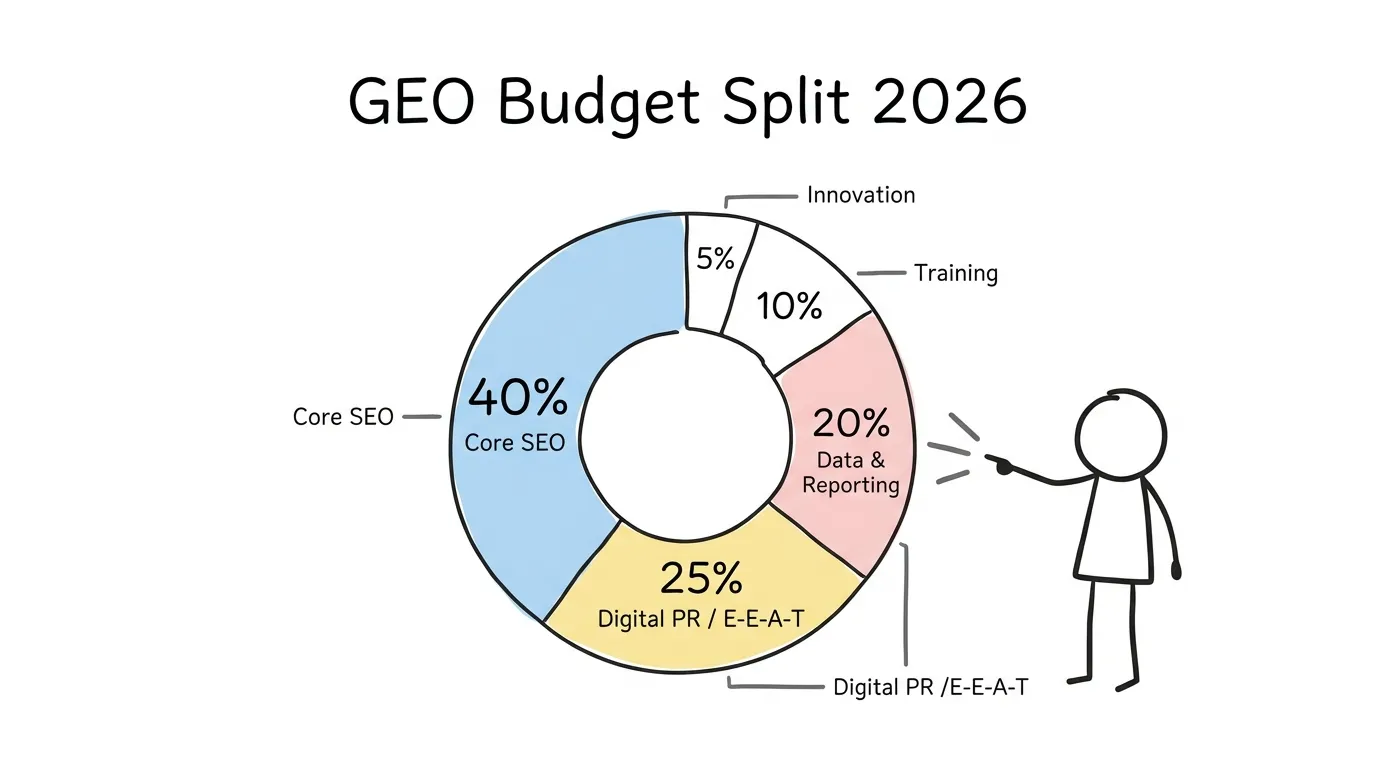
The old SEO budget split three ways: technical SEO, content, and link-exchange PR. That's not enough anymore. Here's a GEO version of the framework:
| Segment | Share | What It Does |
|---|---|---|
| Core SEO | 40% | Defend and evolve the technical and content foundation |
| Digital PR / E-E-A-T | 25% | Authority, mentions, trust |
| Data & Reporting | 20% | Insights, attribution, entity tracking |
| Training | 10% | Cross-skill development and team integration |
| Innovation | 5% | New formats, new platforms, AI-native content |
Note: this is not a call to cut your SEO budget. It's a redefinition of what "exposure" means and where it happens.
Most brands will end up spending more, not less — they'll just spend it differently.
Not enough budget to do everything? That's fine. Use audience insight to set priorities: which platform has the biggest search volume? What do users go there for? What content fits that context? Whose voice lands hardest at that moment? Answer those, and press the money where it matters most.
The marketing funnel is still here — it's just become that "messy middle" Google once talked about. So every stage of the journey needs content variants; you can't wait for people only at the final step.
Run the whole strategy as test-and-learn. But first be clear about what "good" looks like. Success isn't always traffic — sometimes it's engagement depth, sometimes share of voice, sometimes a shift in sentiment.
And don't forget your competitors. Right now is a window to lead that traditional SEO hasn't offered in years. Whoever grabs the open ground and moves first sets the pace.
Finally
We haven't stopped searching. We've just stopped searching only on Google — and we search with higher expectations: faster confirmation, clearer signals, richer content.
Sometimes we want a chatbot, sometimes a TikTok, sometimes a post — and sometimes, all three.
The essence of GEO comes down to one line: in the right place, with the right content, found by the right people.
As you plan for 2026, run four questions past yourself: Do we understand our users' motivations? Wherever users search, are we there? Is trust laid down across the entire journey? Have we given our team the tools, the time, and the trust?
Exposure in 2026 won't come from gaming the system. It comes from understanding the person behind the search box, and showing up where they are — carrying something genuinely useful.
The future of search is search everywhere optimization.
Here's to arriving first on the new battlefield — and winning first.
Continue reading
Related articles

It's 2026: Stop "Buying" AI Tools for Your Marketing Team — Start "Hiring" AI Agents
This learn article explains how AI agents differ from standalone AI tools in marketing, outlines three agent categories — build-your-own platforms, CRM-native agents, and vertical tools — and covers use cases across SEO, social media, advertising, and reporting, plus criteria for choosing one.

What Is GEO? How Your Brand Gets "Mentioned" in the Age of AI Search
An explainer on GEO (Generative Engine Optimization) for e-commerce and DTC brands: how it differs from SEO and AEO, why AI answers shape brand visibility, and eight practices covering question-focused content, consistent brand messaging, structured pages, external evidence, comparisons, and AI mention tracking.

AI Is Already Making Decisions for Your Customers. Are You on the List?
A learn article explains GEO (Generative Engine Optimization): why AI-generated answers now shape which brands customers see, and how SEO fundamentals, entity clarity, citable evidence, and monthly measurement affect visibility in AI answers.