
The AI Gold Rush: Why the First Movers Don't Always Win
A learn piece on the AI marketing gold rush: how generative AI spread across customer service, copywriting, and ad creative testing, the risks of hallucination, bias, copyright, and "AI theater," and why small steps with human oversight beat both standing aside and going all-in.
A while back, a friend of mine who works in marketing invited me to dinner. Before the meal was even over, he hit me with this:
"If I don't use AI, I'm afraid my competitors will leave me in the dust. If I do use it, I'm afraid it'll blow up in my face someday. What am I supposed to do?"
I didn't answer directly. I asked him back: what do you think AI marketing actually is?
He froze.
That question is worth walking through from the very beginning.
How Did This Gold Rush Catch Fire?
In November 2022, ChatGPT launched. It was the first generative AI application ordinary people could actually get their hands on. Note that: the first. Back then, even GPT's API hadn't opened up — programmers who wanted to build on it had no door to knock on.
Then, well, you know the rest. Microsoft quickly wired GPT into Bing Search. Google immediately announced: we have one too, it's called Bard. The two giants went toe-to-toe, and the flames set the whole industry alight.
How hot? Here are a few numbers.
Market research firm Statista made a prediction in 2023: global revenue for AI in marketing would grow from $27.4 billion in 2023 to $107.4 billion by 2028. Nearly four times over in five years.
Two more numbers. More than 80% of industry leaders have already plugged some form of AI into their marketing workflows. A survey by another firm, Acrolinx, cut even deeper: 95.3% of respondents said they were already using it, or about to.
95.3%. That's basically everyone at the table.
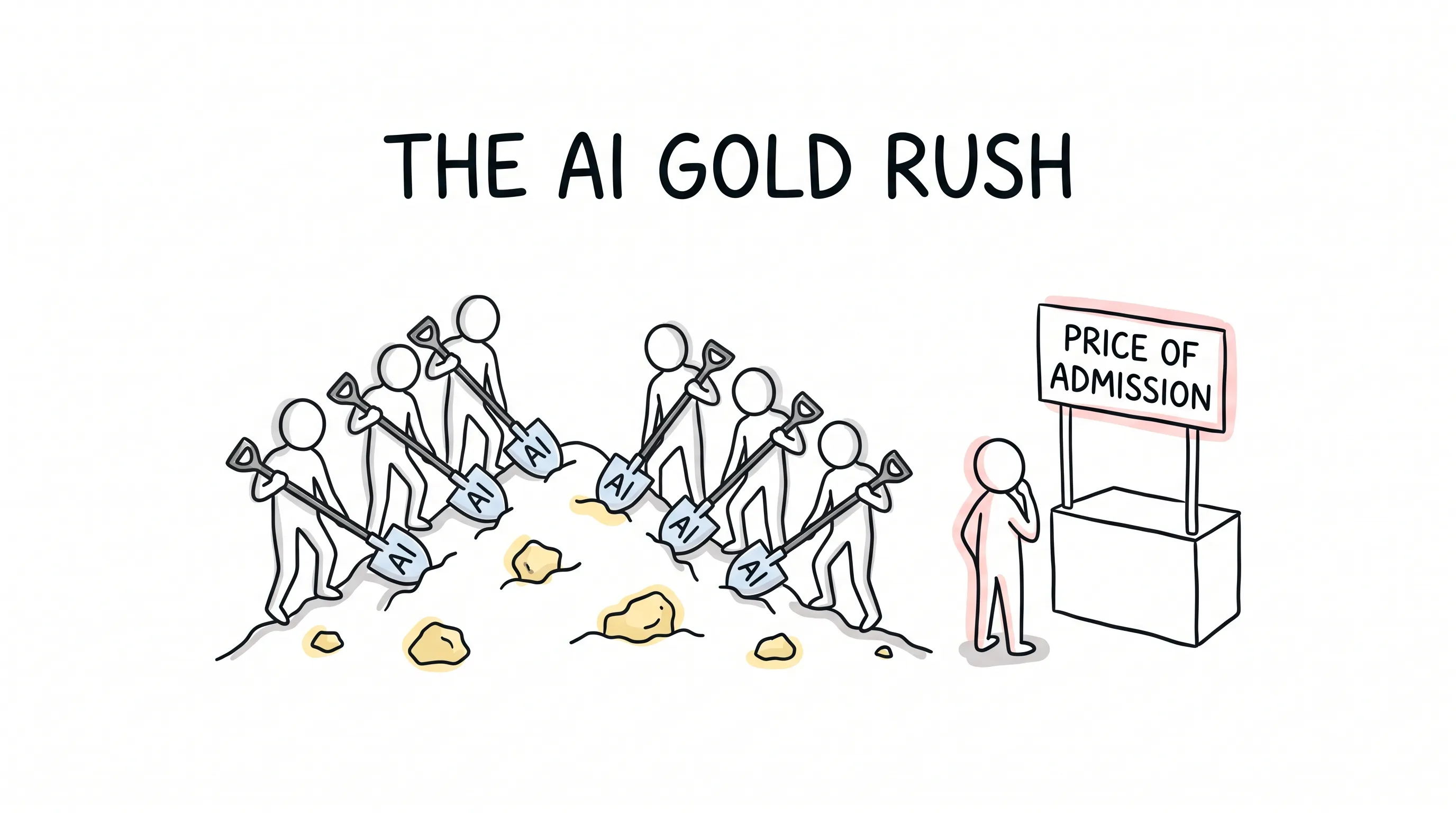
Think about it: when everyone is wielding the same weapon, that weapon is no longer an advantage. It becomes the price of admission.
Once a new technology becomes the price of admission, the cost of staying out is far scarier than the cost of buying in.
What Are Brands Doing With AI?
Where to start? From the place closest to the customer: customer service.
Chatbots aren't new — rule-based ones, conversational-flow ones, brands have used them for years. But once generative AI entered the picture, it was a different magnitude entirely. Take Five9's Agent Assist: customer service quality jumped a whole level, and there's a delightful side effect — customers get to control their own narrative, finish their sentences in their own words, no longer tortured by "press 1, press 2."
The second thing: writing.
Tools like Copy.ai and Jasper let marketers feed in a prompt and get back copy, a creative concept, in seconds. Want to test ten versions of a message? That used to take ten meetings. Now you can test a hundred in a single day. Grammarly goes a step further — not only helping you write correctly, but helping you write the way your brand would actually speak. A customized email, tone and style fully aligned.
The third thing hides backstage, where you can't see it.
Companies like Persado and Phrasee use AI to generate hundreds of headlines and hundreds of ad copy variants in one go, then throw them into multi-armed bandit testing (an automated testing method that shifts traffic to whichever variant performs best) to run on their own. Whichever version wins, the system scales it up automatically. Optimization has gone from human gut calls to machine arithmetic.
How well does it work? Ankit Prakash, founder of the data platform Sprout24, offered a number: after their SaaS partners adopted AI marketing solutions, conversion rates rose 45%, and sales cycles shortened by 30%.
45%. My goodness.
This isn't just about saving money. It's about racing the clock.
Behind the Benefits List Is the Same Sentence
Gather up the wins brands have tasted and it boils down to a handful: output is faster, people are freed up; the bar for experimentation is lower, so teams dare to try anything; AI never sleeps, so global teams can start work at any hour; and the tone stays consistent — no more swinging between buttoned-up and off-the-leash.
The personalization part is especially interesting. Platforms like HubSpot, Adobe Marketo, and Salesforce Marketing Cloud were already sitting on oceans of customer profiles and behavioral data, and now they've grown generative AI directly on top of their own data. What the AI writes genuinely understands that particular customer.
John Mazur, CEO of Chatmeter, once said something I particularly like: AI can listen deeply, reading trends and emotions out of unstructured data, and combined with an omnichannel playbook, the brand–consumer relationship can actually become more human.
Savor that logic: we assumed machines were making marketing cold. Turns out that, used right, machines help people listen more attentively.
But.
Everything has a flip side.
There Are More Ways to Screw Up Than You Imagine
The biggest trap is called hallucination.
When AI runs into something it never learned, it doesn't say "I don't know." It makes things up with a perfectly straight face. So AI-generated content must have a human gatekeeper before it's published. Do the math: half the time you saved goes straight back into review.
Bias is a landmine too. Models take old prejudices buried in the data and amplify them on the way out. Copyright is thornier still — who owns the intellectual property in AI content remains unsettled, and using it may be planting a mine. Then there's privacy: the more personalization, the more you have to touch user data, and the compliance line gets thinner every year. Costs are falling, but tools, training, and people all cost money.
There's also a hidden price: when everyone lets AI write, content starts looking more and more alike. Machine-produced fluency may buy you a uniform sort of mediocrity.
The career impact I won't expand on. Copywriters, designers, programmers — they all know exactly where things stand.
One Camp Says: What's the Rush?
Iliya Rybchin, a partner at the consultancy Elixirr, once said something that stings. He said that some of the companies scrambling to jump on the AI bandwagon may be running bigger risks than the ones sitting on the sidelines.
Why?
Because the noise of innovation is deafening. The vast majority of companies simply cannot tell which applications actually land, and which are snake oil wrapped in an AI skin.
He also coined a term that stuck with me: AI theater.
What is AI theater? It's issuing a press release saying we used AI to build something cool, officially announcing a strategic partnership with some AI platform, declaring you're pouring money into AI products. Lots of motion, lots of fanfare. But according to Rybchin, most of it is staged for PR and investors.
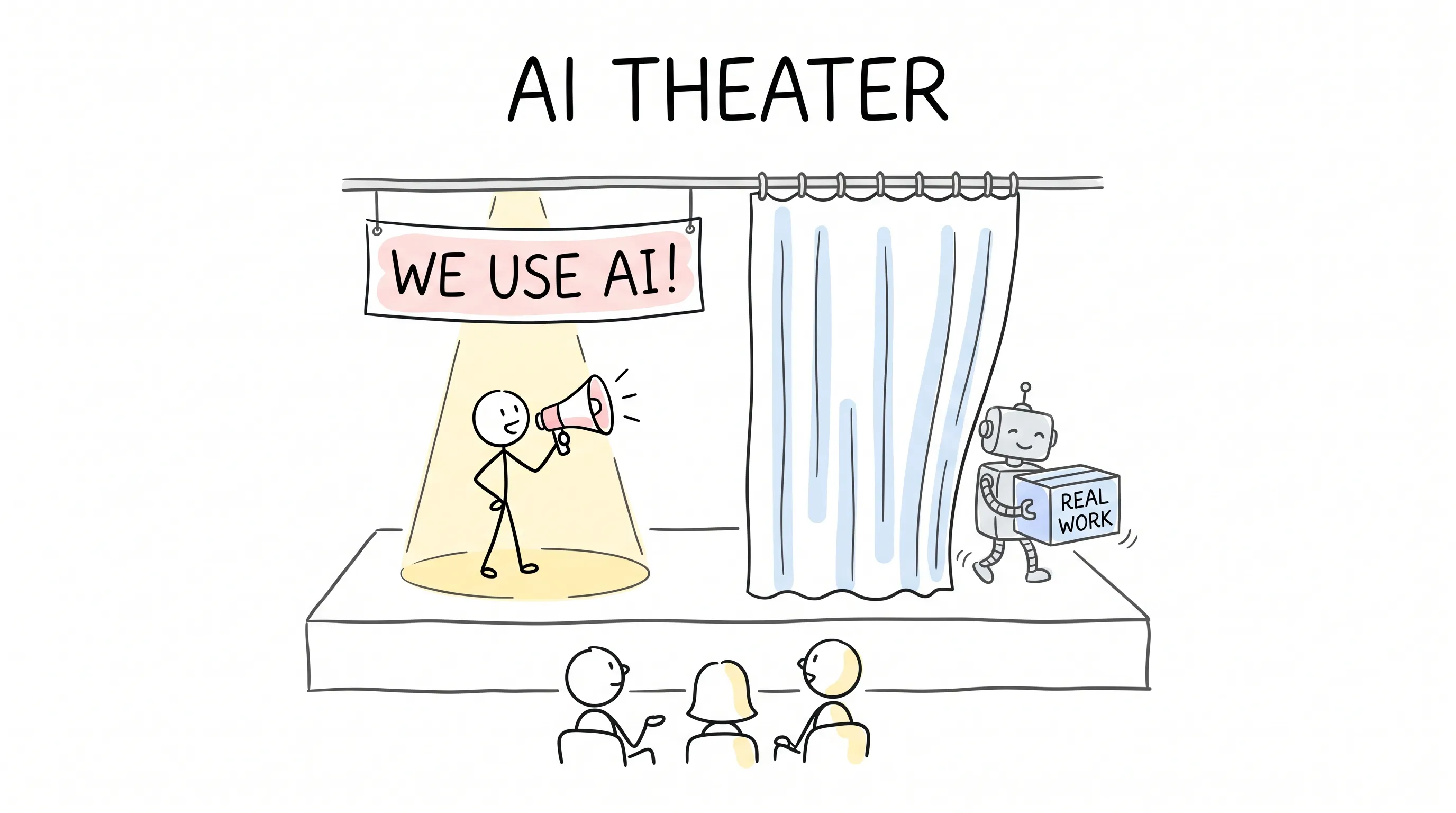
What does real AI application look like? Not sexy at all. It lives deep inside the organization, solving specific problems that outsiders can't even see.
He also asked a question I think everyone should sit with: when a self-driving AI fails, the consequence is a car crash. So what about AI failing in marketing? Content written wrong, recommendations given wrong, ad money spent wrong, optimization pointed in the wrong direction, copyrighted material used that shouldn't have been. What's your "car crash"? How much would it cost you?
Max Wesman, COO of the background-check platform GoodHire, put it even more bluntly: machine learning is, at bottom, still learning — the risk of error never goes away, and what's wagered is the brand's trust. His advice: let AI help you brainstorm and surface insights, but don't let it finish the whole job for you.
Of course, watching from the sidelines has its own logic. Industries like finance and healthcare are naturally cautious about new technologies — they won't move until compliance has settled. Some brands have strong in-house creative teams and workflows that run just fine; there's genuinely no need to throw yourself into chaos chasing a trend. If it ain't broke, don't fix it.
So What Should You Actually Do?
My judgment is simple:
Skip AI, and you'll fall behind. Go all-in on AI blindly, and you may crash first.
It comes down to one idea: take small steps, and keep human eyes on.
AI handles efficiency; humans handle judgment. Let the machine generate a hundred versions — but the person who sets the tone, makes the call, and signs off must be a human. Decide which parts you hand entirely to AI and which parts you guard with human hands, then move. Don't panic just because someone else announced a partnership.
Writing to this point, I remember my friend's dinner-table line: "Don't use it and you're waiting to die; use it and you're asking to die."
Honestly, there aren't that many ways to die waiting or die trying.
The truly dangerous companies are the ones that treat announcing AI as mastering AI. When the AI theater curtain falls, whatever is left on stage, the audience will see it.
AI won't eliminate marketers. But it will eliminate, first of all, the people pretending to use AI.
Here's to you: you don't have to get in early — and may you never have to get out.
Continue reading
Related articles

What Is AI Marketing Automation? It Starts With a 40-Point Gap
A learn article explaining what AI marketing automation is: how learning-based systems differ from rule-based automation, how AI decisioning optimizes message, channel, and timing choices, what data it depends on, and where it applies across the customer lifecycle.

It's 2026: Stop "Buying" AI Tools for Your Marketing Team — Start "Hiring" AI Agents
This learn article explains how AI agents differ from standalone AI tools in marketing, outlines three agent categories — build-your-own platforms, CRM-native agents, and vertical tools — and covers use cases across SEO, social media, advertising, and reporting, plus criteria for choosing one.

What Is an AI Marketing Agent? From "Using AI" to "Delegating to AI"
A learn article explaining what an AI marketing agent is, how it differs from rule-based automation, and which repetitive tasks such as lead qualification, reporting, and campaign monitoring can be delegated while humans keep key decisions.