
The AI-Driven Content Strategy: When to Use AI — and When Absolutely Not
An opinion piece arguing that AI-driven content strategy beats AI-generated content: the author keeps writing articles personally while using AI to audit subscription pages, find topics, review drafts, map audience channels, and match GA4 data to topics and channels.
A few nights ago, two friends of mine who work in marketing got into an argument in a group chat.
One said: AI-written content has no soul, and that's exactly what's killing content marketing.
The other said: it's this good a tool and you won't use it? Do you have a grudge against productivity?
They argued past midnight and neither budged. The next morning, the AI-friendly one came to me for a ruling.
I told them both they'd argued their way off course.
Here's my position up front: I don't let AI write my articles. Every word you're reading right now was typed by me, one keystroke at a time. That's my preference — writing this way feels right to me, and it reads right to my audience.
But not letting it write doesn't mean not letting it work.
There's a global annual survey of content marketers that asks what people actually use AI for. The results are fascinating: only 11% let AI write complete first drafts of articles. 66% use it just for revision suggestions. The remaining majority use it to find inspiration, brainstorm headlines, and tighten up drafts.
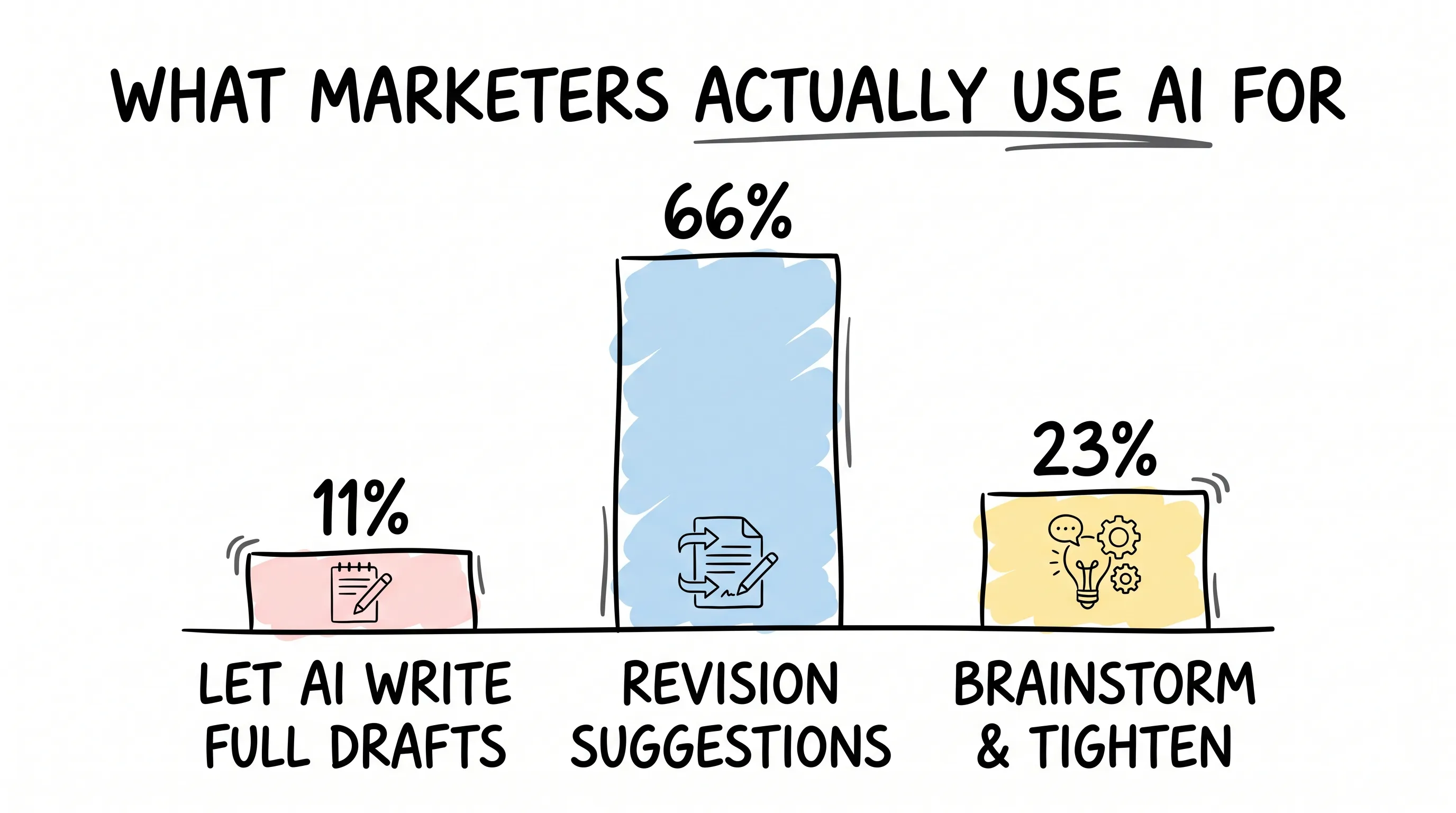
See it? Most people have voted with their feet, and they all voted the same way:
AI is bad at writing articles, but remarkably good at everything around them.
Around them? Auditing, topic selection, channel discovery, data analysis. Let me break down five specific uses — each one you can put to work today.
1. Before You Publish, Let AI Audit Your "Storefront"
What's the storefront? It's the page where readers decide to subscribe and follow you. A blog homepage, a newsletter signup page — same thing.
Think about it: a reader stumbles onto one of your articles, likes it, and wants to subscribe. What do they look at?
Your subscription box. That box is the single highest-conversion-value element in your entire content system. But what does the vast majority of subscription copy on the web say? "Subscribe to us." "Get the latest updates." Says nothing, means nothing.
Another common mistake: organizing sections by format instead of by topic. "Videos," "Live streams," "Whitepapers" — that's format. Readers don't care about format; they care about what they'll learn. "Content strategy," "Growth case studies" — that's topic.
How do you fix it? Screenshot the page, add a note on who you're writing for and what trust signals you have (subscriber counts, user testimonials), and hand the whole thing to AI to act as your auditor. The prompt goes something like:
You are an email growth strategist auditing this content homepage. Extract the 3–5 topics the page covers, check whether the subscription copy reflects those topics, and determine whether the sections are organized by topic or by format. Then score the page against eight criteria, four of which sit on the main conversion path: clarity and specificity of the subscription copy, trust signals, alignment between topics and the subscription promise, and topic-based organization. For each criterion, state the problems you observed and give specific fix recommendations. Finally, give your overall verdict: is this page strong, middling, or weak? Keep as-is, touch up, overhaul, or rebuild from scratch? Then give the one change with the highest payoff.
I ran this on my own blog's homepage. Good grief — AI gave my blog a nickname. It called my article listing "chronologically stacked tiles." I tried to argue back. I thought about it for a long time. I couldn't.
2. Topic Selection: Have AI Find What Nobody Else Has Written
Storefront sorted, next question: what do you write about?
Conclusion first. Three types of content outperform everything else over the long run:
- Original research. You have data nobody else has.
- Strong opinions. You dare to say what others won't.
- Uncovered angles. The entire internet is writing east; you write west.
What performs worst? Generic how-to posts. No proprietary method, no proprietary data, no proprietary angle — the kind any company could write, and AI can too.
If any brand could write a topic, it isn't worth writing about.
How do you find the first three? AI is remarkably good at this. Three prompts.
The first one is my favorite:
What ordinary, almost trivial things would someone in [job title] hold surprisingly strong opinions about?
Try it — plug in "content strategist." The list that comes back will first make you laugh, then make you go quiet. "'Utilize' and 'use' must be kept distinct — I will die on this hill." That kind of thing. Trivial on the surface, but you feel a jolt: hey, I have opinions about that too.
Why is this topic type so brilliant? Because AI can't write it. AI has no opinions, no stance, no hill to die on. Opinion is a moat only humans hold.
One prerequisite, though: courage. Do you dare take a side? Does your team? If an article comes out and nobody disagrees with it, it hasn't earned the label "thought leadership."
The second prompt, for original-research topics:
Tell me: which claims in this industry does everyone repeat but nobody has ever actually tested? If I tested one, would journalists and editors cite it?
The value of this prompt is gap-filling. The internet is full of unverified assertions. Find one, produce the data, and you've patched a hole in the internet. New data is catnip for journalists — they cite you, and the citations bring a steady stream of backlinks; backlinks lift your search rankings. By the way, AI systems call search engines when they answer too, so this traffic flows through two channels at once.
The challenge here is time: can you design a study that's cheap to run? Does your company already have data sitting around? Could you partner with another content team?
The third prompt, for uncovered topics:
Of the most important issues in this industry, which ones do the top blogs almost never touch?
You're human — you can't read every industry article on the internet, so you don't know which gaps are still open. AI can. One sweep, and it hands you a field with no flags planted in it.
But remember to align: a topic being new doesn't mean it fits your buyer. If nobody reads it when you publish, it was all for nothing.
And you can stack these three methods. Picture it: you lay a foundation of new data, then plant a flag of opinion on top. The foundation is yours, and so is the flag. That's probably your hardest-hitting article of the year.
3. Article Done? Run It Past the "Editor AI"
Topic locked, draft finished. Don't hit publish yet.
What are the essential components of a competent article? From my experience, at least these: Does the opening hook someone within three seconds? Do your claims have data and examples behind them? Are there voices other than your own — experts', customers'? Is the layout scannable? Does every screenful as you scroll have a visual anchor? Do internal links lead readers to related content, even to your service pages? And the most critical one: does this piece have a stance? And once readers finish — do you point them to what to do next?
Not every item needs a perfect score, but every item deserves a pass through your head. The easier route: toss the draft to AI and make it the editor:
You are a content strategist auditing this article on behalf of the editor-in-chief, who must decide whether to update it, rewrite it, or take it down. Score it against eight criteria: opening hook, evidence and examples, outside expert voices, scannable formatting, visual support, internal links, a personal stance, and a call to action. After scoring, flag one or two structural problems a scorecard can't fix, then give a clear verdict: strong, middling, or weak; publish as-is, touch up, overhaul, or delete; and the one revision with the highest payoff. Don't hedge.
I audited this very article's first draft the same way. AI made a few suggestions, and a few of them stung. Looks like I've got a few more days of work before this piece clears the bar.
4. Where Does Your Audience Gather?
A lot of content marketers carry a hidden assumption: content can only live on your own turf.
Wrong. The best content operators go wherever the readers are. Pitch to publications, guest on other people's podcasts, partner with creators, show up at events. If you wait by your own patch, the readers won't come.
So how do you find out where they are? Time to bring in the question from Liza Adams, an AI marketing advisor. She calls the places where an audience clusters "watering holes": wherever your readers go to learn, chat, and band together — that's a watering hole. Waiting at the water is far faster than dragging people to your own place.
The prompt goes roughly:
You are a content strategist who knows [job title] in [industry] well. List the specific places this audience learns, exchanges ideas, and gathers: real communities, publications, associations, events, podcasts, video channels, forums, newsletters, influencers — as a table, and tag each place with its opportunity type: ones you can pitch, ones you can guest on, ones you can sponsor, ones to lurk and listen in, ones to propose partnerships with. Finally, recommend the three watering holes a new entrant should prioritize, each with a one-sentence reason.
Someone tried it with "marketing director in healthcare tech," and the list that came back was so long it had to be pruned before it was usable: which publications to pitch, which conferences are worth attending, which podcasts to fight for a slot on. Even if you know nothing about the industry, an hour in you'll have a solid handle on the PR, events, and creator-partnership playbook.
Pair it with one more tool: Sparktoro. The free tier shows which websites and social platforms your audience frequents; the paid tier also lists podcasts, video channels, and forums. Download its report and feed it to AI together with the prompt above — even better results.
5. Feed Your GA4 Data to AI and Match Topics to Channels
This last use, I think, is the most valuable of all.
What does matching topics to channels mean? Look at the difference between search and social: people on search engines are busy and arrive with a question — give them a long-form piece that works the answer through; people scrolling social are idle — give them visual impact that makes them stop.
The same topic in the wrong channel is a great dish served at the wrong table.
How to align them? Don't guess — look at data. Pull a report from GA4: open the "Page path and query string" report, extend the date range; switch the first column to "Page title and screen class"; click the plus sign at the top of a column and add the "Session source" dimension; then set two filters — keep only pages containing blog, and drop direct traffic, which has no analytical value here; export the CSV; delete rows with traffic too low to matter and the garbled machine-translated titles; save and upload.
Then say to AI:
This is a GA4 report showing how each of my blog posts performed across traffic sources. Based on it, suggest 10 new topics; for each topic, match the channel where it's most likely to succeed, note the target visitor's mindset (arriving with a question, or idly scrolling), and add one promotion recommendation.
The trick buried in all of this: the core secret of a great prompt is the input. This time, AI isn't analyzing generic best practices — it's analyzing your own content, your own readers, your own track record. The topics it suggests grow from the same roots as your old content, come with channel matches built in, and it has even thought through the promotion for you.
Yes, an article can be pushed across every channel. But before you write it, you should already know where it's aiming.
Back to Those Two Arguing Friends
What AI can do for content marketing goes far beyond these five: aligning business goals, deciding content formats, choosing promotion channels, setting publishing cadence, keyword research, picking tools, building team workflows, defining metrics. AI can lend a hand with every one of them.
But.
Not one of these prompts can guard quality for you, filter noise for you, supply your perspective for you, or go meet partners and clients in your place.
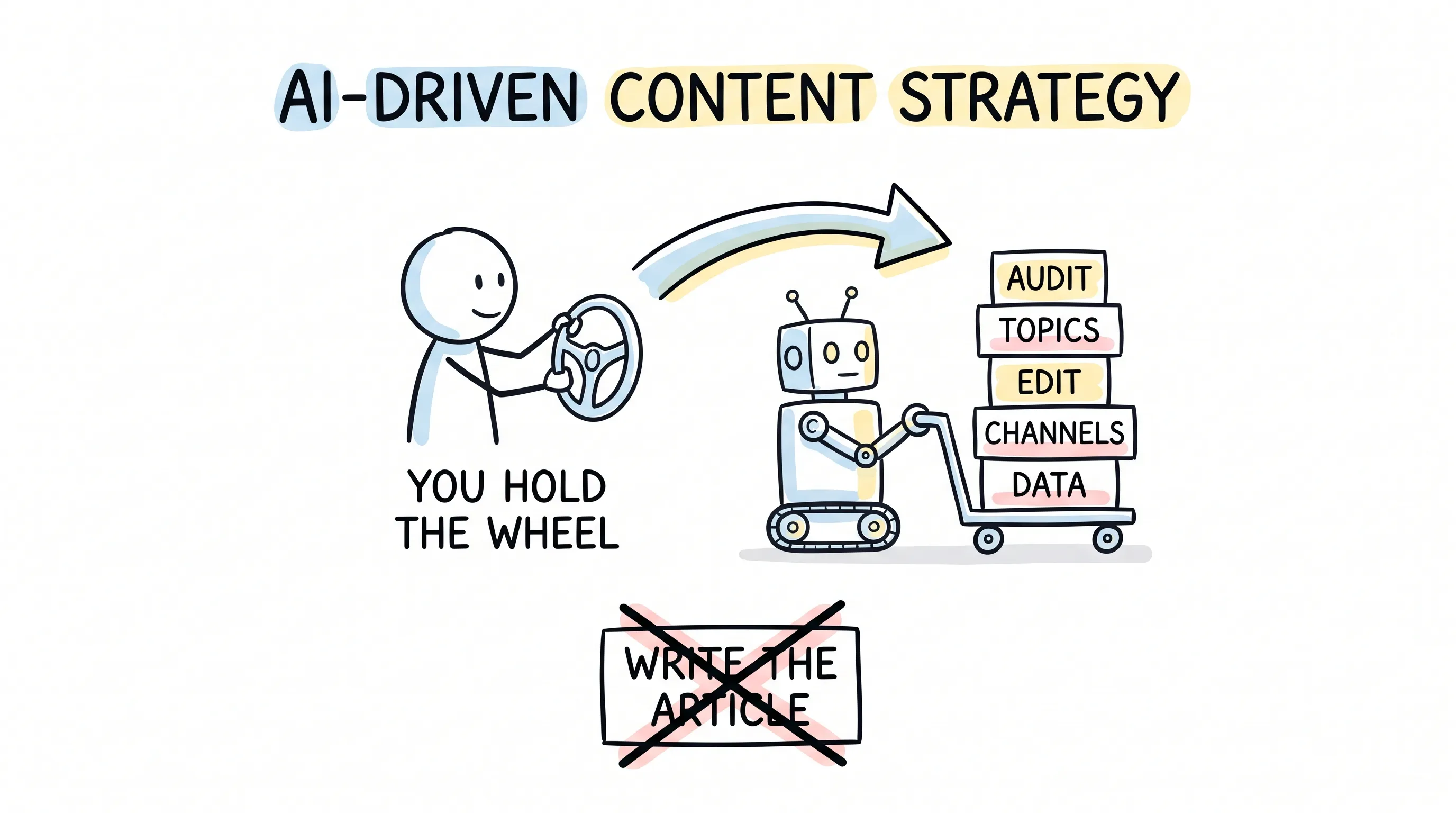
An AI-driven content strategy beats AI-generated content. The former: AI does the heavy lifting, you hold the wheel. The latter: you threw the wheel away.
May the waters stay calm while you steer.
Continue reading
Related articles
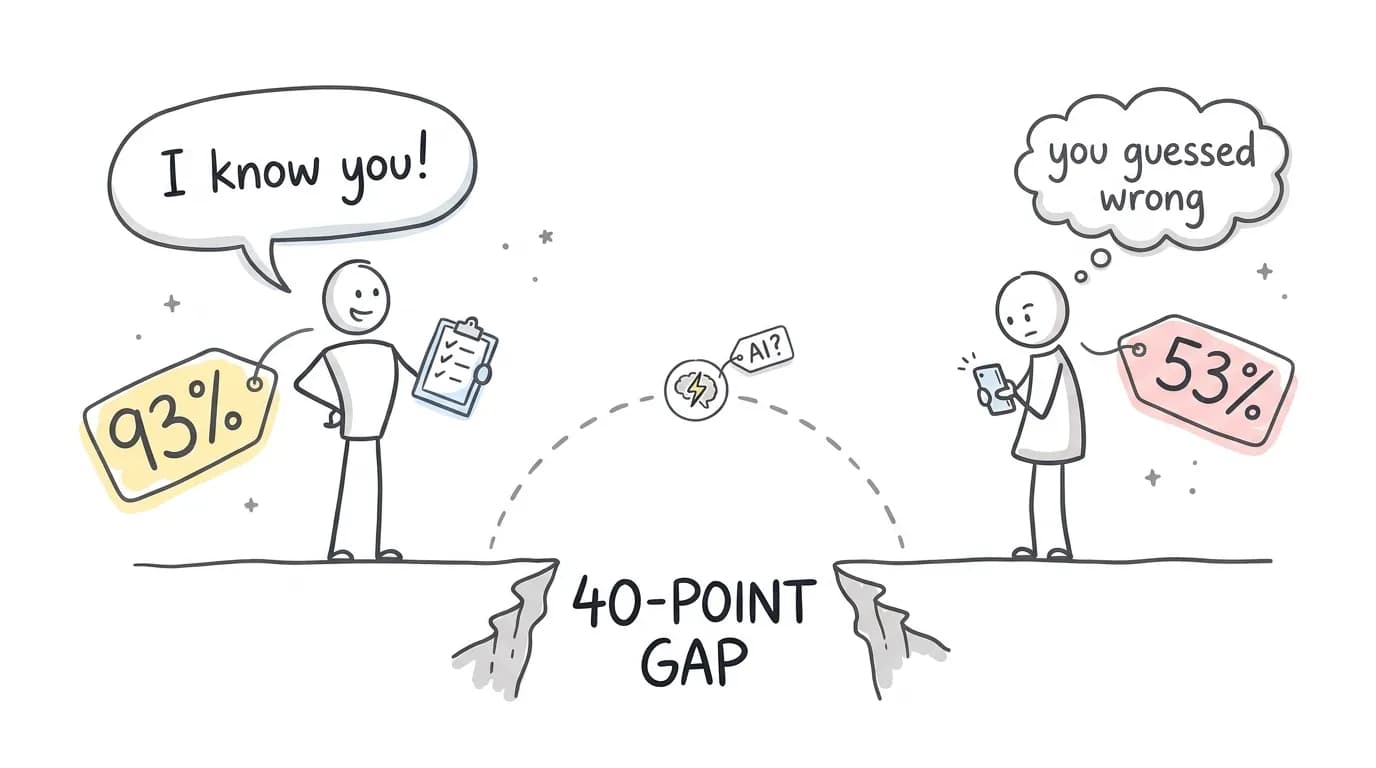
What Is AI Marketing Automation? It Starts With a 40-Point Gap
A learn article explaining what AI marketing automation is: how learning-based systems differ from rule-based automation, how AI decisioning optimizes message, channel, and timing choices, what data it depends on, and where it applies across the customer lifecycle.

It's 2026: Stop "Buying" AI Tools for Your Marketing Team — Start "Hiring" AI Agents
This learn article explains how AI agents differ from standalone AI tools in marketing, outlines three agent categories — build-your-own platforms, CRM-native agents, and vertical tools — and covers use cases across SEO, social media, advertising, and reporting, plus criteria for choosing one.

What Is an AI Marketing Agent? From "Using AI" to "Delegating to AI"
A learn article explaining what an AI marketing agent is, how it differs from rule-based automation, and which repetitive tasks such as lead qualification, reporting, and campaign monitoring can be delegated while humans keep key decisions.